Rainy Day Strategies to Cushion Financial Uncertainty

There’s been lots of talk about the U.S. economy over the past year or two and bad news has dominated the narrative. Rounds of lay-offs continue at enterprise companies: Nike announced plans to shed 1,400 jobs in April; Dell cut 10% of its workforce in March (11,000 employees), for the third year in a row; on May 5, the cryptocurrency exchange platform Coinbase announced a planned lay-off of 14% of its staff, or about 700 employees. Even the popular building contractor rating platform Angie’s List announced in January that 350 jobs would be cut this year.

Your one-person Freelance empire may be holding up despite lay-offs and rising gasoline and grocery prices but even those of you who hold the working capital needed to maintain normal business operations, pay living expenses and continue to fund your retirement account may nevertheless have a gut feeling that warns you to spend cautiously and trim expenses to bolster your savings cushion. An analysis of your financial position is how you begin your resiliency campaign.

Assess business financial condition

The road to financial resilience begins with examining the business’ financial position by conducting a cash-flow analysis. The process will reconfirm the sources of your earnings and how much you pay to keep the business rolling. The cash-flow analysis will illustrate how and when revenue streams bring money into the business (receivables) and the timing and costs of operating and other expenses (payables) that take money out of the business. You’ll take the measure of how and from which sources business revenue is derived, as well as your spend for fixed and variable expenses. You’ll also confront the business top line earnings (gross sales) and bottom line (net) earnings. Your mission is to analyze cash-flow over 12 months, and making note of seasonal variations, so that you’ll obtain a big-picture understanding of your entity’s financial rhythms.

The cash-flow analysis invites your business to “tell” you where you’re making money and where you spend perhaps too much and should consider a less-costly alternative. Identifying areas where spending has you leaking cash is especially helpful if local or national economic conditions make clients inclined to limit the billable hours that feed your revenue. Fewer billable hours will magnify those pesky financial gaps and escalate the impact of a cash crunch crisis, should it occur. Ask your accountant or bookkeeper to run the numbers, or contact your local Small Business Association SCORE to make an appointment and obtain some (probably) free and trustworthy business finance management assistance.

Build a budget that reflects financial reality

Kick-off your fat-trimming budget project by reviewing variable and fixed expenses and verifying how each one contributes to maintaining operations, supporting business growth, supporting customer service and the customer experience, or enabling professional development that reinforces your standing as a thought leader and expert in your field. Whatever expenditures do not at least indirectly support the business or your professional position may need to either be funded at a more modest level or eliminated. Developing your revised budgetary focus does not, however, mean that you must slash as many expenses as possible. Your new budgeting approach should be strategic and guided by business goals and economic reality. Here are useful guide posts:

  • Cut expenses that do not support revenue generation, business operations, or the customer experience.
  • Protect spending on marketing and sales functions to encourage revenue, e.g. client acquisition and retention.
  • Build a cash reserve that can float three to six months of business operating expenses.

Use scenario planning to forecast a worse-case possibility and use that perspective to forecast the next 12 – 18 months of operations. What might your finances look like if revenue drops 10%? Next, consider a more disturbing future and forecast the financial challenges you would likely encounter if, heaven forbid, revenue drops by 25%? It doesn’t feel good, but the scenario planning component of your financial defense plan will force you to anticipate how you might manage and inspire you to think of how to cushion those harsh and stressful circumstances with some savvy advance planning. It’s always easier and more effective when difficult decisions are evaluated and potential remedies are devised when you are calm and not in a panic.

Before any storms arrive, remember that your best defense is a good offense. If at all possible, delay major capital purchases, but remind yourself to avoid severely slashing your marketing budget. You may decide to shrink it, but do not lose sight of the power of consistent marketing and its place as one of the three pillars of a healthy business. Companies that maintain their marketing presence during business downturns consistently outperform businesses that sharply limit marketing activities when the recovery arrives.

In fact, refocused marketing strategies and campaigns could surpass the effectiveness of your current, perhaps more costly, activities. Stepping back from certain paid advertisement and instead doubling down on publishing marketing content—which will cost time, that other valuable resource—could yield excellent results. To the best of your ability, and in accordance with what aligns with your business solutions and customer personae and preferences, consider one or more of the following:

  • Invite a client to participate in a written or video case study. It’s a highly persuasive tool that guides prospects to envision how your solution could resolve their challenge or help a mission-critical goal to be reached.
  • Look for opportunities to portray yourself as a thought leader; that could include moderating or appearing on a panel, speaking at a local business or industry conference or other meeting, teaching a credit or noncredit course in a subject that is aligned with the solutions your company provides, or obtaining an invitation to speak in a webinar or podcast.
  • Look for public relations opportunities that will enhance your visibility and strengthen your brand image. If you are teaching or speaking at a venue that’s open to the public, send a press release to a community newspaper or event listing sites. Also, post your speaking or teaching engagement on your website and social media platforms.

Diversify revenue streams

If your Freelance entity offers just one product or service, you are potentially quite vulnerable to the winds of economic instability. A shift in the competitive landscape, or a new tech product, for instance, can threaten your ability to make a living. Especially in a solo earner household, if revenue earning opportunities become scarce, the outcome could be difficult.

You might not see a quick fix for your problem, but you could create one by asking a question. That is, it could be worth your while to ask clients with whom you are currently engaged if they might be interested in expanding the work you do for them? Frame your proposal in a way that illustrates a desirable and tangible competitive advantage that the client’s company would obtain when your expanded work is implemented. Your clients may help you make lemonade of the lemons and provide you with a new income stream that you hadn’t considered. A complementary service that can be delivered as an add-on or upgrade might also inspire a client to envision how you might bring more value to his/her organization. Similarly, tiered pricing that offers a lower cost basic option as well as a higher-priced premium alternative that provides more extensive service, could bring a new revenue source to your organization.

Then again, it may be more feasible to develop an external revenue stream and explore the possibility of a side hustle. You may have noticed that most mentions of side hustles involve an entrepreneurial angle but that does not have to be the case. Traditionally, a side hustle was an under the radar job that wasn’t discussed with your colleagues. Just 10 years ago, a side hustle could have found you plowing snow in winter, clearing out dead leaves in autumn and performing basic yardwork such as weeding, mowing lawns and pruning forsythia and rose bushes in spring and summer.

BTW, independently or traditionally employed workers who take on a side hustle are for the most part not in financial distress. In fact, those who earn $150K annually are more likely to have a side hustle than those who earn $25K – $50K per year. But regardless of your financial circumstances, a side hustle is a way to future proof your financial position and build a cushion against financial uncertainty.

Leverage external financial resources

Grants, SBA loans and alternative lending programs are created to support business leaders as they plan to scale or aim to increase working capital that’s intended to protect viability during difficult business conditions. If rumors of possible economic uncertainty reach your ears, envisioning what a survival plan for your entity might look like is smart thinking. Sooner rather than later, make it a point to research your options, so that you are apprised of eligibility requirements and timelines that will allow you to prepare and survive.

If your business is carrying significant debt, understanding the landscape of small business debt relief options, including what’s available through programs like those outlined by the Consumer Financial Protection Bureau, can be the difference between survival and losing your beloved business. Also, revisit external financing strategies that match your repayment timeline to your cash-flow cycle.

In closing, be aware that economic instability that periodically occurs in your marketplace is not unusual. Every independently employed professional, traditional business owner and even employees will experience financial challenges at least once. Business leaders who consider financial resilience a given for which they consistently prepare, instead of an emergency response that’s cobbled together in a panic not only survive financial fluctuations, but often emerge stronger once “normal” business conditions return.

Thanks for reading,

Kim

Image: © New England Coin Exchange Cranston, RI

Solution for A Freelancer Pain Point—On-Time Payment

The often unspoken, always frustrating and sometimes embarrassing conundrum that all but the best-connected Freelance professionals are almost certain to encounter at some point is the dilemma of late invoice payments. Talk about a pain point! Waiting for money to arrive can keep you awake at night. A pile-up of late payments can do a lot of damage to a Freelance business and your credit score, too. I routinely include on invoices the preferred payment timeline, which was originally 30 days, but several years ago was shortened to “payment is requested upon receipt of this invoice.” It’s important to set expectations regarding timely payment for services rendered.

It’s been documented that cash-flow difficulties are among the leading cause of shutting down an independent entity. I don’t think former Secretary of State (1973-1977) Henry Kissinger had to worry about erratic receivables when he returned to civilian life and pursued independent work. The powerful always get paid. Readers of this post, I surmise, ought to devise a pro-active invoicing and collections strategy to defend yourself against 45+ days invoice payments that can undermine your intention to manage your own business accounts payable, along with your personal expenses. Slow payments leave one vulnerable to exorbitant late fees.

Your value transcends billable hours

The moral of the story is, avoid hourly-paid work assignments whenever possible. Clients who outsource hourly project work often have a nickel and dime perspective and they are inclined to under-value you and your solution. The axe they’ll use to chip away at your billable hours, no matter how modest, is always within reach, so that a few more dollars can be made available to fund a project that decision-makers feel outranks your work. The billable hours mind-set labels hourly workers (you!) as a commodity. That your skill-set qualifies you to become a collaborator who is capable of delivering sustainable positive outcomes to the client’s organization is unrecognized by the penny-wise, pound-foolish billable hours types. Those individuals are unable, or unwilling, to recognize strategies and actions that you are positioned to recommend might help the client’s company break out of a stagnant status quo and move forward.

Your first order of business is to transcend the hunger for revenue, which may cloud the confidently rational thinking needed to envision a more sustainable business model for your entity. The goal is to upgrade how prospects and clients see you, the caliber of the solution and the contributions you can make to the client’s organization. For guidance, lean into the fractional model of independent working.

Much will depend on your deliverable and industry, but you may find it useful to reframe the perception of your B2B service and interpret the expertise and insights that are the core of your work and promote it as a systemized package, a process improvement system, that once instituted enables your client’s organization to optimize the realization of the mission and goals. Yet, the billable hours model limits the expression of your value and reduces your deliverable to as a band-aid fix. Reframe how you articulate your deliverable and demonstrate that what you offer is not a commodity.

When you’re invited to manage a large, one-off project, you can set the timing of invoice payments by stipulating that the client make an initial payment of 10% – 15% before you begin work. One or more interim payments can be triggered when you achieve project milestones that you and your client will identify together. Your goal in this instance is to limit the final payment to no more than 25% of the total project fee. Include the payment agreement in your proposal and reconfirm it in your contract. Clients are more likely to take retainer fees and major project agreements more seriously than hourly work and they are therefore more likely to pay your invoices on time.

Find a financial system that you will follow

In the final chapter of this story, you’ll acknowledge that Freelance professionals need a financial management system to document your monthly revenue generated, track where your money goes and how much you spend and guides you to separate your business and personal transactions. Good financial management will help you stay organized for quarterly and annual tax seasons and will also support your business (and personal) decision-making by confirming what you can afford to spend and when.

You may find financial management unpleasant, but no adult can escape, whether one is an independently employed Freelance professional or a W-2 employee. In particular, those who are often faced with irregular payments must buckle down and conduct a money minding session every month. You’ll need a tool for financial record-keeping and your choice will depend on your personality type. You may like a digital platform that offers a good option to single-person business entities, as does Quicken; or you may gravitate toward the Microsoft Excel spreadsheet. If your budget allows, you can outsource this role to a Freelance bookkeeper.

Your financial picture is foundational to nearly all business planning, to ensure that you’ll be able to carry out your actions. A system that works is one that gives you a clear view of your available funds, money that’s available to support business operations (working capital) bill payments you must make (accounts payable) and outstanding client invoices (accounts receivable). Establishing and following a financial management ritual provides an accurate picture of your financial capacity In Real Time and lets you know when you have the green-light to move forward without second-guessing every transaction. Just do it.

Thanks for reading,

Kim

Image:  Edward Pevos for MLive

Freelancing Future of Work 2026 and Beyond

In case you hadn’t noticed, how and where many Americans work—the work environment—has changed significantly, especially since the 2020-2021 coronavirus pandemic era. Twenty years ago there were employees, most of whom worked within the IT industry at companies such as Cisco Systems, Google, IBM, or Microsoft, who were allowed to telecommute (as it was known) maybe once or twice a week. Co-workers who were based in different parts of the country (and sometimes on different continents) would periodically hold meetings and the proceedings were transmitted by satellite feed, which, while usually shaky, enabled teams to communicate and share information, make plans and agree on execution and desired outcomes.

Back in the day outsourcing arrived, a solution fueled by employee downsizing, a practice that in the aftermath of the 1987 stock market crash and recession became increasingly common. Outsourcing emerged as a strategy to address the need to replenish depleted labor talent pools without incurring costs associated with (re)hiring full-time employees—-better to avoid paying for health insurance, sick and vacation time and retirement funding. So, out with employees and in with the contractors.

In other words, while several alternative working options in America simmered beneath the surface for decades, it wasn’t until the 2020-2021 coronavirus pandemic that the doors blew off as business leaders recognized the necessity to immediately provide practical and effective solutions to keep their organizations alive and profitable. Enter the remote work force and a huge validation for Freelance professionals. Who knows how to do Work From Home better than you?

How we worked before has been transformed into what historians may one day label the most impactful labor movement since the Industrial Revolution. The transformation of how many people work, that is, the future of how we will work, is represented by Freelance professionals. In 2026, Freelance employment can no longer be called a mere trend—it is a phenomenon that impacts all 3.38 billion workers on planet Earth. The number of Freelance professionals continues to expand and justify the way we work now and will likely continue to work well into the 21st century.

The influence of Freelance labor is demonstrated by its strong year-over-year growth in bellwether markets such as Britain, South Africa, India and the U.S. In 2026, the population of independent workers is predicted to reach 1.57 billion worldwide, with 83 million Freelancers engaged in the U.S.Freelancers make a substantial economic impact, contributing an estimated $1.27 trillion to the U.S. economy in 2024.

Most Freelance professionals work in the knowledge economy and perform services that require specialized expertise, education and training that’s obtained by earning undergraduate or advanced post-secondary school degrees and/or specialized certifications. From bookkeepers and accountants who ensure that clients’ financial statements are accurate and able to inform business decisions to special events photographers who memorialize the proceedings of Fortune 500 corporate meetings and other important events, the skills and ambition of independent workers have pushed the Freelance economy to unprecedented growth,

fundamentally reshaping the worldwide labor market and positioning the global business processing sector—finance and accounting, customer service, human resources, marketing and other B2B services– to generate revenue of $407.1 Billion (USD) in 2026.

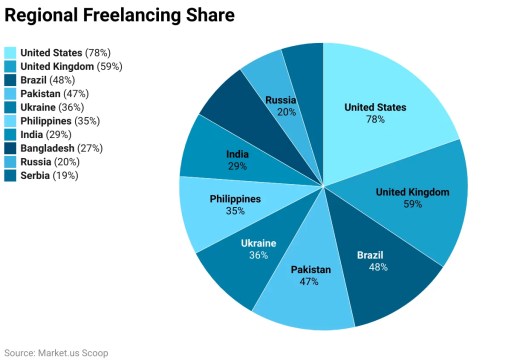
The U.S. has the fastest-growing Freelance economy, with revenue increasing by 78% year-over-year 2023-2024 and a compound annual growth rate (CAGR) of 17% in 2025-2029. The global data-as-a-service giant Statista predicts that by 2027, 86.5 million U.S. workers will Freelance, accounting for 50.9% of the country’s total workforce.


Your inner optimist may interpret this forecast as an opportunity to grow your billable hours; your inner pessimist may see disturbing visions of increased competition in the Freelance hiring landscape. Why not be realistic and take a look at your organization to find where you would be wise to raise the level of your game and enable yourself to be more responsive to clients and prospects in ways that grow your client roster? Make lemonade out of the lemons.

In fact, Freelance professionals are optimistic about the future of Freelance work. Your confidence is fueled by increasing demand for specialized skills and a global pivot toward more flexible work arrangements. According to the Upwork Future of Work Index in April 2025, 82% of Freelancers say their work opportunities have grown since last year, versus just 63% of full-time employees. In that same report, 84% of Freelancers reported that they are excited by how the prospect of Artificial Intelligence tools will reshape their services, offerings and workflows.

Research indicates that Freelance work will continue in growth mode and the data has a high confidence level amongst the experts. You should be able to claim your share of the pie. If the intentions of corporate decision-makers can be taken to the bank (ha!) they support Freelance expertise. A January 2025 Upwork report found that 29% of executives believe that Freelance workers are essential to their business and 48% of CEOs plan to increase their hiring of Freelance workers over the next 12 months.

Still, there are worries that keep you awake at night. A November 2025 survey found that 66% of Freelancers feel that securing enough work is their primary challenge. Other major concerns included managing an irregular income, unpredictable work availability and non-paying clients.

Research also shows that Freelancing in 2026 won’t be all about finding projects; 2026 is shaping up to be about adapting to new skills, technologies and ways of working. Staying informed will help you to prepare and position yourself to keep up as the independent economy continues to grow. The Upwork Future of Work Index found that the most relevant Freelancing strategies to follow in 2026 will be to stay informed about global developments as you remain apprised of relevant shifts that occur in the U.S. B2B Freelance economy.

These are the signals every Freelance consulting specialist should pay attention to. For example, as automation becomes more common, skills that are uniquely human become more valuable. Negotiation, communication, empathy, storytelling, decision-making and leadership will help Freelancers stand out and facilitate building long-term client relationships. These soft skills are now seen as core strengths that technology cannot replace. The Future of Work Index shows that 87% of Freelancers prefer work that helps them improve their current skills or learn new skills, versus work that only allows them to use the skills and proficiency they already have.

 Let’s finish up with some 2025 statistics that examine billable hours and revenue. I’m sure you know that Freelance earnings differ according to the services provided. Generally, the more technical the service, the higher the billable hour. High-demand services such as programming allow Freelancers in the field to bill at $70/hour. Artificial Intelligence and Machine Learning engineering are currently the highest-paid sectors among all Freelancing roles and expertise in one or the other niche allows you to command a billable of $50-$200 per hour. The number of computer and information research scientists is expected to grow by 26% by 2033. (Upwork)

  • Full-time B2B Freelancers on average work approximately 43 hours per week
  • Approximately 54% of Freelancers work five days a week
  • On average, Freelancers earn $99,230 annually; however, the top earners have annual earnings of $200,000. Meanwhile, 25% of Freelancers earn $50,500 annually.
  • The average hourly billable earned by U.S. Freelancers is $47.71, with a range of $132.21 to $14.90 per billable hour. 
  • The average Freelance programmer bills at $60-70/hour and generates annual revenue of about $120,000 
  • The average Freelance writer bills at $30-40/hour and generates annual revenue of about $42,000
  • Online marketers typically earn $50/hour and generate $100,000 annual revenue
  • Freelance graphic artists bill at $40-$45/hour but are known to receive enough billable hours to generate $90,000 in annual revenue

Thanks for reading,

Kim

Image: market.us

Time-Tracking Options for Freelancers

We’re back with a review of more time-tracking services that are especially useful for Freelance consultants. Accurately documenting the time spent on project assignments is important in many ways, primarily to ensure that billable hours charged to clients are correct.  Plus, most time-tracking services will generate an invoice that you can click and send and some will also allow you to accept online payments with bank-level security.

In addition, time-tracking services generate useful reports that show the number of hours you spend on certain types of assignments, information that is useful when creating proposals for projects that you’d like to take on, since it will be necessary to predict the time you expect to spend on the proposed project, which will impact your pricing and determine whether it will be most advantageous for you and the client to choose an hourly rate or project fee payment arrangement.

Harvest

Track time spent on projects easily and efficiently with Harvest, even when you need to follow several projects that contain different tasks that are priced differently. Furthermore, when coordinating a team project, you’re able to assign and time-track various tasks within a project for specific team members.

Reporting is a strength: raw time sheet data will be presented in a visual summary that depicts how your time or the team’s time has been utilized, with key project metrics collated into intuitive reports. The service also generates professional-looking invoices based on your project fee or hourly rate, as determined by the time you’ve logged.  Click and send invoices to clients and receive online payment, confident that site security is bank-level.

Harvest is free for one person to track maximum two projects/month and $12 for one person to track an unlimited number of projects/month.  Harvest

RescueTime

Freelancers who’d like to document how they’re spending time when working on a project and who are not kept on a short leash by a manager will appreciate RescueTime.  It’s not possible to send reports to your client, but you can nevertheless track your time and obtain an accurate picture of your productivity.  You will also receive detailed reports that show you the apps and websites you visited.

As well, RescueTime will record time spent on email and the amount of time you linger on any website. If you’d like to limit the time spent on non-work related websites, then ask the system to block your browsing on any chosen site after a certain amount of time.  Further, you can set goals to inspire yourself to stay on schedule with your project. The premium service plan also allows tracking of off-line time for activities such as telephone calls and meetings. RescueTime Lite is free and RescueTime Premium costs $9.00/month, or $72.00/year.   RescueTime

Tick

Each time you submit a time entry, Tick updates your project and task budgets in real time and reports back to you.  If you regularly track time against an hourly rate determined budget, or a project fee that involves an important deadline or penalties for late completion, then Tick may be your ideal time-tracking solution. It’s also possible to track time on multiple projects simultaneously.  While the service can be used by a solo Freelancer, it is especially suited for a team.

Tick is free if a single user employs the service for one project per month, $19.00/month for an unlimited number of users who’ll track a maximum of 10 projects/month and up to $149.00 /month for an unlimited number of workers to time track an unlimited number of projects.   Tick

Toggl

If you neglect to click the session start button, the service will allow you to enter your working time after the fact, which is helpful for those who are very busy and prone to forget. The service is structured with a team in mind, but it works well for solo professionals.

The service works on all devices, desktop and mobile. Helpful analytic reports will be generated, so you’ll get the big picture of where your time is spent, depending on your assigned tasks.  There is a free version, plus Starter and Premium.  The $9.00 /month Starter package appears to give the best value to Freelancers.   Toggl

Klok

Most helpfully, the service lets users recall and analyze data from previous projects, information that enables you to develop proposals for future projects that will more accurately reflect the time needed to reach key milestones and achieve deadlines. The historical time-tracking data will also help you to price at a level that is fair to both you and the client.

The basic package includes a visual display of your time as you work, plus screenshots, exporting of time sheets, dashboard reporting and invoicing all for a one-time purchase price of $20.00 for up to three users.  Klok Cloud Sync, Klonk Pro and Klokwork Team Console are also available.   Klok

Happy Thanksgiving and thanks for reading,

Kim

Photograph: Orloj, the famous 15th century astrological clock in Prague, Czech Republic

Time-Tracking Freelance Work

How many of you use time-tracking so that you can accurately count your billable hours when on assignment? I still count hours the old-fashioned way and I know that I cheat myself out of no less than an hour or so every week. My bad! I’ve occasionally thought about time-tracking assistance, but I never knew where to begin. A new year will soon welcome us and that’s a traditional motivator to set goals and improve work habits.

As I suspected, time-tracking systems have their differences. Some are designed with remote teams in mind; others make a department manager’s life easier. Certain time-tracking systems have been created to address the needs of Freelancers and we’ll sort through a sampling here:

Due Time Tracking

Due Time is free and easy to use—just create a task, start the timer and launch your session. You can click and add notes to detail the project you’re working on. Due Time also includes an automatic idle time detection feature, so you’re able to make allowances for stepping away from your project now and again and still remain accurate in tracking your work hours.

You’ll be pleased to find that Due Time will generate hourly rate or project fee invoices when you enter the rate. Due Time makes it easy to organize client information by name, address, or even payment currency.  Due Time

TopTracker

Along with tracking the number of hours you spend on project tasks, Top Tracker offers screen shots and webcam shots that document your work. Screen shot pages can be deleted or configured to automatically blur before uploading, so that the image is recognizable to you but all text is obscured. The service works with nearly every freelancing platform and will produce a detailed project activity report to document your performance. The service is free.  TopTracker

Sighted Time Tracking and Invoicing

Sighted Time Tracking seamlessly integrates the functions of time-tracking and invoicing, packaged in either the free Basic Service plan or the Premium Plan at $4.00 /month. You can make detailed project notes for every session and also automatically send invoices for hours worked that are customized for billable hours or project fee.

Furthermore, users can send out quotes to prospects when invited to bid on a project and accept credit or debit card payments online and issue a receipt to the client. Plus, you can do it all on your desktop or mobile device.  Sighted

Tick

Each time you submit a time entry, Tick updates your project and task budgets in real time and reports it back to you.  If you regularly track your time against an hourly rate budget of project fee that involves an important deadline or penalties for late completion, then Tick may be your ideal time-tracking solution. It’s even possible to track time on multiple projects simultaneously.  While the service can be used by a solo Freelancer, it is especially suited for a team.

Tick is free if a single user employs the service for one project per month, $19.00/month for an unlimited number of users who’ll track a maximum of 10 projects/month and up to $149.00 /month for an unlimited number of workers to time track an unlimited number of projects.  Tick

Four more time-tracking options will be examined in the next post. Have a good week!

Thanks for reading,

Kim

Photograph: Sundial at the Gate of Honour at Gonville and Caius College in Cambridgeshire, England

Cash-Flow Therapy

So many businesses in the U.S. are undercapitalized; insufficient cash-flow is a factor in the demise of many ventures that might otherwise succeed.  Cash is king, it is often said, and the wise business owner will do what is necessary to maintain adequate cash-flow in his/her organization.

Make friends with the basic three financial documents and learn to use them as analytical tools.  They exist to enable your success and they will signal you when corrective action must be taken.

Monitor the top line of your company’s Income Statement (sales revenue/ billable hours).  Observe the ebb and flow of the accounts receivable (who owes your business money) and payable (to whom you owe money) on your Balance Sheet.  Make note of the beginning and ending cash balances on your Cash-Flow Statement.  Also on the Cash-Flow Statement, notice the cash sales (representing billable hours payments received as checks, for example) and the operating expenses.

Seasonal variations in billable hours/ sales can potentially exacerbate cash-flow problems if that is an issue in your business (the Christmas to New Year’s slowdown, for example) and pop-up emergency expenses can do the same.  Unfortunately, the outcome for Freelance consultants or other business owners can be a cash deficit, an especially unwelcome state of affairs in a month that involves holiday expenses.

But the primary cause of cash-flow woes is usually a result of persistently insufficient billable hours for services rendered or product sales, perhaps secondary to an anemic client list.

Former Wall Street Journal Assistant Editor Serenity Gibbons points out that if you  struggle to generate enough at the top line, you’re probably facing one of the following challenges:

  • The optimum target clients have not been reached by your marketing campaigns, or the message doesn’t address their priorities or aspirations.
  • The product/ service has limited value to the target clients, or your offerings are overwhelmed by dominant competitors.
  • The product/ service is perceived as too expensive for the value delivered.

It’s time to take control and consider what can be done over the short and long-term to correct the problem.  Do some homework and discover the basic challenges, concerns and goals (as defined by their respective industries) that would motivate your prospective clients and guide their decisions.  Determine why they’re doing business with your competitors and not you.  Moreover, make sure that you are pursuing the best target markets for your products/ services.

A second issue is an administrative one that plagues many Freelancers—-we fail to invoice in a timely and regularly scheduled fashion.  Help your clients to take you seriously and treat you like a “real” business by invoicing when promised. Take measures to improve the odds of getting paid on time and in full.  I’ve lived through this challenge and can report that with a small amount of discipline, it can be overcome.

Third, watch your operating (fixed) and sales related (variable) expenses.  How much are you spending to generate sales revenues/ billable hours? Limit what must get dropped into accounts payable and expand what drops into accounts receivable.

There are usually ways to stem the tide of cash-flow problems, that is, if you take action early enough.  You might start with revisiting your pricing strategy.  Ensure that your pricing reflects the value of your product/ service; that your prices are comparable to what competitors in your area charge for similar services/ products; and that you charge close to the maximum of what clients expect to pay for what you offer. Do some in-depth pricing research, using GSA MOBIS, the federal contract system, as a benchmark.  http://gsa.federalschedules.com/industries/gsa-mobis-consulting-pss-874/

Another useful tactic that serves as a band-aid for cash-flow glitches that are more inconvenient than problematic is your business credit line.  While you’re still able to pay bills on time and have a respectable credit score, investigate obtaining a business credit card through your bank.

Resist the temptation to charge business expenses to your personal credit cards!  Keep business and personal expenses separate and get your arms around the spending in each sector.  Furthermore, a business credit card usually has a much higher credit limit than a personal line and that allows you to more easily make investments in your business and earn cash back and points as you do.

Finally, if inflated business expenses, whether fixed or variable, play a major role in your cash-flow problems, then you will have some decisions to make (re: the selling expenses) and negotiating to do (re: the operating).  If you regularly pay on time expenses for inventory purchases, credit cards, or insurance, for example, get on the phone and ask for lower interest rates or a lower premium.  If variable expenses seem high, reconsider how much you must spend on marketing, advertising, sales and client entertaining.

Thanks for reading,

Kim

Photograph: Baccarat at the Sands Hotel in Las Vegas, NV, with Frank Sinatra (in black tie) as the card dealer (1959)


Thanks for reading,

Kim

Photograph: Baccarat at the Sands Hotel in Las Vegas, NV with Frank Sinatra (in bow tie) dealing the cards (1959)

AI and U: Bye, Bye Billables

The trouble hasn’t trickled down to us middle grade Freelance consultants or small boutique consulting companies yet,  mostly because we are not servicing Fortune 500 C-Suite clients, but apparently, the Artificial Intelligence phenomenon is being positioned to impact in particular the high-end management consultants and not for the better.  Eventually, our comparatively modest stratum will be touched as well, depending on the services that your consultancy provides.  I’ve got no love for the consulting giants Bain and McKinsey, but I’m worried by this trend.

AI is already at work, automating routine tasks such as maintaining calendars, but it is now poised to support decision-making functions in HR, marketing, finance (budgeting) and resource allocation.  It seems safe to say that AI will in the near future be used as a strategic planning tool.

According to The Wall Street Journal, U.S. businesses spent $58.7 billion on management consulting services in 2016, a 7.1% increase over 2015, and the bulk of the business was generated by the financial services industry.  The primary expertise of high-end management consultants is data analysis and presentation and facilitating long-range strategic planning.  It is becoming obvious that AI can execute many functions as well as an elite consultant, and can perform more accurately, faster and at a fraction of the cost of a consultant’s billable rate.

Do you have an iPad or iPhone? Then you are part of the AI revolution yourself whenever you ask voice-activated Siri to give you directions or show you the lunch menu at a new restaurant.  Alexa, the AI voice-activated digital personal assistant app for your tablet or smart phone developed by Amazon, will already allow you to control your smart home features such as lighting, heating/ air conditioning and keyless entry for your doors.  Presently, Alexa has the capability to answer economic questions for clients of the Swiss global financial services giant UBS Group AG.  The Wall Street Journal reported that Alexa will answer UBS client queries by using information provided by its chief investment office.  Alexa is expected to soon begin analyzing markets and may also be used to buy and sell stocks.

Meanwhile Boston-based Blackrock, the financial planning and investment management outfit, which happens to be the world’s largest asset management firm, used by institutions and individuals, is rolling out computer-driven algorithms and models in a move toward management by smart machines, that is, employing passive management rather than active management of their funds.  In other words, a machine will become the asset manager of Blackrock’s funds and not human, salary, bonus and benefits receiving employees.

Like the 1992 candidate for president Ross Perot predicted, that sucking sound you hear is your job going out the window.  The middle class is about to shrink some more.  Happy Labor Day.

Thanks for reading,

Kim

Photograph of Lost in Space, the CBS-TV series 1965 – 1968               Jonathan Harris (as Dr. Smith) and the robot