Be A One-Person Powerhouse

Freelancers continue to refine our business practices as we observe and respond to the mega-trends that impact the global and national economies and, to some degree, affect the way nearly everyone on the planet lives and works. As we move through the mid-point of the 2020s, Freelance professionals are redefining success. We never intended to be builders of corporate empires that employee thousands, but we do intend to build and sustain a profitable business entity.

We believe that we can thrive as leader of a single-person business entity, a one-person empire, where we demonstrate our appeal to a discrete segment of the marketplace. We demonstrate also our grasp of customer needs within that market segment and we deliver services and/or products that our customers value. While aware of the time and cost saving advantages of turnkey processes and operational efficiencies, we reject the notion that one size fits all and we’re happy to build in a degree of flexibility that makes available personalized solutions tailored to address customer needs and concerns.

Niche is the new big box

The Freelance solopreneurs whom I’ve come to know over the years are too smart to try to be all things to all people. Instead, smart, successful Freelancers like you rely on market research to discover customer segments that are most interested in your category of services or products and then learn how to position your company to win business within those marketplace segments. Freelance solopreneurs will be interested to know that leading U.S. market researchers have validated this strategy and now forecast that in 2025 and beyond, start-up entrepreneurs who focus on a niche market will prosper while those who attempt the “all things to all people” big box approach will be on the wrong path.

Globalization is driving this emerging trend, as are AI-powered marketing communications tactics. Together, these powerful forces have made it both uncomplicated and cost-effective for even a business entity headed by a Freelance solopreneur to attract prospective customers in any geo-location that has internet access and invite them into your company’s buyer’s journey and community of followers. The possibility of developing a thriving niche market for your services or products that consists of people from around the world is real and is expected to become the norm for one-person shops as it is for multi-national conglomerates.

While the multi-nationals, however, pursue millions of prospective customers and compete in markets that are often saturated. Standing out in those marketplaces is a challenge that only big fish can afford, sometimes by advertising during the Super Bowl, for example. In stark contrast, those who dwell in micro-niche markets will devote most of their marketing resources to creating trust and legitimacy, demonstrating expertise and authority and building relationships and loyalty. Establishing a presence in a micro niche market, as would a Freelance solopreneur, isn’t just about selling products or services—it’s nearly as much about creating a community where customers feel a sense of belonging.

Because Freelance solopreneurs occupy a unique, personalized, space, customers are inclined to perceive you as an expert who understands their needs on a granular level and capable of solving their unique goals and challenges. In 2025 and beyond, Freelance solopreneur entities will use niche targeting combined with AI-powered analytics, marketing and customer service tools to fuel smart and sustained growth that supports a personalized boutique approach to their B2B or B2C venture. You can promote a brand-enhancing perception by showcasing the following:

  • Communicate capability, quality and consistency

Big business has the financial wherewithal to invest millions in branding, while Freelancers and other small business owners can effectively build and promote their brand, goods and services by adopting a niche market focus to achieve a similar effect by being consistent and integrating personalization and polish across all forms of communication and at every customer or prospect touchpoint. Get the ball rolling with a comprehensively cohesive brand visual identity that begins with an intuitively designed, fast-downloading, sleek, professional-looking website; you can carry that ethos into high-quality marketing materials that create an image that reflects capability, trust and legitimacy.

  • Be a thought leader

A solopreneur Freelance consultant can appear to be a nationally recognized authority if s/he is featured in respected industry media outlets. Establishing yourself as a thought leader confers respect and credibility that makes your business entity appear substantial and established. People tend to assume that everyone who is presented in the media as an “expert” of some sort who presides over a large business that generates an annual income that’s well into six figures and maybe more.

You can use that perception to your advantage: it is well worth your while to seek opportunities to publish your own insightful articles in reputable magazines or journals. Furthermore, you will do well by searching for opportunities to take on speaking roles at conferences, even if that means moderating a panel and appearing on podcasts and webinars whose reputation, while perhaps not blue chip, are nevertheless positioned to create for you the impression of authority and influence.

  • Show social proof at every opportunity

Incorporate social proof into your branding strategy by inviting happy customers to give online or print testimonials that describe how your service or product has solved their business challenge or helped them to achieve an important goal. Alternatively, you can ask customers if s/he would mind if you wrote up a case study that details how your product or service enabled that customer’s goal to be achieved or challenge to be overcome.

Customer success stories, which are brought to life by testimonials and case studies, are highly effective marketing tools and they deserve to be spotlighted on your website and social media platforms. You will provide still more examples of customer success stories when you encourage happy customers to post user-generated content (which includes testimonials), and also reviews on platforms such as Yelp, Google and LinkedIn. You might also request permission from certain customers (more prestigious, that is) to display their company logo on your website.

Another highly effective demonstration of the social proof of your brand reputation among your business community peers and colleagues is to display on your website the business and/or community awards that you’ve either won or for which you’ve been nominated. Seeing the names of recognizable authorities associated with your brand makes you look well-respected and trustworthy—because we are judged by the company we keep.

Inform local media outlets when you’ve got something great to crow about by sending a press release to announce your newsworthy achievements (e.g., a nomination for a business award) or your participation in a well-known charity or community event, such as helping to sell Girl Scout Cookies, supporting the Little League team, or sponsoring a marathon runner who is raising funds for a local hospital or other charity.

  • Expand your online presence

A business that is favorably mentioned in multiple media outlets more than once a year looks much more influential than a business that is mentioned on a single platform—infrequently. Maintaining an active presence on LinkedIn and other social media sites, contributing your insights to industry forums and getting your articles included in relevant publications reinforces the credibility of both you and your business entity.  Occasional press coverage in online or print media outlets, guest blog posts and other articles and social media activity, especially when taken together, can readily give your Freelance solopreneur consulting entity the impression of a capable and respected, if not locally powerful, enterprise. Being cited by industry sources, contributing to discussions and publishing original insights give the impression that you’re a major player, even if you’re running a small operation.

  • Deliver white-glove service

Freelance consultants and SMBs would be wise to develop exceptional customer experiences, including after-sales support services where necessary. B2B customers will greatly appreciate a seamless onboarding process, as well as automated follow-ups and structured client communications—all of which create the impression of a well-oiled machine, whether your company is a team of 20 or a solopreneur entity. Modern tools allow small businesses to operate with the efficiency of much larger organizations. A website and social media chatbot, AI-powered customer service and cloud-based collaboration tools make it possible to efficiently serve customers on every continent. When you create a strong digital infrastructure for your business entity, regardless of the number of workers on your team, you can operate at a level that is as capable and trustworthy as any enterprise-level competitor. You can become a one-person powerhouse!

Thanks for reading,

Kim

Image: © Keerthana Kunnath. In Kerala, India female bodybuilder Chitra Purushotham shows that she is a powerhouse.

260% Hiring Increase Propels Freelancers Beyond Flavor of the Month

Mellow, a global contract and payment services platform whose customers are Freelancers, consulting companies and independent contractors, revealed in Their latest report a startling 260% increase in overseas hiring of Freelance workers by U.S. businesses from 2022 to 2024. The report indicates that the projects were also outside of the U.S. and that skill sets in highest demand included engineers, technical writers, analysts and website developers. The organizations for whom the Freelancers worked were Mellow contractor-of-record clients, based in the for U.S. and with 50-200 employees, categorized as Small and Midsize Enterprises (SME). The Freelancers hired were based in regions with emerging economies, primarily Central Asia, the Middle East/North Africa and Eastern Europe.

Mellow researchers interpret the big picture of their findings as confirming the centrality of Freelance workers as essential participants in a global trend that demands flexible work models and as a standard that will ultimately benefit U.S. based Freelancers. Rather than replacing U.S. workers, Mellow investigators see the predominance of flexible work models as creating new opportunities for both businesses and individuals in the U.S. Mellow emphasizes that the Freelancing surge is not about offshoring, but rather about decentralizing work and enabling businesses to be more agile, competitive and profitable.

Freelancers are a core business strategy

The advantages inherent in flexible, ad hoc, project-specific work arrangements were already apparent to both Freelance workers and the organizations that hire them, and the practice was already well established and growing in acceptance and popularity when the 2020 COVID-19 pandemic forced businesses to reconsider their work models and shift their employees into Work From Home mode. The pivot spotlighted the value of both remote work and the availability of a talented and reliable Freelance workforce. Organization leaders now widely recognize the logic of employing temporary talent for specific projects and this acceptance has brought revisions to their strategies for talent acquisition and workforce management. Freelancers are no longer regarded as just a short-term fix, but instead as a strategic advantage that delivers tangible benefits in today’s layoff-prone environment.

Talent management within an organization is no longer considered primarily an HR strategy and is now recognized as a core business strategy that owners, entrepreneurs and executives must recognize. The data makes it clear that organizations are welcoming Freelance talent and the shift isn’t just about cost savings; it’s also about responding to the need to be agile in a hyper-competitive marketplace that includes the realities of a periodically unpredictable labor market.

Market research company Grand View Partners estimates that global Freelance marketplaces such as Mellow, Fiverr, Guru and Upwork will have a 17.7% Compound Annual Growth Rate (CAGR) for the period 2025 to 2030, according to their recently published Market Analysis Report that examined the market size, share and trends of Freelance platforms. Industries setting the pace and providing a template that other companies can follow include Edtech, out front with an average hiring rate of 108 Freelancers and advertising companies, with an average Freelance hire of 34 contractors.

U.S. Freelancers thrived during difficult years

The years 2022-2024 were challenging for many American workers, executives and business owners. Numerous lay-offs, persistent inflation and widespread hiring freezes came on the heels of the coronavirus shutdown. “Quiet quitting,” the great resignation and persistent demands to return to the office—a condition that many employees find unnecessary, if not unacceptable—dominated the echoverse.

The unrest motivated many companies to adopt a flexible approach to getting the work done and increasingly, company leaders acknowledged that Freelance professionals are uniquely qualified to provide the skills their organizations needed. The inclination to hire Freelance workers also aligns with agile business strategy that likewise requires a flexible, capable and cost-effective workforce that drives innovation, growth and profitability.

 In a January 2023 survey of 1,000 U.S. business leaders of companies with more than 50 employees, Resume Builder showed that 40% of those companies hired Freelance workers to replace laid-off employees and 53% convinced some of their full-time employees to accept Freelance positions, in order to remain employed.

Return-to-office and lay-offs poised to increase Freelance opportunities

Lay-offs have been announced by Hewlett Packard, Grubhub, Meta and Chevron; meanwhile, RTO mandates have been repeatedly announced, most notably by J.P. Morgan, along with Amazon, Dell and Starbucks, all of whom are cracking the whip and herding the last of their WFH employees back into the office. As unpleasant as all that sounds (at least to me), Freelancers are positioned to obtain clients and potentially generous billable hours that result from lay-offs and RTO mandates that are ignored. One door closes and another door opens.

Data from Upwork, the Freelance marketplace used by both Freelance workers and the companies that hire them, shows that Freelance labor is 30-60% less costly than W2 employee labor; the latter entails costs such as payroll taxes, social security payments and vacation and sick time, while the former option enables company leaders to pivot into a flexible workforce arrangement rather than lay-off W2 employees (and perhaps face media scrutiny). Furthermore, Resume Builder data also shows the rise of a strategy called “quiet hiring,” that is demonstrated by the 37% of companies that had recent lay-offs and hired Freelancers to replace laid-off workers.

Regarding RTO mandates, the advantages of Freelance talent are not exclusively limited to remote arrangements. In fact, the in-person Freelance model is a fast-growing segment. Spurred by front-line workforce talent platforms specializing in retail, hospitality and even factory workers, in-person Freelance gig workers are solving significant challenges for industries known to suffer from high rates of employee burnout and churn.

The Freelance future is bright

The demand for Freelance talent is expected to energize the employer side of the equation as evidenced by the predicted 17.7% CAGR within 2025 the SME and large enterprise business categories. The rise of start-up businesses and entrepreneurship in general contributes to the increasing demand for Freelance talent, as detailed in the Upwork Freelance Forward 2023 report, that noted Freelance labor contributed $1.27 trillion to the U.S. economy in annual earnings and also noted that 38% of the U.S. workforce, or 64 million Americans, performed Freelance work as either a primary or occasional source of income.

Start-ups often have limited budgets that constrict their ability to hire full-time employees for every role. Fractional executives, who are Freelancers who serve companies on a C-Suite level, are also taking hold at start-ups and Freelance and fractional workers provide start-ups and SME businesses with an affordable way to access high-quality talent on a short-term or project basis. The scalability of Freelance hiring models makes it easier for entrepreneurs to manage fluctuating or unpredictable workloads while maintaining high-quality standards without exhausting financial or labor resources. The ability to hire specialized Freelancers enables start-ups and other businesses to remain nimble and efficient—agile—which is essential for their growth and survival in highly competitive markets.

The success of Freelancing is perhaps best summed up by data from Mellow which reported that in 2023, the average monthly income of Freelance workers in their report grew by 18% and grew by another 23% in 2024. Mellow’s data also confirmed that the way to earn billable hours is to take on more than one client at a time (but you knew that).

Thanks for reading,

Kim

Image: ©Epic Records. Singer-songwriter Minnie Riperton (1947-1979) in the cover shot for her gold album Perfect Angel (1974)

Trend Tracker Is Free Help from Yelp

Launched in 2014 at the platform’s 10th anniversary, Yelp’s Trend Tracker is receiving so much flattering business press of late that it feels like a relaunch (and I’m sure it is)! If you operate a small business and maintain an active Yelp account, whether or not you subscribe to Trend Tracker, Yelp is talking to you. If you’re a Freelance solopreneur who’s claimed your free Yelp listing and then dropped the subject, Yelp is talking to you, too. Or maybe you’re a self-employed professional, a Freelancer or SMB owner, who does not have an active Yelp account? Whatever the case, Yelp and Yelp’s Trend Tracker beckon with insightful and potentially actionable data that pertains to your industry and can support your mission to build a profitable and sustainable business entity.

What is Yelp’s Trend Tracker?

Trend Tracker is an AI-powered, cloud-based tool that monitors customer searches, reviews and interactions to identify trending topics in real time. Trend Tracker reveals and reports customer search patterns, behavior and emerging customer preferences across a broad array of industries. Trend Tracker harvests data from unique searches the Yelp platform receives each month (178 million in January 2025) and measures the frequency of specific phrases and topics used in those searches. This data sheds light on what you want to know, from customer purchasing trends to popular B2B and B2C services. Furthermore, Trend Tracker goes beyond search terms and also analyzes the text of customer reviews, to further clarify the picture.

It can literally pay to know this stuff because from time to time it may be worthwhile to respond to certain information. You may decide, for example, to update the key words in your content marketing material if Trend Tracker data indicates that target customers have begun to use certain terms when searching your product or service category.

Free market research for Freelancers and SMBs

Trend Tracker analytic insights are available free of charge—join the mailing list and you’ll receive data that is relevant and updated monthly and enables those who pay attention to access boots-on-the-ground marketing insights that can potentially help to promote your products and services more effectively. Supported by Trend Tracker, you’ll be positioned to detect and quickly respond to customer preferences, adjust marketing strategies and/or tactics to better align with shifting customer priorities and maybe even tweak your service or product line to reflect a significant shift in customer tastes.

When business decisions are guided by relevant, reliable data, decision-makers are more likely to achieve their intended outcomes. Decisions and actions that are guided by what matters to prospects and customers IRT will be immensely helpful to business owners. One of the biggest advantages of Trend Tracker is its ability to give you the heads-up on developing trends before they go mainstream and giving you time to update your position and be among the first providers to capitalize on emerging customer demand. Trend Tracker enables you to:

  • Identify emerging customer interests before they become mainstream
  • Adjust marketing strategies and tactics to respond to customer interests in a timely fashion
  • Create events and promotions that reflect developing trends
  • Improve your brand’s online visibility and search engine optimization with trending keywords
  • Stay ahead of competitors (who may not have access to reliable data-driven insights)

What else can Trend Tracker do for you?

So what’s trending that applies to you? Trustworthy intel is what’s trending and it applies to your entity in many ways. Trend Tracker data can even be a resource when you must conduct market research to evaluate your business planning, from the feasibility of scaling or expanding your venture to clarifying your decision-making as you verify, or rethink, a side hustle you hope to launch. News flash! Re: business planning, can we acknowledge that Freelancing does not exclusively pertain to B2B services such as marketing, website development, graphic arts and shooting and editing videos? Can we recognize that Freelance expertise can also be applied to a B2C service entity? In other words, could it be that upgrading home interiors is a more satisfying expression of your entrepreneurial talent than cybersecurity? That seems to be the case for the Property Brothers.

You may be interested to know that the Trend Tracker September 2024 issue reported that in 2024, home services produced record growth for business owners in that industry across the U.S. and drove an all-time revenue bonanza for the category. Trend Tracker data indicated that in 2024, home services were the fastest-growing segment of B2C services in every U.S. state plus Washington D.C. and was the top category for new business launches among all industry categories on Yelp as well. This still trending growth cycle is fueled by renter-friendly home upgrade projects. As many citizens come to recognize that attaining home ownership or trading up from starter house to a more spacious (and grand) residence is unaffordable, remaining in the current home for a longer period of time has become yet another New Normal reality.

As a way to make home feel more comfortable or look more stylish, people are investing in improvements that upgrade living spaces without upsetting the landlord. Another home services industry hot spot, this one pertaining to homeowners, is weatherproofing services that make homes more resilient to what seems like increasingly frequent extreme weather events. Trend Tracker data shows that Yelp users have increased searches for both renter-friendly and homeowner services—could responding to the growing demand become your side hustle or even your full-time Freelance or SMB enterprise? Aspiring business owners have set up shop as Freelance solopreneurs and SMBs to address those priorities, which resulted in big increases in Yelp searches in 2024 vs. 2023:

  • home organization (+362%),
  • peel and stick tile (+73%),
  • wallpapering (+41%),
  • snow removal (+36%)
  • home automation (+27%),
  • drapery installation (+11%)
  • waterproofing (+23%)

In sum, Trend Tracker can be a game-changer that might potentially have a direct impact on your ability to gain or maintain competitive advantage and monitor customer priorities—and maybe even launch a successful business or side hustle. Tara Lewis, who spent 15 years at Yelp helping businesses connect with their target customers and also served as its trend expert, advises that the best way to get started with Yelp’s Trend Tracker is to check out the latest trends noted in the monthly newsletter and pick one insight to test in your business this month. Lewis says that even a small adjustment can lead to noticeable improvements in brand visibility and sales revenue generated. She recommends the following:

  • Practice authenticity in trend-chasing. Don’t just follow trends; make them your own to help your business stand out.
  • Connect with valued customers through shared trending interests. Form meaningful connections with your community by creating events and social spaces that appeal to those who matter most.
  • Use Yelp Trend Tracker data to highlight what you already offer. Your business may be in tune with rising trends — adapt your marketing strategy to make these products or services more visible to customers.
  • Position your business for long-term trends, not just momentary fads. Some trends are fleeting; others reflect larger shifts in consumer behavior. Identify trends with staying power and incorporate them into your business vision.
  • Your brand’s unique personality is your trendiest asset. Lean into what makes your business distinctive to set yourself apart and keep customers coming back.

Thanks for reading,

Kim

Image: © Freepik

LeadGen and Customer Acquisition in 2025

LocaliQ, a digital marketing platform that specializes in lead generation and multichannel marketing campaign management, and is a subsidiary of Gannett Publishing, surveyed more than 730 small business owners and marketers worldwide to get boots-on-the-ground perspectives on leadgen and customer acquisition marketing tactics SMB owners are using now and uncensored feedback on what’s producing the best results. The survey is a rich source of benchmarking and actionable insights that have the potential to inform your approach to leadgen and customer acquisition strategies and tactics this year.

In its first Small Business Marketing Trends Report, LocaliQ shares the results of a deep data dive that’s intended to help Freelance consultants and SMB owners successfully navigate the business landscape they can expect to encounter in 2025 by learning how their peers energize sales revenue by identifying leadgen tactics that promote customer acquisition.

The relevance of LocaliQ data is for many of you validated by the survey demographics—15% of respondents are soloprenuers; 31% have 2-10 full-time employees; 24% have a marketing budget that’s less than $500/ year (5% have no marketing budget); and 74% are based in Canada and the U.S. (all six inhabited continents plus New Zealand are represented). The survey was published in October 2024. How does the average Freelancer or SMB owner attract prospects?

Survey respondents do what you’d expect and it’s safe to assume that they use more than one leadgen tactic to implement their marketing /sales strategy. Social media marketing (free) is used by 52% of respondents; 47% of respondents use (paid) social media advertising; and 40% of respondents use search advertising, i.e., pay-per-click sponsored ads that appear in search engine inquiries. Other popular leadgen tactics are email marketing, used by 39% of respondents and content marketing, used by 33% of respondents. Online listings and directories (28%), display ads (24%) and traditional media (23%) are 20th century tactics and that gives them a similarity (IMHO); when combined, 75% of survey respondents use one or more of these older leadgen tactics.

As for the social media platforms used, it’s no surprise that Facebook dominates—76% of respondents use the platform for leadgen, promoting products and services and otherwise engaging with current customers and prospects. Instagram is used by 63% of survey respondents and LinkedIn, tailored as it is to B2B customers, is used by 43% of respondents. The data also showed that 29% of respondents use video marketing, a feature that is available on the above three platforms and also YouTube, which is used by 38% of respondents and recently rescued TikTok, which is used by 34% of respondents. Surprisingly X, a platform intended for Instant Messaging and other text communications, is used by 41% of respondents for social media marketing (X also hosts video sharing).

Now let’s talk turkey—when asked about their satisfaction (or disappointment) with the results of leadgen tactics, social media marketing and online listings/business directory users are satisfied with results—66% of social media marketing users and 61% of online listings/business directory users are pleased with their leadgen marketing results—still, each group also has a dissatisfaction rate of 15%. Furthermore, there is a rather large group of “neither satisfied nor dissatisfied” —meaning lukewarm?—users associated with those leadgen marketing tactics and 24% of online listing/ business directory users and 19% of social media marketing users joined the lukewarm group. Maybe it’s too difficult to measure leadgen results directly from social media marketing activity, whose conversation threads remain visible for years and likewise for presence on a business listing site or directory that a prospect might see many months after publication?

More clarity is derived from search advertising and it topped the list as the leadgen tactic most respondents are happy with, as evidenced by its 76% satisfaction rate (with 12% dissatisfied and 12% neither satisfied nor dissatisfied). A close second in popularity is video marketing, a leadgen tactic that has a growing user rate on every platform; in this survey, 74% of users are pleased with their video marketing outcomes and just 8% are unhappy (and 17% are neither satisfied nor dissatisfied). Short-form videos, like those on TikTok and Instagram Reels, continue to surge and 58% of respondents have either recently tried or would like to try the format.

Search advertising succeeds because it kicks in precisely when the purchasing motive is strongest and prospects are actively looking to buy a product or service that’s similar to yours. Readily available alternative options are waiting for them, as shown in search ads you’ve seen. Survey respondents also indicate satisfaction with results they’re finding with content marketing (75%) and advertising on social media platforms (73%).

The best source of leadgen is (drum roll) customer referrals! Almost 65% of survey respondents reported that customer referrals are the best leadgen sources. The influence of customer referrals is greatest (75%) for SMBs that have 10 or fewer full-time employees and have less influence in larger organizations—just 46% of businesses with 50 or more employees report that customer referrals are the best source of new customer leads.

Major challenges anticipated in 2025

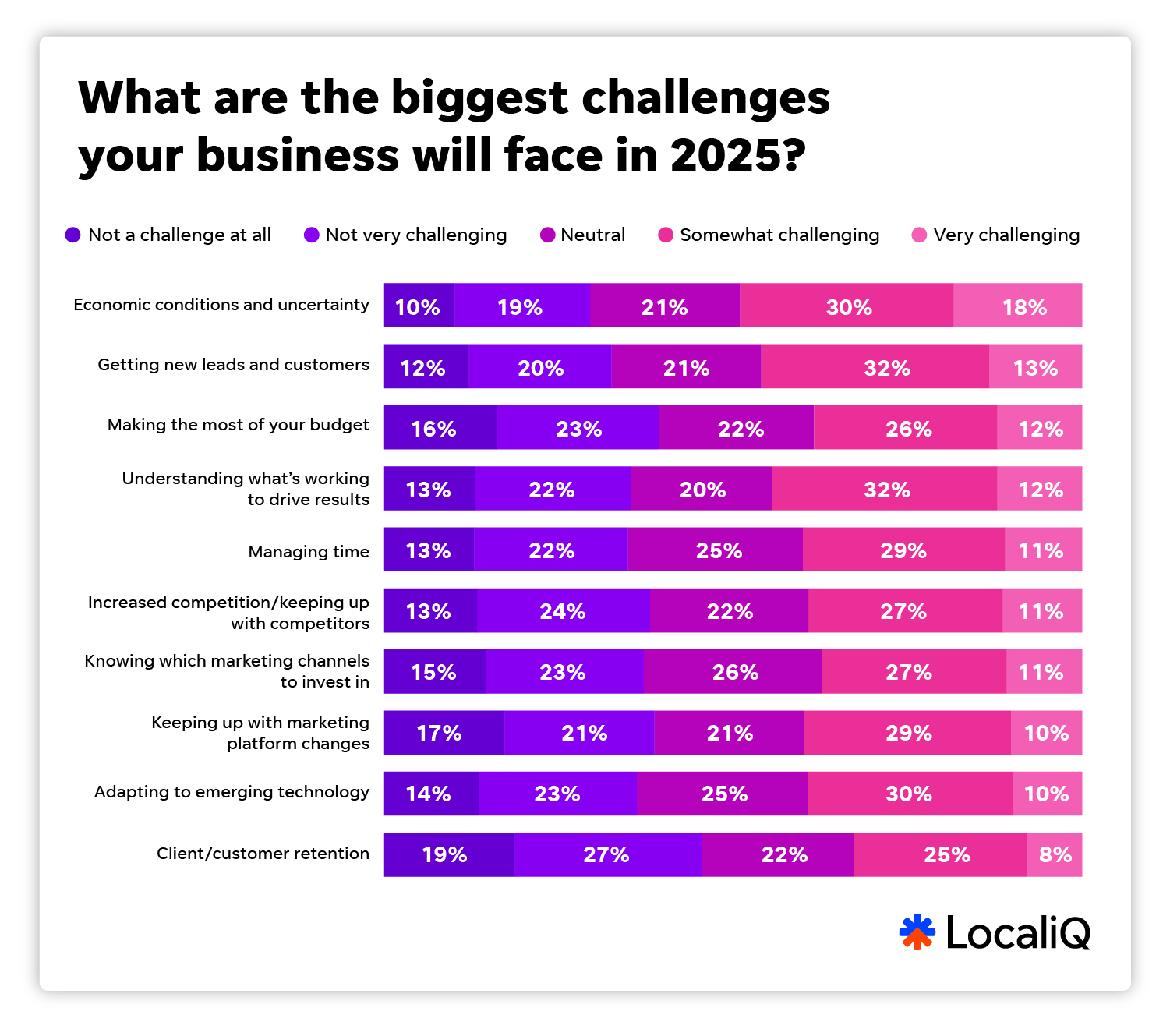
Freelance consultants and SMB owners know that in order to survive and thrive, a clear-eyed view of their economic landscape is necessary. Economic uncertainty, leadgen tactics that stimulate new customer acquisition and optimizing an (often modest) marketing budget are by necessity at top-of-mind. The ability to predict which marketing tactics can be relied on to produce the strongest return on investment is viewed as somewhat or very challenging for nearly half of survey respondents—44% are somewhat or very concerned about the capability of their chosen leadgen tactics to drive results. Adapting to new technology is a concern for 40% of respondents, who indicate they are somewhat or very concerned about keeping up. Furthermore, 45% of respondents are somewhat or very concerned about their leadgen tactics bringing in enough new customers and 48% are somewhat or very worried about economic conditions and uncertainty.

So, what are the recommendations for driving Freelancer and SMB success in 2025? There are no definitive answers and the suggestions offered below are not new and not rocket science. Your goal is to make money, but you could meet with headwinds for any number of reasons. Outcomes produced by your business strategies and tactics cannot be predicted but appropriate design, execution and performance monitoring on your part can be expected to yield at least modest success. Marketing and sales have a direct effect on customer acquisition and generating revenue, making these two closely related functions the money-making engine of a business venture and deserving of your intense focus. Just do it.

It’s helpful to monitor the performance metrics of marketing tactics and for that process, Google Analytics generates relevant and insightful data that enables you to evaluate your campaigns—at no charge. Sign up now! Along with leadgen/customer acquisition, make a point to promote customer referrals by asking your current customers if any of their colleagues or customers have the potential to become one of your customers. Also, create customer experience protocols that at every touchpoint anticipate and respond to customer needs end-to-end, from new or returning customer onboarding to after-sale training or other services. Finally, invite customer feedback by directly speaking with those who do business with you when possible. It’s good business to send out an email survey (maybe once a year), or chat with customers by way of social media; it’s important to learn what customers would like to see you do (or not do), so that you can optimize the experience of doing business with your company.

  • Be prepared to manage both the opportunities and challenges you encounter by being aware, being agile, being resourceful and being resilient.
  • Develop comprehensive marketing/sales strategies and implement with tactics you can expect to be effective. Regularly consult your website (and social media) performance metrics and make adjustments where necessary, to maximize performance.
  • Identify one or two local business associations and aim to attend one program per quarter as a way to obtain professional development and/or enhance your business acumen skills as you meet colleagues and engage in face2face networking that builds mutually beneficial relationships.
  • As soon as your budget allows hire an (outsourced) business accountant or bookkeeper to not only maintain the integrity and timeliness of your business financials and tax filings, but also to discuss and guide the potential business growth and expansion of your venture.

Thanks for reading,

Kim

Image: © kali9/ iStock

Getting Things Done: 10 Tasks to Outsource in 2025

Outsourcing is the practice of delegating certain business functions to an external agency with the goal of enabling the business to focus on primary tasks and responsibilities. Outsourcing enables Freelance consultants and other business owners to devote time and talent to the organization’s core functions by selectively delegating certain tasks to a highly skilled external expert.

The importance of outsourcing in today’s business world cannot be overstated. It is a valuable resource that, when implemented wisely, has the potential to offer significant benefits to businesses of every size, in particular cost savings that would be associated with hiring one or more employees to do work that is instead outsourced and obtaining access to specialized skills that are not available within the organization. Outsourcing promotes effective time and resource management.

Devoting time to functions that are core to your business and gaining useful professional expertise that can upgrade how your business functions are the most persuasive motivations for introducing outsourcing to your entity. Accessing specialized professional skills that would otherwise be unavailable to your organization can be a game-changer that has the potential to enhance productivity, efficiency and even the current or future profitability of your venture. Increased operational efficiency, positioning the business to grow, expand, or scale and promoting risk management practices are additional benefits that can be derived from strategic outsourcing. As businesses strive to become agile and remain competitive in a rapidly evolving market, outsourcing has become an integral part of business strategy.

In addition to choosing the right business functions to outsource, it’s also important to know what you want outsourcing to enable you to achieve. Keep goals in mind—do you want to improve productivity and operational efficiencies, save money, protect your IT network security, or increase profit margins? Set goals and record their starting metrics; continue to follow and measure the impact that outsourcing has on your entity.

Oh, and let’s not confuse outsourcing with off-shoring. Outsourcing is a way to get work off your desk and an opportunity to access special skills that you don’t have in-house and enables you to concentrate on business functions that are best performed by you. The purpose of off-shoring is to find cheap labor, typically located in a developing economy, and paying laborers there to work at an hourly rate that is considerably lower than what is paid in a developed nation. Off-shoring is about minimizing costs by transferring certain business functions to locations outside of the U.S., taking advantage of international currency values and slashing business expenses (payroll, for example) as a way to increase profitability.

Below are 10 tasks you may want to consider outsourcing in 2025, perhaps by hiring a fellow Freelancer.

  1. Accounting and Finance Delegating your entity’s accounting, bookkeeping, or other financial functions to a trustworthy external provider can include tasks such as cash-flow management, tax preparation, payroll management, financial reporting and auditing. Staying compliant with tax laws and regulatory requirements is crucial for every business and an experienced outsourced accountant will have deep knowledge of current laws and ensure that you’ll avoid fines, penalties and legal problems. Additionally, accounting firms typically have in-house expertise in risk management and are able to identify potential financial lapses before they escalate. Freelancers and small business owners can further benefit from the guidance of an outsourced financial expert who has detailed knowledge of the company’s financial position should they inquire about the feasibility of scaling, growth or expansion, or where money can be saved. When interviewing prospective accounting/finance outsourcing experts, consider asking these questions:
  • What’s the biggest financial challenge for a company like this in today’s business landscape?
  • What specific accounting/finance services do you provide?
  • Can I expect monthly, quarterly and annual reporting? Will recommendations be made where necessary, based on the numbers?
  • Will you help me set realistic goals for business growth?

2. Customer Service tasks can range from answering customer queries and handling complaints to providing technical support and managing social media interactions. Your outsourced customer service specialist can provide these services through various channels such as phone calls, emails, live chat and social media platforms and allow your business to provide support 24/7 and otherwise enhance customer satisfaction and the customer service experience that impacts your brand. Your external providers will likely have a team of trained professionals who can handle a wide range of issues and ensure high-quality service. You can help the experience by using automation tools to integrate FAQs and chatbots, complementing human support. When investigating customer service outsourcing, the questions below should be helpful:

  • Does the outsourced customer service candidate possess superior communication skills and highly evolved Emotional Intelligence and excels at clear and empathetic communication?
  • How familiar is the candidate familiar with your preferred support platforms, like Zendesk or Intercom? Multichannel experience is crucial.
  • Define clear and reasonable guidelines for response times to customer questions and tone of voice, in order to maintain consistency and meet customer expectations.

3. Human Resources Under the HR umbrella are numerous subspecialties, such as talent acquisition, payroll processing, benefits administration, training and development, compensation strategy, onboarding and background checks. Delegating HR tasks to a specialized HR outsourced service provider is proactive risk management that will ensure your company’s compliance with labor laws, for example.

HR experts are responding to the evolving business environment that calls upon those in the field to meet the special circumstances of Freelance workers and fast-paced agile business practices. There is now Freelancer Management System (FMS) software that allows HR companies to efficiently manage hundreds or even thousands of Freelance worker, who could be located anywhere in the world, and seamlessly implement their onboard, store documents, manage projects, send invoices and make payments.

As noted above, there are many HR subspecialties and no one is equally adept in all aspects. When addressing this suite of critical business functions, it’s imperative that you work with an outsourcing HR partner that best suits your needs. Insightful questions to ask when considering an outsourced HR talent for your entity will likely include:

  • What services are you most qualified and comfortable supporting? N.B,. it’s important to consider both current and future needs, such as the possibility of scaling or otherwise expanding your entity, which could necessitate talent recruitment.
  • How long will it take to implement the services you need? Also ask about the software or cloud computing required to support those services.
  • Which metrics and reports will be provided? Your HR expert should discuss the reports you’ll receive and how often you’ll receive them.

4. Information Technology Needless to say, your business entity cannot function without the right technologies and they must function reliably and seamlessly. Freelancers and SMBs frequently seek out outsourced IT expertise for essential services such as network management, cloud computing, cybersecurity and website maintenance that ensure your IT infrastructure operations are seamless and secure. Your preferred outsourced IT expert will have invested in state-of-the-art infrastructure and technology that enables business clients (you) to access cutting-edge technology that can maximize productivity and even give your company an advantage over competitors. The following questions will give you useful info:

  • Do you operate 24/7?
  • What services do you provide?
  • What is your approach to security issues?
  • Do you (and possibly also colleagues) work from home, in an office, or as a hybrid?
  • How do you manage power outages?

5. Market Research Is there something you need to learn about your customers or your industry as a whole? Whether you’re thinking about launching a new product or considering expanding into a new market, proper research is integral to the process. In the world of business, knowledge is power—competitive intel, analyzing market trends, identifying target audiences and discovering niche markets directly impact the profitability of your venture.

A diligent market research maven who knows where to look for the relevant data and how to analyze the information can be a game-changing resource for supporting informed decision-making. Those insights can shape product development, marketing strategies and even overall business direction.

In most businesses, data and market research are integral to business success, but data deep dives are known to be rather too time consuming for single person entities maintained by Freelance professionals or skeleton crew sized SMBs. Actually, in nearly every organization, workers should direct their focus to implementing data rather than finding it. Interviews with market research outsourcing candidates can include the following questions:

  • Describe a market research project where you identified a significant trend or insight that impacted business strategy?
  • How have you used quantitative and qualitative research methods?
  • How do you stay updated on the latest market research techniques and technologies?
  • What steps do you take to avoid bias and ensure that the data you collect accurately reflects the market you’re studying?

6. Design and creative Very few people have artistic talent, making outsourced design and creative work a common request. Many professionals accept the limits of their creative ability and delegate design to the artists, who can produce a professional, brand-building appearance for a website, social media pages, logo or business card, December holiday and thank you cards and even branded swag items to send to your most loyal customers when special occasions arise. You might explore the following topics and questions when discussing outsourcing a design project:

  • Review candidate portfolios to ensure their style matches your brand’s aesthetic.
  • What experience do you have with video editing and animation?
  • What is your experience using Artificial Intelligence and how does it fit into your creative process?
  • Discuss and agree on the number of design revisions are included in the project fee.

7. Search Engine Optimization SEO is essential for driving traffic to your website. Freelancers specializing in SEO can audit your site, optimize content and improve your search rankings for competitive keywords. To ensure that your website does what you want it to do, that is, function as your inbound marketing engine and hub for many marketing functions, you should regularly update site content with fresh, optimized info to maintain visibility. You will do well to explore the following topics and questions when seeking to outsource SEO:

  • Ask to see case studies or client testimonials that verify tangible results.
  • Discuss and agree upon the SEO strategy, that is, a clear plan that will prioritize keyword research and backlink-building tactics.
  • Ensure that regular progress reports will be received and that performance results will be incorporated into data-driven strategy and/or tactical adjustments.
  • At what point can you expect to see the SEO needle move in a positive direction?

8. Data Analysis Data-driven insights may need translation and interpretation, so that you can be confident about the story your numbers tell. A data analyst can help you make sense of your business metrics and therefore enable better decision-making. Your business data guru can identify trends, predict customer behavior and provide actionable insights that will guide marketing campaigns and strategies, or even new products or services you might launch. To find the right analyst, ask the following questions:

  • Choose an analyst who’s familiar with your sector to ensure that you’ll receive relevant, timely, actionable insights. How familiar is the candidate with your industry?
  • Review case studies to see examples of past projects so that you can assess candidate ability to make actionable recommendations that drive results.
  • Ensure the candidate is proficient in the use of analytical tools, such as Google Analytics, Microsoft Excel and Power BI, SAS and also the role of AI in data analysis.

9. LeadGen One of your smartest and potentially most successful outsourcing moves can be to stimulate the all-important leadgen process by using marketing automation that’s supported by the Artificial Intelligence capability known as AI-powered Intelligent Virtual Assistance. Time is money and Freelancers who want to drive results would be wise to investigate IVA outsourcing options to streamline their marketing/sales funnel operations. Smart forms, your AI “Agent,” will engage potential clients through interactive conversations, social media, or even direct telephone calls, to efficiently capture leads and qualify them in order to enhance customer acquisition. You’ll also receive regular updates of relevant metrics, most notably your campaigns’ cost per lead and the number of leads that originate from specific professional audience segments. Then, all you’ll have to do is nurture those leads and persuade them to convert. Reach out to your leads across multiple channels, conduct targeted email campaigns, or even host webinars—whatever you need to convert to customers. When meeting with a leadgen outsourcing expert, explore the following questions:

  • How do you create leadgen campaigns that you can expect will produce the desired results?
  • By what standards do you identify robust leads?
  • How do you measure and adjust leadgen campaign results?
  • Please give an example of a challenging leadgen situation you encountered and how you overcame it?
  •  How you have handled objections and rejections in leadgen?

10. Public Relations Freelance consultants often don’t have time to pitch themselves to editors of business publications, speakers bureaus, podcasts and webinar hosts, or business organization liaisons who can schedule them to speak of make an appearance on a webinar or podcast. But everyone knows that PR is an important component of brand-building and positioning oneself as an expert in the field. Authoring a blog or newsletter and social media activity also matter, but face2face interaction has a special impact. To make sure that you don’t allow this important marketing function get lost in the shuffle, consider outsourcing.

While most PR specialists want to design a strategy and use it to shape their client work, it’s usually possible to have your own goals and hire the PR expert to make them happen. Still, understand that an external PR agency can bring a fresh perspective to your business. Your outsourced PR expert can offer unbiased insights and innovative ideas that may not be apparent to you. This outside viewpoint can be invaluable for identifying new opportunities, addressing potential challenges and crafting messages that distinguish you in a crowded marketplace. Another set of eyes can see your brand from a different angle and recognize creative and impactful PR strategies that you did not anticipate.

Furthermore, PR agencies have established relationships with journalists, media outlets, influeners and others in the promotional communications sector. These connections are routinely leveraged to obtain media coverage for clients and amplify your brand’s message. By outsourcing your PR activities, you gain access to this extensive network, which is a resource you would be unlikely to build and maintain on your own. A well-connected PR agency can open doors to new opportunities and ensure that your brand is heard by the right people. The following questions will be insightful when meeting with potential candidates for outsourced PR:

  • How do you develop PR strategies for clients?
  • How do you obtain media placements and coverage for clients?
  • Can you share examples of how you’ve improved a client’s brand visibility or reputation?
  • Do you have case studies that showcase your work and results in our field?

Thanks for reading,

Kim

Image: ©ARTpok/ Shutterstock

What Freelancers Should Prioritize to Prevail in 2025

Taking on 2025

Well, here we are! The trap door opened, we all fell in and like it or not, 2025 has us in its grip. When the inevitable obstacles and setbacks disrupt the flow you planned for your business venture, will you be caught in a whirling vortex of problems—or might you somehow regroup and win a skirmish or two? Better still, will Fortune smile and hand you a big victory this year? More than likely, however, 2025 will be a test of strength and strategy that feels like you’re in a triathlon (swim, bike, run); cross-training, so to speak, will be the best preparation to get your entity in shape to compete and win.

Political instability, compromised national borders, cybersecurity breaches, a metastasizing housing crisis, unrelenting armed conflicts boiling on three continents and wildfires burning in rural and metro areas of the U.S. are just a partial list of adversities troubling the global economy and working against your attempts to make an acceptable profit. The need to develop resilience—the ability to adapt and prevail over unexpected, often destabilizing, occurrences—will be a priority for Freelancers and other small business owners in 2025 (and probably beyond).

More than just surviving, resilience means developing the capability to respond well to unexpected, difficult, events. Resilience gives you the courage to accept sudden, radical change and realize that if it happens, you must take charge and quickly assess the new business conditions to figure out your next move and design a well-executed pivot that aligns your business with the new normal.

As we move into 2025, it’s clear that Freelancers and SMBs must be ready to adapt to a rapidly evolving landscape. By behaving proactively and building up resilience as a defense against economic uncertainty, you can position your entity to not only survive, but thrive, in the coming year.

Master the challenges

How will you prepare for the trends, challenges and opportunities that Freelancers could encounter in 2025? Your must-do list is unlikely to hold any surprises but nevertheless, the evolving economic and political circumstances, global and national, are bound to bring about a shift in the relevance and interpretation of What Matters Now. At the beginning of the year, Freelancers and SMBs will be wise to adopt a big-picture view of their entity and focus on how to remain viable over the next 12 months.

  • Review the pricing structure of products and services
  • Update marketing strategies
  • Identify potential new or niche markets
  • Analyze the company’s financial condition
  • Nurture client relationships
  • Revitalize networking, with goals of developing new relationships and finding new clients

Enhance your brand and be visible

A trusted brand is a valuable resource during times of uncertainty. Clients and prospects gravitate to Freelancers who inspire trust, based on their reputation (brand) and online presence. Beyond showcasing a well-presented portfolio, Freelancers should actively engage on platforms like LinkedIn, as well as join or host webinars, get invited to podcasts, teach workshops or classes related to your core professional expertise at local colleges, business associations, libraries, or other credible venues. It is also recommended that you author informative blog posts, as a guest blogger or on your own site, and share relevant industry insights on social media. In other words, establishing yourself as a thought leader will increase visibility, enhance your brand and attract high-value clients. Showcasing your most desirable skills and competencies can help attract potential clients more effectively.

Social media platforms, most notably LinkedIn, which was designed for professional networking, is an excellent tool for staying in touch with past clients, posting articles you’ve written and connecting with others in your industry. Staying active on the right platforms can increase your visibility and encourage client acquisition.

 Optimize workflow by investing in AI-powered tools

As you grow your client list, you may at times find yourself juggling multiple projects. It’s the realization of your goal, but feeling overwhelmed and stressed can result. You can more efficiently manage your projects, instead of the projects managing you, by using one (or more) online productivity tools to streamline your workflow. From video communication platforms like Microsoft Teams and Goto Meeting to project management platforms like Asana and ClickUp, the right online tools will help to expedite your workflow. Incidentally, familiarizing yourself with one or more popular software tools can make you appear more competent, and therefore more marketable, to those clients who, all things being equal, prefer working with Freelancers who are familiar with their company’s preferred in-house workflow platforms.

Moreover, Artificial Intelligence is revolutionizing how Freelancers work in every industry—graphic designers can use AI to generate initial concepts for marketing materials they’ve been hired to create; copywriters can identify the most popular keywords to include. Marketers can discover copywriting ideas and conduct content analyses, accountants and bookkeepers can automate routine tasks and direct their focus to high-value work that clients appreciate, such as strategic financial decision-making. Staying updated on the latest AI advancements and incorporating them into your workflow will ensure that you deliver faster and smarter solutions for your clients. You will be wise to do some research and incorporate AI into your business.

Learn and grow by seeking client feedback

To achieve success, Freelance professionals must use all available opportunities to build a healthy client list; part of the process is to invite post-project follow-up, that is, client feedback. Understanding what is or isn’t working for clients helps you evaluate in real time your business processes and ensure that they reflect client preferences. Feedback can also lead you to make updates to your services and/or products, or introduce new features, add-ons, or upgrades that clients will value and buy. Demonstrating your attentiveness to feedback supports your goal of building a robust and loyal client base, which is another strategy that promotes stability during uncertain economic times—you’ll have a cushion. As you know, providing the best product or service and presenting a client experience that distinguishes your organization from competitors is a critical component of long-term success.

With your final project invoice, make it a practice to send a short survey and invite the client to share his/her thoughts about the experience of working with you. Some remarks may make you wince, but uncensored feedback is the best way to become aware of weaknesses and, on the bright side, discover opportunities for further growth. You could even discover a niche market, if several clients let you know that they’d appreciate it if you’d provide an additional product or service.

Finally, not only will post-project feedback help you learn a great deal very quickly, but it’s also a great way to show clients that their satisfaction matters. Routinely inviting client feedback can also enhance your brand and make you more marketable.

Routinely request referrals

Politely asking a satisfied customer to provide referrals of those who may be interested in your products and/or services is good business. Referrals can be requested in different forms, from asking a former client to write a reference letter for you to casually inquiring whether a client has any contacts who could use your services or products. However you pose the question, take care to use proper tact and time your request wisely. Additionally, be specific about what you’re asking for and include an opt-out to avoid any potential awkwardness.

If you don’t feel comfortable asking for a referral, asking for an online review can be a great alternative. Whether it’s posted on the profile page of a social media site like LinkedIn or appears on a business ranking site such as Yelp or Trip Advisor, reviews are just as important for Freelancer professionals as they are for SMB owners.

Thanks for reading,

Kim

Image: © Ogden Pioneer Days Rodeo. Since its debut in 1934, the Pioneer Days Rodeo has ranked as one of the top five large outdoor rodeos on the Professional Rodeo Cowboys Association circuit. Shown here is an image from July 2021.

What Can You Do to Cultivate Customer Loyalty?

Recruiting a new customer is a victory, the goal of every business owner and Freelance professional—but you can’t exhale yet. When it comes to making money it’s not only what you make, it’s what you keep, and that folk wisdom applies not only to sales revenue, but also to customers. The real genius of being in business is learning how to retain customers.

Building a thriving community of customers is foundational to sustaining a business entity; strategies dedicated to nurturing customer loyalty by persuading them to continually do business with you is an important part of a comprehensive marketing plan. Loyal customers are repeat customers; they also refer new customers and that makes it imperative to develop strategies that generate and encourage customer loyalty. Neglecting this function can easily result in customers you worked so hard to attract eventually moving on, perhaps to do business with a competitor.

Unfortunately, many businesses struggle to retain customers, a consequence that can diminish sales revenue and weaken the ability to survive. It has long been known that implementing strategies designed to retain customers is fundamental; customer acquisition cost has increased by nearly 50% since 2013, making it so much more expensive to acquire a new customer, as compared to the cost associated with retaining an existing one, further proving the value of repeat customers and promoting the loyalty that stimulates repeat business.

Customer loyalty is the happy result of the relationship between satisfied customers and the businesses they know and trust. Building a loyal customer base for your entity brings benefits in at least two ways—it discourages customer churn and therefore limits the marketing dollars you’d need to spend trying to retain them and second, loyalty helps you grow and preserve your current group of customers. Not only that, promoting loyalty can also convince customers to become cheerleading advocates for your brand.

In other words, encouraging customer loyalty can do wonders for your business, like enhancing sales revenue, strengthening customer relationships and brand building. You just need to work at it consistently! Below is a list of customer loyalty strategies, one or more that’s sure to be useful for you.

Exceed expectations

Customer expectations are feelings, actions and outcomes that customers anticipate will result from their experience with your brand, from first impressions to final purchase and on to using the service or product that was purchased. You’ve probably heard the oft-repeated advice that urges businesses should “under promise and over deliver”—you do that by exceeding customer expectations. So, if you promise a customer that you’ll follow-up to answer a question or resolve a problem within 24 hours and you contact the customer within six hours, you’ve exceeded customer expectations and planted the seeds of loyalty. Common customer expectations include:

  • Quality product. Product quality is at the top of most customer checklists. They want a product that meets their needs and delivers on the promises of its description, photos and reviews. 
  • Great customer service. Customers expect businesses to provide friendly and knowledgeable customer service before, during and after they make their purchases.
  • Value for price. Value is represented by the satisfaction customers feel when the price of the product or service seems appropriate (or like a good deal). Perceived value for money spent is subjective, but customers want a price they believe is justified.
  • Personalized interactions. Customers want to feel like the company values them by providing an efficient, pleasant and personalized buyer’s experience.  

Exceptional customer experience

Promoting customer loyalty involves more than offering products and services that satisfy the needs, goals, or problems of customers. To truly win over a customer and create loyalty, you must persuade them to become your cheerleaders. An exceptional customer experience is the true foundation of customer loyalty. Superior service is integral to encouraging customer loyalty and promoting positive word-of-mouth that differentiates you from competitors.

Customers who are pleased with the experience your brand provides, and also trust the reliability and quality of your products and services, are positioned to become loyal customers. They’ll usually be happy to share their favorable experiences with friends, family and colleagues and give your brand enthusiastic endorsements that commonly result in referrals of new customers and repeat business. These demonstrations of customer loyalty are a powerful, and inexpensive, way to reach new customers and build your customer base, sales revenue and brand.

  • Surprise and delight. To create a positive, memorable experience for your customers, remember that it’s the small and unexpected things that keep them coming back.

Expertise

Because your goal is to attract and retain customers, generate referrals and recruit brand cheerleaders, know that you’ll promote those aims by demonstrating that you are a reputable and trustworthy expert in your field. You’ll build credibility and customer loyalty by sharing your professional know-how with customers and prospects.

  • Educate customers. Content marketing is all about educating customers and it is now the marketing strategy that most customers prefer. The purpose of marketing is to persuade prospects to do business with you. For example, if you are a Freelance gardening and landscape specialist, you would do well to create videos, and/or publish a monthly newsletter or blog that focuses on helping plants survive winter and how to prepare a garden for spring plantings. Throughout the seasons, new posts will address how your readers can create a beautiful garden. Distribute your customer/ follower education info to your email list and encourage list members to subscribe to regularly receive the info.

Reliable

Conscientiously build a reputation for being consistent and dependable to further support customer loyalty for your brand. For example, if you promise that a product will be delivered within 48 hours after purchase, take steps to ensure delivery occurs within that time frame. Or if the graphics for the marketing campaign brochure you’re creating for a client must be ready for a 10:00 AM meeting that your client has scheduled with his client, be prepared to work as long as it takes to produce a perfectly designed and edited deliverable at the agreed-upon time and place, to make both your client and yourself look good.

Flexible

While it’s important to have policy and procedure guidelines in place, it is smart to remember that customers have circumstances and problems they grapple with. So, if you’ve established a 14-day return policy, but a customer wasn’t able to return the product within that window, perhaps because of a business or family emergency, graciously accepting the return and offering either the usual refund or store credit may be the best course of action. It’s likely that you’ll gain much more than you’ll lose and it will be an effective way to encourage customer loyalty.

Communicate

One of the easiest ways to keep in touch with customers is through email. Ask for customer email contact info after completing purchases, or while they explore your sales/marketing funnel during the buyer’s journey, so you can send information that a prospect would like to see, or keep existing customers updated on new products, or perhaps follow-up with them after a sale to inquire about their perception of their customer experience. This information can be used to improve customer satisfaction.

Studies have proven that personalized emails have a transaction rate 6 times higher than impersonal emails. Addressing recipients of your marketing emails by name, sending birthday or holiday greetings to existing customers, or thanking a customer for a recent purchase are the types of outreach that customers appreciate. Personalized messages can help create an emotional bond between your brand and your customers that promotes customer loyalty.

Social media platforms will help to bring your customers into a community. Communities are an effective way to start conversations with your customers and also encourage user-generated content. You might start by inviting customers to share pictures of themselves using your product for posting on Facebook, Instagram, or Pinterest, for example.

Feedback

Whenever a customer makes a purchase, request their feedback with an email questionnaire or online survey link sent to their email (you can also place that link on your company website). It’s important that you know what customers like or dislike about your products and/or services and how they feel about your customer service and experience. If you aren’t aware of this information, you will be unable to make changes that will make your customers happy. Always be ready to listen to customers and address their concerns a timely manner. Make it easy for them to get in touch with your company by clearly displaying the email address, phone number and social media links on your website and in emails.

  • Make it easy to communicate with a real person. While technology has made it easy for customers to find information regarding your product or service, it’s a mistake for business owners to hide behind a wall of tech. There’s going to be an event that causes a customer to feel the need to speak with a real-life person. Make sure that your contact information is easily located on your website and in your emails and follow-up on inquiries in a timely fashion.
  • Spend time with customers. Speaking with customers is good business—they’ll immediately recognize that you care about them as individuals and want to provide a pleasing customer experience for them. It’s Relationship Building 101. Furthermore, you can learn a few things, such as what motivates them become, and remain, your customers. What you learn in conversations with customers is invaluable—the intel can be used to generate more specifically useful content and support the development of more effective marketing campaigns. Moreover, you might even be able to recruit customers who are especially happy with your brand to share their experiences in testimonials or case studies.

Transparency and integrity

There will be days when things fall apart. Rather than retreating into excuses and denial, put your big boy/big girl pants on and be honest with customers about the bad news. Mistakes happen; customers know this and when you face up to the problem, customers will respect and appreciate your honesty. Don’t get defensive or over-sensitive if you get called out on something that was your fault. Instead, use emails and social platforms to take responsibility and resolve the issue.

Train employees

Employees are part of your team and they are capable of generating customer loyalty—or destroying it. Employees who buy into your brand promise and culture are more likely to themselves feel loyal toward your company and inclined to share their enthusiasm with friends, family and the customers they assist. Make sure your employees have the proper training and tools to enhance the customer experience and keep them updated about company developments that will support their work. Always treat employees with respect and listen to insights and suggestions they have to streamline procedures, sharpen your marketing campaigns and pay special attention to any rumblings of customer discontent.

Incentives

You want to give customers reasons to keep coming back and that’s when incentives can be helpful. Your give-away could be as simple as a 10% discount on their next purchase that is at least $50 or giving them a free (relatively inexpensive) branded item after their tenth purchase. Instituting a loyalty program might include the following.

  • Points System – Customers earn points which can be used for a reward.
  • Tier system – Provide a small reward and increase the reward over time.
  • Support programs around your customer’s values – Customers aren’t just concerned with monetary rewards, show your support for programs that they support.
  • Coalition programs – Team up with a related company for deals outside of your company

Happy New Year!

Kim

Image: © The Next Crossing. Marrakesh, Morocco 2017

Freelance or Fractional?

What’s the newest growth niche on the horizon for professionals who work independently? Voices in the echoverse are buzzing about an innovative hiring model that has the potential to offer exciting work opportunities to highly skilled Freelancers and other self-employed professionals. This undeniably practical, and revolutionary, hiring model is called fractional.

You may have heard the term a couple of times over the past year or so, but never checked out the backstory? Know that talk of recruiting fractional, that is, interim, talent to guide (often start-up) companies in need of specialized expertise is capturing the attention of more decision-makers every month and urging Freelancers, et al. to consider the fractional work sector. For those with the required skill set, there may be interesting and challenging, possibly high-profile, and lucrative assignments for which you would make a good candidate.

What drives fractional?

Fractional work has joined the gig economy, enabling businesses to access C-Suite level talent on a short-term basis when urgent projects require a complex or sophisticated solution. That business leaders are able to eliminate the considerable costs associated with hiring a full-time senior level employee, a process that typically involves a lengthy candidate search and several interviews, followed by salary and benefits package negotiations, aligns with business practices that start-up funders and business lenders prefer.

Business leaders like keeping payrolls lean, a solution that became fashionable in the late 1980s (and shows no signs of abating). Turning to temporary talent sources, i.e., Freelance professionals and fractional executives, allows CEOs to strategically hire for specific projects without incurring burdensome expenses. Fractional employee expert Abby Sugar sums up the prevailing opinion, “You get to have a high-level strategic executive thinker that you might not need on a daily basis.” She continues, “You don’t need to be paying a super-high monthly salary for somebody if you’re not that large yet and so you need a higher-level person to help you strategically execute and bring on a fractional COO (Chief Operating Officer) instead of a lower-level person at a low hourly rate.”

Ms. Sugar’s observation is further demonstrated by the appearance of fractional Chief Marketing Officers who are now an increasing presence in start-up havens like Austin, TX and Silicon Valley, CA. According to Chief Outsiders, a leading company that places fractional CMOs into well-funded start-ups, there’s been a 38% jump in demand for fractional CMOs in the past year; the Association of Professional Executives in Marketing and Sales predicts the demand for fractional CMOs will grow by another 20% in the next five years. Below are comparisons between working as a fractional executive and a Freelance professional.

Typical work projects

  • Fractional: Fractional executives fill a specific business need on an ongoing basis, e,g., six months or more, but as a part-time commitment. Fractional execs are known to take on strategic roles, mission-critical tasks and projects that require working closely with the hiring company team. For example, a fractional CMO may be hired to develop and execute marketing strategy and contracted to work a certain number of hours per week. Unlike Freelancers, fractional workers often become a de-facto part of organization staff and integrated into company culture. 
  • Freelance: Freelancers are hired to complete specific, project-based tasks that are sometimes ongoing, e.g., producing a monthly newsletter or managing social media accounts, and at other times short-term, e.g., designing a website or planning a company meeting or other event. Freelance projects generally top out at mid-level complexity and unlike fractional execs, Freelancers generally do not become immersed in the company’s functioning, culture, or values.

Typical expertise level

  • Fractional: Fractional hires are C-Suite level executives, experienced professionals with a proven track record in their field. They bring considerable knowledge and expertise to the table and can be expected to produce the desired outcomes. In fact, they can be a game-changer for start-ups and companies executing a turn-around. Services like Upwork, the previously mentioned Chief Outsiders and others connect companies, often start-ups or those involved in a scale or turn-around, with seasoned executives who provide specialized skills and leadership experience on a part-time or per-project basis. Fractional execs can be a cost-effective way to access the expertise a CEO needs to achieve specific goals while avoiding the costs of hiring a full-time employee.
  • Freelance: Freelance professionals also may have been C-Suite executives, or they may have reached manager level, and own the skills needed to successfully take on complex work assignments. Others are highly skilled and results-oriented as well, but more suited to less complex, but nevertheless strategic, mission-critical assignments. Freelance professionals may have gained experience in a particular niche, or they may be generalists who expertly perform any number of tasks.

The emergence of companies that welcome Freelance and fractional workers demonstrates the resilience of the gig economy. Now, talented professionals who’ve developed specialized skills at either a senior or junior level, and are hungry to experience working in different industries or environments, can work on a per-project basis and monetize their expertise as they take on important assignments that challenge and excite.

Thanks for reading,

Kim

Image: ©HGTV. Jonathan (L) and Drew Scott, The Property Brothers on season 7 (2020) Brother v. Brother

How to Scale Your B2B Services Company

Independent and ambitious Freelancers, like other business owners, are inclined to brainstorm strategies and tactics that may have the potential to increase their company’s revenue and profit. Central to the entrepreneurial dream is building an entity that attains success as you define it and that often entails making money. But as with all business decisions, it’s necessary to determine which strategy and tactics have the greatest likelihood to reach the pot of gold. As always, the most reliable way to answer that question is to conduct comprehensive marketplace research and examine your company’s key performance indicators.

Grow, scale, or expand?

It is imperative that you recognize which KPIs point to a particular revenue and profit boosting strategy and give you the confidence to follow that solution. To earn more revenue and become more profitable, there are three options—expand, grow, or scale. Each strategy requires certain marketplace conditions and financial and other resources and carries its own kind of risk.

Expansion is a much bigger investment, especially for Freelance professionals, who typically operate a service business, work alone and deliver the service yourself. Launching your operation in a new location typically places a significant demand on financial and logistical capabilities, making growth or scaling, which both entail relatively fewer demands on resources, more accessible to Freelancers.

OK, so how can you recognize which option makes more sense for you? First, let’s know what we’re talking about. Many business owners and Freelancers misunderstand the meanings of growth and scale, so let’s take a sidebar and examine their definitions. Growth means adding more projects, new services and/or signing additional clients as the engine of your strategy to boost revenue and profit—activities that mostly entail more expenses. Scale focuses on increasing revenue and profit without significantly increasing the associated production costs. Essentially, scaling means working smarter, not just harder, and aligns well with the financial and logistical capabilities of the typical Freelance professional.

Nevertheless, scaling a business, particularly a small, service-based company, will require extensive preparation and a well-designed strategy to make it work. To evaluate the possibility of scaling your operation, you’ll dive into company KPIs and conduct an extensive financial analysis, marketplace research and strategic planning. Data-driven decision-making will yield the most trustworthy information and outcomes.

Furthermore, when contemplating your scale, or any other significant business investment, as you study the data, contact your business accountant, who is familiar with your financial situation and is positioned to be your Sherpa and guide you as you climb (scale!) the mountain. There are a couple of obvious questions that you should address before calling the accountant.

  • So, how’s business? Are clients lining up to do business with you? Are you meeting, if not exceeding, your revenue targets? How many clients are on your roster? If business is off the chain, then get your accountant on the phone and share the good news. However, if you’re merely pleased with your performance metrics, set higher goals and observe what happens during the next two or three quarters. if you surpass those metrics by an impressive margin, it may be time to call the accountant and discuss next steps.
  • Client feedback Listening to what clients observe or experience can steer your business toward success and it’s good business to invite them to give their perspective. Invite clients to share their thoughts and suggestions regarding your services. Client insights may open your eyes to add-ons, upgrades and/or new services you can provide and what they tell you could contribute substantially to your scale. Make giving feedback convenient by occasionally including surveys in marketing emails, soliciting online reviews, maintaining an active presence on social media, or making yourself available for in-person conversations. Your objective is to hear and assess what clients say about your services, company and the customer experience you provide. You can use their feedback to better understand what clients like, what you can do better and get early warnings of emerging trends and how your clients feel about what’s on the horizon. With this knowledge, you can tailor your services to meet this demand and strengthen your positioning as a go-to provider in the industry, whether or not you decide to scale.

Use data to evaluate a potential scale

Analyzing and interpreting company performance data will do more than answer the expand, grow, or scale question. KPIs will also spotlight company strengths and weaknesses, help you recognize competitive advantages and call your attention to gaps that limit progress and need fixing. With the help of your accountant, your KPI data analysis will also indicate the overhead expenses, staffing and other resources, so that a realistic budget can be developed.

Moreover, your analytics tools can build reliable data-driven sales forecasts for the proposed scale that will include the number of new clients needed, average billable hours/ hourly rate and sales revenue you must generate within a particular time frame. BTW, if you were wondering when and how to incorporate AI into business operations, evaluating a potential scale could be your motivation.

Find your money-making niche

Turn to marketplace and industry data to point you to a niche you might enter. You might also consider how you to diversify your current service line? In either scenario, consult your data projections to suggest whether client price tolerance will allow you to achieve a profit margin that covers the expense of delivering at scale. Competitive intel is also likely to be useful; for example, there may be few competitors in certain market segments because there’s no money to be made. Once you’ve learned where the opportunities are, you can start making changes to scale successfully.

Upgrade marketing and branding

Build up company visibility and reputation with robust marketing and branding. Sharpen your marketing messages and establish a presence on inbound and outbound marketing channels that are a fit for your services. Search Engine Optimization, social media and content marketing should be especially useful. Nearly half of all clicks on search engines come from organic searches, which suggests that prospects are more likely to trust the results they find naturally.

Your marketing and branding strategies will also be more impactful when guided by data. By analyzing metrics such as website traffic, conversion rates and client engagement, you’ll be likely to discover actionable insights that may shape marketing strategies and campaigns that produce the results you need.

Standardize service delivery, invest in automation

Scaling a service-based business requires being able to deliver those services in the same way, every time. A strategy that will both save time and ensure that your profit margin is sufficient to cover the expense of delivering at scale is to package your services as a menu of products and eliminate the need for you to customize every order. Next, create standard operating procedures to ensure quality, efficiency and consistency in how your services are delivered. Map the step-by-step workflow, provide written or video instructions for clients and if applicable, ensure that your team is trained on best practices, so that clients will receive the same excellent results every time.

With a service-based business it is you, Freelancer friend, perhaps assisted by a team member, who will provide your services. In order to scale, you must develop and perfect turn-key, streamlined processes that allow you to work with the number of clients necessary to realize the scale. From your client onboarding procedure to billing and invoicing, automation will make your organization more efficient, appear more professional, inspire trust and build your brand at every touch point. Not only that, you’ll have more time to focus on improving your business and optimizing the scale.

Thanks for reading,

Kim

Image: Jack’s First Beanstalk, illustration from Jack and the Beanstalk, a circa 1734 English fairy tale. Author and illustrator unknown.

Your Business: Get the View From 30,000 Feet

If you operate a business, you know all too well that your work is never done. There is always a problem to solve, reports to run and statistics to analyze, emails to send, a customer to speak with (remember to take a break every now and again!). Along with the hands-on, task oriented items on your to-do list, there is another responsibility that business owners have, one that’s seldom discussed but is nevertheless a must-do—to think about the business entity and figure out how to make it grow and thrive.

Thinking about your company—where it is now, where it was a year go and where you’d like it to be in 12-24 months—demonstrates the difference between being a leader, who embodies the vision of the entity and a manager, who implements goals that enable the vision to be realized. Freelance solopreneurs must wear both hats—the manager, who prioritizes efficiency and gets things done and the forward-thinking leader, who engages in big picture thinking to contemplate the state of the business and looks to connect the dots between problems and their impact, recognize potential opportunities and plan for the future.

Ulyses Osuna, founder of the sizzling hot PR and personal branding firm Influencer Press https://influencerpress.com/ and protégé of marketing rock star Neil Patel, founder of both Kissmetrics and Crazy Egg https://www.crazyegg.com/ , recommends that business owners/leaders regularly examine your organization to assess what’s happening now and what might happen in the future. To effectively steward your business entity, it is critical that business leaders regularly devote time to think about your organization and observe how it functions in real time. Factors you may examine to supply relevant insights may include:

  • marketplace conditions, including the competitive landscape
  • how the company delivers its products and services
  • perceptions of the customer experience, including customer service, that the company presents
  • top-line and bottom-line sales revenues
  • the inbound marketing conversion rate
  • plans for growth and expansion

For companies large and small, including Freelance Consultants, Osuna feels that devoting an hour or two each week to studying the organization is needed to see and interpret the big picture view from 30,000 feet. Business leaders must do more than grind it out just to stay on top of (admittedly important) day-to-day responsibilities and keep things in motion. Remember what inspired you to create your entity; you want it to be all it can be. To maximize your organization’s potential, first get a warts-and-all understanding of where it is now, so you can recognize growth and expansion opportunities and decide how to prepare the company to pursue those opportunities. Neglect your business leader due diligence and fail to conduct frequent check-ins with the organization you created and you’ll eventually find yourself at the helm of a rudderless ship, tangled in the weeds, as you work hard but remain stuck and unable to achieve worthy goals that were once attainable.

Osuna says he gives his clients thought-provoking, sometimes edgy, questions to answer and you (and your team, if applicable) can do the same. It’s OK to address just a question or two in your brainstorming sessions, so long as you take a deep dive and keep it real. Osuna urges you to move forward and execute quickly when you have an ah-ha moment and discover something that might move the needle—do research thoroughly and plan carefully—because good ideas deserve immediate follow-up.

BTW, Freelance solopreneurs who doubt the wisdom of asking themselves questions and then answering themselves can refer to Consulting Drucker: Principles and Lessons from the World’s Leading Consultant, written by William Cohen, PhD (September 2018), to confirm that Osuna’s brainstorming method can produce useful results. Cohen’s book examines the influence that business consultant, educator and author Peter Drucker (1909-2005), who is known as the father of modern business management, has had on business practices. Cohen and his research team found that asking yourself questions and responding to them as if you are a separate entity, can produce credible answers. Your brain will supply answers, or attempt to, making the practice beneficial for a single individual to contemplate questions that require objective and big picture thinking.

Cohen at al. theorize that the primary reason for this phenomenon is that oftentimes, the facts needed to answer questions and resolve problems are already stored in your memory, even if some information cannot be easily accessed. Asking yourself questions, treating your brain as a separate entity and allowing it to find potentially useful answers, can eliminate many of the biases that may otherwise block you from identifying effective solutions. There is a limit to the phenomenon, however— if you are under a great deal of stress, or the problem is either too big or the situation is too demanding, the brain may not function well enough to identify a workable solution to the question or problem, even when you frame the query as if addressing someone other than yourself.

The list of questions below are written to help you successfully launch weekly or monthly business brainstorming sessions for your entity by focusing on three business functions that Drucker identified as vital: attraction of prospects, customer conversation rate and delivery of products or services. You can choose other questions to ponder, depending on your circumstances, and address them at your own pace. You may take on only two or three per week/month but devote an hour or two in each session to think about your business entity, it’s challenges and potential.

  1. Which systems improvements will make doing business easier, more efficient and/or less expensive?
  2. Which media outlets would best showcase the company and brand and has the company/or I been featured in one or more in the past 12 months?
  3. If I was able to hire one (or more) employees whose salary would be paid by a grant and cost me nothing, in what capacity would it make sense for the person(s) to work and would s/he work?
  4. Do my products/ services optimally fulfill the needs and aspirations of my customers? Should I add an upgrade or a simplified version or should I develop a new service or offer a new product?
  5. If I was given a no-strings gift of $300,000 to exclusively spend on the business, what would I spend it on?
  6. What do customers value most about the company? Where do customers feel the company falls short?
  7. Does the content produced for the company showcase me as a thought leader? In what categories have I (or can I) establish authority? This could involve guest articles, interviews, or speaking engagements.
  8. What do you want the company to look like in one year, two years, or five years?
  9. How do I provide solutions that solve client problems or achieve client goals?
  10. If I could do it over again, would I create this business in the way I have done—what, if anything, might change?
  11. What are the most common objection that prospects give to your sales pitch and what might be the best response?
  12. What is the biggest priority that the company faces now?

Thanks for reading,

Kim

Image: The Thinker created in 1904 by Auguste Rodin (1840-1917) on display at the Peabody Essex Museum, Salem, MA 2016 exhibit, “Rodin: Transforming Sculpture.”