Is Your Social Media Strategy Delivering?

Half the money I spend on advertising is wasted; the trouble is I don’t know which half.”

Possibly apocryphal quote often credited to 19th century Philadelphia department store magnate John Wanamaker.

Accurately measuring the impact of the marketing activities you create to promote your company’s services and/or products and, furthermore, analyzing the impact of your marketing to verify that the activities were worth the time and money invested in them can be somewhat of a puzzle for a marketing manager. In particular, the return on investment of social media activity can be nebulous, given that much of its focus is often devoted to relationship-building that stimulates one or more aspects of brand-building, for example, brand loyalty and brand reputation. Determining which of your go-to social media platforms is your top performer might be difficult to confirm, there is not always an obvious path to follow as you track and document your customer’s behavior or buyer’s journey from first contact through purchase; and then there are those who jump ship somewhere between those points and the debrief on that scenario is yet another drama to unravel.

Social media remains a hugely popular marketing tactic that for the most part has earned its accolades in both free and paid options. So, it comes as somewhat of a surprise that recent marketing research shows that at a representative group of enterprise companies, the social media marketing spend is softening. According to the Spring 2024 edition of the CMO Survey, which surveyed 292 marketers employed by leading U.S. companies, social media investments declined from 17% in Spring 2023 to 11% in Spring 2024, reaching its lowest level in seven years.

The CMO Survey found further confirmation of this occurrence in participant responses to the question “Which best describes how you show the impact of social media on your business?” and one-third, all of whom are marketing leaders, reported “we haven’t been able to show the impact yet.” The remaining participants were evenly split on whether they’ve “proven the impact quantitatively,” with some stating that they have a “good qualitative sense of the impact, but not a quantitative impact.”

Maybe you’ll soon decide to pull back on social media paid ads, too, and rely more heavily on the “free” option (free except for the time spent to choose and post content that interests followers, that is) since it remains an effective method of customer outreach and enables you to build and sustain relationships with customers, convert prospects into customers and boost brand visibility. Your social media spend may decrease, but that adjustment could motivate you to make the most of a reconfigured, but still valuable, marketing investment.

Multi-channel is most effective

According to an analysis of performance data associated with social media marketing campaigns, the format produces greater results when used in combination with other marketing tactics, e.g. monthly newsletters and/or case studies, e-books, podcasts, or webinars. Furthermore, when researchers examined 10 years of CMO Survey retrospective data, below-average performance of social media marketing campaigns was reported by participants whose answer to “How effectively does your company integrate customer information across purchasing, communication and social media channels?” revealed weak scores describing the use of that data during the period 2011 – 2023. The performance ranking scale measuring customer data sharing ranged from “not at all” to “very highly.”

In light of the findings of the 10-year retrospective, survey researchers recommend that marketers consult with a Customer Relations Management (CRM) company, e.g., Sprout Social, HubSpot, BuzzSumo, or SalesForce, to ensure accurate interpretations and beneficial integration of their social media marketing performance data to enhance the success of future marketing campaigns. Correctly interpreting and utilizing social media marketing performance data ensures that you’ll have a holistic understanding of customer behavior that’ ‘s inclined to positively impact the buyer’s journey your company provides.

Use social media to grow your customer list

The CMO Survey also found that nearly half of companies use social media platforms to sell their services and products. However, survey data reveals that fewer than 20% of those companies leverage their social media engagement to invite customer feedback that might improve aspects of the customer experience or even suggest new product or service opportunities that the company could explore and possibly launch. Companies that exploit this easily accessible customer feedback opportunity are able to develop a customer experience that responds to and retains customers, encourages referrals and increases sales revenues and profitability.

Improvise to stay timely and relevant

Finally, enhancing your ability to provide a timely response to breaking news that matters to your customers and prospects right now is just about guaranteed to enhance both the relevance and visibility of your brand—and using social media makes this possible. Still, marketing managers often neglect opportunities that are easy to address, as evidenced by the self-reported survey participant score of “average” when describing behavior associated with the statement “Responding quickly to opportunities and challenges when managing your most engaged customers.”

CMO Survey findings convincingly show that adopting a flexible, even improvised, approach to your social media engagement is the most effective aspect of your strategy and that your awareness of breaking news and developing events is most urgent and beneficial when providing a timely response is desirable. Communicating with your customers and prospects by acknowledging the unfolding event or unexpected (surprise) development, with a humorous or witty remark demonstrates your authenticity. In short, building in processes designed to make you ready for and prepared to quickly respond to various types of communication opportunities is able to improve the ROI of your company’s social media marketing and engagement.

Thanks for reading,

Kim

Image: © Simon Smith. Bunhill for Getty Images

LeadGen and Customer Acquisition in 2025

LocaliQ, a digital marketing platform that specializes in lead generation and multichannel marketing campaign management, and is a subsidiary of Gannett Publishing, surveyed more than 730 small business owners and marketers worldwide to get boots-on-the-ground perspectives on leadgen and customer acquisition marketing tactics SMB owners are using now and uncensored feedback on what’s producing the best results. The survey is a rich source of benchmarking and actionable insights that have the potential to inform your approach to leadgen and customer acquisition strategies and tactics this year.

In its first Small Business Marketing Trends Report, LocaliQ shares the results of a deep data dive that’s intended to help Freelance consultants and SMB owners successfully navigate the business landscape they can expect to encounter in 2025 by learning how their peers energize sales revenue by identifying leadgen tactics that promote customer acquisition.

The relevance of LocaliQ data is for many of you validated by the survey demographics—15% of respondents are soloprenuers; 31% have 2-10 full-time employees; 24% have a marketing budget that’s less than $500/ year (5% have no marketing budget); and 74% are based in Canada and the U.S. (all six inhabited continents plus New Zealand are represented). The survey was published in October 2024. How does the average Freelancer or SMB owner attract prospects?

Survey respondents do what you’d expect and it’s safe to assume that they use more than one leadgen tactic to implement their marketing /sales strategy. Social media marketing (free) is used by 52% of respondents; 47% of respondents use (paid) social media advertising; and 40% of respondents use search advertising, i.e., pay-per-click sponsored ads that appear in search engine inquiries. Other popular leadgen tactics are email marketing, used by 39% of respondents and content marketing, used by 33% of respondents. Online listings and directories (28%), display ads (24%) and traditional media (23%) are 20th century tactics and that gives them a similarity (IMHO); when combined, 75% of survey respondents use one or more of these older leadgen tactics.

As for the social media platforms used, it’s no surprise that Facebook dominates—76% of respondents use the platform for leadgen, promoting products and services and otherwise engaging with current customers and prospects. Instagram is used by 63% of survey respondents and LinkedIn, tailored as it is to B2B customers, is used by 43% of respondents. The data also showed that 29% of respondents use video marketing, a feature that is available on the above three platforms and also YouTube, which is used by 38% of respondents and recently rescued TikTok, which is used by 34% of respondents. Surprisingly X, a platform intended for Instant Messaging and other text communications, is used by 41% of respondents for social media marketing (X also hosts video sharing).

Now let’s talk turkey—when asked about their satisfaction (or disappointment) with the results of leadgen tactics, social media marketing and online listings/business directory users are satisfied with results—66% of social media marketing users and 61% of online listings/business directory users are pleased with their leadgen marketing results—still, each group also has a dissatisfaction rate of 15%. Furthermore, there is a rather large group of “neither satisfied nor dissatisfied” —meaning lukewarm?—users associated with those leadgen marketing tactics and 24% of online listing/ business directory users and 19% of social media marketing users joined the lukewarm group. Maybe it’s too difficult to measure leadgen results directly from social media marketing activity, whose conversation threads remain visible for years and likewise for presence on a business listing site or directory that a prospect might see many months after publication?

More clarity is derived from search advertising and it topped the list as the leadgen tactic most respondents are happy with, as evidenced by its 76% satisfaction rate (with 12% dissatisfied and 12% neither satisfied nor dissatisfied). A close second in popularity is video marketing, a leadgen tactic that has a growing user rate on every platform; in this survey, 74% of users are pleased with their video marketing outcomes and just 8% are unhappy (and 17% are neither satisfied nor dissatisfied). Short-form videos, like those on TikTok and Instagram Reels, continue to surge and 58% of respondents have either recently tried or would like to try the format.

Search advertising succeeds because it kicks in precisely when the purchasing motive is strongest and prospects are actively looking to buy a product or service that’s similar to yours. Readily available alternative options are waiting for them, as shown in search ads you’ve seen. Survey respondents also indicate satisfaction with results they’re finding with content marketing (75%) and advertising on social media platforms (73%).

The best source of leadgen is (drum roll) customer referrals! Almost 65% of survey respondents reported that customer referrals are the best leadgen sources. The influence of customer referrals is greatest (75%) for SMBs that have 10 or fewer full-time employees and have less influence in larger organizations—just 46% of businesses with 50 or more employees report that customer referrals are the best source of new customer leads.

Major challenges anticipated in 2025

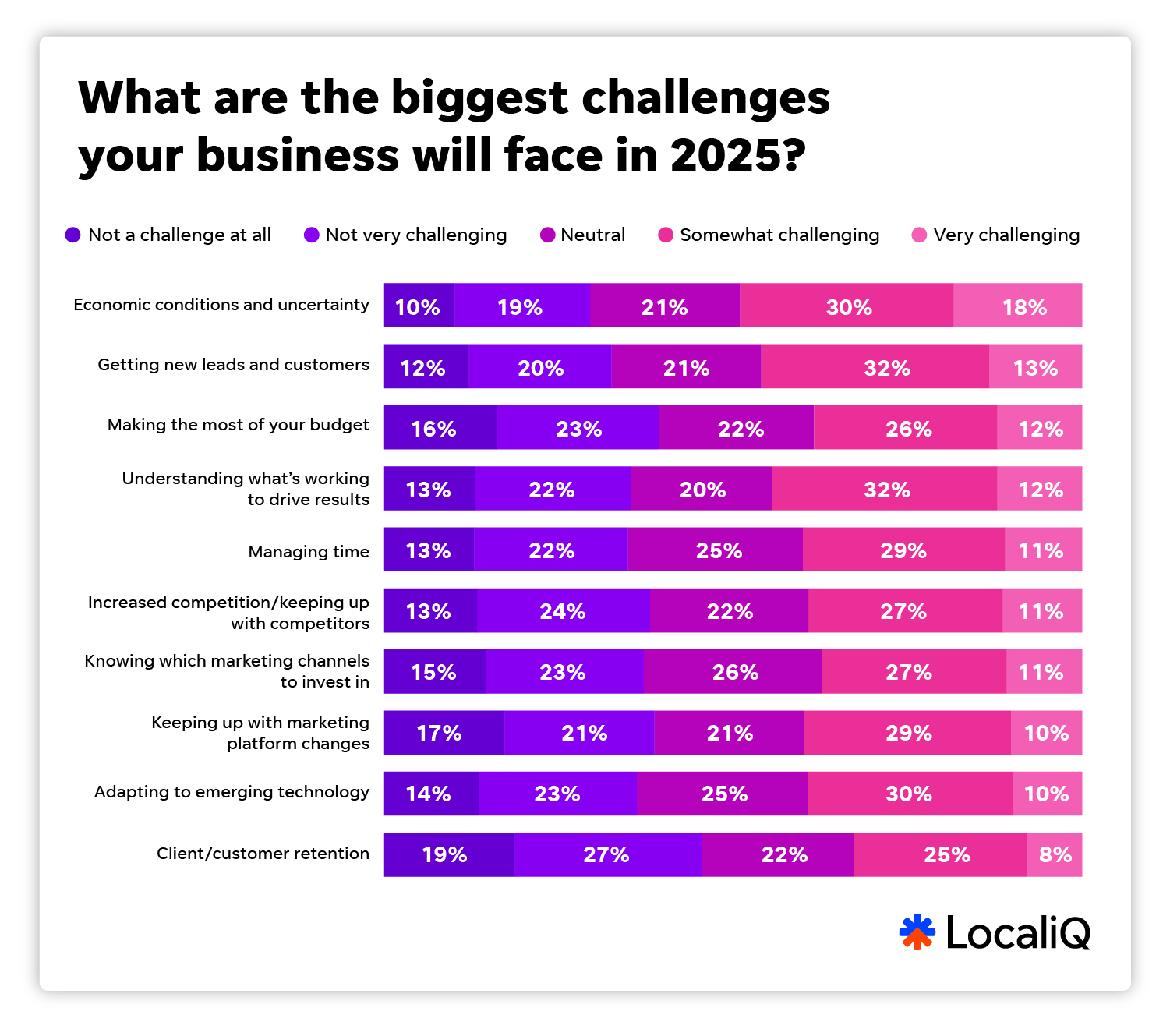
Freelance consultants and SMB owners know that in order to survive and thrive, a clear-eyed view of their economic landscape is necessary. Economic uncertainty, leadgen tactics that stimulate new customer acquisition and optimizing an (often modest) marketing budget are by necessity at top-of-mind. The ability to predict which marketing tactics can be relied on to produce the strongest return on investment is viewed as somewhat or very challenging for nearly half of survey respondents—44% are somewhat or very concerned about the capability of their chosen leadgen tactics to drive results. Adapting to new technology is a concern for 40% of respondents, who indicate they are somewhat or very concerned about keeping up. Furthermore, 45% of respondents are somewhat or very concerned about their leadgen tactics bringing in enough new customers and 48% are somewhat or very worried about economic conditions and uncertainty.

So, what are the recommendations for driving Freelancer and SMB success in 2025? There are no definitive answers and the suggestions offered below are not new and not rocket science. Your goal is to make money, but you could meet with headwinds for any number of reasons. Outcomes produced by your business strategies and tactics cannot be predicted but appropriate design, execution and performance monitoring on your part can be expected to yield at least modest success. Marketing and sales have a direct effect on customer acquisition and generating revenue, making these two closely related functions the money-making engine of a business venture and deserving of your intense focus. Just do it.

It’s helpful to monitor the performance metrics of marketing tactics and for that process, Google Analytics generates relevant and insightful data that enables you to evaluate your campaigns—at no charge. Sign up now! Along with leadgen/customer acquisition, make a point to promote customer referrals by asking your current customers if any of their colleagues or customers have the potential to become one of your customers. Also, create customer experience protocols that at every touchpoint anticipate and respond to customer needs end-to-end, from new or returning customer onboarding to after-sale training or other services. Finally, invite customer feedback by directly speaking with those who do business with you when possible. It’s good business to send out an email survey (maybe once a year), or chat with customers by way of social media; it’s important to learn what customers would like to see you do (or not do), so that you can optimize the experience of doing business with your company.

  • Be prepared to manage both the opportunities and challenges you encounter by being aware, being agile, being resourceful and being resilient.
  • Develop comprehensive marketing/sales strategies and implement with tactics you can expect to be effective. Regularly consult your website (and social media) performance metrics and make adjustments where necessary, to maximize performance.
  • Identify one or two local business associations and aim to attend one program per quarter as a way to obtain professional development and/or enhance your business acumen skills as you meet colleagues and engage in face2face networking that builds mutually beneficial relationships.
  • As soon as your budget allows hire an (outsourced) business accountant or bookkeeper to not only maintain the integrity and timeliness of your business financials and tax filings, but also to discuss and guide the potential business growth and expansion of your venture.

Thanks for reading,

Kim

Image: © kali9/ iStock

Content That Captivates

It is said that content is king—agree? I’ll bet you do. But are you aware that not all content is equally able to move viewers to respond to its verbal or visual messages? Most content does its job, which is to increase awareness of the brand within the target audience. But certain marketing content has a heightened impact on viewers; that content is perceived as uniquely relatable, credible, or even inspiring— it captivates. Captivating content has been known to persuade some who experience it to step into the buyer’s journey of the product or service it promotes. Content that captivates can motivate your prospects to actively explore the possibility of doing business with you.

Content strategy

Are you motivated to actively explore how to create content that captivates your customers and prospects? Then devise a content strategy, a plan that functions as a road map to guide the creation, delivery and management of marketing content that promotes your company’s sales and branding goals. A content strategy is the most important element of your content marketing campaigns. Without a strategy, you’re vulnerable to losing your way and becoming overwhelmed by the dizzying array of content possibilities that are available. While almost any form of content may be persuasive and also captivating, but not every format will effectively advance your sales and branding goals.

A content strategy is essential to the process of defining basic who, what, when, where and why questions that refine your understanding of marketing activities and distribution channels that your customers and prospects will gravitate toward. A well thought-out strategy will provide focus and direction to your content marketing activities and how and where you deliver your message. The questions below will help you identify content that will resonate with your target audience.

  • Who will view your content?
  • What solutions do content readers/viewers need, what goals must they achieve?
  • What types of content and which channels can be expected to attract readers/viewers?
  • What brand voice (tone and personality) can be expected to facilitate communication with your audience?
  • What goals do you want to achieve with your content?

Email marketing

Email marketing continues its reign as one of the most effective marketing tools available to transmit marketing messages and build trust in your products, services and brand. Moreover, email marketing campaigns are excellent generators of qualified leads and enable ongoing communication with customers, existing and lapsed, allowing you to nurture relationships and encourage repeat business.

Marketing emails are more likely to be read than other types of content and their average return on investment triumphs over other types of content. According to the Cambridge, MA inbound marketing giant HubSpot, email marketing communications are more likely to be read than all other types of content and have an average open rate of 46-50% and click-through rate of 2.6-3% — metrics that surpass the appeal of social media and all other forms of digital content.

Furthermore, because email marketing lists are opt-in and consist of those who want to hear from you, the email list itself is a valuable marketing tool that you can use to distribute additional communications, such as your blog or newsletter. For that reason, email list-building is an ongoing activity practiced by savvy marketers. Make a plan to grow your email list with these tactics:

  • Create a premium library: Promote your expertise and build your email list with a special offer that’s available only to those who sign up to receive a link—to a webinar or podcast you’ve participated in, a case study or e-book you’ve written, for example—sent in exchange for a name and email address.
  • Online subscriber forms: Your blog, website and social media accounts have a mechanism for visitors to add contact info and receive your published content or follow you.
  • Invite subscribers in-person: Whether you are on a sales call or, as discussed in the previous post, you attend a trade show or other in-person event, as you meet and greet you may find colleagues who would appreciate being added to your email list—subject to an opt-in, because you want their permission. If you teach or speak somewhere, make an attendee sign-up sheet available so that you can collect more contact info to grow your list.
  • Call-to-action: Invite those on your inbound marketing buyer’s journey to receive a free 30-minute consultation with you, to discuss their needs and goals and your company’s solutions. Invite those who would like to attend a workshop you’re scheduled to teach or panel you’ll moderate to RSVP by way of your CTA. When you decide to hold your own MeetUp, also discussed in the previous post, ask those who plan to attend to sign-up. All CTA responses can deliver contact info.

Webinars and podcasts

More than simply marketing content, these formats can be classified as professional development. With an engaging topic and a skilled presenter or host, these formats can generate a substantial audience. When the webinar or podcast topic relates to solutions your company offers, you can create a seamless transition into how viewers/listeners can solve their most pressing problems.

Webinars and podcasts can be even more effective when cross-promoted with other content, such as an e-book. Furthermore, webinar registrations are an excellent method of collecting email addresses and other information from qualified leads who are genuinely interested in not only the topic, but potentially your category of products or services. Webinars continue to be a popular digital content option and when promoted to the right audience, they can become far more engaging and attractive to qualified leads than a blog post covering the same topic would be.

Social media

By adding relevant, authoritative content, including videos, surveys, blogs and user-generated content such as customer reviews and testimonials to this very personalized content resource, you can effectively leverage social media to attract qualified leads.

According to a March 2024 report released by Forbes Magazine Advisor, 78% of prospects and customers research social media platforms first when seeking information about brands, a trend that demonstrates social media’s pivotal role as a leading source of brand-related content. Social media’s interactive nature allows prospective customers to get behind the scenes and learn backstories that provide an informative and intimate experience that can foster a deep connection with a brand.

Social media promotes community-building, a bonding among customer peer groups whose members participate in discussions, post product reviews and happily share their brand experiences. Social media platforms are where brands can interact with customers in real time, to foster a sense of community around their products or services with a goal of building and nurturing relationships.

Marketers join in and participate in groups and conversations, responding to comments and messages they receive and facilitating meaningful communication with their target audience. By enhancing the influence of this highly personalized format by posting content that engages and captivates, you can leverage your brand’s social media presence to deliver qualified leads.

Video

Video has emerged as a leader among content marketing formats. The power of video marketing reflects a growing customer preference for visual and auditory storytelling that gives the format great influence in capturing audience engagement. When marketing video is used in tandem with other digital marketing formats—marketing emails and social media posts, for example—their sales conversion rate is substantively enhanced. Product demos and explainer videos, case studios, testimonials and videos of your previous podcasts and webinars provide opportunities to enhance the inbound marketing power of your company website.

Video marketing has proven to be highly effective and 95% of marketers observed an increase in brand awareness when using the format. As a result, 90% of marketers credit their successful lead generation campaigns to video content and 87% link the format to sales revenue growth. The viewer engagement rate for marketing videos posted to YouTube in 2024 is 5.91%.

In particular, short-form video content is especially adept at gaining audience attention—attention spans are brief and viewers don’t always have the time or patience needed to watch longer videos. It’s been shown that marketers have 2.7 seconds to capture audience attention with your video. While engagement is valued and viewers want to learn about your company, they want to learn fast. BTW, 75% of video views occur on mobile devices, so optimizing for mobile viewing is crucial.

Within its abbreviated time frame, video content can deliver enticing visual options that captivate your audience and keep them coming back for more. You can record yourself in an explainer video or product demo discussing how your solution solves problems and supports the achievement of customer objectives. Or you may want to record customer testimonials or even record a case study, podcast or webinar—content you can upload to your website and social media accounts or invite browsers to request in exchange for contact info that builds your email list. You can also film a live event.

Live videos are in-the-moment exciting and authentic and especially well-suited for generating engagement in the viewing audience, creating relationships and building the brand. You can use the live video tool available on your social media apps to announce a new product or service or show viewers new items from your product line. Because there is little to no editing done, live videos often have a raw and edgy look; however, you’ll need a space that you can keep quiet and private as you record your live video. Furthermore, if live streaming is your intention, you’ll also need the right technology.

Now here’s a surprise—the arrival of silent videos. When you think about it, you’ll realize that many people watch videos in public spaces: waiting in line at the bank or grocery store, taking public transportation, or even while in a company meeting. Earbuds may not be handy or politically correct; it’s been reported that 92% of users watch videos with the sound off. Silent videos solve the problem so you can communicate your message without audio and make the visual component of the video the main focus. Close caption text (subtitles) allows you to make the most of the visuals and incorporate on-screen captions for necessary text info.

If your budget allows, speak with a marketing company to discuss your goals and the type of video that can be expected to deliver your desired ROI. Remember that your video can be posted to multiple platforms, from your website to email marketing communications, your newsletter, blog and social media accounts. If budget is an issue, or if you’re confident of your creativity, by all means grab your smartphone or tablet and experiment with making a video in-house. Taking an online tutorial is sure to be helpful and there are dozens to choose from. Here’s one you might like.

Thanks for reading,

Kim

Image: © The Richard Avedon Foundation. Model Stephanie Seymour wears Chanel in a 1990 photo by Richard Avedon (1923-2004)

Managing Your Digital Image

Because the internet plays such a dominant role in life, it’s crucial that you take steps to ensure what’s posted about you is both accurate and positive. Information that appears online and is associated with you—your published content and information that identifies you—is collectively known as your digital identity. This information functions as a virtual introduction to you and tells your online story. Your digital identity is the foundation of your digital image and intended to be an asset. Because what appears online is basically immortal, it’s imperative that your digital image, defined by the published content and other information attached to you and your business entity, is presented in a flattering, trust and confidence-building manner.

It is assumed that prospective clients or employers will search your name and business online before making any meaningful contact to discuss your products or services, so it makes sense to periodically monitor and curate your digital identity to ensure that information is current and represents you well. Your primary objective when editing your info is to corroborate your digital narrative and the talking points you commonly share when meeting with prospective clients or employers. The core function of your digital image and the narrative it communicates is to confirm your credibility and build trust.

According to “Assessing Web3’s Building Blocks,” an article recently published by financial services giant J.P. Morgan that explores digital identity, four factors contribute to the digital identity (listed below). It is incumbent upon you to proactively examine the information included in your digital identity so that your online image and narrative will support your professional experience, education, achievements and, by extension, your personal and business brand.

In addition to ensuring that information is accurate, decide how you want prospects to see you. Remove text and images that don’t reflect your goals or brand. If a friend has posted a not-so-flattering image on a social media site and tagged you, ask him/her to kindly delete it.

  1. Identifiers: Your name, email, addresses and social media handles.
  2. Identity Attributes: Information about you, including educational degrees and employment history.
  3. Reputation: Your online persona, contributions, affiliations and followings.
  4. Digital Collectibles & Assets: Anything you own in digital form, commonly non-fungible tokens.

Always professional

Be mindful to consistently adhere to professional standards whenever communicating electronically, ever aware that text and images posted can remain forever, whether intended for public consumption or personal texts and emails. Be vigilant and safeguard your reputation; avoid committing to writing your uncensored thoughts about potentially sensitive political or religious topics. It may, as well, be wise to avoid expressing your positions on current events. You don’t want to worry about being compromised by a leak and ending up being canceled and in need of expensive and rarely completely effective crisis or reputation management services.

Social media listening and digital presence

It’s important to know what appears in an online search of yourself and it’s a smart idea to periodically consult the major search engines—Google, Bing, AOL, Yahoo and also Yelp, Yellow Pages, or other industry-specific ranking sites that would apply to your entity—and search your name and your business entity to examine the results and assess the quality and reach of your digital presence. To avoid or correct misinformation, take control by claiming and updating an existing listing and, if you like, create a listing for your entity if none appears. Furthermore, make it a practice to regularly conduct a social media audit on yourself, so you can remove problematic content before prospects and competitors see it.

You may also be well-served by investing in a social media listening campaign, a marketing strategy that refers to researching whether positive or negative conversations regarding you, your entity, products and/or services currently appear in social media and other online platforms. Social media listening monitors online channels to detect mentions of your brand, competitive brands and related keywords.

The use of (paid) social media listening tools enables you to gain an accurate understanding of how customers and prospects feel about your products, services and company by discovering what they say on social media channels. Through social listening, you can track all mentions of your brand on social media in real-time and get not only valuable insights into how customers feel about your products or services, but also verify what their pain points are and learn what they’d like to see from you in the future. Social media listening is also an excellent source of competitive intel, as it can monitor competitive brands, trending content and sentiment analysis on topics related to your industry to obtain a comprehensive understanding of what customers and prospects think about your competition.

Social media listening has become a major marketing strategy at national and global brands. It was originally thought that marketers at smaller businesses would not benefit from the practice, mostly because the cost wouldn’t justify the ROI. Yet over the past few years, social media listening is now considered essential and an increasing number of mid-size and small business owners and marketers recognize its value. The biggest motivators are likely greater affordability offered by marketing companies and the explosive growth of online customer engagement fueled by the pandemic shutdown. social media listening data can be used to inform everything from marketing and product strategy to customer service and support, helping you make smarter, data-driven decisions that will have a positive impact on your business’s bottom line. To learn more about social media listening services click: https://www.webfx.com/blog/social-media/social-listening-tools/#:~:text=7%20best%20social%20listening%20tools%20in%202024%201,5.%20Mention%206%206.%20BuzzSumo%207%207.%20Keyhole.

Thanks for reading,

Kim

Image: ©The Bettman Archive. Gloria Swanson (center) as Norma Desmond in Sunset Boulevard (1950). Co-written and directed by Billy Wilder, the film received three Academy Awards, including Best Screenplay/Story.

10 Tips to Energize Email Marketing

Email marketing remains an effective and valuable practice that deserves a place in the marketing strategy of Freelancers and other small business owners. If you haven’t explored email marketing as a way to promote your venture, read on and learn why you will reap benefits from developing email marketing campaigns and how to maximize their success.

Data supplied by Statista, the Germany-based marketing info giant, reports that an estimated 4.3+ billion citizens of planet Earth use email. Maybe that’s why email marketing continues to be central to our business and personal lives? Email marketing campaigns will help you to promote your products and services, acquire new customers or retain current customers, increase your venture’s annual revenue and position yourself as a thought leader and expert in your field.

Email marketing remains one of the most effective forms of outbound marketing, whether you send email appeals and announcements to prospects and current customers or publish a company blog or newsletter. According to data from the e-commerce company Oberlo, 81% of small business owners use email marketing as their primary method of customer acquisition and 80% use email marketing outreach to support customer retention. Marketing researchers have calculated that email marketing campaigns generate an average ROI of $43 for every $1.00 spent. In 2022, B2B and B2C email marketing campaigns combined generated $9.62B in sales revenues.

  1. Update your list. Review your address list each month and follow-up on all emails that “bounce,” that is, are returned. Verify and update the address or delete the name.
  2. Personalize greeting. Your readers likely have little use for a emails that are addressed to no one in particular and reek of spam. Impersonal mailings are not endearing and are usually deleted. Your email marketing distribution service has the capability to personally address the communications you send.
  3. Opt-in, opt-out, sign-up. To grow your database, make it easy for those who’d like to follow you and/or subscribe to your emails by making your sign-up/ opt-in link visible. On the other hand, those who’d rather not receive your mailings should be able to easily decline them. The unsubscribe/ opt-out link is usually placed at the end of the email.
  4. Customize templates. Represent and promote the value of your brand by having a custom template designed for your marketing communications. The cost is modest and will give your campaigns a professional look that is immediately recognizable to your audience. Choose a template design that is uncluttered and visually cohesive. Also, since more than half of the audience will view your emails on a mobile device, confirm that your marketing service uses responsive design.
  5. Relevant content. Know the topics that will interest your readers. Stay current in your knowledge of national and local developments by regularly reading nationally focused business publications and the business section of your local newspaper. Furthermore, it’s helpful to create a marketing calendar, because some topics are seasonal and your information should be timely so that it will be useful. In other words, if your email will discuss taxes, keep in mind the filing dates for quarterly and annual taxes. As well, keep in mind the Pareto principle, best known as the 80/20 rule, to keep audience engagement high. Make about 80% of your content educational and no more than 20% self-promotional. In time, your audience will come to trust you as a source of helpful information, which will keep them opening your emails. Your emails are about the reading audience and not about you.
  6. Tempting subject line. Give readers an incentive to open your emails by creating subject lines that command attention. The subject line is the most important element of a marketing email. If it’s not compelling, your email will be swiftly deleted. A good subject line often arouses curiosity or surprise. It may even shock recipients, or make them laugh. A well-crafted subject line makes recipients want to go further and find out what you have to say.
  7. Interactive extras. Every so often, give readers something unexpected and interesting to see or do as they skim through your content. Devise a one or two question survey to let them tell you how they feel about an issue. Not only will you get to know them better, they’ll appreciate that you value their opinions. A 60-90 second audio and/ or video clip that showcases something they’ll find useful is another good tactic. Including an image that ties into the message and purpose of the email is yet another good idea. Limiting extras to a maximum of two is suggested, to avoid clutter or sensory overload.
  8. Social media teasers. Before emails are sent, post a line or two of content on social media as a way to cross promote and expand the audience for your mailings. Let social media visitors know that the content is exclusive to your email list and use this incentive to increase sign-ups.
  9. One irresistible call-to-action. The purpose of your emails is to convince readers to do something—-hire you, watch your webinar, read your case study, come out to meet you and hear you speak. If email recipients don’t know what you want them to do within 20 seconds of opening your email, whether that’s visiting a page, calling a phone number, or completing a form, they will most likely click and delete.
  10. Consistent schedule. Whether you send a newsletter, blog post, or marketing letters once a quarter, once a month, or once a week—-every Tuesday at 11:00 AM Eastern or the 15th of every month—-be consistent. Predictability breeds trust.

FYI, as of March 5, 2023, data supplied by the email marketing company Constant Contact reported on email open rates in various industries and a sampling is below. As of January 2023, the combined B2B and B2C sales conversion rate of email marketing campaigns was 8.17%.

  • Administrative support—billing, phone answering—29.1%
  • Business consulting—marketing, advertising, management–28.3%
  • Financial services—accounting, bookkeeping, insurance–27.1%
  • Technology services–19.3%
  • Health & wellness–home care, nutrition, dental, medical–35.3%
  • Cleaning, contractors, landscaping–38.6%

Thanks for reading,

Kim

Image: Invented by Edward E. Kleinschmidt in 1914, the high speed teletype machine allowed users to both send and receive typed messages and was a major breakthrough in telecommunications technology. The picture shows teletype machines being used in England during WWII.

Marketing Automation—Give It A Try

Can you afford to invest $50 or so each month in marketing for your business? Can you afford not to? Marketing is a hugely important business function—how else can your future customers know what you do and know where to find you? You may struggle to keep up with your marketing aspirations—it’s a common problem. Small businesses owners and Freelancers are often too busy to fully implement the marketing campaigns that they devise. Today, let’s talk about how marketing automation can create a great leap forward for your LeadGen strategy and deliver a nice increase to your sales revenue.

The most successful marketers know that automating routine marketing functions will enhance your ability to provide the most effective marketing campaign outreach and as well the best possible buyer’s journey experience for prospective customers. When marketing automation software is in place, all prospect requests for information about your products or services will receive timely follow-up. You, your team and your company will look good as a result —professional, responsive, trustworthy and reliable, all brand enhancing qualities.

As you know, marketing automation is the process of using technology and software to automate your company’s marketing activities across all of your digital channels—website and social media platforms. By using automation, you can target prospective customers easily and efficiently and launch special outreach campaigns by using automated email messaging that is peronalized to reflect the customer’s buying history or interest. BTW, according to a recent survey, 80% of prospects reported that they were more likely to do business with companies that offer a personalized buyer’s journey experience. Data from consulting giant McKinsey revealed that personalized emails sent to prospects can reduce customer acquisition costs by as much as 50 % and increase sales revenues by 5–15 %.

Consider trying these four digital marketing automation strategies. Doing so can potentially free up 10 hours/week of your valuable time and allow you to focus on other aspects of your business. Marketing automation service packages and pricing vary widely, but a basic plan offered by most companies is unlikely to take a big bite from an inflation impacted budget. Plugs, there is reason to be optimistic about adding to top line sales revenue. Spend a little money, make more back.

Build targeted email campaign lists

Despite the obituaries that have been written over the years, email marketing has shown us all that like a cat, it has nine lives. Email marketing automation is very useful for LeadGen, helping to generate sales from prospects in your sales funnel. Marketing is all about providing the right information at the right time in the buyer’s journey. Automating email outreach enables you to send that correct message to the right person at the right time and simultaneously save time and increase efficiency as you communicate with prospects.

Nurture warm leads

Encourage the process of converting prospects into clients by personalization—from correct names to accurate buying history data — and enhance prospect engagement. Help yourself and your team to respond quickly to contact forms that prospects submit when they’d like to schedule a call or meeting with you or someone from your team. Follow-up fast on calls-to-action from prospects who’d like to receive your newsletters or attend a talk that you’ll give. Marketing automation will guarantee that you’ll avoid the embarrassing occurrence of leads that get lost in the shuffle and drop off your radar screen.

Your goal is to move prospective customers through the buyer’s journey, AKA the sales funnel, to become a paying customer, Your marketing automation system can monitor consumer activity and assist you in determining where in the sales funnel your prospects are. You can select the info that your leads will receive and the frequency of emailing at each step of the buyer’s journey to help you execute an effective lead-generating strategy.

Automate social media posting

At the beginning of each month, help yourself and create a calendar by planning 30 days worth of social media content ideas. For example, every week, vary your content by type (i.e., educational, entertaining, inspiring, tips and tricks, behind-the-scenes, etc.). This will help keep your social media audiences engaged and interested in your posts while making it easier for you and your team to create the content.

Furthermore, when filming videos or taking photos for social media accounts, aim to capture a variety of content that can be reused and repurposed for various posts. This will cut down on the content creation time, as you’ll utilize one shoot for multiple pieces of content.

Analyze campaign performance

Measuring the success (or not-so-much) of marketing campaigns is often guess work. Especially for Freelancers, following the rate of client acquisition, that is, the bottom line represented by the clients you bring in or bring back, is what many of you do. More ambitious types, or those responsible for marketing in larger organizations, most likely work with spreadsheets to monitor the performance of marketing initiatives. I’ve done it before and I find spreadsheets to be very time-consuming. Plus, not everyone on the team who should regularly post updates will do that without prompting fom the team leader, which takes time.

The beauty of marketing automation is that when you program the software to perform certain functions, the results will always be accurately reported. Once you’ve categorized your leads and customers according to where they are in the buyer’s journey, you can email targeted content that’s specific to each lead, increasing your marketing and sales effectiveness. Next, the lead tracking function will automatically update the system if that lead becomes a customer or makes an important action that might signal a movement toward becoming a customer, such as downloading a price sheet or requesting a copy of a case study.

Once you customize your system, all you’ll have to do is log in, view the results and evaluate what the information tells you. Appropriate follow-up and other trust-building actions can take place every time. Potential customers do not get lost in the shuffle. You make more money!

See the best marketing automation options for 2023 here: https://www.g2.com/categories/marketing-automation

Thanks for reading,

Kim

Image: © Walter Nurnberg/Getty Images. 1960s computer technology

Get Multi-Channel Marketing Right

Much has been written in recent years to extol the virtues of multi-channel marketing. Business owners and marketing department leaders are urged to create a consistent, unified message/ story for their company and its products and services and blast that message to a broad range of media outlets and platforms, the better to reach as many target customers and prospects as possible.

That’s excellent advice as I see it, but there’s more for marketers to consider. The noise level in the 21st century marketplace is so overwhelming and calls for clearly defined strategy and execution plans if you expect to achieve the ROI you want. A one-size-fits-all mindset isn’t going to work.

Because storytelling and messaging are the heart and soul of marketing, a more precise and effective method of using multi-channel marketing is needed to fully realize your marketing objectives when communicating with various audiences through multiple marketing channels. To get the most out of your marketing campaigns, define the purpose of the message/ story you’re putting out to your niche audiences and understand the reach of every outlet and platform you intend to use.

For example, recognize that the purpose, message and platforms that are most suitable for PR/ brand promotion will differ somewhat from the promotional strategy you’ll follow when the objective is to drive sales, announce that you’ll speak at the Rotary Club next month, or grow your blog audience. Read on to get useful ideas on how you might approach some typical marketing agendas.

The objective is PR/branding

So you’re trying to persuade a media outlet to mention you in an article? Start by reading few issues or posts, so you’ll get a feel for the topics covered and know who writes articles about your subject of interest. Next, call and email the business editor and pitch your proposed story. Articles must have a story theme that could be of interest to readers. Popular themes, I’ve noticed, are wellness initiatives, participation in a community event that’s sponsored by a popular local charity and green/ environmentally supportive business practices.

Your objective to receive earned media exposure is to build your brand through name recognition and enhance your company reputation by publicizing the good work that you do. I’m sure you understand that singing the praises of your products and services would be the wrong message for this agenda and requires a different emphasis for your marketing message/ story.

The objective is selling

When selling is your focus, the marketing message/ story will speak to decision-makers and key stakeholders, including end-users. Addressing the most common and dramatic pain points for the use of your product or service and emphasizing the most desirable outcomes is a must.

Marketing messages expressed by way of content marketing such as case studies, a workshop you’ve presented, an article you’ve written, or a webinar or podcast in which you appeared can build trust and confidence by letting you showcase your know- how.

The marketing message/ story will paint a picture that helps prospective customers envision how the features and benefits of your product or service can efficiently address their purpose for using what you sell. Testimonials and on- line reviews also speak convincingly to decision-makers in this instance.

The objective is repeat business and referrals

Customer retention and referrals can be enhanced and encouraged when customers feel valued and part of something bigger than themselves—-a community. Social media is tailor- made for this aspect of your multi-channel marketing strategy.

If your customers skew younger, Tik Tok and SnapChat are ideal platforms for posting videos that make a memorable point in just 60 seconds—- a one minute movie! Twitter is great for posting updates, the platform you use to remind your audience that tomorrow at 4:00 PM they should tune in to your webinar or podcast. Facebook and Instagram are great places to tell stories with photos and longer videos. That’s where you give brand fans a behind-the-scenes look at you and your team and let people get to know you a bit.

Your customer retention and referral marketing message/ story will be subtly different from the PR and selling scenarios. Brand enhancement will incorporate your values and social responsibility but will also subtly reinforce the results achieved with your (first-rate and reliable) product or service, after- sale support and customer service, The story presented will be a feel-good, but you’ll want to embed a purpose and a gentle call-to-action. Come back to see us again and tell your friends!

Thanks for reading,

Kim

Image: An auctioneer in action at Sotheby’s in New York City.

Eyes On the Competition

As was noted in three or four recent posts, business data and other forms of business information, which may consist of the observations and predictions of researchers, journalists and other experts, have always been an essential resource for business owners and leaders. As we move through the 21st century, data-driven decision-making, enabled by powerful software programs and artificial intelligence, has become the hallmark of responsible business management.

Chief among the market research that every successful business owner or leader must do is assess the competitive landscape in his/her marketplace. Questions you’ll want to find answers to include:

  • Who sells products and services similar to your own?
  • Who are their customers?
  • What is the estimated size of their market?
  • Who dominates, how and why?
  • How do the marketplace leaders attract and retain customers?
  • What is their price range?
  • How successful are they?
  • Can you launch your venture alongside these competitors and achieve sustainable success?

Mapping your competitive landscape also includes identifying direct competitors, meaning companies whose services and products closely resemble your own and indirect competitors, that is, those whose products and services present an alternative choice within a similar price range that can be sold as a potentially satisfactory solution. Understanding the difference between direct and indirect competitors can be simplified by comparing the process to shopping for a Valentine’s Day gift.

The chocolate shops are all direct competitors, with price as a potential differentiator, because chocolates are more or less interchangeable. The same can be said for florists. But chocolate shops and florists are as well one another’s indirect competitors within a similar price range because for $50.00, you can buy either a nice bouquet or a nice box of chocolates.

Start your investigation with a key word search using terms commonly chosen to describe your company’s products and/ or services to see who appears and how they rank. Whoever makes it into the top 10 are the most successful of your competitors. You can also check out member lists at the business and professional groups you’ve joined (yet another reason why business associations are a good investment). Visit the websites of the top 4 or 5 competitors in your search, along with their social media pages and Yelp reviews.

Make note of speaking engagements made by the principals—-host organization and topic, along with company participation in local charity events and business awards and nominations received. If successful competitors have done any of those things, don’t be ashamed to follow with a me, too.

Popular products and services

Knowing what sort of products and services are best-sellers for your top competitors is tremendously useful intel and will enable you to make smarter decisions about building your solutions and making your prospect’s hot buttons blink.

So try to figure out what competitors sell the most, what sells the least for them and what’s somewhere in the middle. Keep the best sellers in mind as you design your services, perhaps adding a differentiating something extra to create more value in a way that’s affordable for you, or that you can sell at a premium.

Finally, watch for what gets revised and what gets dropped. Notice how products and services are described and positioned and, if possible, priced. Learn from competitors’ mistakes.

Leadgen strategies

Absolutely, spend time analyzing the website landing pages and social media accounts of your major competitors. You want to know how they keep their pipelines filled and how they persuade prospects to remain on the buyer’s journey. What informational goodies and special offers have they sprinkled into their TOFU, MOFU and BOFU ( top, middle and bottom of the funnel)?

You may find the inevitable free-for-the-price-of-your-email-address e-book or highlights of a keynote speech delivered at a popular conference. You’re looking for inspired, desirable content choices that you hadn’t thought of, so you can offer something similar as a way to engage prospects and stimulate lead creation.

Blog and newsletter content

Pay attention to topics that are most often covered and those that are infrequently discussed. Notice also if certain topics are spotlighted during particular months. Observe which types of posts are often shared on social media and note which platforms are most often used (and which ones used the least). Your objective is to help yourself plan a content marketing strategy that features topics of interest to prospective readers and simultaneously support the premise that you are a reliable source of good information and a capable professional.

If you’re feeling more curious, use a traffic analysis tool to search for the blog-related URLs in the Top Pages list. Analyze their unique page views and visits, conversions, traffic sources ⁠— make note of all the data that’s presented. Publishing a respected blog or newsletter could become an integral building block of your success. .

Selling points

What objectives emerge as the core purpose, the main problem-solving motivation, that your competitors speak to when communicating to prospects—on their website and social media platforms, in case studies, and testimonials and in their newsletters and blog posts? What do they aim to help their customers achieve when making the case to do business with them? What descriptive language is used? Also, what benefits do they emphasize to persuade prospects to reach out to them?

Moreover, what competencies do your competitors trumpet as a valuable resource that their clients prize and prospects desire? Is it a specialized academic degree, skills certifications, prior work experience and/ or prestigious client list?

Call-to-Action

What you want to know is how competitors sell their CTA. “Buy now” and “click here” are phrases you can think up on your own. The purpose of this research is to see examples of (presumably effective) CTA pitches, both the give-away info and what is said to create an appetite for it. The information offered should be something that prospects are likely to find useful, or somehow interesting and for some items they’ll be willing to surrender their email address to obtain it.

A free 30-minute phone conversation with you or a team member that will allow serious prospects to get insight and answers about how your products and services might help them achieve a goal or solve a problem should make a tempting offer. Click the link to learn more about effective CTAs (gotcha!):

https://freelancetheconsultantsdiary.wordpress.com/2021/04/06/a-call-to-action/

Thanks for reading,

Kim

Image: Krystle (L, Linda Evans) and Alexis (Joan Collins) were eternal rivals and fierce competitors on the prime time soap opera Dynasty (ABC-TV 1981-1989)

Online Reputation Management and Your Brand

A business owner’s work is never done, it seems. Along with recruiting customers in an increasingly challenging business climate, fulfilling customer expectations, providing excellent customer experiences and instituting procedures that ensure pleasant and efficient after sale support when needed there is, as well, the responsibility to monitor and manage the online reputation of your brand, your business and you. Creating, enhancing and perhaps also defending the online reputation of your brand must be an ongoing component of your company’s PR and SEO marketing strategies.

Developing and nurturing an appealing and trustworthy brand for your enterprise has always been the cornerstone of comprehensive and effective marketing campaigns and strategies. The pandemic-induced acceleration of numerous online communication formats has compelled business owners and leaders to amplify the online presence of their brands in order to effectively compete.

As a result, it is more necessary than ever to carefully curate, align and script all marketing themes and messages used to promote your brands along with the associated image, audio or video content posted to an array of platforms. Business owners and leaders would be wise to actively shape and manage the online image and reputation of their brands to continually reinforce brand narratives and positive perceptions.

Online Reputation Management is now an ever more critical branding function, essential as you develop marketing and branding strategies that build name recognition with the power to attract customers. A trusted brand is a valuable resource and can create for your business a loyal troop of boots-on-the-ground influencers who are motivated to write positive reviews in online rating sites and dispense word-of-mouth endorsements that can make or brake your business. From the online content that communicates relatable brand stories that build trust and loyalty within your target market to search-friendly platforms and key words that promote your brand’s online visibility, you can create an electronic architecture that supports and sustains an appealing and confidence-inspiring brand.

To help your business overcome the multi-year impact of the coronavirus pandemic, do what you can to allocate resources to create and implement a robust Online Reputation Management strategy. For best results, assess the efficacy of your online branding strategies by employing the tactic of social listening.

The act of monitoring social media and other online platforms helps track mentions and notifications about your brands and facilitates quick responses to customer compliments or complaints, which are the building blocks of an effective engagement strategy. Social listening means discovering patterns and connecting the dots in the comments or questions heard in monitoring. Social listening reveals to you the big picture—not just the trees, but the forest—and encourages you to analyze the context and larger trends that surround those (online) conversations, so that you might discover opportunities to act that enable you to better speak to and serve your market.

The customer data and marketing platform Clutch.com recently reported the following:

  • 54% of digital marketers consider Online Reputation management necessary for the success of their company
  • Brands frequently utilize social listening, following the social media outlets favored by their customers, to gain insights into what is trending or waning in customer preferences and priorities
  • The primary benefit that companies gain from investing in Online Reputation management is growth in sales
  • 35% of businesses queried plan to allot more time and money to Online Reputation management

Thanks for reading,

Kim

Image: Fredric March as Dr. Henry Jekyll in Dr. Jekyll and Mr. Hyde (1931) directed by Rouben Mamoulian

Self-Promotion that’s Savvy, Not Shameless

If you do not put the word out about your talents, achievements and (perhaps discreetly) your ambitions, or if you do so ineptly, you are leaving money (and also a satisfying life, I think) on the table. Despite what some people would have you believe, no one finds success on their own. The self-made man is a myth. You are going to need some help along the way and to rally influential people to your side, you must let them know what you can do.

Bill Gates’ mother held a job at IBM that gave her access to a powerful person in the company, who agreed to meet with her son and his friend Paul Allen so that the two could explain the special project they were working on. As we know, their project eventually became Microsoft.

How to deliver your self-promotion

Effective self-promotion is a subtle and powerful communication skill. I consider it an art. It can be learned. Maybe we should start with what to avoid?

It’s frightfully easy to come off as obnoxious when telling others about how fabulous you are and the riveting details of your long list of magnificent, truly enviable, accomplishments. Most of us know that outright bragging is not cool, but we have also heard more than enough hyper-ambitious people pretending to be modest as they trot out a humble brag act at every opportunity.

Witnessing either spectacle usually induces an eye roll, if not a headache. But how can you show finesse and talk yourself up in a way that doesn’t turn off friends and colleagues?

A good Karma method is to be generous and share credit for your successes with those who helped you achieve them. There is a huge benefit associated with this generous act—- you gain allies. Your allies, because you’ve made it clear that you value them and their work, will be inclined to do you the enormous favor of promoting your magnificent achievements for you, which gives you much more credibility and influence than if you say it all yourself. So as you climb the ladder, not only will your allies help you, they’ll recruit more allies for the cause.

When to self-promote

Choose the politically correct time to self-promote. There are situations when one is expected to do so, but be aware that there are only so many opportunities available. Employees are invited to discuss their accomplishments at their annual performance review, when campaigning for a raise, or when seeking to interview for a promotion. Freelance consultants, when speaking with prospective clients or writing proposals with the aim of winning projects, are expected to spell out and sell their competencies, relevant experience and achievements.

What to promote

Make it known that you’ve earned a new educational degree or professional certification, the date, time and place of an important presentation you’ll deliver, or should you be invited to join a prestigious board.

Other self-promoting without penalty opps include announcing your appearance on a podcast, webinar, or panel. Announcing that you’ve written and published, or edited, a book is also a self-promoting bow you’re expected to take. Launching a workshop (that you must sell!) is another self-promotion gateway.

Where to self-promote

Especially since face2face events remain limited, savvy people know that social media is an acceptable self-promotion tool. Update your profiles as you upgrade your skills and announce your showcase events as appropriate.

Again, bring in some good Karma and acknowledge the achievements of your connections and contacts as they appear in your feed, so that your communication is not all outbound. Self-promotion, no matter how skillfully delivered, still requires good relationships in order to capitalize on your good work.

Thanks for reading,

Kim

Image: Steve Martin in The Jerk (1979) directed by Carl Reiner and written by Steve Martin