Adopt an Adaptability Attitude

In a business environment experiencing constant turbulence—from both the advantages and downsides associated with the growing use of Artificial Intelligence powered software tools, to political struggles both domestic and international, to marketplace volatility—adaptability has become a prized leadership attribute. Leaders who can exhibit agility, resilience and foresight when yet another upheaval approaches, showing they can lead, and will not be derailed, by the slings and arrows of instability and uncertainty, stand out among their peers and competitors. Adaptability and its pillars—agility, forethought and resilience— have become the foundation for business transformation, innovation and leadership.

Do you consider yourself able to own the fundamentals of adaptability when the ground beneath your feet starts quaking and you’re wondering what your next move should be? Are you are able to steer the ship when big waves are crashing and causing your Freelance entity to rock and roll? Are you able to decipher when you should stay the course and when a pivot seems the better option? The practical definition of adaptability in a business sense may need some clarification. According to Marlo Lyons, an executive, team and career coach who hosts the Work Unscripted podcast, recommends that leaders prepare for 2026 and beyond should:

1) Model change-ready leadership. Among the many disruptive events that have occurred since the mid-20th century, unexpected shifts in national and global business conditions or new technology may appear and gain traction—like mobile phones (Nokia) and music (Walkman)—that impact the way we live and work. The adaptable leader will display behavior that transforms panic into calm as s/he interprets change and unpredictability as manageable challenges rather than a business threat. The adaptable leader shifts into crisis management mode and is prepared to make sound, data-driven decisions that support responsive strategy development while sharing information and rallying team spirit to maintain trust and productivity. Lyons guides her coaching and leadership development clients to “look through the lenses of growth, transformation and risk and align with that perspective and show that you’re thinking like a leader, shift your language from protecting the past to shaping the future.” She points out that responses such as “This is how we’ve always done it” demonstrate a lack of adaptability; it’s a weak excuse and should be avoided by those who aspire to function as an adaptable, effective leader. Try some version of these inquiries—“What might we gain if we reimagine this?” or “What would this look like if we started from scratch today?” Leadership is demonstrated by asking questions that encourage resourcefulness, creativity, strategic thinking, future-proofing and adaptability.

2) Take data-driven risks, be accountable for outcomes.  The adaptable leader possess the emotional intelligence to balance risk-taking, accountability and empathy when the team is struggling from change fatigue and maybe fear as well. Demonstrating empathy means helping people process the discomfort of change and the unknown while maintaining momentum and keeping both hands on the wheel. A leader who doesn’t attempt to gaslight the team and models transparency by acknowledging that change is often unsettling but reassures team members that s/he is there to help everyone maintain equilibrium while traveling through the unknown, able to meet important deadlines and deliver on mission-critical projects—is the prototype of an adaptable leader. Adaptable leaders create psychological safety and encourage performance consistency. The mission of an adaptable leader is to support your people through uncertainty while continuing to hold them to expectations—high-quality work and timely delivery. Empathy keeps stakeholders and team members engaged and accountability keeps everyone moving forward. Leaders who can demonstrate both will earn trust, model EQ and show the team, clients and competitors that you operate as an adaptable leader.

3) Listen, learn and grow. With the rise of AI, leadgen automation and the powerful algorithms of quantum computing, especially when paired with AI, continuous learning in the form of professional development, self-directed and expert-led, is no longer optional. Leaders aspiring to maintain their skill set understand how emerging technologies will impact their teams and the overall organization.

Adaptability and learning agility have become the foundation for business transformation, innovation, and leadership—in a word, excellence. Strengthening and consistently demonstrating your adaptability is an ongoing professional development seminar—and a required course for those who’d like to function as successful leaders in 2026 and beyond. Lyons says that adaptability is linked to the following:

  • Agility

Agility is the ability to not only pivot quickly when priorities shift, but to also bring others along with you—like your team and other stakeholders. It is not always necessary to blindly agree with every suggestion made by superiors or key stakeholders. Agile thinking is a core component of being forward-thinking and viewing change as an opportunity for innovation.

  • Resilience

Resilience means that you’re able to maintain your composure under pressure. Resilience is a characteristic that supports objective thinking, creativity and your personal best performance—while you’re in the midst of an unexpected turbulent event. Leaders who find a calm focus are prepared to manage the situation, starting with the ability to direct their composure to creating psychological safety for those on their team. Subduing fear and panic, as you know, brings both short and long-term benefits, most notably the ability to contribute and work at their personal best along with you, and thus enhancing productivity and loyalty to both you individually and the company. It will pay to be transparent and acknowledge, rather than attempt to deny, the difficulty of the market and the company’s financial challenges and directed team members to focus on whatever it is they can control. A leader’s continuing steadiness will provide clarity and consistency that allowed their team to keep delivering results amid constant disruption.

  • Foresight

Foresight separates reactive, seat-of-the-pants managers from visionary leaders. A prime differentiator between the two is the willingness to recognize that looking beyond whatever performance metrics are observed in the present to anticipate what tomorrow’s challenges could be. More than staying on top of current company performance and studying market data, as well as paying attention to what key competitors are up to—are there any noticeable pivots?—detecting and studying early signs of instability, or significant change, is how to avoid being blindsided. You always want to be positioned to assess potential remedies (or opportunity) and develop the right strategy in response.

But foresight that pertains to market shifts is just part of the equation. Leaders also need to have foresight in technologies innovation and understand the benefits and outcomes that explain the why and wherefor of leveraging them. Leaders who continuously research and map future capability needs, and upskill their teams to understand how and when to use emerging technologies, will demonstrate the strategic foresight and enterprise readiness that illustrate adaptable leadership.

Thanks for reading,

Kim

Image: © Spencer Platt/Getty Images. Midtown Manhattan July 29, 2025.

Rev Up Resilience To Ramp Up Productivity and Reduce Stress

Is it my imagination, or has life become increasingly stressful year after year? In my experience, it feels as if navigating normal life (is there still such a thing?) and being productive in one’s occupation requires more effort than was necessary just a few years ago. The bar for success seems higher and the level of productivity (and luck, I might add) required to win the race is consequently higher.

Productivity is a multi-faceted function and we’ve examined how to maximize its application from technology, marketing and sales perspectives. Today, we’ll examine the impact of health on productivity and get ideas on how to do what must be done without damaging one’s physical or psychological well-being.

BTW, the American Psychological Association agrees with my observations. According to its 2023 Work in America survey, 77% of U.S. workers experienced job-related stress during the previous month and 57% reported negative outcomes as a result, including emotional exhaustion and lack of motivation that undermined their ability to do their best work. Stress and its usual byproducts, burnout and anxiety are also linked to the often-celebrated hustle culture, whose supporters brag about their marathon workdays and insist that the sacrifice is the price of admission for attaining a thriving business or career.

In the beginning hustle culture can be helpful and that pedal-to-the-metal work ethic will propel you toward your goal. But in the long-term, being a workaholic (that’s the old-school term) can cost you your health—and it might even undo the success you’ve attained. Lengthy periods of intense stress carry significant downsides, physical and psychological, including loss of energy, concentration and creativity—the building blocks of productivity that hustle culture is supposed to enhance. When you’re constantly in overdrive, the brain’s capacity to focus, exercise good judgment and perform other “executive” functions deteriorates. Related cognitive assets, notably decision-making, problem-solving and strategic thinking, can also weaken. The inevitable outcome is that productivity craters.

So how can you improve your capacity to be productive and enhance your executive cognitive functions along the way? It may sound counterintuitive to some, but when you’re not just determined, but also realistic, about achieving important goals, the first step is to step away from the hustle culture fad.

You may be convinced that hard work is the partner of ambition and to a great extent that is true, but pushing yourself to exhaustion is almost guaranteed to result in an assault on your physical and psychological well-being. Instead, you will be wise to regularly nurture and replenish your energy stores to cultivate resilience, minimize stress and bring about strength, focus and calm control. Reserve those hustle culture 12+ hour workdays for extreme circumstances, such as responding to an emergency or meeting an important deadline. Prioritizing your health can be treated as a strategic imperative—is it not your greatest resource when all is said and done?

Organize and prioritize

Managing time is central to facilitating productivity. Strategic time management minimizes stress because it gives you a road map for your day and the road map enables a sense of calm control that makes productivity flow. When you have too much on your plate and you’re putting out fires and everything is an emergency, the secret to navigating the chaos is to create a road map that prioritizes your tasks from the top down—most important to least important. If you’re unsure about which tasks are most urgent, confirm the consequences for late completion by checking deadlines, investigating the potential of missed opportunities, or incurring fines. Another idea is to consider the reward or risk of the task’s completion. For example, will completing this task provide increased revenue? Asking yourself these questions can help narrow down the true priorities on your to-do list.

Maximizing productivity and minimizing stress requires that you take ownership of your schedule and plan your time so that you can manage your workflow. Time management is the secret sauce that will make you feel in control and less stressed, no matter what kind of workload you’re dealing with. A realistic to-do list can be very helpful as well as empowering. Even if events conspire against you and you don’t quite complete your daily itinerary, you’ll know what you must do the next day, or later in the week. Best of all, you’ll be confidently on your path to improved productivity as you become more realistic about scheduling and estimating time commitments.

Once you’ve determined your priorities, you can assess what you can handle and begin to identify tasks that might be handed over to an expert. Bringing in reinforcements is a crucial step in successfully navigating chaos. Today’s business reality is that there are not infrequently too many to-do’s for one person to handle. Business leaders must learn to delegate to a team member or outsource to an outside expert.

Delegate/ outsource

If you’ve come to the realization that there aren’t enough hours in the day to get through your typical to-do list, it’s time to behave like a real leader and off-load some of the work. If you have employees, evaluate the feasibility of delegating certain tasks. If you are a Freelance soloprenuer, examine your budget and evaluate the feasibility of outsourcing certain tasks.

Outsourcing is the practice of delegating certain business functions to an external individual or agency with the goal of enabling the business owner and/or employees to focus on primary tasks and responsibilities. Outsourcing enables Freelance consultants and other business owners to devote time and talent to the organization’s core functions by selectively delegating certain tasks to a highly skilled external expert. Removing certain tasks from your plate will enable you to focus on projects that are core to your business, as it factors in that you may not have either the inclination or expertise to optimally complete certain tasks. Accepting your limitations, something we all would be wise to do, should allow you to both improve your productivity and also lower your stress level.

  • Choose the right tasks    You, team leader, are responsible for understanding and communicating the strategic, big picture view of the work.  Subcontractors and part-time help are responsible for their area of specialized skills.  You coordinate all tasks and ensure that milestones are met and the deliverables are provided within the project deadline and budget.
  • Provide resources and authority Ensure that that employees or outsourced help will have the resources—information, time, budget, equipment— and the authority to do what you’ve asked of them.  Don’t make them run to you whenever they need to take action.  Rather, empower them and let them apply their intelligence and creativity to making you look good.
  • Establish expectations Especially if you delegate to an employee, explain the goals of the task(s) and how it supports short or long-term plans.  Explain also how results of the work will be measured. Confirm that those who work for or with you understand their individual responsibilities and the collective goal. Make sure that the goals are SMART: Specific, Measurable, Attainable, Relevant and Timely.
  • Provide feedback and acknowledge success   Monitor performance and quickly correct any misunderstandings or problems. Find teachable moments and provide training or useful suggestions when needed.  Encourage and enable excellent work to keep people motivated and productivity high.  Employees or Freelance consultants you’ve hired will appreciate that you recognize and diplomatically call out superior work and will rectify weak performances with the proper coaching.
  • Relax and recharge The first ingredient in your productivity enhancement recipe is sleep. Inadequate sleep is epidemic these days and it is seriously detrimental to one’s health and ability to manage stress.  An unexpected outcome of sleep deprivation can be weight gain, which can be exacerbated by the release the stress hormone cortisol, which increases appetite.  When we are fatigued, our choice of foods is usually unhealthy and laden with sugar for an energy boost, or high fat, or salty.  The stage is then set for taking on unwanted pounds (and I’ve been there!). As you know, fatigue undermines creativity, judgment and decision-making, productivity and self-discipline.  Do what you can to get in those eight hours or so each night.  Getting enough sleep just might help you discover the energy to begin (or restart) a regimen of regular exercise. Exercise provides physical release and reduces tension and stress, calms and clears the mind, helps us to sleep better and even improves self-esteem. Exercise also improves the functioning of the immune system and in the process helps us to fight off certain diseases. You may play a sport, ride a bike, swim, walk, do aerobics, yoga, Pilates and/or lift weights. Experiment with different types of exercise to learn what you like and do it on a regular basis. 

Thanks for reading,

Kim

Image: © Ljupco for Getty Images

What Freelancers Should Prioritize to Prevail in 2025

Taking on 2025

Well, here we are! The trap door opened, we all fell in and like it or not, 2025 has us in its grip. When the inevitable obstacles and setbacks disrupt the flow you planned for your business venture, will you be caught in a whirling vortex of problems—or might you somehow regroup and win a skirmish or two? Better still, will Fortune smile and hand you a big victory this year? More than likely, however, 2025 will be a test of strength and strategy that feels like you’re in a triathlon (swim, bike, run); cross-training, so to speak, will be the best preparation to get your entity in shape to compete and win.

Political instability, compromised national borders, cybersecurity breaches, a metastasizing housing crisis, unrelenting armed conflicts boiling on three continents and wildfires burning in rural and metro areas of the U.S. are just a partial list of adversities troubling the global economy and working against your attempts to make an acceptable profit. The need to develop resilience—the ability to adapt and prevail over unexpected, often destabilizing, occurrences—will be a priority for Freelancers and other small business owners in 2025 (and probably beyond).

More than just surviving, resilience means developing the capability to respond well to unexpected, difficult, events. Resilience gives you the courage to accept sudden, radical change and realize that if it happens, you must take charge and quickly assess the new business conditions to figure out your next move and design a well-executed pivot that aligns your business with the new normal.

As we move into 2025, it’s clear that Freelancers and SMBs must be ready to adapt to a rapidly evolving landscape. By behaving proactively and building up resilience as a defense against economic uncertainty, you can position your entity to not only survive, but thrive, in the coming year.

Master the challenges

How will you prepare for the trends, challenges and opportunities that Freelancers could encounter in 2025? Your must-do list is unlikely to hold any surprises but nevertheless, the evolving economic and political circumstances, global and national, are bound to bring about a shift in the relevance and interpretation of What Matters Now. At the beginning of the year, Freelancers and SMBs will be wise to adopt a big-picture view of their entity and focus on how to remain viable over the next 12 months.

  • Review the pricing structure of products and services
  • Update marketing strategies
  • Identify potential new or niche markets
  • Analyze the company’s financial condition
  • Nurture client relationships
  • Revitalize networking, with goals of developing new relationships and finding new clients

Enhance your brand and be visible

A trusted brand is a valuable resource during times of uncertainty. Clients and prospects gravitate to Freelancers who inspire trust, based on their reputation (brand) and online presence. Beyond showcasing a well-presented portfolio, Freelancers should actively engage on platforms like LinkedIn, as well as join or host webinars, get invited to podcasts, teach workshops or classes related to your core professional expertise at local colleges, business associations, libraries, or other credible venues. It is also recommended that you author informative blog posts, as a guest blogger or on your own site, and share relevant industry insights on social media. In other words, establishing yourself as a thought leader will increase visibility, enhance your brand and attract high-value clients. Showcasing your most desirable skills and competencies can help attract potential clients more effectively.

Social media platforms, most notably LinkedIn, which was designed for professional networking, is an excellent tool for staying in touch with past clients, posting articles you’ve written and connecting with others in your industry. Staying active on the right platforms can increase your visibility and encourage client acquisition.

 Optimize workflow by investing in AI-powered tools

As you grow your client list, you may at times find yourself juggling multiple projects. It’s the realization of your goal, but feeling overwhelmed and stressed can result. You can more efficiently manage your projects, instead of the projects managing you, by using one (or more) online productivity tools to streamline your workflow. From video communication platforms like Microsoft Teams and Goto Meeting to project management platforms like Asana and ClickUp, the right online tools will help to expedite your workflow. Incidentally, familiarizing yourself with one or more popular software tools can make you appear more competent, and therefore more marketable, to those clients who, all things being equal, prefer working with Freelancers who are familiar with their company’s preferred in-house workflow platforms.

Moreover, Artificial Intelligence is revolutionizing how Freelancers work in every industry—graphic designers can use AI to generate initial concepts for marketing materials they’ve been hired to create; copywriters can identify the most popular keywords to include. Marketers can discover copywriting ideas and conduct content analyses, accountants and bookkeepers can automate routine tasks and direct their focus to high-value work that clients appreciate, such as strategic financial decision-making. Staying updated on the latest AI advancements and incorporating them into your workflow will ensure that you deliver faster and smarter solutions for your clients. You will be wise to do some research and incorporate AI into your business.

Learn and grow by seeking client feedback

To achieve success, Freelance professionals must use all available opportunities to build a healthy client list; part of the process is to invite post-project follow-up, that is, client feedback. Understanding what is or isn’t working for clients helps you evaluate in real time your business processes and ensure that they reflect client preferences. Feedback can also lead you to make updates to your services and/or products, or introduce new features, add-ons, or upgrades that clients will value and buy. Demonstrating your attentiveness to feedback supports your goal of building a robust and loyal client base, which is another strategy that promotes stability during uncertain economic times—you’ll have a cushion. As you know, providing the best product or service and presenting a client experience that distinguishes your organization from competitors is a critical component of long-term success.

With your final project invoice, make it a practice to send a short survey and invite the client to share his/her thoughts about the experience of working with you. Some remarks may make you wince, but uncensored feedback is the best way to become aware of weaknesses and, on the bright side, discover opportunities for further growth. You could even discover a niche market, if several clients let you know that they’d appreciate it if you’d provide an additional product or service.

Finally, not only will post-project feedback help you learn a great deal very quickly, but it’s also a great way to show clients that their satisfaction matters. Routinely inviting client feedback can also enhance your brand and make you more marketable.

Routinely request referrals

Politely asking a satisfied customer to provide referrals of those who may be interested in your products and/or services is good business. Referrals can be requested in different forms, from asking a former client to write a reference letter for you to casually inquiring whether a client has any contacts who could use your services or products. However you pose the question, take care to use proper tact and time your request wisely. Additionally, be specific about what you’re asking for and include an opt-out to avoid any potential awkwardness.

If you don’t feel comfortable asking for a referral, asking for an online review can be a great alternative. Whether it’s posted on the profile page of a social media site like LinkedIn or appears on a business ranking site such as Yelp or Trip Advisor, reviews are just as important for Freelancer professionals as they are for SMB owners.

Thanks for reading,

Kim

Image: © Ogden Pioneer Days Rodeo. Since its debut in 1934, the Pioneer Days Rodeo has ranked as one of the top five large outdoor rodeos on the Professional Rodeo Cowboys Association circuit. Shown here is an image from July 2021.

Give Me A Break!

Ambitious people work hard. Their to-do list is too long—and they wouldn’t have it any other way. They are achievers and they have mountains to climb. They are always flat-out crazy busy and cannot afford to waste a single moment. Working hard, working smart (hopefully) and working nonstop defines being productive, as they see it. Productivity is the engine of ambition. To the hard-working ambitious, this is a no-brainer, right?

It seems that many, if not most, ambitious people buy into this mind-set. To show the world (and themselves) that they are not slackers, they may brag about sleeping just four or five hours at night, because they have so much work to do. Others brag about waking up at 5:00 AM, so that they can wring as much productivity as possible from the day. Working 10 or 12-hour days and maybe skipping lunch, too, is standard behavior for members of the Hard Working Club; even vacations can include a Dropbox file filled with documents to review and a list of emails destined to populate their send file.

If the above scenario describes you, please know that I admire your ambition, work ethic and determination to succeed. To keep you on your path, I respectfully offer an observation—in order to sustain your ability to work hard and smart and maximize your productivity so that you can take aim at the ambitious goals you want to achieve, you must effectively manage your energy, concentration (i.e., focus) and endurance, mental and physical. Proper management of energy has nearly as much impact on productivity as the time spent working on your task.

Recall an instance when you finally had time to work on a task that was hanging over your head, but you put it off because you were too unmotivated or exhausted to do it. What your brain and body were telling you was that every once in a while, it is beneficial to stop working and rest. Rest periods—breaks—during your working day are more powerful than you might realize. In fact, rest breaks can improve productivity because they allow you to replenish your physical and mental energy.

A period of at least 10 minutes, during which you stop working and engage in a restorative activity (or inactivity) helps your body and mind to relax and refresh. Fatigue undermines concentration, creativity and endurance. Ignore that reality and you can find yourself unable to focus or perform well. Habitually pushing yourself to work through fatigue is not a sign of discipline or determination. Ignoring your human needs is counterproductive and can lead to burnout, a condition associated with unfortunate physical and psychological consequences.

By contrast, taking short breaks throughout the workday will restore your energy and help you maintain the physical and mental endurance needed to maximize your productivity. Taking breaks also supports the healthy self-regulation of your emotional state and behavior—that is, your mood—to promote positive interactions with others. When over-tired, we are vulnerable to responding to others in ways that are reactive—brusque or irritable—and we’re prone to taking frustrations out on others.

So, to stay at the top of your game, take a few micro-breaks throughout the day. Those respites can be as brief as 10 minutes in duration, but they matter. Just as micro-stresses might accumulate at work, micro-breaks can help you counter the negative effects. Below are examples of how and when you can incorporate restorative, productivity-enhancing breaks into your crazy busy workday.

1. Give yourself permission to take breaks.

Challenge the assumption that you’re too busy to take a break—you can’t afford to not take a break! Instead of leaving it to chance that you’ll find a few random minutes to squeeze in the rest you need, be as intentional about restoring your energy as you are about working hard and being productive. When you get into your car to begin a journey, you must have fuel in the tank. Taking a break during your workday is like going to a filling station to get the fuel needed to reach your destination.

2. Schedule breaks and set reminders.

Schedule blocks of time during the day when you’ll step away from work-related activity and do something that allows your mind and body to relax, so that you can replenish your physical and cognitive energy. You can let your biorhythms guide your break time and schedule a rest period when science predicts that your energy is at its lowest — in mid-to-late afternoon.  Research shows that our energy is typically lowest at around 3:00 P.M. You might try giving yourself 15-minute breaks at mid-morning and mid-afternoon, plus a 30-60 minute lunch break. Adjust the timing as you see fit.

If you’re inclined to get lost in your work and ignore the physical or cognitive hints that signal it’s time to rest a few minutes, install a pop-up alert on your desktop or phone to encourage you to stop working for a few minutes. Having a visual cue on your workspace screen, maybe a coffee mug, or an image of someone walking a dog or in a yoga pose, is a practical and entertaining reminder that break time has arrived. There are several apps designed to do this and some are free.

3. Build on bio breaks.

The breaks we must all take are the bathroom breaks. You can build an add-on to one or more of your bio breaks by “stacking,” that is, developing a new habit by attaching it to an existing habit or behavior. So, after your bio break, add your preferred relaxation or exercise activity. In this way, you pair something you want to do (or should do), with something you must do, such as visiting the bathroom. After your bio break, it will feel easier to transition to a 10–15-minute break that you devote to practicing deep breathing, meditating, climbing a stairwell or, for a longer break, taking a walk or run.

4. Batch email and other communications.

It can be tempting to use a few spare minutes when you have them to quickly respond to email or Slack messages, to make what could be an avalanche of mail more manageable. Yet, blocking out specific times in your workday for responding to emails is not only an efficient use of time, the practice also makes it easier to develop the habit of scheduling time exclusively devoted to breaks that do not include some form of work. It is in your interest to enable yourself to periodically relax and refresh, to sustain your energy and work at peak productivity.

5. Maintain meeting boundaries.

If possible, do not allow yourself to be trapped in meetings that exceed their allotted time frame (admittedly, this is easier to enforce when you preside at the meeting). If you are not the convener or meeting leader, be proactive about defending your boundaries by communicating in advance that you have another commitment that follows the meeting and therefore, you must observe the adjournment time indicated on the agenda and make your exit. Setting the expectation from the start that you will leave a meeting on time subtly encourages other attendees to be sensitive to the need to adjourn promptly.

It’s imperative to exert control over your time. When meetings exceed their projected adjournment time it can cause you to join your next meeting late, which is disrespectful and possibly disruptive to those attendees. Moreover, being late adds stress to your day. Most people will appreciate your stated intention to leave the meeting when the expected conclusion time arrives because respecting time often benefits them as well. In the event that you arrive late to your next meeting, spending just 15 seconds to take three deep breaths can help you focus, feel more prepared and be fully present.

6. Your go-to routine for unexpected breaks.

When possible, take advantage of unexpected breaks that occur when a meeting adjourns early or, conversely, starts late. Whether you listen to music, stretch your neck and roll your shoulders, or engage in a breathing exercise, creating in advance an easy to do and remember relaxation routine will allow you to use unanticipated breaks to your advantage. When it happens, embrace the serendipitous gift of time and use it to reduce stress and replenish your energy.

Thanks for reading,

Kim

Image: © Bettmann Archive, Lunch Atop a Skyscraper photographer unknown, September 1932. Iron workers take a lunch break 800 feet above West 49th Street during the construction of NBC Studios at 30 Rockefeller Plaza.

Should You Outsource? Think It Through.

I’ll wager that the biggest obstacle Freelancers and small business owners face is limited time. There are so many responsibilities you must manage in order to keep the show on the road. Now look at the bright side—if you’ve got lots to do, it means that your business is growing and has the potential to grow even more. Your stumbling block is, most likely, that you have a small team (maybe just yourself) and you struggle to get your arms around a list of important decisions to make and other responsibilities that demand your attention. You may also have deadlines looming`.

You always assumed, but the point has now been emphatically made, that productivity is a key ingredient in the recipe for success. It’s imperative that you have the focus and ingenuity to develop goals and objectives that will promote your mission and then create and execute strategies and action plans that bring your plans to life. If you’re overwhelmed and stressed by an unmanageable to-do list, you’ll be unable to perform at peak efficiency. Circumstances will force you to make a change because at some point, every business owner must address the challenge of how to get the work done— on time, on budget and in ways that deliver a rewarding customer experience.

Spoiler alert—all potential solutions, including the choice of keeping the status quo (and eroding both the success you’ve created and your health), require that you spend money. The good new is, if you’ve objectively assessed your situation and determined how to efficiently handle your responsibilities, you will be positioned to increase productivity and business revenue.

Weighing your options

The process begins by confirming the tasks that must get done, acknowledging if anyone other than yourself can be reasonably expected to successfully perform certain tasks and documenting the number of days in a typical week you face a backlog of work. If you frequently work more than 50 hours per week, that indicates you’d benefit from bringing in help. If you frequently work more than 60 hours per week, that indicates you’d benefit from a full-time or part-time employee (W-2 tax form). If your need of assistance is more intermittent, for example, during the last week of the month or one or two afternoons a week, outsourcing (1099NEC tax form) is your best solution.

Make an honest assessment of your time, abilities, preferences and money. Furthermore, once you’ve decided which tasks are unsuitable for you, own the tasks that can be most effectively done by you. For example, it will likely be for the best that anytime the face of your brand must be represented, you, business owner, should be present. However, a number of office-based functions can be effectively handled by a savvy outsourced professional. An outsourced marketing expert will be able to suggest goals, objectives and strategies to jump-start growth in ways that the business owner may not immediately envision. A bookkeeper who has experience working with small or mid-size companies will not only bring the entity’s accounts up to a high standard of detail and accuracy but can also advise on issues such as cash-flow problems.

Accept that it may be too expensive for you to perform certain tasks if it diminishes your pursuit of billable hours. In general, if a certain task takes you or your team too long to do, it probably makes sense to outsource the function, especially if it’s something that must be done on a regular basis. Furthermore, if a task is highly specialized, it may make sense to outsource it to someone who spends their time immersed in that particular function and has a real expertise.

Consider outsourcing functions when:

  • You don’t have the ability to adequately perform the task
  • You have the ability to do the work, but dislike doing it
  • You have the ability to do the task, but the time needed to get it done is unacceptable (maybe because it’s specialized and you and your team lack the expertise)
  • You’ve realized how much billable time you’re losing by performing tasks that you could pay someone else to do (for less than your own billable rate).

Enable outsourcing success

Establish goals and define expectations for this new role in your organization, so that you can create a good experience for yourself, your team and the specialist(s) you bring in to provide outsourced services. It will be very useful to include in your productivity improvement journey an outsourced Human Relations professional who specializes in job analysis. This individual will discuss and confirm your recommendations of tasks that might be successfully outsourced and responsibilities that will be best handled by you, or current staff. Your outsourced HR adviser can also develop job specs, review and discuss your performance objectives and suggest the compensation you should offer to whom you’d like to hire.

Benefits of outsourced talent:

  • Cost: When you outsource certain tasks or services, you don’t have to pay the same wages as you would if you hired an in-house employee. Hiring outsourced talent is a way to manage fixed operating expenses as you nurture business growth. Furthermore, outsourced talent does not come with costs associated with in-house employees, such as taxes, insurance, holiday and vacation pay and other workplace expenses.
  • Efficiency: By outsourcing, you can free-up yourself and your team to focus on more important aspects of your business. This allows you to be more productive and get more done in less time.
  • Talent: Outsourcing is an attractive option when you need specialized skills or expertise only on an intermittent or short-term basis. Outsourcing gives you on-demand access to talent that would be impractical to permanently hire.
  • Scalability: If you have access to a larger pool of talent and resources, your business can scale up quickly without incurring the expenses associated with hiring W-2 employees or configuring additional office space, or even additional equipment rental fees. Chances are, your outsourced experts work remotely.

How to choose the right provider

When looking for the right expert to handle those functions you’ve decided to outsource, consider the provider’s specific industry experience. Choose providers who have excellent references and communicate well. When outsourcing critical functions or handling sensitive information, data security and confidentiality are of paramount importance. Assess the outsourcing partner’s security protocols, compliance with industry standards and measures to protect intellectual property. Evaluate their data protection policies, employee training, and physical and digital security measures to ensure the safety and integrity of your confidential information. Cultural fit and values alignment between your organization and the outsourced specialist are often overlooked but can significantly impact the success of the working relationship. Consider factors such as work ethics, corporate culture and shared values to ensure a smooth integration and collaboration.

Frequently outsourced functions:

  • Accounting and bookkeeping: Outsourcing accounting and bookkeeping services can not only save time, but also ensure that business cash is well-managed. You will be grateful when, for example, cash-flow is efficiently managed and you can make better business decisions. Moreover, you’ll be relieved to know that the business complies with tax regulations.
  • Human resources: Outsourced HR services can provide cost-effective solutions should you need to hire additional employees and decide whether the new hires should be brought in as employees or outsourced specialists. Your HR specialist can also create the job specs and refine your organization’s new customer or new hire on-boarding process, to ensure that all paperwork is present and written correctly and see to it that you present a seamless experience that reflects well on your brand.
  • Payroll: Outsourcing payroll services will save time and money by eliminating the need to close books or run reports after every payroll cycle. Regarding new hires and contractors, your outsourced payroll expert will ensure that all tax forms are sent in the on-boarding materials and that information to guarantee timely payment is included and signed by both parties.
  • Information technology: Outsourcing IT services can be beneficial for small businesses that need access to technical expertise without the overhead costs associated with hiring in-house IT staff. You must have a network that consistently delivers peak efficiency. Seamless and reliable IT performance is a necessity.
  • Customer support: Outsourcing customer support services can help your organization provide better customer service without having to hire additional staff or invest in expensive technology solutions that may not deliver the relationship-building personal touch that your organization needs.
  • Legal services: Outsourcing legal services can be a cost-effective way for small businesses to gain access to legal expertise without the onerous expense of paying to add the salary of an in-house attorney or law firm to your payroll. Depending on your needs, it may be smart to negotiate a retainer fee, if legal advice is a regular requirement. Otherwise, contact a business, patent, employment, or other attorney on an as-needed basis.
  • Marketing: Outsourced marketing services can be beneficial when you need help creating and executing marketing strategies, running campaigns and tracking results. Your outsourced marketing expert will introduce marketing automation to your company, or will optimize the automation system you have in place. This specialist will also maintain your social media accounts and ensure timely responses to comments and questions.
  • Web design and development: Outsourcing website design and development services can bring a level of design and technical expertise to your website that you and your team do not possess, even if coding skills are available in-house. Your inbound marketing and marketing automation depend heavily on an attractively, intuitively designed site that downloads quickly and operates efficiently. Your website designer may also provide technical support services that keep your site up and running, as noted above.
  • Virtual assistance: Virtual assistants provide administrative support services for tasks that may include scheduling appointments, managing emails, making travel arrangements and more–allowing small business owners to focus on running their business instead of getting bogged down with mundane tasks. Many virtual assistants offer specialist digital and social media marketing services, helping you attract new customers and some offer specialized accounting and bookkeeping services.

Thanks for reading,

Kim

Image: Stephen Root as Milton Waddams in Office Space (1999), directed by Mike Judge

Why, When and How to Delegate

WHY? Because you have a boatload of things to do and there aren’t enough hours in the day to complete them all. Because you may not have the expertise or inclination to do everything that needs to get done. Because removing certain tasks from your plate will improve your productivity and also lower your stress level.

The best leaders know how to delegate. There is an art to delegating, though, and to do it well takes practice. Some leaders resist delegating because they assume it will take as much time to explain to someone how to do what needs to be done as it would to do it themselves. Others are so buried in work that they’re unable to recognize what only they, the leader, can do and what someone else can do.

Those who have employees should also realize that delegating certain tasks to the team represents skills-building opportunities for them. Delegate selected tasks and you acknowledge the expertise within your team and demonstrate your trust in their professionalism. Employee job satisfaction will increase, as will the quality of work they do, because your employees will feel valued and respected.

Delegating can be a win-win for all, but upfront planning and maybe also a tutorial will be necessary. Furthermore, you’ll need to decide who you’ll delegate to and why.

WHEN? First, take an honest look at your to-do list and the timetables involved. Do you have the time and bandwidth to do it all? Then, determine which tasks can be called executive functions that only you can do, like meeting with clients or writing proposals and contracts. Next, acknowledge your primary skill set and own up to those tasks that you simply hate doing.

Now you’re ready to figure what you might delegate. Rather than muddling through and forcing yourself to take on what you either don’t do well or hate doing, do the smart thing and delegate to employees or to a Freelancer who has the expertise needed.

Bookkeeping, graphics, payroll and video meeting tech help are often outsourced. Do you have an important client proposal to prepare? If you’ve been invited to submit a proposal that may win you a new client, ask a team member who has a talent for creating data presentation graphics to turn the numbers you’ll include in the financial section into easily understood and visually interesting charts and graphs. Train a team member who has an affinity for technology to run and manage the tech requirements for videoconference meetings and webinar.

HOW?

Communicate expectations

Be specific about what you would like to be done. If there is a deadline attached, make it known. Create project milestones to help guide and pace the project and ensure that the final deadline is achieved. Commit directions to writing, so that everyone understands and you remember what you asked for. Verify that the person(s) to whom you delegate understands what to do, the process you would like him/her to follow and the deadline for completion. If you delegate to a team, appoint a project leader.

Provide resources

Empower the person or team to whom you delegate and give them full access to all necessary information, budget, authority and all necessary support to come through for you. Provide the context of why their work is integral to the overall success of the larger project, if that is what is delegated, or explain why the routine task you have now passed along may seem mundane but is nevertheless vital to operating or managing the company.

Verify and give feedback

Ask questions about the progress of the work and examine what has been done. If a mid-course correction is needed, show patience as you point out what must be redone and why. Were your directions not understood, or were the required tools or resources not made available? If everything is going well, be generous with your praise.

Thanks for reading,

Kim

Image: Chefs training in the culinary arts program at the University of Hawaii

Trending: Remote Work

A recent survey of 500 + venture capital backed tech company founders conducted by the Kung Group, a San Francisco Bay Area organizational development consulting firm, revealed that the most prominent response employers have had to the coronavirus pandemic has been the launch of the work from home culture.

70% of Kung Group survey responders said they planned to allow some or all of their employees to continue to work from home when their office reopens.

76% of responders reported that their employees had either maintained or increased business productivity while working from home.

66% of responders plan to reassess their company’s future use of and need for office space, as a result of their company’s success with the work from home strategy.

The predictive value of the survey results has been confirmed by prominent technology companies, including Google, Facebook, Square and Twitter, indicating that a significant portion of employees will continue to work from home when the shutdown ends. Facebook projects that in 5 – 10 years, 50% of its employees will work from home.

Remote work is poised to become a defining feature of the early 21st century work place—-work from home, work from anywhere. The new normal for millions of Americans will not include returning to the office. Some employees are already considering a change in their living arrangements, as they contemplate trading cramped and expensive city apartments for houses in the suburbs, or even rural locales, where a home office (single or his & hers) can easily coexist with their personal lives.

Amid the enthusiasm for the shrinking of the corporate office, business owners and leaders would be wise to give serious thought to the practical functionality of the company. In particular, how to build cohesive and productive teams that theoretically might stretch from Ghana to Georgia to Goa?

Needless to say, exceptional communication and collaboration proficiency will be needed. For certain projects, companies may learn that face2face interaction produces the best results.

In support of that approach Apple has decided to continue the company culture of in-house collaboration and is in the process of moving 12,000 employees back into the Apple Park headquarters in Cupertino, CA. Even Facebook is hedging its bets on remote work; it’s been reported that the company plans to create hub offices in the (moderately priced) cites of Atlanta, Dallas and Denver.

But the question for readers of this column is, what will happen to Freelancers in the office space shake-up? It remains to be seen, of course, but there may be reasons for cautious optimism.

If so many team members are working remotely, we Freelancers may have a better chance of inspiring the trust and confidence of decision-makers because to a certain extent, a significant percentage of the workforce will operate in a similar fashion to Freelancers, with the exception of submitting a monthly invoice. Freelancers can much more easily position ourselves as another remote team member.

Furthermore, the shutdown encouraged businesses to re-evaluate many jobs and discover that an unexpectedly wide range of tasks can be performed remotely. The consensus is that most tasks relegated to employees working remotely have yielded satisfactory results. The expectations of their customers have been met.

So the outcomes of remote work have been demonstrated and it bodes well for Freelancers. As businesses recover from the shutdown and need more hands on deck to get things done, decision-makers will feel more comfortable about bringing us on board. Ka-ching.

Harshvendra Soin, Chief People Officer at Tech Mahindra, a multinational technology company headquartered in Pune, India, recently said, “We hire gig workers for niche or scarce legacy skills which are not immediately available internally.” Tech Mahindra has an AI based talent marketplace called Talex that identifies gig workers internally. Soin elaborated, “ We have built an external marketplace called Flex.ai, that allows employers to seamlessly tap into the Freelance workplace.”

Top Freelance skills in demand include business planning, brand strategy, cloud computing, data analytics, digital marketing and SAP implementation. Now you’re smiling.

Thanks for reading,

Kim

Photograph: A traveler passing through South Station in Boston, MA gets some work done remotely.

Your Technology Recovery Plan

We’ve been tethered to our tech devices over the past few weeks and they enabled our productivity in many ways. However, now that several states are in the process of cautiously discontinuing quarantine protocols, I think it’s time for us to rethink our heavy tech dependency. Too much of a good thing can lead to unfortunate consequences.

Unzip Zoom

I suspect that those who shifted from going to the office to working from home were particularly entangled in videoconference technology, which can eventually send team members into diminished productivity (or maybe just annoyance) if overdone. Well meaning managers inexperienced in the mechanics of leading an entirely remote team are known to hold many meetings and because videoconferencing technology exists, some managers will hold a (probably Zoom hosted) meeting every morning at 9:00 AM, for example, so everyone will be in the loop and, especially, the big bosses will know that your boss is getting the work done (or doing a good job at making it look that way!).

Despite the technology’s surging popularity, there is no need for every meeting to be a videoconference call. Audio only conference calls remain useful, especially when they are of less than 30 minutes duration. Furthermore, the matter at hand might be resolved in a two paragraph email. Resist the temptation to use video calls as your default communication tool because that’s not what it was designed to be.

Moreover, no one who is working from home should on a regular basis feel the need to assess the Home & Garden Magazine readiness of their home/ office space whenever they need to talk business. Not only that but your home may not have the best WiFi service. Your neighbors are also working from home, participating in videoconference meetings while their children are home schooling lessons on Skype or Google Hangout. Your internet signal could slow down or freeze up. Videoconferences are pressure and one does not always need to take it on to get the job done.

Physical over digital

As was discussed in the last post, suggest a face2face meeting with your VIP and arrange to have at least a beverage on the table when you meet. Oh, it’s been so long since we’ve been able to grab a coffee or whatever and sit down at a table and talk. Oh, how powerful that simple ritual is and how we took it for granted until it was gone!

Now that it is, or soon will be, within our grasp again, why not pay homage and invite a client you’re reconnecting with to meet you for ice cream now that warmer days are here? Surprise and delight!

Daily tech break

Rest your eyes and hunched shoulders and schedule two 30 minute tech tool breaks every day (unless you’re on project deadline). Believe it or not, taking a couple of short breaks during your work day is a time management technique that boosts energy, concentration power, creativity and productivity. We all need to periodically unplug and refresh ourselves physically, psychologically and emotionally because resting is necessary.

Pencil and paper

It’s also possible to walk one’s use of technology all the way back and periodically remind yourself of the charms of paper and pencil. The next time you (and your team or client, for that matter) need to brainstorm ideas or make a list, pull out a sheet of paper and a pen and write in longhand. Whether you’re in a face2face or videoconference meeting, don’t be afraid to go low tech old school every once in a while. You can use the white board in your office and plot a timeline in longhand. When you’ve completed it, take a picture with your phone and send it around. The raw, in the moment look of your notes will be the soul of creativity and authenticity.

Finally, you can cut back your screen time and reclaim the lost art of reading a physical book or newspaper. Every Sunday I buy the paper and read it in sections throughout the week. My eyes and brain appreciate the break; I enjoy it and find it relaxing.

Whenever I grab something to eat, I almost always also grab something to read as well. If I want to share an article with someone, I go online to find the link and copy/ paste, reminding myself that technology maintains its advantages.

Thanks for reading,

Kim

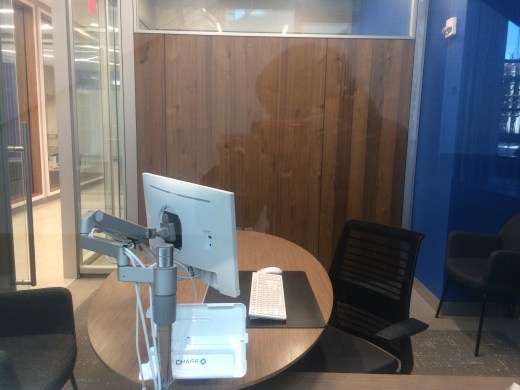
Photograph: Kim Clark May 19, 2020. Office at Chase Bank 800 Boylston Street Boston, MA.

Productivity Hacks To Keep You On Track

Whether you work at home or in a co-working space, Freelance consultants will not see payment for our work until key milestones are reached or the project is complete.  Pay day will come around as scheduled only when we have the discipline to do our best work and get the job done.  Productivity equals a pay check for the self-employed.  Productivity also means that one is able to devote adequate time to activities that enhance the consulting practice, such as professional development and networking, as well as having time to enjoy a personal life.  Here are a few things you can do to maintain peak performance every day.

Define your work schedule

In general, Freelancers need to be available when clients expect us to be available. Answering client emails within an hour and calls as they come in demonstrates that we’re responsive and trustworthy.  Define the hours that you’ll be on the job and commit to working within that time frame.  Unless you’re on a very time-sensitive project, being “open for business” from approximately 8:00 AM – 6:00 PM Monday through Friday, with the exception of holidays, will seem reasonable to your clients.

Perform one task at a time

Multi-tasking has lost its luster.  Productivity experts now realize that we perform better when we work on one task at a time and give it our full attention.  Attempting to work simultaneously on more than one task can easily result in errors that require do-overs that undermine productivity.

Schedule time for content marketing and social media

Investigate social media aggregators such as FlockBuffer and Hootsuite , so that you can manage your blog, newsletter and social media accounts all from one dashboard.  Aggregators allow you to efficiently schedule and focus on this aspect of your consulting practice, whether you check in every day or once a week.  Some of these services offer a free, but limited, option that might meet your needs.

Organize your work space

Followers of Feng Shui understand the importance of maintaining a clean, neat desk and office space, as do devotees of Marie Kondo, author of The Life-Changing Magic of Tidying Up (2011). De-cluttering is good for the soul and good for productivity, too.  For more information, please read my post Feng Shui for your office .

Be proactive

Every day, create a to-do list for the next day.  Rank the list into A-Tasks (high priority), B -Tasks (important, not urgent) and C-Tasks (do them when time allows).  The A-Tasks are what you start with each day.

Do not allow yourself to be controlled by non-business related incoming calls and emails. Put your ringer on silent and keep an eye on caller ID, so you’ll know if you must answer a call and do the same with emails—answer what pertains to business immediately.  You may want to devote the early morning and evening to answering non-urgent calls and emails.

Take breaks

Every 90 minutes to two hours, take a brain break.  On a nice day,  you might take a walk around the block.  If it’s cold or wet, leave your desk, find a comfortable place to put your feet up and meditate for 15 minutes.  Recharging your energy stores is important for promoting concentration, focus and creativity.

Invent deadlines

Decide how much time you should spend on a particular task and make yourself follow the time you allot.  Creating a bit of urgency can be a useful tactic to keep yourself motivated and working.

Eliminate distractions

Close your office door when you are not home alone, or signal that you’re engrossed in work if you’re in an open plan co-working space, to discourage others from dropping in to gossip or otherwise ease their boredom at your expense.  However, make yourself available to your child during your break times or when s/he has an urgent need and be available to take important work-related questions posed by your co-working colleagues.  It is unrealistic to hermetically seal yourself off from your environment, but nevertheless imperative that you have the ability to work undisturbed.

Exercise

Numerous studies conducted over the past 20 years have shown a positive correlation between regular exercise and productivity, in addition to the benefits for one’s physical and psychological health.  Create a physical and psychological foundation that supports your productivity by hitting the gym, going for a run or swim, or participating in the team sport of your choice, at least four times a week, for a minimum of 30 minutes per session.

Review and evaluate your day

At the end of the day, evaluate how well you measured up to the items on your to-do list. Did you accomplish what you set out to do? Identify what helped, or hindered, your performance and make any necessary adjustments.

Thanks for reading,

Kim

Image: The Gleaners (1857) Jean-Francois Millet (1814 – 1875)                                     Courtesy of La Musee D’Orsay, Paris

Knowing How to Delegate Is a Productivity Plus

Those of us who work alone frequently need to at least maximize, if not increase, our productivity and hiring part-time or temporary help may be what it takes to get us there.  Sometimes, you need to ramp up to take on a big project for which you’ll need specialized competencies that are not in your skill set, prompting you to hire subcontractors.  In that case, you’ll lead a team and coordinate numerous tasks that drive completion of the project deliverables.  In other cases, you need administrative help to free you from routine tasks like bookkeeping and invoicing, or following-up with customer service requests.

In each scenario, the ability to effectively delegate will be instrumental in creating a positive working environment, where your hired help will strive to do their best work, so that desired outcomes are achieved.

Delegating can be considered both an art and a science and with practice, it can be mastered.  An unwillingness or inability to delegate indicates poor leadership.  Leaders who insist upon having their hands tightly on the wheel of every initiative are often perceived as controlling micromanagers by those who work with them. Such behavior telegraphs a lack of trust or even respect.  It is demotivating and ultimately counterproductive.  Here’s a checklist to help you perfect your delegating skill.

  1. Learn and assess the skills and interests of team members/ employees                                                                                                                        Consult with and observe your team members or employees when putting together a working group or assigning tasks and accommodate, to the best of your ability, their strengths and preferences, according to the project needs.  This could be a skills development opportunity for some and the wise leader will enable that process whenever possible and reap the benefits.
  2. Choose the right tasks to delegate                                                                                     You, team leader, are responsible for understanding and communicating the strategic, big picture view of the work.  Subcontractors and part-time help are responsible for their area of specialized skills.  You coordinate all tasks and ensure that milestones are met and the deliverables are provided within the project deadline and budget.
  3.  Provide the tools and authority to do the work                                                    Ensure that your employees or team have the resources—information, time, budget, equipment— and the authority to do what you’ve asked of them.  Don’t make them run to you whenever they need to take action.  Rather, empower them and let them apply their intelligence and creativity to making you look good.
  4. Be clear about expectations                                                                                           Explain the goals of the project or tasks and how they support short or long-term plans.  Explain how results/ success will be measured. Confirm that those who work for or with you understand their individual responsibilities and the collective goal. Make sure that the goals are SMART: Specific, Measurable, Attainable, Relevant and Timely.
  5. Provide feedback, guidance and encouragement.  Acknowledge success.     Monitor performance and quickly correct any misunderstandings or problems. Find teachable moments and provide training or useful suggestions when needed.  Encourage and enable excellent work to keep people motivated and productivity high.  Team members and employees will appreciate that you recognize and diplomatically call out both superior and weak performances.


Thanks for reading,

Kim

Image: A Goldsmith in Baghdad (1901), Kamal al-Mulk (1847-1941) courtesy of the Islamic Consultative Assembly in Tehran, Iran