Crisis Communications: Monitor and Defend Your Online Presence

Managing the online presence and reputation of a brand, whether personal or company, is no longer considered mere vanity or over-reaching micromanagement. Regular tracking and review of all content that pertains to your organization and shows up in searches—its services and products, the company itself and its leaders—including AI-powered searches, is now recognized as a necessity. Vigilant and consistent monitoring of information that appears online about your company and you, as the principal of your Freelance consulting practice or fractional executive, owner/leader of a traditional business, small or large, or not-for-profit organization executive, can be viewed as an aspect of risk management strategy.

It is imperative for all business owners and leaders to carefully shape and defend their brand’s online image and ensure that all information presented is accurate and leaves viewers of your content with a positive impression, meaning, a portrayal that encourages credibility and trust.

Unflattering or outright negative content associated with your brand, as well as inaccurate info, has the potential to undermine or damage your organization’s credibility. It is therefore highly recommended that Freelancers and other business owners and leaders regularly assess all AI-generated and online mentions of their company and personal brand and verify the accuracy of the information found.

Take control of your online presence

Integral to a comprehensive marketing campaign is building a digital presence that illustrates the competence and credibility of the organization. Online reputation management is essential to defending that carefully curated image, whether you maintain a solopreneur consulting practice, operate a small company, or lead a national or multi–national conglomerate. Failing to take defensive action and waiting until negative content has become an embarrassing crisis may cause an unfortunate outcome that stains your own or your company’s reputation.

Inspection tours are the how you’ll discover inaccurate information and/or negative content. Inspecting the search engines is Step One of your mission to defend and, if necessary, correct online information pertaining to you and your organization. Learning where and how to locate, edit, or suppress content that is untrue or unflattering is the most important step of restorative crisis communications activity. Proactive monitoring and strategic content creation will be central to maintaining control of your online image. The presence of negative content, which may include customer reviews and other user-generated content, can have a direct effect on company reputation and sales revenue: Approximately 94% of customers report that a negative merchant review on a review site persuaded them to avoid doing business with that merchant.

Step Two of your brand defense is the actual defensive action, where you may simply update information to correct what appears sites like Yelp or Google. More thought and time will be necessary if you discover content that is inaccurate and perhaps also misleading; in these cases, you may decide that a substantive reset of your brand narrative is in order. Your best defensive action will be to create and publish relevant, high-quality content that is capable of enhancing your online authority and burying the harmful content by pushing it further down in search rankings.

Google search operators

Re: your search engine inspection tours in most cases, a Google or Bing search of the brand will surface a comprehensive list of brand mentions. However, a more thorough search might locate additional content that you can review and if you discover incorrect information or harmful material on less popular search engines or on online communities, you can explore how to make corrections and/or counteract negative content with a post or two that displays your authority and integrity.

To take a deeper dive and search for potentially harmful content that might otherwise go unnoticed., you’ll be pleased to find that Google’s search capabilities extend far beyond entering a name into the search bar to see what appears. Dipping into advanced search operators will broaden your scope and, if it exists, may help you to locate negative content that does not appear in a traditional search.

To find what may be hiding in the shadows, launch an exact match search by placing your name in quotation marks (e.g., “John Smith” or “The Best Company”) to specify search results to that unique name and eliminate unwanted mentions. To further refine search results, you can exclude irrelevant pages using the minus sign. for example, searching for “The Best Company” -Instagram removes Instagram results and help your mission to dig up potentially damaging content pertaining to your brand that may be posted on less visible sites.

Furthermore, a site-specific search can help when you suspect that a particular domain features negative information about your brand. Typing the site domain address, followed by a colon and your company name will produce only results from that chosen site. It is also useful to search variations of your name, for example, “J. Smith” or “Best Company;” — subtle changes could possibly bring up mentions that do not appear in the traditional searches.

Set-up Google Alerts for ongoing monitoring

It is wise to be vigilant and regularly monitor your name online, to prevent damage before it spreads. Google Alerts is a free tool that notifies you whenever new content is indexed and includes your name. To get started, visit Google Alerts and enter your full name and company name along with relevant variations (e.g. “Jane Smith” or “Jane K. Smith”). Use quotation marks to ensure your alert captures the exact phrase. Then click “show options” to select how frequently you’d like to receive alerts —the “as-it-happens” option is best for reputation management. Set alerts to receive notification of name mentions and be sure to correct inaccuracies and gratuitously negative content. Counteract what is negative with relevant and compelling content that can potentially suppress unflattering narratives.

You can also filter alerts by geographic location and type of content, such as blogs, news articles, or discussions. Finally, enter your email address to start receiving updates. These alerts act as a digital early warning system. You’ll know immediately if a new piece of content starts gaining traction — giving you time to prepare a response or counter-strategy. Staying visible online requires more than awareness — it demands consistency and strategy.

  • Monitoring social mentions and online discussions

Negative content is known to more frequently begin on nontraditional search engines. Social media platforms, forums and blog comments can amplify by way of the metaverse effect and damage to your brand image can spread quickly—even as it never appears in traditional search results.

To really scrutinize your online presence, investing in the services of a social listening site such as EmbedSocial or AgoraPulse will detect online conversations that mention your name and your company name across blogs, Twitter, Facebook, YouTube, media outlets and more. Social listening platforms also provide sentiment analysis, an excellent feature that distinguishes between harmless chatter and attacks on your brand reputation. Most social listening platforms are a paid service but if a free solution will be more appropriate for you at this time, consider Talkwalker Alerts (by HootSuite). Incidentally, Talkwalker provides more extensive web and social listening coverage than Google Alerts and is easy to integrate into your workflow.

Finally, make a point to investigate online communities like Reddit and Quora. These platforms typically feature informal discussions and some have been known to quickly go viral. Get your investigation started with a targeted search— reddit.com:The Best Company to uncover mentions that might not appear on Bing or Google. Knowing what’s being said about you when you’re not in the room lets you know who your friends are and also gives you the opportunity to respond with a brand image defensive strategy.

Thanks for reading,

Kim

Image: © Behnaz Farahi. Gaze to the Stars, an installation created by Behnaz Farahi, Assistant Professor at the MIT Media Lab at the Massachusetts Institute of Technology in Cambridge, MA. Gaze to the Stars was displayed on the MIT Great Dome December 2024-March 2025.

Be A One-Person Powerhouse

Freelancers continue to refine our business practices as we observe and respond to the mega-trends that impact the global and national economies and, to some degree, affect the way nearly everyone on the planet lives and works. As we move through the mid-point of the 2020s, Freelance professionals are redefining success. We never intended to be builders of corporate empires that employee thousands, but we do intend to build and sustain a profitable business entity.

We believe that we can thrive as leader of a single-person business entity, a one-person empire, where we demonstrate our appeal to a discrete segment of the marketplace. We demonstrate also our grasp of customer needs within that market segment and we deliver services and/or products that our customers value. While aware of the time and cost saving advantages of turnkey processes and operational efficiencies, we reject the notion that one size fits all and we’re happy to build in a degree of flexibility that makes available personalized solutions tailored to address customer needs and concerns.

Niche is the new big box

The Freelance solopreneurs whom I’ve come to know over the years are too smart to try to be all things to all people. Instead, smart, successful Freelancers like you rely on market research to discover customer segments that are most interested in your category of services or products and then learn how to position your company to win business within those marketplace segments. Freelance solopreneurs will be interested to know that leading U.S. market researchers have validated this strategy and now forecast that in 2025 and beyond, start-up entrepreneurs who focus on a niche market will prosper while those who attempt the “all things to all people” big box approach will be on the wrong path.

Globalization is driving this emerging trend, as are AI-powered marketing communications tactics. Together, these powerful forces have made it both uncomplicated and cost-effective for even a business entity headed by a Freelance solopreneur to attract prospective customers in any geo-location that has internet access and invite them into your company’s buyer’s journey and community of followers. The possibility of developing a thriving niche market for your services or products that consists of people from around the world is real and is expected to become the norm for one-person shops as it is for multi-national conglomerates.

While the multi-nationals, however, pursue millions of prospective customers and compete in markets that are often saturated. Standing out in those marketplaces is a challenge that only big fish can afford, sometimes by advertising during the Super Bowl, for example. In stark contrast, those who dwell in micro-niche markets will devote most of their marketing resources to creating trust and legitimacy, demonstrating expertise and authority and building relationships and loyalty. Establishing a presence in a micro niche market, as would a Freelance solopreneur, isn’t just about selling products or services—it’s nearly as much about creating a community where customers feel a sense of belonging.

Because Freelance solopreneurs occupy a unique, personalized, space, customers are inclined to perceive you as an expert who understands their needs on a granular level and capable of solving their unique goals and challenges. In 2025 and beyond, Freelance solopreneur entities will use niche targeting combined with AI-powered analytics, marketing and customer service tools to fuel smart and sustained growth that supports a personalized boutique approach to their B2B or B2C venture. You can promote a brand-enhancing perception by showcasing the following:

  • Communicate capability, quality and consistency

Big business has the financial wherewithal to invest millions in branding, while Freelancers and other small business owners can effectively build and promote their brand, goods and services by adopting a niche market focus to achieve a similar effect by being consistent and integrating personalization and polish across all forms of communication and at every customer or prospect touchpoint. Get the ball rolling with a comprehensively cohesive brand visual identity that begins with an intuitively designed, fast-downloading, sleek, professional-looking website; you can carry that ethos into high-quality marketing materials that create an image that reflects capability, trust and legitimacy.

  • Be a thought leader

A solopreneur Freelance consultant can appear to be a nationally recognized authority if s/he is featured in respected industry media outlets. Establishing yourself as a thought leader confers respect and credibility that makes your business entity appear substantial and established. People tend to assume that everyone who is presented in the media as an “expert” of some sort who presides over a large business that generates an annual income that’s well into six figures and maybe more.

You can use that perception to your advantage: it is well worth your while to seek opportunities to publish your own insightful articles in reputable magazines or journals. Furthermore, you will do well by searching for opportunities to take on speaking roles at conferences, even if that means moderating a panel and appearing on podcasts and webinars whose reputation, while perhaps not blue chip, are nevertheless positioned to create for you the impression of authority and influence.

  • Show social proof at every opportunity

Incorporate social proof into your branding strategy by inviting happy customers to give online or print testimonials that describe how your service or product has solved their business challenge or helped them to achieve an important goal. Alternatively, you can ask customers if s/he would mind if you wrote up a case study that details how your product or service enabled that customer’s goal to be achieved or challenge to be overcome.

Customer success stories, which are brought to life by testimonials and case studies, are highly effective marketing tools and they deserve to be spotlighted on your website and social media platforms. You will provide still more examples of customer success stories when you encourage happy customers to post user-generated content (which includes testimonials), and also reviews on platforms such as Yelp, Google and LinkedIn. You might also request permission from certain customers (more prestigious, that is) to display their company logo on your website.

Another highly effective demonstration of the social proof of your brand reputation among your business community peers and colleagues is to display on your website the business and/or community awards that you’ve either won or for which you’ve been nominated. Seeing the names of recognizable authorities associated with your brand makes you look well-respected and trustworthy—because we are judged by the company we keep.

Inform local media outlets when you’ve got something great to crow about by sending a press release to announce your newsworthy achievements (e.g., a nomination for a business award) or your participation in a well-known charity or community event, such as helping to sell Girl Scout Cookies, supporting the Little League team, or sponsoring a marathon runner who is raising funds for a local hospital or other charity.

  • Expand your online presence

A business that is favorably mentioned in multiple media outlets more than once a year looks much more influential than a business that is mentioned on a single platform—infrequently. Maintaining an active presence on LinkedIn and other social media sites, contributing your insights to industry forums and getting your articles included in relevant publications reinforces the credibility of both you and your business entity.  Occasional press coverage in online or print media outlets, guest blog posts and other articles and social media activity, especially when taken together, can readily give your Freelance solopreneur consulting entity the impression of a capable and respected, if not locally powerful, enterprise. Being cited by industry sources, contributing to discussions and publishing original insights give the impression that you’re a major player, even if you’re running a small operation.

  • Deliver white-glove service

Freelance consultants and SMBs would be wise to develop exceptional customer experiences, including after-sales support services where necessary. B2B customers will greatly appreciate a seamless onboarding process, as well as automated follow-ups and structured client communications—all of which create the impression of a well-oiled machine, whether your company is a team of 20 or a solopreneur entity. Modern tools allow small businesses to operate with the efficiency of much larger organizations. A website and social media chatbot, AI-powered customer service and cloud-based collaboration tools make it possible to efficiently serve customers on every continent. When you create a strong digital infrastructure for your business entity, regardless of the number of workers on your team, you can operate at a level that is as capable and trustworthy as any enterprise-level competitor. You can become a one-person powerhouse!

Thanks for reading,

Kim

Image: © Keerthana Kunnath. In Kerala, India female bodybuilder Chitra Purushotham shows that she is a powerhouse.

Is Your Social Media Strategy Delivering?

Half the money I spend on advertising is wasted; the trouble is I don’t know which half.”

Possibly apocryphal quote often credited to 19th century Philadelphia department store magnate John Wanamaker.

Accurately measuring the impact of the marketing activities you create to promote your company’s services and/or products and, furthermore, analyzing the impact of your marketing to verify that the activities were worth the time and money invested in them can be somewhat of a puzzle for a marketing manager. In particular, the return on investment of social media activity can be nebulous, given that much of its focus is often devoted to relationship-building that stimulates one or more aspects of brand-building, for example, brand loyalty and brand reputation. Determining which of your go-to social media platforms is your top performer might be difficult to confirm, there is not always an obvious path to follow as you track and document your customer’s behavior or buyer’s journey from first contact through purchase; and then there are those who jump ship somewhere between those points and the debrief on that scenario is yet another drama to unravel.

Social media remains a hugely popular marketing tactic that for the most part has earned its accolades in both free and paid options. So, it comes as somewhat of a surprise that recent marketing research shows that at a representative group of enterprise companies, the social media marketing spend is softening. According to the Spring 2024 edition of the CMO Survey, which surveyed 292 marketers employed by leading U.S. companies, social media investments declined from 17% in Spring 2023 to 11% in Spring 2024, reaching its lowest level in seven years.

The CMO Survey found further confirmation of this occurrence in participant responses to the question “Which best describes how you show the impact of social media on your business?” and one-third, all of whom are marketing leaders, reported “we haven’t been able to show the impact yet.” The remaining participants were evenly split on whether they’ve “proven the impact quantitatively,” with some stating that they have a “good qualitative sense of the impact, but not a quantitative impact.”

Maybe you’ll soon decide to pull back on social media paid ads, too, and rely more heavily on the “free” option (free except for the time spent to choose and post content that interests followers, that is) since it remains an effective method of customer outreach and enables you to build and sustain relationships with customers, convert prospects into customers and boost brand visibility. Your social media spend may decrease, but that adjustment could motivate you to make the most of a reconfigured, but still valuable, marketing investment.

Multi-channel is most effective

According to an analysis of performance data associated with social media marketing campaigns, the format produces greater results when used in combination with other marketing tactics, e.g. monthly newsletters and/or case studies, e-books, podcasts, or webinars. Furthermore, when researchers examined 10 years of CMO Survey retrospective data, below-average performance of social media marketing campaigns was reported by participants whose answer to “How effectively does your company integrate customer information across purchasing, communication and social media channels?” revealed weak scores describing the use of that data during the period 2011 – 2023. The performance ranking scale measuring customer data sharing ranged from “not at all” to “very highly.”

In light of the findings of the 10-year retrospective, survey researchers recommend that marketers consult with a Customer Relations Management (CRM) company, e.g., Sprout Social, HubSpot, BuzzSumo, or SalesForce, to ensure accurate interpretations and beneficial integration of their social media marketing performance data to enhance the success of future marketing campaigns. Correctly interpreting and utilizing social media marketing performance data ensures that you’ll have a holistic understanding of customer behavior that’ ‘s inclined to positively impact the buyer’s journey your company provides.

Use social media to grow your customer list

The CMO Survey also found that nearly half of companies use social media platforms to sell their services and products. However, survey data reveals that fewer than 20% of those companies leverage their social media engagement to invite customer feedback that might improve aspects of the customer experience or even suggest new product or service opportunities that the company could explore and possibly launch. Companies that exploit this easily accessible customer feedback opportunity are able to develop a customer experience that responds to and retains customers, encourages referrals and increases sales revenues and profitability.

Improvise to stay timely and relevant

Finally, enhancing your ability to provide a timely response to breaking news that matters to your customers and prospects right now is just about guaranteed to enhance both the relevance and visibility of your brand—and using social media makes this possible. Still, marketing managers often neglect opportunities that are easy to address, as evidenced by the self-reported survey participant score of “average” when describing behavior associated with the statement “Responding quickly to opportunities and challenges when managing your most engaged customers.”

CMO Survey findings convincingly show that adopting a flexible, even improvised, approach to your social media engagement is the most effective aspect of your strategy and that your awareness of breaking news and developing events is most urgent and beneficial when providing a timely response is desirable. Communicating with your customers and prospects by acknowledging the unfolding event or unexpected (surprise) development, with a humorous or witty remark demonstrates your authenticity. In short, building in processes designed to make you ready for and prepared to quickly respond to various types of communication opportunities is able to improve the ROI of your company’s social media marketing and engagement.

Thanks for reading,

Kim

Image: © Simon Smith. Bunhill for Getty Images

Trend Tracker Is Free Help from Yelp

Launched in 2014 at the platform’s 10th anniversary, Yelp’s Trend Tracker is receiving so much flattering business press of late that it feels like a relaunch (and I’m sure it is)! If you operate a small business and maintain an active Yelp account, whether or not you subscribe to Trend Tracker, Yelp is talking to you. If you’re a Freelance solopreneur who’s claimed your free Yelp listing and then dropped the subject, Yelp is talking to you, too. Or maybe you’re a self-employed professional, a Freelancer or SMB owner, who does not have an active Yelp account? Whatever the case, Yelp and Yelp’s Trend Tracker beckon with insightful and potentially actionable data that pertains to your industry and can support your mission to build a profitable and sustainable business entity.

What is Yelp’s Trend Tracker?

Trend Tracker is an AI-powered, cloud-based tool that monitors customer searches, reviews and interactions to identify trending topics in real time. Trend Tracker reveals and reports customer search patterns, behavior and emerging customer preferences across a broad array of industries. Trend Tracker harvests data from unique searches the Yelp platform receives each month (178 million in January 2025) and measures the frequency of specific phrases and topics used in those searches. This data sheds light on what you want to know, from customer purchasing trends to popular B2B and B2C services. Furthermore, Trend Tracker goes beyond search terms and also analyzes the text of customer reviews, to further clarify the picture.

It can literally pay to know this stuff because from time to time it may be worthwhile to respond to certain information. You may decide, for example, to update the key words in your content marketing material if Trend Tracker data indicates that target customers have begun to use certain terms when searching your product or service category.

Free market research for Freelancers and SMBs

Trend Tracker analytic insights are available free of charge—join the mailing list and you’ll receive data that is relevant and updated monthly and enables those who pay attention to access boots-on-the-ground marketing insights that can potentially help to promote your products and services more effectively. Supported by Trend Tracker, you’ll be positioned to detect and quickly respond to customer preferences, adjust marketing strategies and/or tactics to better align with shifting customer priorities and maybe even tweak your service or product line to reflect a significant shift in customer tastes.

When business decisions are guided by relevant, reliable data, decision-makers are more likely to achieve their intended outcomes. Decisions and actions that are guided by what matters to prospects and customers IRT will be immensely helpful to business owners. One of the biggest advantages of Trend Tracker is its ability to give you the heads-up on developing trends before they go mainstream and giving you time to update your position and be among the first providers to capitalize on emerging customer demand. Trend Tracker enables you to:

  • Identify emerging customer interests before they become mainstream
  • Adjust marketing strategies and tactics to respond to customer interests in a timely fashion
  • Create events and promotions that reflect developing trends
  • Improve your brand’s online visibility and search engine optimization with trending keywords
  • Stay ahead of competitors (who may not have access to reliable data-driven insights)

What else can Trend Tracker do for you?

So what’s trending that applies to you? Trustworthy intel is what’s trending and it applies to your entity in many ways. Trend Tracker data can even be a resource when you must conduct market research to evaluate your business planning, from the feasibility of scaling or expanding your venture to clarifying your decision-making as you verify, or rethink, a side hustle you hope to launch. News flash! Re: business planning, can we acknowledge that Freelancing does not exclusively pertain to B2B services such as marketing, website development, graphic arts and shooting and editing videos? Can we recognize that Freelance expertise can also be applied to a B2C service entity? In other words, could it be that upgrading home interiors is a more satisfying expression of your entrepreneurial talent than cybersecurity? That seems to be the case for the Property Brothers.

You may be interested to know that the Trend Tracker September 2024 issue reported that in 2024, home services produced record growth for business owners in that industry across the U.S. and drove an all-time revenue bonanza for the category. Trend Tracker data indicated that in 2024, home services were the fastest-growing segment of B2C services in every U.S. state plus Washington D.C. and was the top category for new business launches among all industry categories on Yelp as well. This still trending growth cycle is fueled by renter-friendly home upgrade projects. As many citizens come to recognize that attaining home ownership or trading up from starter house to a more spacious (and grand) residence is unaffordable, remaining in the current home for a longer period of time has become yet another New Normal reality.

As a way to make home feel more comfortable or look more stylish, people are investing in improvements that upgrade living spaces without upsetting the landlord. Another home services industry hot spot, this one pertaining to homeowners, is weatherproofing services that make homes more resilient to what seems like increasingly frequent extreme weather events. Trend Tracker data shows that Yelp users have increased searches for both renter-friendly and homeowner services—could responding to the growing demand become your side hustle or even your full-time Freelance or SMB enterprise? Aspiring business owners have set up shop as Freelance solopreneurs and SMBs to address those priorities, which resulted in big increases in Yelp searches in 2024 vs. 2023:

  • home organization (+362%),
  • peel and stick tile (+73%),
  • wallpapering (+41%),
  • snow removal (+36%)
  • home automation (+27%),
  • drapery installation (+11%)
  • waterproofing (+23%)

In sum, Trend Tracker can be a game-changer that might potentially have a direct impact on your ability to gain or maintain competitive advantage and monitor customer priorities—and maybe even launch a successful business or side hustle. Tara Lewis, who spent 15 years at Yelp helping businesses connect with their target customers and also served as its trend expert, advises that the best way to get started with Yelp’s Trend Tracker is to check out the latest trends noted in the monthly newsletter and pick one insight to test in your business this month. Lewis says that even a small adjustment can lead to noticeable improvements in brand visibility and sales revenue generated. She recommends the following:

  • Practice authenticity in trend-chasing. Don’t just follow trends; make them your own to help your business stand out.
  • Connect with valued customers through shared trending interests. Form meaningful connections with your community by creating events and social spaces that appeal to those who matter most.
  • Use Yelp Trend Tracker data to highlight what you already offer. Your business may be in tune with rising trends — adapt your marketing strategy to make these products or services more visible to customers.
  • Position your business for long-term trends, not just momentary fads. Some trends are fleeting; others reflect larger shifts in consumer behavior. Identify trends with staying power and incorporate them into your business vision.
  • Your brand’s unique personality is your trendiest asset. Lean into what makes your business distinctive to set yourself apart and keep customers coming back.

Thanks for reading,

Kim

Image: © Freepik

LeadGen and Customer Acquisition in 2025

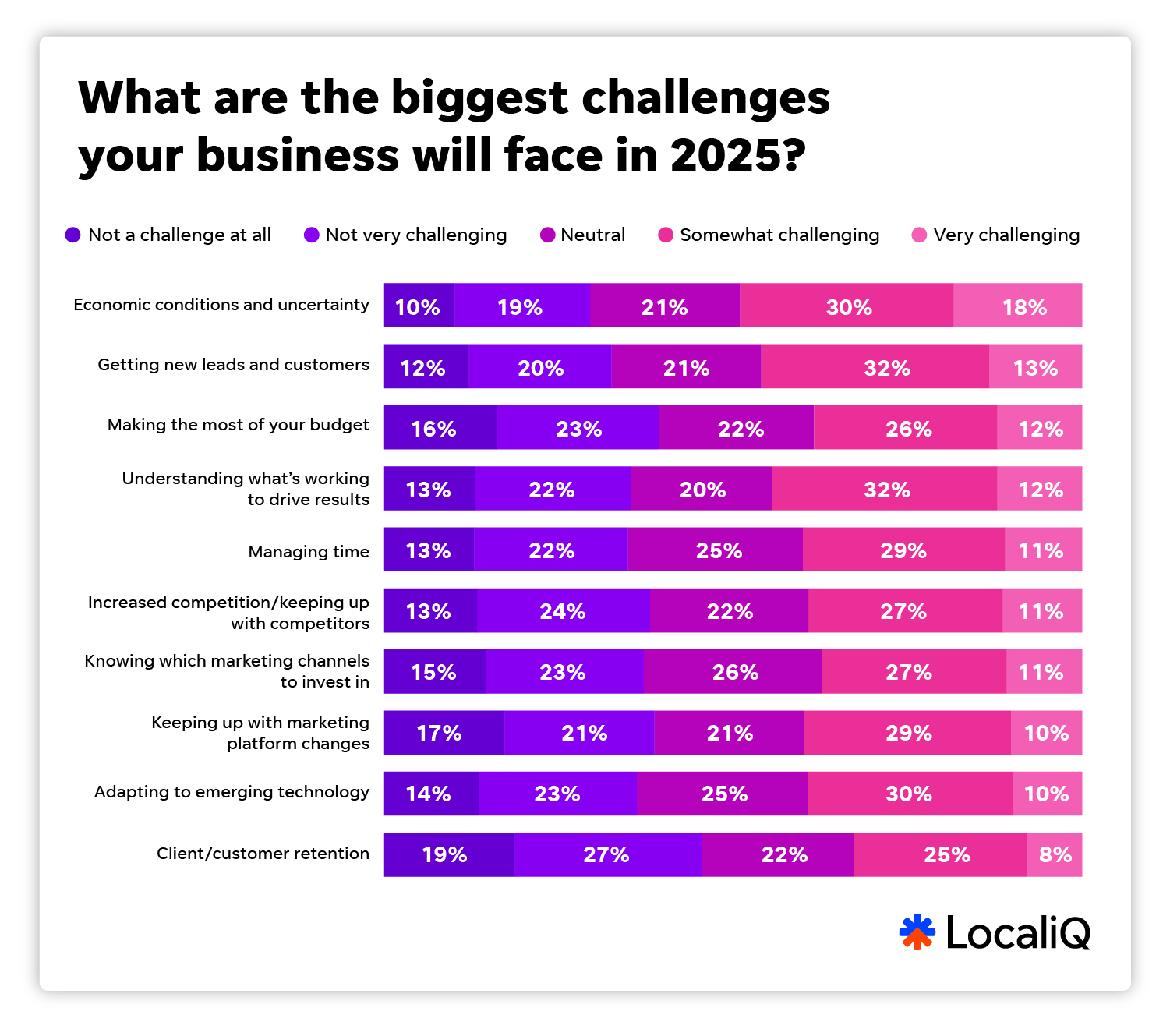
LocaliQ, a digital marketing platform that specializes in lead generation and multichannel marketing campaign management, and is a subsidiary of Gannett Publishing, surveyed more than 730 small business owners and marketers worldwide to get boots-on-the-ground perspectives on leadgen and customer acquisition marketing tactics SMB owners are using now and uncensored feedback on what’s producing the best results. The survey is a rich source of benchmarking and actionable insights that have the potential to inform your approach to leadgen and customer acquisition strategies and tactics this year.

In its first Small Business Marketing Trends Report, LocaliQ shares the results of a deep data dive that’s intended to help Freelance consultants and SMB owners successfully navigate the business landscape they can expect to encounter in 2025 by learning how their peers energize sales revenue by identifying leadgen tactics that promote customer acquisition.

The relevance of LocaliQ data is for many of you validated by the survey demographics—15% of respondents are soloprenuers; 31% have 2-10 full-time employees; 24% have a marketing budget that’s less than $500/ year (5% have no marketing budget); and 74% are based in Canada and the U.S. (all six inhabited continents plus New Zealand are represented). The survey was published in October 2024. How does the average Freelancer or SMB owner attract prospects?

Survey respondents do what you’d expect and it’s safe to assume that they use more than one leadgen tactic to implement their marketing /sales strategy. Social media marketing (free) is used by 52% of respondents; 47% of respondents use (paid) social media advertising; and 40% of respondents use search advertising, i.e., pay-per-click sponsored ads that appear in search engine inquiries. Other popular leadgen tactics are email marketing, used by 39% of respondents and content marketing, used by 33% of respondents. Online listings and directories (28%), display ads (24%) and traditional media (23%) are 20th century tactics and that gives them a similarity (IMHO); when combined, 75% of survey respondents use one or more of these older leadgen tactics.

As for the social media platforms used, it’s no surprise that Facebook dominates—76% of respondents use the platform for leadgen, promoting products and services and otherwise engaging with current customers and prospects. Instagram is used by 63% of survey respondents and LinkedIn, tailored as it is to B2B customers, is used by 43% of respondents. The data also showed that 29% of respondents use video marketing, a feature that is available on the above three platforms and also YouTube, which is used by 38% of respondents and recently rescued TikTok, which is used by 34% of respondents. Surprisingly X, a platform intended for Instant Messaging and other text communications, is used by 41% of respondents for social media marketing (X also hosts video sharing).

Now let’s talk turkey—when asked about their satisfaction (or disappointment) with the results of leadgen tactics, social media marketing and online listings/business directory users are satisfied with results—66% of social media marketing users and 61% of online listings/business directory users are pleased with their leadgen marketing results—still, each group also has a dissatisfaction rate of 15%. Furthermore, there is a rather large group of “neither satisfied nor dissatisfied” —meaning lukewarm?—users associated with those leadgen marketing tactics and 24% of online listing/ business directory users and 19% of social media marketing users joined the lukewarm group. Maybe it’s too difficult to measure leadgen results directly from social media marketing activity, whose conversation threads remain visible for years and likewise for presence on a business listing site or directory that a prospect might see many months after publication?

More clarity is derived from search advertising and it topped the list as the leadgen tactic most respondents are happy with, as evidenced by its 76% satisfaction rate (with 12% dissatisfied and 12% neither satisfied nor dissatisfied). A close second in popularity is video marketing, a leadgen tactic that has a growing user rate on every platform; in this survey, 74% of users are pleased with their video marketing outcomes and just 8% are unhappy (and 17% are neither satisfied nor dissatisfied). Short-form videos, like those on TikTok and Instagram Reels, continue to surge and 58% of respondents have either recently tried or would like to try the format.

Search advertising succeeds because it kicks in precisely when the purchasing motive is strongest and prospects are actively looking to buy a product or service that’s similar to yours. Readily available alternative options are waiting for them, as shown in search ads you’ve seen. Survey respondents also indicate satisfaction with results they’re finding with content marketing (75%) and advertising on social media platforms (73%).

The best source of leadgen is (drum roll) customer referrals! Almost 65% of survey respondents reported that customer referrals are the best leadgen sources. The influence of customer referrals is greatest (75%) for SMBs that have 10 or fewer full-time employees and have less influence in larger organizations—just 46% of businesses with 50 or more employees report that customer referrals are the best source of new customer leads.

Major challenges anticipated in 2025

Freelance consultants and SMB owners know that in order to survive and thrive, a clear-eyed view of their economic landscape is necessary. Economic uncertainty, leadgen tactics that stimulate new customer acquisition and optimizing an (often modest) marketing budget are by necessity at top-of-mind. The ability to predict which marketing tactics can be relied on to produce the strongest return on investment is viewed as somewhat or very challenging for nearly half of survey respondents—44% are somewhat or very concerned about the capability of their chosen leadgen tactics to drive results. Adapting to new technology is a concern for 40% of respondents, who indicate they are somewhat or very concerned about keeping up. Furthermore, 45% of respondents are somewhat or very concerned about their leadgen tactics bringing in enough new customers and 48% are somewhat or very worried about economic conditions and uncertainty.

So, what are the recommendations for driving Freelancer and SMB success in 2025? There are no definitive answers and the suggestions offered below are not new and not rocket science. Your goal is to make money, but you could meet with headwinds for any number of reasons. Outcomes produced by your business strategies and tactics cannot be predicted but appropriate design, execution and performance monitoring on your part can be expected to yield at least modest success. Marketing and sales have a direct effect on customer acquisition and generating revenue, making these two closely related functions the money-making engine of a business venture and deserving of your intense focus. Just do it.

It’s helpful to monitor the performance metrics of marketing tactics and for that process, Google Analytics generates relevant and insightful data that enables you to evaluate your campaigns—at no charge. Sign up now! Along with leadgen/customer acquisition, make a point to promote customer referrals by asking your current customers if any of their colleagues or customers have the potential to become one of your customers. Also, create customer experience protocols that at every touchpoint anticipate and respond to customer needs end-to-end, from new or returning customer onboarding to after-sale training or other services. Finally, invite customer feedback by directly speaking with those who do business with you when possible. It’s good business to send out an email survey (maybe once a year), or chat with customers by way of social media; it’s important to learn what customers would like to see you do (or not do), so that you can optimize the experience of doing business with your company.

  • Be prepared to manage both the opportunities and challenges you encounter by being aware, being agile, being resourceful and being resilient.
  • Develop comprehensive marketing/sales strategies and implement with tactics you can expect to be effective. Regularly consult your website (and social media) performance metrics and make adjustments where necessary, to maximize performance.
  • Identify one or two local business associations and aim to attend one program per quarter as a way to obtain professional development and/or enhance your business acumen skills as you meet colleagues and engage in face2face networking that builds mutually beneficial relationships.
  • As soon as your budget allows hire an (outsourced) business accountant or bookkeeper to not only maintain the integrity and timeliness of your business financials and tax filings, but also to discuss and guide the potential business growth and expansion of your venture.

Thanks for reading,

Kim

Image: © kali9/ iStock

TikTok Countdown: Proceed to Pivot

The Supreme Court announced on Friday January 17 that it voted 9-0 to uphold the Senate-approved “Protecting Americans from Foreign Adversary Controlled Applications Act”, a ruling that defined TikTok and other apps owned by Chinese corporations that operate in the U.S. and have more than a million U.S. users as a national security risk for America and compelled ByteDance, owner of the popular TikTok social media platform, to either sell out to a U.S. company or cease operating in this country as of Sunday January 19, 2025. On Saturday night January 18, ByteDance shut down TikTok in the U.S., per the SCOTUS ruling. Site visitors were greeted with the message: “Sorry, TikTok isn’t available right now. A law banning TikTok has been enacted in the U.S. Unfortunately, that means you can’t use TikTok for now.”

Furthermore, the SCOTUS ruling prevents American companies from hosting or delivering content for the Beijing-based social media platform unless parent company ByteDance sells the platform to a U.S. buyer, or a U.S ally. A source close to TikTok reportedly said that “multiple critical service providers” indicated to TikTok that they would no longer carry the app or its data, which forced the app offline. Service providers cited fears that the ban would be applied starting Sunday January 19, despite Biden administration signals to the contrary. The app went dark on Saturday January 18 about two hours before the shutdown deadline and as of Sunday January 19, the TikTok app was not available at the Apple App Store or the Google Play store.

But in true soap opera cliff-hanger style, TikTok did not remain offline in the U.S. for any length of time and leave 170 million U.S.-based TikTok users in the lurch. In fact, it was evident that TikTok would quickly resume operating in the U.S., perhaps inspired by a growing awareness by lawmakers of both parties that the decision to force a TikTok closure is quite unpopular. Some congressional leaders who originally championed the TikTok law are now considering delaying enforcement. So, Washington is setting up to pass the buck—surprise!

  • A U.S. official has confirmed that the outgoing Biden administration would not force TikTok to cease operations in the U.S. on January 19 and will allow the incoming Trump administration to implement the law.
  • In a TikTok video, platform CEO Shou Zi Chew asked President-elect Donald Trump to find a solution that keeps the site available in the U.S. Trump said he would “be making the decision” about TikTok and confirmed that he discussed the platform with Chinese President Xi Jinping. In a phone interview with NBC News on January 18, the President-elect confirmed that he would “most likely” delay the TikTok ban for 90 days after he takes office on January 20 but added that he had not yet made a final decision. Incidentally, Mr. Shou expects to be in attendance for Trump’s inauguration.

What would a TikTok ban look like?

OK, so what might the world look like for TikTok users if the unthinkable happens and the site really is banned in America for a significant length of time? Before going any further, let’s confirm that it will not be illegal to have TikTok on your phone. TikTok has been banned in the U.S. as of January 19, but it’s not illegal to keep the app on your phone or other devices.

  • No new downloads: TikTok was removed from app stores on January 19 and aspiring new users were unable to download the app. Current user accounts were blocked and shown the message detailed above.
  • No updates: Those who are somehow able to access the site would no longer receive updates and the site would eventually stop working properly. Functionality would diminish.

If you are one of the approximately 7 million U.S. residents who use TikTok one minute videos to promote a business, you are advised to act now to protect your entity. President Trump‘s vow to keep the app available notwithstanding, the clock really is ticking and this drama is your wake-up call. It’s imperative that you be proactive and prepare to pivot into Plan B and develop actionable strategies that enable the transfer of your business marketing functions out of an exclusively TikTok arrangement and into a safe, multichannel harbor. Whether or not there is a prolonged TikTok shutdown, keeping all your eggs in one basket has always been risky and is nearly always inadvisable. There is strength in diversity and that’s our mission today. Let’s discuss Plan B—your pivot and survival strategy.

“We have to save it”

As you’ve heard, the TikTok shutdown was in effect for just 14 hours and President Donald Trump pledged to issue an executive order following his inauguration and give TikTok a 75-day reprieve before the SCOTUS law goes into effect, saying that “We have to save it.” President Trump suggested that a 50% American ownership of TikTok is his preference at this time. If TikTok plays a vital role in your marketing campaigns, you can breathe again—-but this soap opera isn’t over yet and you would be wise to use the 75-days to get your house in order.

1. Build and optimize your own website

You relied on TikTok and don’t have a business website, you say? You should protect yourself and take control now, by way of a DIY site-building (and tutorial assisted) project or by outsourcing to a Freelance web developer colleague whose references you’ve checked, so that you can create a website solution that’s customized to fit the needs of your business venture. The only online platform that you completely control is your website. Social media platforms belong to the company that owns them, meaning that your TikTok content actually belongs to ByteDance and your Facebook posts belong to Zuckerberg. If that thought doesn’t motivate you to create a functional website for yourself, I don’t know what will.

On your website, you own and control your marketing content and can also sell your products and services, post customer surveys and calls-to-action and, maintain a sales/marketing funnel for inbound customer appeals and, best of all, you’ll own and control all customer data that you collect and maintain because the site is yours. Keep in mind that your website can and should be designed to function as the primary hub for all activities that drive customer engagement and transactions of any kind. Furthermore, be certain to enable site cybersecurity and configure https in your website address, which is the secure version of http, the primary protocol used to send data between a web browser and a website. The principal motivations for https are authentication of the accessed website and protection of the privacy and integrity of the exchanged data while it is in transit.

2. Develop a robust email list

Congratulations to you if your TikTok following is significant—but during the site shutdown, all of your customer contact info was Missing In Action, beyond your reach. Because email marketing remains a powerful resource, act now to find an alternative platform that gives you control of your most important piece of customer (and follower) data—email addresses. Investigate and compare email marketing platforms and get started ASAP. Once you’ve selected a provider, create opt-in forms to grow your list as you continue contacting and nurturing your relationship with your loyal base of customers. Your email list is how you own your audience and you must be able to support mutual communication between your audience and your company.

3. Diversify your online channels

Don’t be complacent and let yourself remain a one-trick pony. The TikTok drama reminds us all that social media platforms you rely on today might be gone tomorrow. A good defensive strategy is to spread the wealth and consider multiple channels for your content and customer outreach, guided by the platforms your target market follows. TikTok followers are obviously visual and gravitate to videos, so think Instagram Reels, YouTube Shorts and Facebook for your Plan B pivot into multiple channels—plus your website, which will be the gatekeeper of everything. Pinterest, a visual imagery search engine, could be another useful marketing channel that your customers and prospects like. Diversifying will give you better control over customer engagement and monetization, so instead of betting the house on a single platform, spread your bets.

4. Create a viable sales/marketing funnel

Why not launch your pivot by creating landing pages that lead prospects and other followers to sales/marketing funnels you’ve established on different platforms and advertise your powerful new online presence? It will also be good for brand building to give prospects (followers) and customers a reason to connect with you outside of social media — whether it’s a free e-book, a special offer, or a chance to join a community of customers and followers. You could do well to check out Constant Contact to automate those funnels and turn prospects and followers into active customers.

5. Use SMS marketing to connect instantly

SMS marketing (text messages) can give a jolt to customer outreach. You can invite your email list members to opt-in for real-time updates (always request permission, even if you send the first message without asking first) and exclusive offers via text. This tool can be one of your most powerful ways to stay connected with your target market and reach them instantly. For example, a strong SMS list can boost sales conversion rates of limited time special offers and also lift attendance at your webinars and podcasts where you are a guest or the host.

Thanks for reading,

Kim

Image: ©Shopee Mobile Malaysia Sdn.Bhd.

Rip Off the Band-Aid: Why Prospects Refuse to Be Customers

You’ll never preside over a thriving business enterprise, be it large, small, or somewhere in-between, unless you consistently recruit new customers—as you simultaneously encourage repeat business, that is! Maintaining a healthy customer list is a balancing act that requires constant attention. When creating marketing strategies and campaigns for your entity, I think it’s safe to say you create content expected to interest current and prospective customers who have at least a back-burner need for your service or product categories.

But as you brainstorm potential marketing messages to fuel your next inbound or outbound marketing campaign, your thoughts could eventually land on a cohort of elusive and reluctant prospects—- noncustomers, who buy little or nothing from either you or your competitors. Who are those outliers lurking at the fringes of your marketplace, you may wonder? Admittedly, Freelancers and owners of small or medium size businesses will (correctly) assume that it’s a smarter bet to direct your time and money to prospects who’ve shown a need for products and services offered in your marketplace. Nevertheless, you may not be able to ignore the silent awareness of noncustomers who may have a latent, unacknowledged need for what you sell. Could they exist in sufficient numbers and hold revenue potential to constitute a niche market for you? Maybe.

The answers you seek can most efficiently be revealed with comprehensive market research, data-driven and available in software like Qualtrics and other SaaS companies to get trustworthy customer intel that helps you make informed decisions. Once you’ve discovered the identities of your noncustomers, guided by the industries they occupy, you can then verify the business case for how your services and/or products could be worthwhile for them.

As you research your noncustomers, you may quickly see that they’re not all alike and that each subgroup has idiosyncratic biases, doubts, concerns, even misperceptions that explain why they’re noncustomers. Research may reveal that for some of them, the decision to decline to buy from either you or your competitors could make sense. That said, your noncustomers, while perhaps operating in different industries and maintaining different perspectives, might share certain similarities—goals, challenges, or concerns, for example, that could give them something to talk about if they all show up at the same holiday party. Subject to an analysis of relevant data that’s interpreted well, you may be able to build on what your noncustomers have in common and discover a potential niche market that you might convert into a few good customers.

Noncustomers categories

The challenge of noncustomers was researched by W. Chan Kim and Renee Mauborgne, who sought to help companies more effectively understand and, where possible, convert the untapped demand of these inaccessible prospects and in so doing create the genuine demand for a company’s products and services that they named blue ocean. Kim and Mauborgne are professors of business strategy at INSEAD (Institut Europeen d’Administration des Affaires) and coauthors of Blue Ocean Strategy (2005), the book and the marketing theory. The developed an analytic framework used to study the phenomenon of noncustomers and they sorted the cohort into three tiers.

  • First Tier: Soon-to-be

First Tier noncustomers are on the fringe of your market and waiting for an opportunity to leave your industry. They’re not precisely noncustomers; when they must, they’ll buy certain products or services offered by companies in your category but know that they have no love for any company operating in your industry.

What drives First Tier noncustomers? They may be dissatisfied with the available products or services in your industry and hoping for a solution that better satisfies their needs.

  • Second Tier: Refuseniks

Second Tier noncustomers make a conscious choice against your market and deliberately decline to buy your industry’s product or service offerings. These noncustomers have seen the available solutions that might fulfill their needs but have decided against them.

What drives Second Tier Noncustomers? They may find the available products or services unaffordable or somehow inappropriate for their needs.

  • Third Tier: Unexplored

Third Tier noncustomers are psychologically farthest away from your marketplace. These noncustomers have never considered products or services sold in your industry to be an option and so they’ve made no purchases. It’s assumed that the needs of third tier noncustomers are addressed by another industry.

What drives Third Tier Noncustomers? They never viewed your industry’s products or services as a viable option and therefore never considered exploring what you sell.

Marketing messages for noncustomers

Prospects who erect barriers and refuse to be considered are not easy to overcome, as you know. Kim and Mauburgne recommend that those looking to appeal to noncustomers to first, search for similarities that link your various noncustomer subgroups and second, focus on low hanging fruit. In other words, figure out which noncustomer groups you can expect to most easily, quickly and inexpensively communicate with and then create strategies and campaigns to win them over, if that is possible. Spotlighting benefits they stand to receive when using your products or services may be persuasive.

Identifying those similarities shared by your different noncustomers will be a good job for your data analytics software. Once you’ve figured out the landscape, you can then decide which problem or priority to address. After that, you create a marketing message you expect will resonate with your chosen cohort and distribute through channels they can be expected to trust and follow.

  • Neuromarketing: emotional appeal

Some behavioral experts believe that 95% of customers’ buying decisions are made subconsciously and this strategy seems to me like a potentially successful one for reeling in noncustomers. It’s entirely possible that even your toughest B2B customers aren’t using as much logic as they’d like you to believe when they evaluate (or ignore) the possibility of buying your product or service. Moreover, the biggest urge that’s attached to unconscious decision making is emotion. What all this means is if you effectively appeal to your noncustomers’ feelings, you’ll have a better chance of influencing their buying decisions.

Research also shows that marketing campaigns that have purely emotional content perform twice as well when compared to content that only uses logic. Furthermore, for some unexplainable reason, content that includes both emotion and logic doesn’t connect as well as exclusively emotional marketing content, whether the content features positive or negative emotions. Emphasize emotions in your marketing content when reaching out to customers or noncustomers by including storytelling, humor, music, or other behaviors that resonate with their emotions. Instead of focusing solely on product features or benefits, create emotional content that strives to encourage a personal connection with your viewers.

Thanks for reading,

Kim

Image: © Getty Images/Ingram Publishing (2014)

Artificial Intelligence–Where Do You Begin?

I haven’t used AI much, other than inviting this platform to do a free AI review of the posts I write for you, to make sure that the information is reasonably complete, for example, and my vocabulary choices clearly communicate what I want to share. Sometime soon, though, incorporating AI tools into my modest Freelance operation will be inevitable and as a Freelancer who fares best when operating expenses are reined in, thinking strategically about the business functions that will inaugurate my AI roll-out is a must. So as I work through this decision, I’ve decided to take you with me, because you’ll also need to figure out AI for your business needs in the near future. An AI tool is not an impulse buy. To obtain the results you want, big-picture thinking is needed.

  • Assess your current operations: Before spending money and implementing AI technology, review your business processes and identify where an upgrade would make a difference. For example, how might your productivity benefit if you could generate more extensive and specific data insights, or improve the effectiveness of marketing campaigns, or expedite content generation —blog, newsletter, marketing emails? Where might AI create the most value for your organization?
  • Start small: Choose one or two areas to implement AI tools and learn how to produce the results you want. A website chatbot programmed to answer inbound marketing FAQs might be a good place to start.
  • Let AI provide inspiration: In particular when using AI for content creation, remember that AI gives you a draft, such as suggesting good topics, or personalizing marketing messages for diverse audiences. Avoid directly posting AI-generated content on your website or social media accounts as your final version. Check AI suggested sources for accuracy.

Which AI tools are suitable for Freelancers and SMB?

As we head into 2025, it is understood that AI will become an essential resource to promote business growth, identify how to improve competitive positioning and overall move an organization forward. Whether you use AI to generate data analyses, conduct market research, create a revenue forecasting model, or manage customer relationships, these tools are designed to support companies of every size. Whether you’re a Freelance writer, wedding planner, or bookkeeper, there are AI tools that will improve your business operations in many ways, from project management to image creation, search engine optimization to financial projections. One or more of the four AI tools below may get you off to a good start.

Canva

Canva Magic Design makes it easier to design graphics that reflect your brand when you must create presentations, proposals, marketing emails, or other documents. Magic Design (with a complementary feature called Magic Write) is part of all Canva plans, including the free version. Jumpstart your design with either a text query or photo and Magic Design will auto-generate relevant templates that fit your description. With plain text commands and just a few clicks, you can create customized graphic designs. Just describe your preferred image or upload your media and Magic Design will create social media posts, presentations and even videos. No coding and advance design skills required. Subscription is either free, or from $9.99/month for Magic Design Pro.

  • Ask Canva to produce social media graphics for your marketing campaigns.
  • Update webpage template colors and fonts to match your brand color scheme.
  • Turn AI-generated content into a presentation slide deck.
  • Transform Instagram posts into a series of swipeable images known as a LinkedIn carousel post.
  • Upgrade your Canva plan with Magic Design for Presentations or Magic Design for Video.

Asana Intelligence

Asana Intelligence is an add-on to the Asana project management platform and is especially well-suited for IT, marketing and operations needs. Website developers and others who work with multiple clients might use Asana Intelligence to track client projects and write status updates that keep clients informed. Teams may use Asana Intelligence to aid in making shared project management faster and easier. Customer service virtual assistants can speed up client workflows when the Intelligence feature is activated. Users can also ask questions on any work in Asana to receive insights, identify challenges and set up next steps., keeping the client in the loop. This versatility makes Asana Intelligence a nice choice for those responsible for both creative and administrative work. Premium and Business tier Asana plans include the Intelligence feature at no additional cost. Plans start at $10.99 per user, per month.

  • Create automated workflows that activate when someone new joins your Asana team or project.
  • Sort and label projects with auto-generated fields.
  • Generate summaries and action items for projects.
  • Edit project summaries and team messages for voice, tone and clarity.
  • Find data points and information in a project within an Asana workspace.

ChatGPT

ChatGPT is a generative AI chatbot that users can interact with through conversation threads, making it an excellent tool for projects that require lots of Q & A to drill down into specific market challenges, customer pain points, or competitor strengths, for example. Its conversational interface makes ChatGPT great for narrowing down discussions that help you discover the nuances—that might mean an exploration of your customer journey or understanding your customer’s end-user workflows. ChatGPT can also help build a more powerful go-to-market strategy for new product launches by identifying influential players in your target market and revealing relationships and interactions between those influential players that can influence both product or service sales and the customer experience. This step is very helpful to find people to interview and build relationships with to improve your go-to-market strategy. Buy a Plus subscription is $20/month to access what you’ll probably need.

  • Data collection for market research.
  • Discover and explore untapped market opportunities.
  • Write drafts for project proposals.
  •  Identify growth strategies, find ways to reach new audiences and discover insights that position you as an industry thought leader.
  • Create a revenue forecasting model to assist in predicting future financial performance based on historical data and assumptions. Conduct scenario analysis, a financial model that allows users to test different possibilities and assess their impact on financial outcomes.

Lumen5

Lumen5 is an AI video generation platform for marketers. The platform enables those without training or experience to easily create video content by simplifying the process of converting text into engaging visual content. Its user-friendly drag-and-drop interface and automatic text transformation capabilities make video creation much easier, saving time and effort. Storyboarding and video editing are two key advantages. You can use the service to create two kinds of videos:

  • Auto-captioned talking head videos using footage that you upload.
  • Marketing videos based on written presentations, documents, or blog posts.

When creating marketing videos based on a document, the text is all you need. You don’t have to film any footage yourself—Lumen5 will generate visual content that pairs with your words. Lumen5 plans start at $19 per month and allow you to create both videos and AI-generated voice-overs for your clients.

  • Marketers can use the tool to create content for client marketing campaigns.
  • Sales managers can turn presentations into personalized videos for prospects.
  • Freelancers can turn to Lumen5 for help creating their own social media content.

Disadvantages of AI

While AI has numerous highly valuable benefits, the technology also carries potential downsides. Being circumspect about the big picture consequences of implementing AI is important for you, your customers and your community. Think corporate social responsibility.

  • Job displacement–AI’s abilities to automate processes, generate rapid content and work for long periods of time can mean job displacement for human workers.
  • Data quality–AI models are only as good as the data they are trained with. The model will produce unreliable results if the data is incomplete or inaccurate. If you’ve previously used SAAS tools, always double-check the result of AI generated info.
  • Hallucinations–AI systems may inadvertently “hallucinate” or produce inaccurate outputs when trained on insufficient or biased data, leading to the generation of false information. 
  • Ethical concerns–AI systems may be developed in a manner that isn’t transparent, inclusive or sustainable, resulting in a lack of explanation for potentially harmful AI decisions as well as a negative impact on users and businesses.
  • Privacy concerns–The data collected and stored by AI systems may be done so without user consent or knowledge and may even be accessed by unauthorized individuals in the case of a data breach.
  • Environmental costs–Large-scale AI systems can require a substantial amount of energy to operate and process data, which increases carbon emissions and water consumption.

Thanks for reading,

Kim

Image: © Marciobnws for Shutterstock. The Creation of Artificial Intelligence by Man, an image inspired by The Creation of Adam (1508-1512) by Michelangelo.