LeadGen and Customer Acquisition in 2025

LocaliQ, a digital marketing platform that specializes in lead generation and multichannel marketing campaign management, and is a subsidiary of Gannett Publishing, surveyed more than 730 small business owners and marketers worldwide to get boots-on-the-ground perspectives on leadgen and customer acquisition marketing tactics SMB owners are using now and uncensored feedback on what’s producing the best results. The survey is a rich source of benchmarking and actionable insights that have the potential to inform your approach to leadgen and customer acquisition strategies and tactics this year.

In its first Small Business Marketing Trends Report, LocaliQ shares the results of a deep data dive that’s intended to help Freelance consultants and SMB owners successfully navigate the business landscape they can expect to encounter in 2025 by learning how their peers energize sales revenue by identifying leadgen tactics that promote customer acquisition.

The relevance of LocaliQ data is for many of you validated by the survey demographics—15% of respondents are soloprenuers; 31% have 2-10 full-time employees; 24% have a marketing budget that’s less than $500/ year (5% have no marketing budget); and 74% are based in Canada and the U.S. (all six inhabited continents plus New Zealand are represented). The survey was published in October 2024. How does the average Freelancer or SMB owner attract prospects?

Survey respondents do what you’d expect and it’s safe to assume that they use more than one leadgen tactic to implement their marketing /sales strategy. Social media marketing (free) is used by 52% of respondents; 47% of respondents use (paid) social media advertising; and 40% of respondents use search advertising, i.e., pay-per-click sponsored ads that appear in search engine inquiries. Other popular leadgen tactics are email marketing, used by 39% of respondents and content marketing, used by 33% of respondents. Online listings and directories (28%), display ads (24%) and traditional media (23%) are 20th century tactics and that gives them a similarity (IMHO); when combined, 75% of survey respondents use one or more of these older leadgen tactics.

As for the social media platforms used, it’s no surprise that Facebook dominates—76% of respondents use the platform for leadgen, promoting products and services and otherwise engaging with current customers and prospects. Instagram is used by 63% of survey respondents and LinkedIn, tailored as it is to B2B customers, is used by 43% of respondents. The data also showed that 29% of respondents use video marketing, a feature that is available on the above three platforms and also YouTube, which is used by 38% of respondents and recently rescued TikTok, which is used by 34% of respondents. Surprisingly X, a platform intended for Instant Messaging and other text communications, is used by 41% of respondents for social media marketing (X also hosts video sharing).

Now let’s talk turkey—when asked about their satisfaction (or disappointment) with the results of leadgen tactics, social media marketing and online listings/business directory users are satisfied with results—66% of social media marketing users and 61% of online listings/business directory users are pleased with their leadgen marketing results—still, each group also has a dissatisfaction rate of 15%. Furthermore, there is a rather large group of “neither satisfied nor dissatisfied” —meaning lukewarm?—users associated with those leadgen marketing tactics and 24% of online listing/ business directory users and 19% of social media marketing users joined the lukewarm group. Maybe it’s too difficult to measure leadgen results directly from social media marketing activity, whose conversation threads remain visible for years and likewise for presence on a business listing site or directory that a prospect might see many months after publication?

More clarity is derived from search advertising and it topped the list as the leadgen tactic most respondents are happy with, as evidenced by its 76% satisfaction rate (with 12% dissatisfied and 12% neither satisfied nor dissatisfied). A close second in popularity is video marketing, a leadgen tactic that has a growing user rate on every platform; in this survey, 74% of users are pleased with their video marketing outcomes and just 8% are unhappy (and 17% are neither satisfied nor dissatisfied). Short-form videos, like those on TikTok and Instagram Reels, continue to surge and 58% of respondents have either recently tried or would like to try the format.

Search advertising succeeds because it kicks in precisely when the purchasing motive is strongest and prospects are actively looking to buy a product or service that’s similar to yours. Readily available alternative options are waiting for them, as shown in search ads you’ve seen. Survey respondents also indicate satisfaction with results they’re finding with content marketing (75%) and advertising on social media platforms (73%).

The best source of leadgen is (drum roll) customer referrals! Almost 65% of survey respondents reported that customer referrals are the best leadgen sources. The influence of customer referrals is greatest (75%) for SMBs that have 10 or fewer full-time employees and have less influence in larger organizations—just 46% of businesses with 50 or more employees report that customer referrals are the best source of new customer leads.

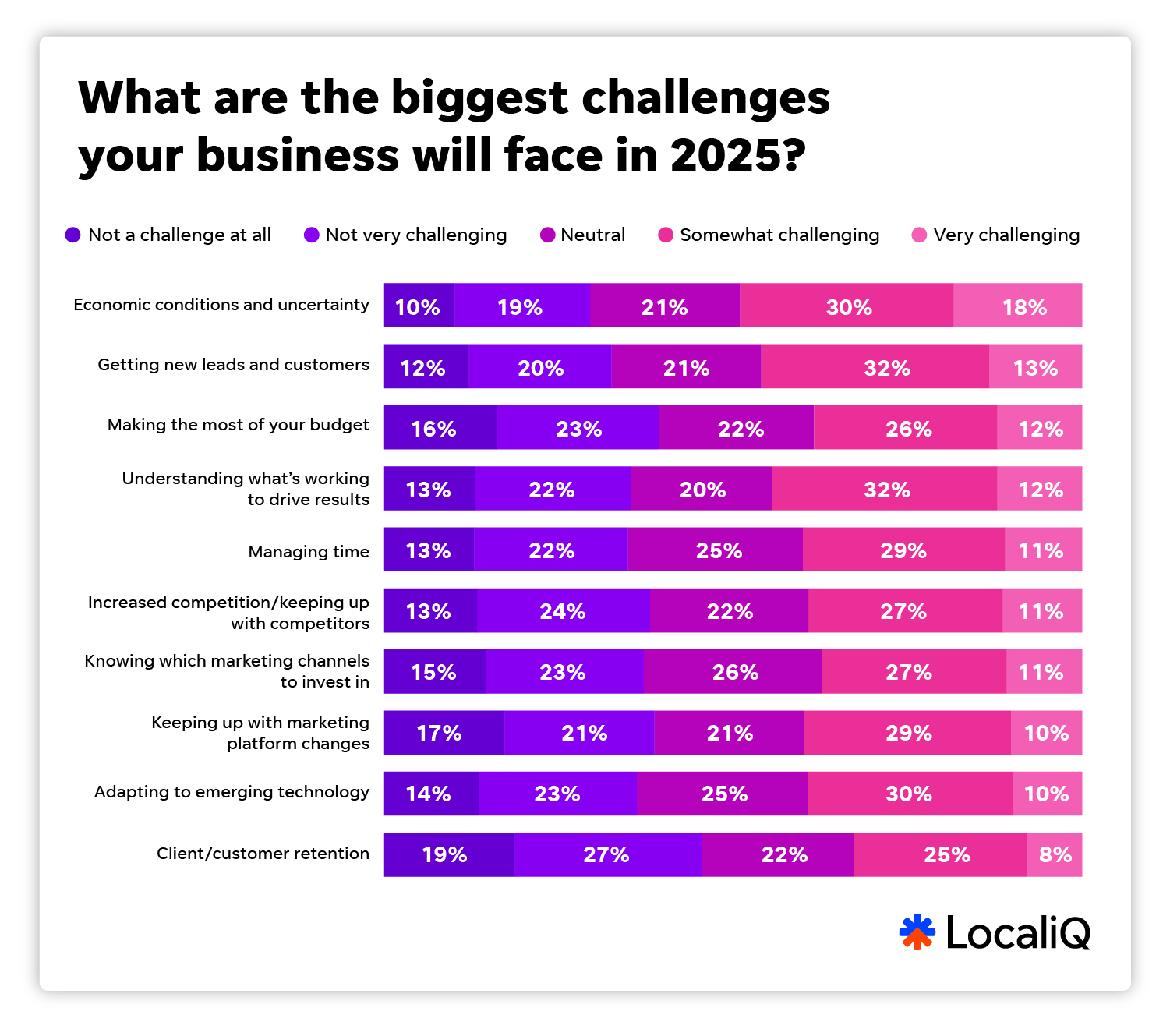
Major challenges anticipated in 2025

Freelance consultants and SMB owners know that in order to survive and thrive, a clear-eyed view of their economic landscape is necessary. Economic uncertainty, leadgen tactics that stimulate new customer acquisition and optimizing an (often modest) marketing budget are by necessity at top-of-mind. The ability to predict which marketing tactics can be relied on to produce the strongest return on investment is viewed as somewhat or very challenging for nearly half of survey respondents—44% are somewhat or very concerned about the capability of their chosen leadgen tactics to drive results. Adapting to new technology is a concern for 40% of respondents, who indicate they are somewhat or very concerned about keeping up. Furthermore, 45% of respondents are somewhat or very concerned about their leadgen tactics bringing in enough new customers and 48% are somewhat or very worried about economic conditions and uncertainty.

So, what are the recommendations for driving Freelancer and SMB success in 2025? There are no definitive answers and the suggestions offered below are not new and not rocket science. Your goal is to make money, but you could meet with headwinds for any number of reasons. Outcomes produced by your business strategies and tactics cannot be predicted but appropriate design, execution and performance monitoring on your part can be expected to yield at least modest success. Marketing and sales have a direct effect on customer acquisition and generating revenue, making these two closely related functions the money-making engine of a business venture and deserving of your intense focus. Just do it.

It’s helpful to monitor the performance metrics of marketing tactics and for that process, Google Analytics generates relevant and insightful data that enables you to evaluate your campaigns—at no charge. Sign up now! Along with leadgen/customer acquisition, make a point to promote customer referrals by asking your current customers if any of their colleagues or customers have the potential to become one of your customers. Also, create customer experience protocols that at every touchpoint anticipate and respond to customer needs end-to-end, from new or returning customer onboarding to after-sale training or other services. Finally, invite customer feedback by directly speaking with those who do business with you when possible. It’s good business to send out an email survey (maybe once a year), or chat with customers by way of social media; it’s important to learn what customers would like to see you do (or not do), so that you can optimize the experience of doing business with your company.

  • Be prepared to manage both the opportunities and challenges you encounter by being aware, being agile, being resourceful and being resilient.
  • Develop comprehensive marketing/sales strategies and implement with tactics you can expect to be effective. Regularly consult your website (and social media) performance metrics and make adjustments where necessary, to maximize performance.
  • Identify one or two local business associations and aim to attend one program per quarter as a way to obtain professional development and/or enhance your business acumen skills as you meet colleagues and engage in face2face networking that builds mutually beneficial relationships.
  • As soon as your budget allows hire an (outsourced) business accountant or bookkeeper to not only maintain the integrity and timeliness of your business financials and tax filings, but also to discuss and guide the potential business growth and expansion of your venture.

Thanks for reading,

Kim

Image: © kali9/ iStock

TikTok Countdown: Proceed to Pivot

The Supreme Court announced on Friday January 17 that it voted 9-0 to uphold the Senate-approved “Protecting Americans from Foreign Adversary Controlled Applications Act”, a ruling that defined TikTok and other apps owned by Chinese corporations that operate in the U.S. and have more than a million U.S. users as a national security risk for America and compelled ByteDance, owner of the popular TikTok social media platform, to either sell out to a U.S. company or cease operating in this country as of Sunday January 19, 2025. On Saturday night January 18, ByteDance shut down TikTok in the U.S., per the SCOTUS ruling. Site visitors were greeted with the message: “Sorry, TikTok isn’t available right now. A law banning TikTok has been enacted in the U.S. Unfortunately, that means you can’t use TikTok for now.”

Furthermore, the SCOTUS ruling prevents American companies from hosting or delivering content for the Beijing-based social media platform unless parent company ByteDance sells the platform to a U.S. buyer, or a U.S ally. A source close to TikTok reportedly said that “multiple critical service providers” indicated to TikTok that they would no longer carry the app or its data, which forced the app offline. Service providers cited fears that the ban would be applied starting Sunday January 19, despite Biden administration signals to the contrary. The app went dark on Saturday January 18 about two hours before the shutdown deadline and as of Sunday January 19, the TikTok app was not available at the Apple App Store or the Google Play store.

But in true soap opera cliff-hanger style, TikTok did not remain offline in the U.S. for any length of time and leave 170 million U.S.-based TikTok users in the lurch. In fact, it was evident that TikTok would quickly resume operating in the U.S., perhaps inspired by a growing awareness by lawmakers of both parties that the decision to force a TikTok closure is quite unpopular. Some congressional leaders who originally championed the TikTok law are now considering delaying enforcement. So, Washington is setting up to pass the buck—surprise!

  • A U.S. official has confirmed that the outgoing Biden administration would not force TikTok to cease operations in the U.S. on January 19 and will allow the incoming Trump administration to implement the law.
  • In a TikTok video, platform CEO Shou Zi Chew asked President-elect Donald Trump to find a solution that keeps the site available in the U.S. Trump said he would “be making the decision” about TikTok and confirmed that he discussed the platform with Chinese President Xi Jinping. In a phone interview with NBC News on January 18, the President-elect confirmed that he would “most likely” delay the TikTok ban for 90 days after he takes office on January 20 but added that he had not yet made a final decision. Incidentally, Mr. Shou expects to be in attendance for Trump’s inauguration.

What would a TikTok ban look like?

OK, so what might the world look like for TikTok users if the unthinkable happens and the site really is banned in America for a significant length of time? Before going any further, let’s confirm that it will not be illegal to have TikTok on your phone. TikTok has been banned in the U.S. as of January 19, but it’s not illegal to keep the app on your phone or other devices.

  • No new downloads: TikTok was removed from app stores on January 19 and aspiring new users were unable to download the app. Current user accounts were blocked and shown the message detailed above.
  • No updates: Those who are somehow able to access the site would no longer receive updates and the site would eventually stop working properly. Functionality would diminish.

If you are one of the approximately 7 million U.S. residents who use TikTok one minute videos to promote a business, you are advised to act now to protect your entity. President Trump‘s vow to keep the app available notwithstanding, the clock really is ticking and this drama is your wake-up call. It’s imperative that you be proactive and prepare to pivot into Plan B and develop actionable strategies that enable the transfer of your business marketing functions out of an exclusively TikTok arrangement and into a safe, multichannel harbor. Whether or not there is a prolonged TikTok shutdown, keeping all your eggs in one basket has always been risky and is nearly always inadvisable. There is strength in diversity and that’s our mission today. Let’s discuss Plan B—your pivot and survival strategy.

“We have to save it”

As you’ve heard, the TikTok shutdown was in effect for just 14 hours and President Donald Trump pledged to issue an executive order following his inauguration and give TikTok a 75-day reprieve before the SCOTUS law goes into effect, saying that “We have to save it.” President Trump suggested that a 50% American ownership of TikTok is his preference at this time. If TikTok plays a vital role in your marketing campaigns, you can breathe again—-but this soap opera isn’t over yet and you would be wise to use the 75-days to get your house in order.

1. Build and optimize your own website

You relied on TikTok and don’t have a business website, you say? You should protect yourself and take control now, by way of a DIY site-building (and tutorial assisted) project or by outsourcing to a Freelance web developer colleague whose references you’ve checked, so that you can create a website solution that’s customized to fit the needs of your business venture. The only online platform that you completely control is your website. Social media platforms belong to the company that owns them, meaning that your TikTok content actually belongs to ByteDance and your Facebook posts belong to Zuckerberg. If that thought doesn’t motivate you to create a functional website for yourself, I don’t know what will.

On your website, you own and control your marketing content and can also sell your products and services, post customer surveys and calls-to-action and, maintain a sales/marketing funnel for inbound customer appeals and, best of all, you’ll own and control all customer data that you collect and maintain because the site is yours. Keep in mind that your website can and should be designed to function as the primary hub for all activities that drive customer engagement and transactions of any kind. Furthermore, be certain to enable site cybersecurity and configure https in your website address, which is the secure version of http, the primary protocol used to send data between a web browser and a website. The principal motivations for https are authentication of the accessed website and protection of the privacy and integrity of the exchanged data while it is in transit.

2. Develop a robust email list

Congratulations to you if your TikTok following is significant—but during the site shutdown, all of your customer contact info was Missing In Action, beyond your reach. Because email marketing remains a powerful resource, act now to find an alternative platform that gives you control of your most important piece of customer (and follower) data—email addresses. Investigate and compare email marketing platforms and get started ASAP. Once you’ve selected a provider, create opt-in forms to grow your list as you continue contacting and nurturing your relationship with your loyal base of customers. Your email list is how you own your audience and you must be able to support mutual communication between your audience and your company.

3. Diversify your online channels

Don’t be complacent and let yourself remain a one-trick pony. The TikTok drama reminds us all that social media platforms you rely on today might be gone tomorrow. A good defensive strategy is to spread the wealth and consider multiple channels for your content and customer outreach, guided by the platforms your target market follows. TikTok followers are obviously visual and gravitate to videos, so think Instagram Reels, YouTube Shorts and Facebook for your Plan B pivot into multiple channels—plus your website, which will be the gatekeeper of everything. Pinterest, a visual imagery search engine, could be another useful marketing channel that your customers and prospects like. Diversifying will give you better control over customer engagement and monetization, so instead of betting the house on a single platform, spread your bets.

4. Create a viable sales/marketing funnel

Why not launch your pivot by creating landing pages that lead prospects and other followers to sales/marketing funnels you’ve established on different platforms and advertise your powerful new online presence? It will also be good for brand building to give prospects (followers) and customers a reason to connect with you outside of social media — whether it’s a free e-book, a special offer, or a chance to join a community of customers and followers. You could do well to check out Constant Contact to automate those funnels and turn prospects and followers into active customers.

5. Use SMS marketing to connect instantly

SMS marketing (text messages) can give a jolt to customer outreach. You can invite your email list members to opt-in for real-time updates (always request permission, even if you send the first message without asking first) and exclusive offers via text. This tool can be one of your most powerful ways to stay connected with your target market and reach them instantly. For example, a strong SMS list can boost sales conversion rates of limited time special offers and also lift attendance at your webinars and podcasts where you are a guest or the host.

Thanks for reading,

Kim

Image: ©Shopee Mobile Malaysia Sdn.Bhd.

Get Multi-Channel Marketing Right

Much has been written in recent years to extol the virtues of multi-channel marketing. Business owners and marketing department leaders are urged to create a consistent, unified message/ story for their company and its products and services and blast that message to a broad range of media outlets and platforms, the better to reach as many target customers and prospects as possible.

That’s excellent advice as I see it, but there’s more for marketers to consider. The noise level in the 21st century marketplace is so overwhelming and calls for clearly defined strategy and execution plans if you expect to achieve the ROI you want. A one-size-fits-all mindset isn’t going to work.

Because storytelling and messaging are the heart and soul of marketing, a more precise and effective method of using multi-channel marketing is needed to fully realize your marketing objectives when communicating with various audiences through multiple marketing channels. To get the most out of your marketing campaigns, define the purpose of the message/ story you’re putting out to your niche audiences and understand the reach of every outlet and platform you intend to use.

For example, recognize that the purpose, message and platforms that are most suitable for PR/ brand promotion will differ somewhat from the promotional strategy you’ll follow when the objective is to drive sales, announce that you’ll speak at the Rotary Club next month, or grow your blog audience. Read on to get useful ideas on how you might approach some typical marketing agendas.

The objective is PR/branding

So you’re trying to persuade a media outlet to mention you in an article? Start by reading few issues or posts, so you’ll get a feel for the topics covered and know who writes articles about your subject of interest. Next, call and email the business editor and pitch your proposed story. Articles must have a story theme that could be of interest to readers. Popular themes, I’ve noticed, are wellness initiatives, participation in a community event that’s sponsored by a popular local charity and green/ environmentally supportive business practices.

Your objective to receive earned media exposure is to build your brand through name recognition and enhance your company reputation by publicizing the good work that you do. I’m sure you understand that singing the praises of your products and services would be the wrong message for this agenda and requires a different emphasis for your marketing message/ story.

The objective is selling

When selling is your focus, the marketing message/ story will speak to decision-makers and key stakeholders, including end-users. Addressing the most common and dramatic pain points for the use of your product or service and emphasizing the most desirable outcomes is a must.

Marketing messages expressed by way of content marketing such as case studies, a workshop you’ve presented, an article you’ve written, or a webinar or podcast in which you appeared can build trust and confidence by letting you showcase your know- how.

The marketing message/ story will paint a picture that helps prospective customers envision how the features and benefits of your product or service can efficiently address their purpose for using what you sell. Testimonials and on- line reviews also speak convincingly to decision-makers in this instance.

The objective is repeat business and referrals

Customer retention and referrals can be enhanced and encouraged when customers feel valued and part of something bigger than themselves—-a community. Social media is tailor- made for this aspect of your multi-channel marketing strategy.

If your customers skew younger, Tik Tok and SnapChat are ideal platforms for posting videos that make a memorable point in just 60 seconds—- a one minute movie! Twitter is great for posting updates, the platform you use to remind your audience that tomorrow at 4:00 PM they should tune in to your webinar or podcast. Facebook and Instagram are great places to tell stories with photos and longer videos. That’s where you give brand fans a behind-the-scenes look at you and your team and let people get to know you a bit.

Your customer retention and referral marketing message/ story will be subtly different from the PR and selling scenarios. Brand enhancement will incorporate your values and social responsibility but will also subtly reinforce the results achieved with your (first-rate and reliable) product or service, after- sale support and customer service, The story presented will be a feel-good, but you’ll want to embed a purpose and a gentle call-to-action. Come back to see us again and tell your friends!

Thanks for reading,

Kim

Image: An auctioneer in action at Sotheby’s in New York City.

Meeting New Clients When They’re Virtual

As we journey through the COVID business landscape, B2B product and service providers have mostly found that the process of selling to their current clients has successfully been transferred to virtual methods, that is, videoconferencing and the telephone. But the biggest shortcoming of virtual communication is revealed when the goal is to meet and cultivate new clients.

As business (and education, government, fitness, worship, et al.) has transitioned to remote functioning one glaring truth has emerged— it’s much easier to shift existing relationships into virtual mode than it is to create new relationships, business or personal, by way of Zoom. That’s especially true in B2B sales. While many Freelancers and other business owners and leaders have directed resources toward strengthening existing client relationships, facilitating new client acquisition has folks wringing their hands.

It’s been conclusively demonstrated that it costs at least five times more time and money to acquire a new client than it costs to maintain a current client, but it remains a fact that every business must put into motion a client acquisition strategy. New clients represent the potential for future growth and they are an essential component of a healthy business ecosystem.

The problem is, relationships are more easily created during face2face interactions and we’re just not able to meet people anymore! The lockdown has either closed or severely restricted nearly all public gathering spaces. Video and voice calls keep us connected, albeit at a distance, but those relationships are in many cases already established.

So our question of the day is—-how can a business effectively grow its client list when access to new prospects is unexpectedly limited? Let’s consider some alternatives to the once customary networking formulas.

Low hanging fruit and a system reboot

Mine your client data, knowledge and relationships to discover how you might persuade those with whom you’ve been doing business to do more business. Find the low hanging fruit on a tree familiar to you. In some instances, it may be necessary to reboot certain relationships if clients were forced to cease or curtail operations due to the shutdown and its aftershocks.

Create reasons to contact clients whose organizations were adversely but not fatally impacted, perhaps by emailing COVID business resource information as a conversation starter. While trading emails or calls, you’ll be able to inquire about the location of where business is now conducted—in the office or from home.

Ask those clients how they’re responding to the COVID environment and listen carefully for a way, however small, you can help get his/her company up and rolling again. You may rewarded with a handful of billable hours as conditions improve. This strategy is working for me, BTW.

Conversely, some businesses are experiencing growth during the pandemic and you should make it a point to identify those organizations and include those for whom your products or services can be a fit in your marketing efforts. Maybe you can get a referral from a friend, family member, or client?

Encourage referrals

Referrals confer to you the golden status of being considered a known and trusted quantity. Other than a Super Bowl ad, there is no better endorsement for your business than a referral. People who read reviews of books, movies, restaurants, or hotels are in reality searching for a business whose customers give it good referrals.

Create the conditions for good word-of-mouth about your service by excelling at superior customer service at every client touch point. Present a 360 degree pleasant and efficient experience from the intuitive navigation of your website, the relevance of your content marketing posts, to your follow-up and willingness to go the extra mile to provide the necessary solution, to your project proposals and invoicing.

Give your clients lots of good things to say about doing business with your organization. Ask them to spread the word. On client invoices, offer a 15% or so discount on their next invoice if a referral is made and a sale results.

Case studies and testimonials showcase how clients feel about your finest work. They are a form of referrals and business owners and leaders are advised to include such valuable endorsements on the company website and on social media platforms.

Get found with Inbound Marketing

Revisit your understanding of the ideal clients for your company’s products or services. Do you know who the decision-makers is? Do you know who is likely to influence the decision-maker and other important stakeholders? When writing your content, it’s imperative to know to whom you are speaking.

With a heightened sense of your ideal client in mind, evaluate, refine and expand your company’s online presence and popularity with content designed to fill the sales funnel with prospects who have authority, who make decisions, who have influence. Create email marketing subject lines that catch the eye and resonate with those prospects. Align your white papers, blog, newsletter and case studies to address goals and questions that are meaningful to your prospects. Appeal to what motivates prospects to take the leap and do business with you. Post content to Twitter, LinkedIn, Instagram and Facebook to expand your reach.

Finally, why not experiment with developing relationships through online communities? Investigate LinkedIn groups, for example, and search for one or two that seem like a good fit. Follow conversations and learn what active members discuss. When you feel ready, pose a question or respond to one. Whenever you participate, your LinkedIn contact info is accessible to interested parties and the seeds of follow- up are planted.

The sales landscape has changed for the time being, but the fundamentals of selling remain. If your product or service solves a problem, provides a solution, for a potential buyer, if a price can be agreed upon a sale will be made. Pursuing introductions and attempting to build relationships with new prospects in the virtual space is not without challenges but it also brings certain advantages. Geography is no longer a barrier.

Moreover, most prospects begin the buying journey online, searching Yelp and other rating sites to find out who can and cannot be trusted, cruising through social media and visiting websites that appear in the top 10 of their text or voice searches (those would mostly be big companies, for those wondering why there is no mention of SEO here).

Buyers are acclimating to the virtual space, becoming more accepting of the new normal and what it entails. The scope of relationships hatched in the virtual space may not be quite what we’re accustomed to, but I predict that both buyers and sellers will adapt as necessary to do business.

Thanks for reading,

Kim

Image: Athena, a special guest character on Lost in Space (CBS-TV 1965-1968) appeared in season 2, episode 16, of the series on January 4, 1967.

New Normal Marketing Strategies

We are all painfully aware that business and life are different now that the ambitious coronavirus has burst into the scene and shows no inclination to leave center stage. Adaptions and workarounds are our new normal; creativity, resilience and perseverance have been shifted into overdrive.

What Freelancers and business owners who are determined to win are doing is continually surveying and assessing their business conditions so that they might reasonably predict what things might look like in 6-12 months and prepare accordingly. These folks have set aside for now any products or services that are no longer viable and have honed in on how they can best accommodate the needs of clients now and into the next year or two.

Virtual communication looks as though it will be with us for a while, regardless of when a coronavirus vaccine is approved in the U.S. or other countries. Our clients have transitioned to virtual quite comfortably and until the appetite for face2face interaction reappears (prediction: 3 years), smart Freelancers and business owners are ramping up their online capabilities in every way.

Website

Update your company website to showcase those products and services that can be sold with a new normal message. What have you provided that can be sold online or reconfigured and carried out virtually? If you can add text that communicates your company’s response to your clients’ potential concerns, do so. If you can communicate how your company can help clients better serve their clients, be sure to include those reassurances.

Do you have Call to Action buttons on your website? If you’ve ever needed a way to encourage clients to ask questions and engage and build a relationship with your organization, it is now. On your website landing page and on any pages that describe products or services, a Call to Action come-on should be available to bring visitors to an online chat, telephone number that allows a click to dial, or a pre-addressed email that encourages website visitors to type a question and hit send.

Good Call to Action phrases include “Click here for more information,“ “Click here to speak with a customer service rep “ “Click here to receive our monthly newsletter,” “Click here to register for our free training course,” or “Click here to place your order.”

Content marketing

Show your empathy and understanding of the predicament that many of your clients find themselves in through the topics you address in your content marketing posts—-like what I’ve been doing in this column since the shutdown. My goal is to help you stay motivated, stay resilient, get creative and remain in business. How am I doing?

Social media

Social media is micro, it’s personal. designed for you to promote interactive communication with clients and build a community. Social media is visual and tailor-made for behind-the-scenes looks at your organization.

Draw in your clients and other followers with a few still photos or a 5-minute video of you and your team preparing for a podcast guest spot or an online course that you’ll deliver. Do you have some new, or newly reconfigured, product or service to announce? Speak to the camera and tell your fans personally.

Your clients can even get to know one another as they get to know you and your business. Demonstrating that you understand their new concerns and responsibilities gives your company credibility and that equals trust.

Marketing and more marketing

Just keep promoting yourself and your business capabilities. Can you get an article published in a business newspaper or magazine? Can you get a quote in an article? Can you be a guest on a podcast? Are you sharing and reposting your content marketing posts—-newsletter, blog, case studies, white papers—-on LinkedIn, Twitter, Facebook or other outlets?

Marketing will help you get to know your clients and prospects, allow them to get to know you and gives your organization the something extra that gets you ahead of the competition. Marketing always pays off. Make the effort, reap the rewards.

Thanks for reading,

Kim

Photograph: Kim Clark. Social Justice Warriors deliver a message that promotes their cause in a live taping at the steps of the MA State House in Boston on August 11, 2020.

Newsletters, the Jewel in the Crown of Content Marketing

Email marketing remains a highly effective way to engage and connect with clients, prospects and referral sources.  Email marketing can take several forms and according to marketing experts, newsletters are the most effective format.  There are few content marketing tactics that do a better job of attracting, retaining and even winning back lapsed clients than a newsletter that contains well-presented, relevant information that arrives on a regular basis.

Whether readers discover your newsletter while browsing your website or it’s delivered to inboxes by an email marketing service, a newsletter (or blog) will build and enhance your brand, keep your business at top-of-mind, drive traffic to your website and encourage prospective clients and referral sources to learn more about your products and services.  Listed here are building blocks that will help you create a newsletter that will reflect well on your expertise, your business and your brand.

  1. Goals   The newsletter will be one component of your overall marketing /content marketing strategy.  Acknowledging that your newsletter is the cornerstone of your content marketing strategy and that your content marketing strategy plays a leading role in your overall marketing strategy will help you to identify appropriate goals and metrics that will monitor the success rate of your marketing activities. Consider how launching a newsletter will support your organization’s marketing goals.  Are you looking to generate leads and sales? Or are you attempting to establish yourself as a thought-leader and expert as a way to build trust and attract more prestigious clients, expand referrals, get a teaching appointment, or speaking engagements?
  2. Frequency   Decide what your schedule will allow you to do in terms of researching sources and publishing original content.  Be realistic about your time, because sticking to a predictable publishing rhythm will be important to your readers.  Choose as your publishing schedule a date (like the 1st, 15th, or 30th of the month) or a day (the 3rd Tuesday, for example).  A monthly newsletter will help you to build readership most efficiently, but a bi-monthly schedule might be OK.
  3. Template   Reinforce your visual brand and use the colors and graphic style elements used in your business cards and website also in your newsletter design.  An online search will bring you to numerous free newsletter templates and email marketing services will have templates as well.  Choose a template that you like and that will be easy to read.  Readers should be able to quickly scan topic headlines.  Make sure that your template will allow you to upload images as desired. Hubspot, the Cambridge, MA content marketing firm, in a recent survey found that 65% of email marketing readers prefer images to text when reading newsletters.  It’s also important to choose a template that will give sufficient “above the fold” space for you to create headlines that encourage readers to dive in. “Above the fold” is a newspaper industry term that describes the area above the fold in the newspaper.  In a digital newsletter, above the fold refers to what readers can see without scrolling.  Place your best headlines above the fold to reel in readers.
  4. Mobile friendly   A 2018 study by Adestra, a U.K.-based email marketing service, found that 59% of emails are first opened on mobile devices but according to Marketing Land, a digital publication whose target readers are marketing professionals, only 17% of marketers regularly send responsive emails.  Take the steps to format your newsletter in responsive design, so that it will be easy to read on a smart phone or tablet.
  5. Newsletter content   Create a newsletter that consistently delivers to readers  information that they are likely to find interesting and useful.  There are those whose idea of a newsletter consists of links to articles that have appeared in industry journals, sometimes accompanied by a personally written prelude.  That’s probably OK to do two or three times a year, but I highly recommend that you research a topic or two and write 800 – 1500 words of original content.  Your newsletter does not have to exceed two pages, including photos or short videos.
  6. Subscriber base   Your mission will be to capture as many email addresses as ethical behavior allows (no spamming please!).  Take a passive approach and make it possible for readers to subscribe on your website.  Take an active approach and initiate a business card exchange as you meet people in your travels.  Mention that you have a newsletter that covers a particular topic and ask if they’d like to receive it.  If the answer is yes, then you’ll add a new name to your list.  Include an unsubscribe feature in your newsletter template.  Check the statistics of your newsletter, in particular the bounce rate and open rate.  Correct or remove bad email addresses, to keep the list clean and your statistics accurate.  According to Mailchimp, the average newsletter open rate is 20%.  However, when you publish a newsletter that consists of original content that readers value, the open rate can be much higher.  From 2012 – 2016, I was the principal author of a women’s club newsletter (I am still a member) and the open rate approached 70%.

Thanks for reading,

Kim

Photograph: Bob Bernstein (l) and Carl Woodward at The Washington Post in May 1973. The two won the Pulitzer Prize for Public Service in 1973 for their reporting on the Watergate story.  ©Associated Press

Content Marketing Survey Findings

In 2016 the PA based marketing services company Clutch surveyed 300+ producers of online B2B content to obtain insight into how readers find, engage with and act on digital business-themed content.

The Clutch Content Marketing Survey 2016 interviewed 300+ expert content marketing writers from across the U.S. to determine how those who produce B2B content can most effectively create, publish and promote content for their organizations.  Key findings were:

  • 88% of online B2B content consumers read business content at least once a week
  • 45% of online B2B content consumers read content to stay current with trends in their respective industries
  • 20% of online B2B content readers use content to help make decisions about whether to purchase products or services
  • 45% of online B2B content consumers read about technology, 24% read about small
    business and 21% read about workplace/ HR topics
  • 87% of online B2B content readers visit search engines to look for business content
  • 85% of online B2B content readers commonly find business content on social media

Robert Rose, Chief Strategy Officer at the Content Marketing Institute in New York City, emphasizes that “Content marketing is a marketing technique of creating and distributing relevant and valuable information to attract, acquire and engage a clearly defined and understood target audience, with the objective of driving profitable customer action.” In other words, the goal of your content marketing posts, videos, podcasts and images should be to develop a relationship with your customers, using relevant content to win them over.

main goals for content marketing

Furthermore, the expert content marketers surveyed advised that target audience personas are the most important attributes to consider when developing your content marketing strategy. “Most businesses have an idea about their audience and how it is segmented but, when it comes to taking those audiences into a content marketing strategy, they often flounder,” said Quinn Whissen, Marketing Director at Vertical Measures, a content marketing agency in Phoenix, AZ.

types of content enterprise companies create most frequently

Although challenging, clearly identifying and defining target audience personas is the foundation of an effective content strategy.  Understanding who will read the content determines the information to include and the best platforms for presentation.

content that performs best

Content marketing can be an effective tool for creating brand awareness and generating leads that convert to sales or billable hours, but realize also that it can generate benefits that go beyond a page one article ranking in Google or driving traffic to your website. Consider how content might help your organization to meet key business objectives.  How can your content increase sales?”

HubSpot, a marketing services firm based near Boston, MA, found that the more marketing content a potential customer reads on the company website, the more likely s/he is to buy their software.  Jeffrey Vocell, Senior Manager of Product Marketing, reports that HubSpot follows up with a customized email after a user reads three or four articles.

Metrics matter

  • Expert content marketing writers prioritize their brand story, mission statement and content types when creating their content strategy
  • 49% say that brand awareness is their main goal for content marketing
  • Research/original data, infographics, product reviews and blog posts are the most effective types of content
  • Metrics that reflect sales (32%), content readership (29%) and lead generation (29%) are more important than content sharing metrics (10%)
  • Paid advertisements outperform organic efforts when promoting and distributing content

content marketing metrics

Survey findings yield three core recommendations for content marketing:

  1. Tailor all marketing content to specific audiences.  First identify the different reader personas, then create content that matches their needs, interests, aspirations and behaviors.
  2. Identify the business goals you aim to achieve and consider how your content can enable that. For example, if you want to obtain more links back to your website, be sure to generate research/original data, infographics, product reviews, videos, blog posts and case studies.
  3. Spend less money on content creation and more on distribution.  Creating high-quality content is useless if you don’t dedicate enough effort or resources to getting it in front of your target audience.  If you can’t afford paid advertising, focus on media outreach, such as traditional journalists and influencers.

tactics used to distribute content

Regarding the most effective content distribution methods, the survey found that expert content marketers most often use paid advertisements  including pay-per-click (71%), organic social media (70%) and traditional marketing channels (69%), i.e. print media, TV, radio and direct mail.

Distribution and promotion of the content must be customized to the target audience.  For example, “If content distribution and promotion is done for recent college graduates, it has completely different channels and focuses, compared to content aimed at executives,” explains Andrea Fryrear, Chief Content Officer at Fox Content of Boulder, CO.

Finally, remember that content marketing can deliver benefits to your company that go beyond achieving a page one Google listing for an article you’ve posted or driving traffic to your website. “We don’t simply want to have an impact on marketing, but rather on the entire business unit within that organization,” said Chad Pollitt, Vice President of Audience at Relevance, an online content marketing publication based in MD.

Thanks for reading,

Kim

Photograph: Vaudeville and film star W.C. Fields as a carnival sideshow barker in Two Flaming Youths (Paramount Pictures, 1927)

Machine Learning: Coming To A Freelancer Near You

Machine learning is a ground breaking technology that uses Artificial Intelligence to allow computer systems to automatically “learn” from the patterns of the user’s online browsing choices, without the need to program the system to do so.  Many of us became familiar with AI and machine learning through movie choices offered to us on Netflix or music on iHeartRadio.  Think also of the Digital Personal Assistants Siri and Amazon Alexa, other applications of AI and machine learning that many have embraced.  Machine learning focuses on developing computer programs that can access data, analyze that data (to find patterns) and then use that information to “learn.”

Machine learning and AI are slowly filtering down the food chain from global and national corporations to regional operations.  Start-up entrepreneurs are launching enterprises that employ machine learning and early adopter Freelance consultants will soon be able to incorporate machine learning beyond what we may already be doing with Siri and Netflix.  In particular, marketing is poised to become a primary utilization of the technology, in businesses of every size.

About a year or two ago, you noticed that when you visited a particular website and then returned to Facebook, LinkedIn, or your chosen online homepage, an ad from the site you visited would soon pop up and tempt you with an offer.  The phenomenon is called “real-time” by marketing specialists and it’s driven by the data that your browsing history generates via machine learning and AI.  It’s a manifestation of being responsive to a potential customers’ interests as a way to fill the sales funnel and facilitate a sale.

To take AI and machine learning a few steps closer to ordinary mortals on planet Earth, these tools are uniquely suited to B2B marketing, because they limit the (costly) trial-and-error activities that haunt every online or off-line marketing campaign.  Now, your marketing activities, whether presented in an online display ad, social media posts, or content marketing outreach, will be seen by those whose online searches indicate that they are likely to be interested in exploring your products and services.

Machine learning, augmented by AI, will allow marketing specialists to greatly reduce the wasteful expenditures inherent in every marketing budget and direct those valuable dollars toward self-qualified leads who have a much greater potential to become paying customers.  Your marketing campaigns cannot help but become more cost-effective whether online or offline, print ads in traditional publications, banner ads on individually targeted websites, social media posts, or email marketing.

Speaking of social media posts, machine learning allows marketing specialists to monitor trending topics on various platforms, i.e., topics that currently resonate with particular market segments.  Certain of those memes can become the basis of content for blogs, newsletters, email marketing and other promotional activities.

Finally, let’s circle back to what machine learning has been doing for Netflix and iHeartRadio, which in marketing speak is called demand forecasting.  When movie and music choices are offered to you, the goal is to give you what you want before you know you want it.  Current algorithms are doing a pretty good job of doing that now, but more sophisticated algorithms are in development, with predicting accuracy refined by machine learning and AI.  What is offered will still be a guess and just a suggestion, but for many of us, at least once in a while, we’ll receive an offer that we cannot refuse.

Thanks for reading,

Kim

display.png   Happy Valentine’s Day!

Photograph: Jean Jennings (l) and Frances Bilas programming ENIAC (Electronic Numerical Integrator and Computer), the first large-scale computer to run at electronic speed   Courtesy of the University of Pennsylvania (1946)

Make Your Marketing Content Pop

Long time readers of Freelance: the Consultant’s Diary  noticed that a few months ago, I was inspired to regularly add artwork to the posts, something that in the 9 years I’ve been writing for you had been done only four times (including one movie trailer video).  Regularly including artwork with the posts occurred to me after I went to see the Tall Ships Parade at Boston Harbor one Saturday afternoon in mid-June.  I used my iPhone to take photos of those amazing ships and decided to post one on my LinkedIn site and another on a blog post.  I loved the look of the photo with the post, even if it in no way referred to what was written.  I was just giddy over the fact that I took a group of nice-looking photos, something that is not guaranteed with me! I was off to the races.

But where could I obtain interesting, free and legal images on a regular basis? In the U.S., intellectual property laws are  enforced and using the work of a photographer or painter without permission or (sometimes) payment could result in a lawsuit.

Some of you will recall that a few months ago I served as an (uncredited) editor and photo editor for a short women’s history book.  My job was to source mostly historic (and preferably free) photographs.  I visited the Boston Public Library website, which has links to Flickr and  Digital Commonwealth collections that were very helpful.  You’ll find thousands of historic and other photos on the site and nearly all have no copyright restrictions and are free to use.  BPL appreciates a line of attribution, “Photograph (or image) courtesy of Boston Public Library.”

The New York Public Library is another excellent source of (mostly) free historic photographs  Wallach Collection of Prints and Photographs . NYPL would also appreciate a credit for images used in your published content.  Be sure to confirm who has rights to the image and follow the directions for inclusion in your content.

Not every photo is free to use.  From the British Museum in London’s site (where there are hundreds of thousands of images of paintings, photographs and fine art objects), there are guidelines to keep marketers and researchers on the right side of the law  copyright and permissions . I’ve requested and received permission for three or four photographs.  Lucky me, I obtained those permissions within 24 hours, but if a photographer or other artist is deceased and the work is now controlled by a foundation, it could take a month or more for the board to review your request and make a decision. BTW, copyright and IP laws are applied more loosely for a blog or newsletter that features no advertising and more strictly for a book.

When looking for free contemporary stock photos, you’ll find 200,000 mostly in color on Unsplash .  The photographers would appreciate a credit line and a thank you sent.  Morguefile  is another site that I’ve successfully used, with its 350,000 mostly color photographs to comb through.  Be aware, however, that stock photos often do not resonate with viewers, even if what you find illustrates the story you are telling.  That is why most of my blog photos are fine art paintings or photographs.

The images that you include in your newsletter, website, blog, ads, or social media should reflect your brand and reinforce the story you tell.  Searching for appropriate images is time-consuming, but I consider it time well spent.  You, gentle reader, are well worth the investment.

Thanks for reading and Happy Thanksgiving,

Kim

Image: Freedom from Want (The Thanksgiving Picture)  Norman Rockwell, 1942   Courtesy of the Norman Rockwell Museum, Stockbridge, MA


Survey Discussion: How Freelancers Market Our Services (2016 – 2017)

Today we have recommendations on how Freelance consultants and small business owners can implement as needed the results of a survey of 1,700 of our peers that was conducted in December 2016 by FreshBooks, a Toronto company that sells cloud based accounting solutions designed for Freelance professionals and small business owners http://FreshBooks.com .

Given the limited time that Freelancers and small business owners have available to devote to new client acquisition and once we’ve accepted the fact that the pool of new clients must be constantly replenished, it is essential that what we do has a very good chance of delivering the necessary results.

The survey indicates that devoting one’s marketing activities to tactics that are ranked as highly effective across all three age cohorts and then diversifying the tactics utilized, has the potential to reap tangible benefits for all age cohorts, despite the fact that each has a clear preference for certain activities and an ROI track record to defend those practices.

Exceeding client expectations of the work you are hired to do is the recipe for obtaining referrals from satisfied clients. Building relationships with peers that you meet at the chamber of commerce, on volunteer boards, at the gym, or at your religious institution, for example, is often a highly successful marketing and business development tactic for Baby Boomers, with 67% relying on referrals to find new clients. The ability to obtain referrals from business and personal relationships will become more accessible to Generation X and Millennials over time, as their personal and client relationships expand.  There is no more effective advertising than word of mouth.

Millennials have made hay with content marketing tactics and 42% of the age cohort use that marketing tactic. I will guess that a certain percentage of what is called email marketing, which has an adoption rate of 24% across the three age groups, overlaps with content marketing because email is how newsletters are sent. Generation X and especially Baby Boomers are advised to step up the use of content marketing if for no other reason than several surveys have demonstrated its satisfactory ROI.

Content marketing is poised to surpass the use of paid advertising because it seems that B2B prospects find advertisements insufficiently credible or engaging and they have gravitated to the brand story approach that is content marketing. Commissioning a marketing case study to put on one’s website and can be used in other marketing activities, is another highly effective method of content marketing (but it is not inexpensive).

Public speaking in the form of teaching, speaking, training (and I will stretch to say it also includes podcasts, webinars and appearing on a panel as speaker or moderator) is acknowledged by 39% of  survey participants across all three cohorts as being a highly effective marketing tactic and I respectfully suggest that you adopt the practice if you have not already done so.

It may be a little intimidating for Millennials to assume the role of expert, but appearing as a guest on a webinar or podcast seems less of a stretch than teaching business courses or speaking at professional association meetings. Your diarist is in the Baby Boom generation and I’ve done a fair amount of teaching and speaking over the years, but I’ve never directly received either a client or referral from any engagement. Rather, prospective clients are always seem impressed when I mention those activities, so be advised that you may see your teaching and speaking ROI indirectly.

Finally, since the survey explored financial management, we might pause and consider that topic as well. While only 20% of survey responders financed their businesses with bank loans, that doesn’t mean that they don’t need help managing the business finances (and their personal finances).  One third of the responders has a relationship with a bank and yet 52% report that they feel big banks are not a good fit for small business owners and Freelance consultants.

Survey findings indicate that Freelancers and small business owners with the greatest financial acumen operate the most successful ventures and enjoyed self-employment the most.  That description applied to 25% of responders.  Overall, responders are wary and uninformed about new financial software that might help them better understand and optimize their financial record-keeping data and learn how to use either what they already own, or software they could buy, and learn to understand and manage the financial aspects of their businesses.

The FreshBooks people recommend that Freelancers and small business owners invest in financial management training.  Courses are either regularly or sporadically available at adult learning centers, libraries, business networking groups, professional associations and the Small Business Administration.  https://www.sba.gov/business-guide/manage/manage-your-finances-business-credit

Thanks for reading,

Kim

Photograph: Falmouth (MA) Road Race August 21, 2016 courtesy of Joseph Cavanaugh