2025 Year-End Business Report Card

Reflecting on the waning year is the best way to give yourself an honest and very helpful big picture understanding of what occurred in your business. You will come face2face with planned initiatives, unexpected opportunities and risks that paid off, or at least broke even, and those that, unfortunately, failed to fulfill your hopes. , and what you might adjust to reach your 2026 goals. A year-end review suggests which strategies will likely build on successes, gives insight into what you should eliminate, as least for now, and what might come through for you in the new year, perhaps with some adjustment. A year-end review encourages productivity that brings good results by helping you move forward and build momentum—and ensuring that you avoid reinventing the wheel or repeatedly start from ground zero, which is sure to slow your progress. 

Review the year in business

When reviewing the past 12 months of your business, there are a few questions and metrics that will give you a good baseline of what you would be wise to pursue, adjust, or eliminate during the upcoming year.  After answering these questions, you can more effectively map out your goals for next year. Set attainable, data-driven targets that challenge, but are also within reach. This is also a great time to identify if you might want to outsource certain functions in the next year to help you reach your 2026 goals.

  • How many projects did I work on?
  • What was my total sales revenue?
  • What were the sources for these deals? (e.g., referrals, networking, social media, website marketing funnel)
  • On a scale of 1-10, how would I rate my new client prospecting efforts?
  • How consistent was I with marketing—blogs, newsletters, webinar appearances, social media? Did I create and follow outreach strategies or was it intermittent?
  • What could I have done better in terms of marketing?
  • What did I do exceptionally well that contributed to my success?
  • What area did I struggle with the most? (Hint: this may be an area to either get help with or improve in 2025).

Evaluate performance of lead generation strategies

  • Inbound marketing continues to be an absolute requirement for B2B growth. Creating a consistent stream of leads is very important if you want to build a business that is sustainable and that you can scale and grow. The goal is to invite a steady flow of leads from different sources. Inbound marketing is considered the most practical and method for keeping your pipeline filled with prospects who are curious about your services or products. Inbound marketing is also efficient, with numerous marketing studies confirming that inbound marketing campaigns and activities generate about 54% more leads than outbound marketing. Furthermore, inbound marketing costs up to 62% less per lead than traditional outbound marketing. In 2026, inbound marketing appeals are predicted to remain the primary source of how B2B buyers themselves expect to discover, evaluate and shortlist vendors, as 80 % of all B2B sales interactions will take place across a spectrum of digital channels, from company websites to social media platforms. Think of inbound marketing content and activities as a magnet that pulls in already-curious prospective buyers. The purpose of inbound marketing is to educate, build trust and generate qualified leads by providing valuable, problem-solving, content. Be advised that most of the buyer’s journey unfolds long before a prospect reaches out to a select group of potential vendors to obtain deal-sealing (or deal breaking) information. Those on a serious buyer’s journey already have a list of key questions to ask, to discuss and learn about the particulars of a service, or would like to see a product demonstration. Note that inbound marketing leadgen results in the prospect initiating contact with companies that look promising as they define it. The content you create (or fail to create)—stories, education, testimonials, case studies, conversations—determine whether you’ll be chosen to make the prospective buyer’s vendor shortlist. Review and assess your inbound marketing activity and confirm which campaigns were the most successful and which may benefit from a reworking. Your inbound marketing activity most likely includes some of the following activities.
    • Thought leadership (producing relevant and valuable information—e-book, case study, webinar or podcast appearance, blog, newsletter)
    • Sales/marketing funnel (company website)
    • Social media posts (text or audio/visual formats)
    • Referrals
    • SEO search (company website)

  • Outbound marketing content and activities enable you to broadcast your pitch to everyone in your chosen target demographics. The style is push: you/your brand initiates the contact with prospects whether or not they’re hyper-local in-market as you disseminate your message (“This is who we are and why you want to know us”). Outbound marketing methods are typically promotional—attention-grabbers, such as cold emails and direct mailings (recipients are often taken from membership or other lists), conference or event sponsorships, paid display advertisements/ paid social media ads.
    • Public speaking (guest speaking, teaching, panel/moderator) 
    • Face2face networking events (business groups or social gatherings)
    • Email updates
    • Participating in community charity events 
    • Paid online leadgen (pay-per-click)

Create a content calendar and map out marketing campaigns

Planning and scheduling your content is one of the best things you can do for your business—and your time and creativity. There are a few ways you can look at the year and decide the message of your content. Readers who have been with me for a couple of years or more will, for example, recognize that in late June – early July, I publish an annual Summer Reading List, which consists of 10 business and leadership-themed books that should appeal to those who are independently employed, whether as Freelance consultants or small business owners. Certain books might also appeal to traditionally employed executives in either the for-profit or not-for-profit sectors. In late November, I publish a December holiday client gift suggestions list.

Which events that occur in your industry might serve as focal points for your content? Could it be “back to school,” which could prompt you to present related content in August, or the arrival of a season—wintertime skiing and ice skating, an early spring marathon, an annual national conference that is regularly attended by members of your core target market, or Small Business Saturday in November?

When you develop a plan now, you can expect to emerge with a draft that you can finalize as you get closer to scheduled target dates for your content. Your content calendar draft will support and encourage you to publish relevant marketing content that’s timed to maximize its impact. Planning is so much better than flying by the seat of your pants!

Budgeting

In sum, the year-end review of your business entity can be a catalyst for growth and success. It encourages continuous learning and improvement and inspires you to think and act proactively. Your year-end review is among the most effective processes you have to evaluate the overall performance of your venture and by so doing, give yourself an opportunity to learn from successes and failures, make informed decisions and set challenging, yet realistic, strategic goals for the new year. In your review, you can analyze your 2025 actual spend against your budgeted expenses. You’ll be able to identify spending variances and learn why budget targets were exceeded. Insights from your 2025 budget review will assist in building realistic budget forecasts for 2026.

Keep in mind that forecasting is about anticipating the funding you’ll need to implement marketing campaigns, as well as paying for business operating expenses, from bookkeeping expenses to business association member dues to purchasing customer relations software to enhance your marketing functions. One hand washes the other when your leadgen marketing funnel brings in the revenue that enables you to operate at peak performance (as you define it)!

So—how did your budget and business expenses line up in 2025? Consult your financial statements— Balance Sheet, Profit & Loss (Income) Statement and Cash Flow Statement and conduct a financial health assessment of your entity. These documents provide a snapshot of your company’s assets, liabilities, equity, revenues, expenses and profits throughout the year. It would be a great idea to discuss company financials with your business accountant, to get his/her perspective on how to enhance your company’s sustainability and financial possibilities. Why not send an email now and get a meeting on your January calendar?

Happy New Year and thanks for reading! I look forward to greeting you in 2026.

Kim

Image: © Freepik

8 Freelance Business Ideas To Become Your Side Hussle or Full-Time Enterprise

Many people dream of being their own boss and starting a business entity of their own. Operating a business entity that’s based in your home or a co-working space, interacting with clients in their environment or by videoconference, you’ll gain more control over your professional goals and financial aspirations than is possible as an employee. Self-employment may also allow you to achieve a more desirable work-life balance (but there may be lots of hard work to do before that can happen).

OK—so thoughts of entrepreneurship, probably on a small scale, maybe part-time at first and full-time at some point, is a growing presence in your conscious thoughts. But while you’re ready to explore the possibility of starting a business, do you know the services or products you’d like to provide? To assist your decision-making, you’ll find below eight Freelance micro-business possibilities that are intended to help you clarify your goal and chart a path forward.

Some of these opportunities require significant work experience, educational or professional credentials. Some can be started from home on the cheap, while others require dedicated office space and capital investment. I’ve intentionally omitted the usual suspects—such as website building and design, social media marketing, search engine optimization, or marketing content writing—because you can think of those choices without my input. I’d like to get you thinking about the road less traveled (which just might be dog walking!)

To ensure that you choose the right business venture for yourself, it’s crucial to consider a few factors before you pursue a Freelance sole proprietorship. Consider this post as an exercise to evaluate, rule-out and finally recognize what may could have potential to be a good Freelances business venture idea for you and worthy of follow-up?

What are your credentials—work experience, education and competencies?

For instance, if you already have a CPA license, venturing out as a Freelance accountant would be a natural avenue to explore. If you have experience as a writer, you might consider editorial services, or if you’ve spent years working in the food and beverage industry, you could explore catering or becoming a personal chef. You don’t need me to suggest those options if you own the corresponding credentials and work experience. The list below is to present options to those of you in the “what about this” early phase of possibility.

As you explore your options, consider whether special licenses (for example, hairstylists and electricians) or if the work requires additional education and professional certifications. There is also the necessity of relationships. In some fields, access to clients is defined by who knows (and trusts) you and without that currency building a viable business may be impossible.

Determine the goals of your small business—how hard do you want to work?

For some people, launching a Freelance entity or other small business involves the risk of leaving full-time employment and saying goodbye to a weekly check that produces a predictable and dependable amount of money (even if it’s borderline inadequate), along with vacation pay, sick time and paid holidays in order to commit to the new endeavor. For others, a Freelance entity will be a side hustle gig, a part-time thing that’s meant to deliver a meaningful supplemental income, managed in addition to the primary income. The new enterprise might also provide a creative outlet as it improves your cash flow and grows your bank account.

Consider how much money you’re hoping to earn from the business, how many clients/ customers will be needed to make the venture become profitable and how many hours you’ll need to work each week to make it feasible. In other words, about how much revenue will you need to earn by, say, the 24-month mark to feel that the work involved to keep things going is worth it?

As you conduct further examination of a business idea that might be promising, be certain to research the amount of money needed for start-up and business maintenance (working capital) expenses. For example, if additional education, certification and licensing will be required (or helpful to attract clients) how much will it cost and how long will it take? How much money must you invest to obtain or manufacture the product you’d like to sell?

Time is a resource and must always be a factor in calculating business expenses, start-up or operating. If your projected time frame for the launch is five years or more, then obtaining a master’s degree and gaining three years or more work experience, or saving money to put toward the purchase of equipment or other serious financial investment, may be perfectly acceptable. However, if you’re thinking of opening your doors in 2026-2027, you’ll want to minimize your investment of time and money and choose your business venture accordingly. Regardless of your vision of entrepreneurship, it’s a good idea to create a written business plan to use as your road map from business idea to business launch.

Study your location and identify what’s most feasible there.

Finding customers/clients is essential to every business, so conduct a market analysis before you open shop. For instance, a business as a foreign language translator and interpreter will be more profitable if you live in a community with a significant international population. You should also research what businesses already exist, that is, research the competitive landscape. Are there very few foreign language translator/interpreters in your market? Or is there a glut of the those professionals in your town?

Surprise—competitors are a good sign (up to a point). If you have essentially no competitors, it could be that there is little money to be made. On the other hand, a glut of competitors may leave little opportunity to find clients for yourself. This is why market research is a must-do.

Decide if you want to offer an online or in person service or sell e-commerce.

The digital age has created many opportunities for entrepreneurs to run a business from behind a laptop, meaning that their enterprise can operate wherever reliable internet access and potential customers are available. That’s not for everyone, though. If you prefer, and are able to finance, a brick-and-mortar shop or office that’s located in your community because you are more comfortable interacting with clients and customers in person, then launch a business that allows you to operate in that environment.

  1. Launch a YouTube channel

If you have a topic that allows you to consistently produce content that appeals to a broad viewer audience, you may be able to monetize your YouTube popularity and create a revenue stream. (see the best audience-building practices here.) Advertising revenue is the most common way to monetize YouTube programming. Additionally, you can add to your income by selling branded merchandise, creating ticketed live events that you’ll hold in locations where you have created a sizeable fan base, or by creating sponsored content.

Your earning potential will vary based on subscriber count and video views, demographics and ad engagement. On average, creators earn about $1 to $5 per 1,000 views after YouTube takes its 45% cut. Most YouTubers will top out with a nice side hustle level of earnings, while superstars are capable of generating millions of dollars.

2. Private Sport Coach

Active adults and children alike often seek athletic instruction that provides more sophisticated techniques than they can learn in group formats offered in gyms or at school. If you’re highly skilled in an athletic discipline, you can help take athletes to the next level and maybe put them on the path to turning pro.

  • Golf
  • Tennis
  • Diving
  • Skiing
  • Ice skating
  • Swimming
  • Horseback riding

Your qualifications should include significant coaching skills and experience in order to convince prospective clients that you are prepared to deliver high-level instruction. Depending on the communities in which you’re coaching, you may need to develop strategic relationships and/or have a good idea of where and how to advertise your expert services to ambitious students who are looking to raise the level of their game.

 3. Dog walking, boarding, training

If you have a flexible schedule and can make multiple house calls, you may be able to generate significant revenue as a dog walker. Dog walkers take pooches out for their daily constitutional walks one or more times a day, individually or in small groups.

In some cities, like New York, dog walking alone has become be a thriving business. However, it’s more common for dog walkers to offer additional services, from feeding the pets to visiting dog parks and other spaces that give four-legged customers playtime and/or providing socializing behavioral dog training.

Because people seldom take along their pets when they travel, pet daycare and overnight/ extended stay boarding spaces have become big business in some locales. Freelance dog walkers and trainers are known to make decent money by offering a personal pet-sitting service — either by staying at the pet owner’s home while they pet are out of town, or by caring for pets at your place.

Launching a dog walking and pet-sitting/boarding service requires almost nothing in start-up costs. Your list of credentials should include personal pet ownership — if not currently, then the past — and other pet-related experience. You should also collect referrals and testimonials from pet owners whose pets you’ve previously cared for.

4. Gift Basket Designer

December holiday gift baskets are a huge industry and featured in nearly all holiday gift suggestion lists, including mine. Finding a niche is the best way to start out in the gift basket business. Are you a dog-lover, horse enthusiast, exercise guru, or one who loves pampering and can assemble baskets that hold the things that people with this interest would like?

Do you already create a product that a gift basket could be built around? If so, you could create custom, themed gift baskets that can be shipped across the country or sold in local stores.

5. Foreign Language Interpreter and Translator

In communities with international populations, dependable interpreters and translators are considered quite valuable and assignments are often plentiful. If you already speak one or more languages in addition to English, and you are highly fluent in those languages, you may want to invest in the process of becoming a Freelance foreign language translator and interpreter and you may be able to generate a healthy revenue stream.

Foreign language translators/interpreters are typically certified, by successfully completing a language competency course that involves 40 – 60 hours of training. From there, professional translators/interpreters can determine the specialty niche that you would like to occupy—for example, business, government, technical, medical, or legal. Build a portfolio to showcase your expertise in your preferred niche and surf the job boards to search for work opportunities.

Because translating written materials from one language to another is a significant part of the work, ensure that your reading comprehension and writing skills in your specialized language(s) are at a high level. Translation requires reading and understanding a text thoroughly so you can communicate the context of the material when converting work to another language.

6. Resume Writer

The use of Artificial Intelligence and rounds of lay-offs that periodically dominate the news have encouraged many workers to polish up their resume and prepare to shop it around. If you have the judgment to know how to choose and showcase the skills that attract HR employment specialists and/or hiring managers, as well as possessing a talent to skillfully include those key words that influence the first-round of the candidate selection process, then resume writing may be a lucrative Freelance full-time or part-time enterprise for you.

The art of writing a confidence-building cover letter is another competency that you should hone, to use for clients who need a resume for one or more specific jobs. The ability to craft a cover letter that aligns with the job specifications and your client’s qualifications enhances the success rate of your clients and helps you ask for testimonials that will grow your business (and allow you to increase your fee).

To sharpen your skills and get familiar with what grabs the attention of prospective employers, spend a few months applying for Freelance resume writing assignments on Upwork or Fiverr—it will be a very instructive paid internship for you.

7. Onsite bicycle repair

Bicycles continue to grow in popularity, spurred on by those who want to promote a clean environment, and minimize the use of fossil fuels, as they commute from point A to point B. Riding a bike achieves that those objectives, but it also creates a need for bicycle maintenance—and that could be an opportunity for you.

Obtaining access to a garage or other work space where you can safely store your tools of the trade and also enable you to efficiently perform complex repairs that would be too difficult to execute onsite in a customer house call will most likely allow you to grow your customer base. Then again, house calls to customers may have lots of potential as well, especially for Freelancer bicycle repair experts who plan to operate in a densely populated city or metro area.

If you’re able to access to a somewhat large and secure space, consider offering to store bicycles during the winter months, when cold winds and icy roads take away the pleasure and practicality of bicycle transportation. Bicycle repair is likely to be seasonal in most parts of the country, due to winter snow and cold, but you may find many clients from late March through November or even mid-December but those with the right space accommodation can make money on both ends. If your area is populated with a large cycling community, you might be able to buy and sell reconditioned used bikes and add some revenue through a retail channel, in addition to your repair business.

Finally if you work on weekends, you might consider arranging and promoting cycling meet-ups, that can do very well in locales with a large and enthusiastic cycling community. You could hire someone to act as a regular or occasional distance bike ride leader who might offer midnight rides in the city or daytime rides on country roads.

8. Smart Home & IoT Integration Services

Smart home adoption is growing and thriving, with projections that 75% of US homes will have connected devices by 2026. Consulting with prospective clients, system set-up and support services for smart home and( Internet of Things) IoT devices, especially for seniors or disabled users, could be a profitable Freelance business idea for 2026 and beyond.

Homeowners, property managers and small businesses are interested in customized solutions for, especially, home and business physical security and energy efficiency. Recurring service fees and maintenance contracts provide you with a steady revenue stream.

Surprisingly, those who are 60 years and older are interested in IoT smart home technology, as a way to improve the possibility of remaining in their homes as they age. As technology becomes more complex, hands-on integration and support will be among the most essential business ideas 2026 for local entrepreneurs.

Happy Solstice,

Kim

Image: © Victory Stables Equestrian Academy, Martindale, TX August 2023

Adopt an Adaptability Attitude

In a business environment experiencing constant turbulence—from both the advantages and downsides associated with the growing use of Artificial Intelligence powered software tools, to political struggles both domestic and international, to marketplace volatility—adaptability has become a prized leadership attribute. Leaders who can exhibit agility, resilience and foresight when yet another upheaval approaches, showing they can lead, and will not be derailed, by the slings and arrows of instability and uncertainty, stand out among their peers and competitors. Adaptability and its pillars—agility, forethought and resilience— have become the foundation for business transformation, innovation and leadership.

Do you consider yourself able to own the fundamentals of adaptability when the ground beneath your feet starts quaking and you’re wondering what your next move should be? Are you are able to steer the ship when big waves are crashing and causing your Freelance entity to rock and roll? Are you able to decipher when you should stay the course and when a pivot seems the better option? The practical definition of adaptability in a business sense may need some clarification. According to Marlo Lyons, an executive, team and career coach who hosts the Work Unscripted podcast, recommends that leaders prepare for 2026 and beyond should:

1) Model change-ready leadership. Among the many disruptive events that have occurred since the mid-20th century, unexpected shifts in national and global business conditions or new technology may appear and gain traction—like mobile phones (Nokia) and music (Walkman)—that impact the way we live and work. The adaptable leader will display behavior that transforms panic into calm as s/he interprets change and unpredictability as manageable challenges rather than a business threat. The adaptable leader shifts into crisis management mode and is prepared to make sound, data-driven decisions that support responsive strategy development while sharing information and rallying team spirit to maintain trust and productivity. Lyons guides her coaching and leadership development clients to “look through the lenses of growth, transformation and risk and align with that perspective and show that you’re thinking like a leader, shift your language from protecting the past to shaping the future.” She points out that responses such as “This is how we’ve always done it” demonstrate a lack of adaptability; it’s a weak excuse and should be avoided by those who aspire to function as an adaptable, effective leader. Try some version of these inquiries—“What might we gain if we reimagine this?” or “What would this look like if we started from scratch today?” Leadership is demonstrated by asking questions that encourage resourcefulness, creativity, strategic thinking, future-proofing and adaptability.

2) Take data-driven risks, be accountable for outcomes.  The adaptable leader possess the emotional intelligence to balance risk-taking, accountability and empathy when the team is struggling from change fatigue and maybe fear as well. Demonstrating empathy means helping people process the discomfort of change and the unknown while maintaining momentum and keeping both hands on the wheel. A leader who doesn’t attempt to gaslight the team and models transparency by acknowledging that change is often unsettling but reassures team members that s/he is there to help everyone maintain equilibrium while traveling through the unknown, able to meet important deadlines and deliver on mission-critical projects—is the prototype of an adaptable leader. Adaptable leaders create psychological safety and encourage performance consistency. The mission of an adaptable leader is to support your people through uncertainty while continuing to hold them to expectations—high-quality work and timely delivery. Empathy keeps stakeholders and team members engaged and accountability keeps everyone moving forward. Leaders who can demonstrate both will earn trust, model EQ and show the team, clients and competitors that you operate as an adaptable leader.

3) Listen, learn and grow. With the rise of AI, leadgen automation and the powerful algorithms of quantum computing, especially when paired with AI, continuous learning in the form of professional development, self-directed and expert-led, is no longer optional. Leaders aspiring to maintain their skill set understand how emerging technologies will impact their teams and the overall organization.

Adaptability and learning agility have become the foundation for business transformation, innovation, and leadership—in a word, excellence. Strengthening and consistently demonstrating your adaptability is an ongoing professional development seminar—and a required course for those who’d like to function as successful leaders in 2026 and beyond. Lyons says that adaptability is linked to the following:

  • Agility

Agility is the ability to not only pivot quickly when priorities shift, but to also bring others along with you—like your team and other stakeholders. It is not always necessary to blindly agree with every suggestion made by superiors or key stakeholders. Agile thinking is a core component of being forward-thinking and viewing change as an opportunity for innovation.

  • Resilience

Resilience means that you’re able to maintain your composure under pressure. Resilience is a characteristic that supports objective thinking, creativity and your personal best performance—while you’re in the midst of an unexpected turbulent event. Leaders who find a calm focus are prepared to manage the situation, starting with the ability to direct their composure to creating psychological safety for those on their team. Subduing fear and panic, as you know, brings both short and long-term benefits, most notably the ability to contribute and work at their personal best along with you, and thus enhancing productivity and loyalty to both you individually and the company. It will pay to be transparent and acknowledge, rather than attempt to deny, the difficulty of the market and the company’s financial challenges and directed team members to focus on whatever it is they can control. A leader’s continuing steadiness will provide clarity and consistency that allowed their team to keep delivering results amid constant disruption.

  • Foresight

Foresight separates reactive, seat-of-the-pants managers from visionary leaders. A prime differentiator between the two is the willingness to recognize that looking beyond whatever performance metrics are observed in the present to anticipate what tomorrow’s challenges could be. More than staying on top of current company performance and studying market data, as well as paying attention to what key competitors are up to—are there any noticeable pivots?—detecting and studying early signs of instability, or significant change, is how to avoid being blindsided. You always want to be positioned to assess potential remedies (or opportunity) and develop the right strategy in response.

But foresight that pertains to market shifts is just part of the equation. Leaders also need to have foresight in technologies innovation and understand the benefits and outcomes that explain the why and wherefor of leveraging them. Leaders who continuously research and map future capability needs, and upskill their teams to understand how and when to use emerging technologies, will demonstrate the strategic foresight and enterprise readiness that illustrate adaptable leadership.

Thanks for reading,

Kim

Image: © Spencer Platt/Getty Images. Midtown Manhattan July 29, 2025.

Storytelling Is the New Advertising

Not long ago, advertisements you saw in newspapers and magazines were made to capture attention with style and flare. Whether those advertisements were from back in the day, or 21st century pop-ups that invade the screen on your device as you scroll through websites, ad copy displayed flawless visuals and meticulously phrased text, both carefully crafted to dazzle and persuade a broad swath of the ad’s target market viewers. But that was then and this is now.

In the here and now, tightly scripted advertisements appear to be losing their hold on audiences. The viewing public, some of whom are within your target market, are apparently tiring of what can easily be interpreted as ad agency engineered, focus-group tested and totally corporate. Your future clients, and maybe you, too, value what feels genuine, relatable, believable—authentic. Your future clients are hungering for comfort food served in a favorite neighborhood place, not a four- course banquet served in a grand, Michelin starred restaurant.

What future clients are increasing drawn to is storytelling—personal testimony that comes across as unscripted and communicates a set of values and guiding principles that inform how you conduct your business and and even personal life. The influence and impact of storytelling continues to expand and it seems to already have become the future of adverting in B2B and B2C markets.

Advertising experts call the emerging storytelling phenomenon the trust economy and it is winning loyalty (and wallets) with its apparently unrehearsed, believable, real first-person accounts that are overtaking the glossy ads of days past. For example, brands that feature storytelling by the company founder—maybe showing a clip that illustrates what’s happening behind the scenes or revealing that a percentage of company profit is devoted to a certain philanthropy and also explaining how the recipients benefit— are winning customers, growing their follower and customer communities and surpassing the usual results of traditional advertising. In today’s marketplace, authenticity—which is a defining ingredient of trust— has become real currency. Authentic storytelling is how you can earn it.

Maybe the rise of storytelling is a reaction to all those banner ads and pop-ups that clutter screens and have come to annoy digital audiences? Ad-blocker usage is high, especially among Generation Z (born 1997-2012) and Generation Alpha (born 2010-2025) cohorts, whose members show skepticism toward traditional advertisements. According to marketing researchers and thought leaders, authenticity is now a leading B2B purchasing driver, with prospective buyers more likely to buy from brands they perceive as transparent and real. This generational demand for “truth” means over-engineered marketing campaigns and content may no longer resonate with your target audience. But the apparently candid testimonials that typify storytelling are perceived as believable, authentic and trustworthy.

Powerful stories

On every continent and throughout human history, people with a gift for telling a story have held power in their community. We like hearing a good story that is told well. Stories told by company founders and even employees have a persuasive resonance in today’s marketplace. For example, entrepreneurs who share factors that motivated them to launch their business entity and tell the company origin story—and perhaps bravely admitting their struggles, pivots, or failures — create intimacy and relatability with their audience that neither impossibly glamorous models or bland-looking actors who were once the faces of hundreds of companies, smiling and spouting the official brand messages—cannot match.

Furthermore, traditional ads—TV, radio, print, or digital— are more expensive than ever and their returns are diminishing. By contrast, trust and authenticity-driven advertising (marketing) campaigns often require smaller budgets and deliver outsized impact in viewer engagement and word-of-mouth.

Storytelling, which is an outbound marketing strategy and therefore defined as a push promotional marketing tactic, is fundamentally different from the typical message broadcasting that defines outbound marketing, from television, radio, or print ads to sponsoring the holiday tree lighting in your neighborhood.

Expert storytelling invites the audience into a journey. Stories are a shared experience, personal and intimate and capable of making what is a transactional relationship—selling and buying— into communities of shared values and beliefs and whose participants can develop loyalty. Harvard Business Review notes that brands that present authentic narratives in their advertising and other content marketing activities see measurable improvements in consumer trust and loyalty. As well, Nielsen’s Trust in Advertising Report highlights that recommendations from “people like me” remain the most trusted source of brand information and vastly outperforms paid ads.

Build trust into marketing strategies

The core of storytelling is about developing a narrative that is believable and therefore resonates on an emotional level with audience members. The goal is to create a connection with your audience that inspires trust in and loyalty to your brand. A marketing strategy whose message prioritizes truth and has authenticity as its core delivers story narratives that your current and future clients will believe in. Your brand story, when effectively told, can connect with your current and future clients on a deeper level, providing feelings of belonging and loyalty. This emotional connection is crucial in building a lasting relationship between the brand and its consumers. When developing your storytelling strategy and choosing key elements to incorporate in the narrative, you might include:

  • showcasing not only the company founders, but also employees as storytellers
  • Sharing behind-the-scenes happenings with humility, honesty and maybe a touch of humor as well
  • Participating in social media as well as selected in-person community events or platforms to create opportunities that invite two-way communication with your clients, prospects and other followers
  • To evaluate the impact and outcomes of your storytelling marketing campaigns, measure not just impressions but also viewer sentiment, advocacy and engagement metrics

Develop your brand story

Storytellers may sound unscripted and in the strictest sense of the word, that may be true. However, effective storytellers, whether they are entertainers or entrepreneurs, know their talking points. They know the theme and purpose of the narrative. They know how to present the story to the audience and make it capture attention and flow. In other words, creating an effective brand story requires careful consideration. Here are key elements to keep in mind:

  • Know your audience: Understanding your target audience is always essential in public speaking. Make a list of what you feel represent your values, guiding principles, priorities and purpose and consider how they impact the company. You may also want to include challenges and pain points and a reach-for-the-stars goal or two. Tailor your story narrative to resonate with your audience.
  • Clear message and purpose: You don’t want to rant, you don’t want to humble brag. You must have a purpose, an objective, that can lead you to devise a compelling story. Your story should have a clear and concise message. Avoid overcomplicating the narrative; focus on the core message you want to convey, keeping it simple. You should have a Call to Action—what do you want your audience to do—maybe make a purchase, so that they can feel philanthropic by knowing that a portion of each sale will be used to fund a worthy cause, e.g., a healthcare or educational organization?
  • Authenticity: Authenticity is crucial to storytelling. Your clients can easily detect inauthentic narratives, which can damage a brand’s reputation. Ensure that your story aligns with your brand values, company vision and mission.
  • Emotional appeal: Incorporate elements that evoke emotions. Whether it’s joy, sadness, inspiration or nostalgia, an emotional connection can significantly enhance the impact of your story.
  • Organize the narrative: Your story must have a beginning, middle and end. It must have an intro that intrigues viewers and a conclusion that inspires them. A Call-to-Action will tell them how to direct the emotions your story has built up; it creates a common purpose among audience members and is a bonding and community-building experience.
  • Visual and verbal aspects: Combine visual and verbal elements to create a cohesive and immersive experience. Use imagery, videos and written content to bring your story to life.

Thanks for reading,

Kim

Image: © Alejandra Brun/ Agence France-Presse for Getty Images. Charles Robinson, member of the Choctaw tribe (AL, LA, MS, OK), dances during his storytelling presentation in Lima, Peru, August 2003

Tax Year 2025 Updates for Freelance Workers

There are two inevitables in human existence and one of them is taxes. The good news is that in many cases, one can prepare and develop a strategy to minimize the impact of the tax burden. The ability to devise a good strategy requires current information and that is the topic today.

You’re probably aware of Federal legislation known as the One, Big, Beautiful Bill. You may not know that parts of OBBB have been revised and proposed changes to federal tax Form 1099-K were tabled and guidelines from previous years have been restored.  

Officially titled the Payment Card and Third Party Network Transactions form,1099-K reports payments received from income generated by self-employed workers and paid to them by Third Party Settlement Organizations such as PayPal, Square, Stripe 2, or Venmo. Revenue received from transactions from online marketplaces, including Airbnb and eBay and also revenue derived from billable hours earned at Freelance B2B services platforms such as Fiverr and Upwork also trigger a 1099-K.

It’s important that Freelance professionals remain updated on federal and state tax legislation so that you can anticipate and prepare for your tax liability. If you’re able to choose your payment method—maybe you’re thinking of offering digital payment options for client invoices?—you would be wise to first assess the impact of that change to your finances. Giving clients additional payment options is now considered a competitive advantage and an aspect of customer service. But when you’d like to initiate payment flexibility, first discuss the matter with a tax accountant and let the tax filing implications, and also other financial advice, guide your invoice payment options.

Internal Revenue Service Form 1099-NEC

What will not change is IRS Form 1099-NEC (non-employee compensation). The form will be sent to self-employed workers, including Freelance professionals, other independent contractors and side-hustle specialists, who’ve been paid $600 or more in a given year. Your earnings most likely will not trigger a 1099-NEC if you billed the client less than under $600 in a calendar year, but you are still responsible for reporting all income whether or not you were sent a 1099-NEC. As a self-employed Freelance consultant, you are required to report self-employment income if your net earnings were $400 or more.

Internal Revenue Service Form 1099-K

As noted above, IRS Form 1099-K reports payments that Freelancers and other sellers of B2B or B2C goods and services received through Third Party Settlement Organizations such as PayPal, Square, Stripe 2, or Venmo for sales transactions between buyers and sellers have returned to the $20,000 billables and 200 transactions thresholds. Upwork and Fiverr will send 1099-K to Freelance workers whose billables equal or exceed $600 in a year, as noted above. Be advised that the proposed $2,500 (for 2025 earnings) and $600 (for 2026 earnings) thresholds are no longer in effect for 2025 and 2026.

As with 1099-NEC (and W-2), 1099-K statements must be sent to you, by email or hard copy, no later than January 31, 2026. If your clients pay you directly by credit, debit, or gift card, you’ll get a 1099-K from your payment card processor no matter how many payments you received or the total dollar amount of those payments.

Keep in mind that your state may have a lower reporting threshold for TPSOs, which could result in you receiving a Form 1099-K, even if your total gross payments and transactions did not exceed the federal $20,000 annual reporting threshold. Some states have their own rules for 1099-K reporting and your state threshold could be lower than the federal limit. While the IRS requires payment platforms to issue a 1099-K only if you have at least $20,000 in payments and 200 transactions for 2025, several states have set their reporting threshold at $600, regardless of the number of transactions.

Qualified Business Income (QBI) deduction

If your business entity is structured as a pass-through, you could be eligible for a 20% tax deduction by way of the IRS Section 199A Qualified Business Income (QBI) deduction. If you are an owner of a pass-through business entity, including S-corporations, Limited Liability Companies (LLC), Partnerships, including Limited Partnerships (LP) and Sole Proprietorships, can claim the QBI benefit whether or not they itemize deductions or take the standard deduction.

The QBI deduction allows eligible taxpayers to deduct up to 20 % of their QBI, plus 20 % of qualified real estate investment trust (REIT) dividends (not to be confused with income generated from rental property). Income earned through a C-corporation or W-2 wages are not eligible for the QBI Section 199A deduction. Eligible taxpayers can claim the deduction for tax years January 1, 2018 through December 31, 2025.

So who can do this? If taxable income (before the QBI deduction) is at or below the threshold amount—and thresholds are different for every year from 2018 – 2025, with the 2025 upper threshold at $197, 300 for single filing status and $394, 600 for married joint filing status—you’ll have access to the full deduction BUT the amount paid by an S-corp or a partnership that is treated as reasonable annual compensation for the taxpayer will not be eligible. To determine if your business may qualify for the QBI, click here to see this older, but useful, IRS form. Most of all, reach out to your tax accountant ASAP and verify your status.

Retirement Plan contribution deferral increase

Have you made a contribution to your retirement this year? If not, you have until December 31, 2025 to slide under the wire and save for your future. These retirement contributions come right off your income, lowering your tax bill and boosting your retirement financial readiness.

The Solo 401(k)—also known as the self-employed 401(k), individual 401(k), personal 401(k) or, to use the IRS’s preferred term, the one-participant 401—is known for its high contribution limits that enable Freelance consultants who have no employees for whom you provide benefits, to save for retirement. That includes Freelancers and gig workers who are Sole Proprietors, or structure their business entity as an LLC, S-corporations, C-corporations, or Partnership. If you have no employees, step right up to launch your preferred version of a single-person retirement fund.

  • In 2025, the maximum contribution is $23,500 (wearing your entity’s employee hat), plus an additional 25% of compensation (wearing your entity’s employer hat). You can also contribute an additional $7,500 in catch-up contributions if you are age 50-59 or age 64 or older. Those between age 60 and 63 may contribute an additional $11,250 in catch-up contributions if the plan allows.
  • In 2026, the maximum you can contribute is $24,500 as the entity employee plus an additional 25% of compensation as the entity employer, with additional catch-up contribution opportunities if you are 50 years or older.

If you file tax form Schedule C as a Sole Proprietor and have a SIMPLE IRA retirement plan, you are also treated as both employer and employee when calculating and reporting your plan contributions. Report both your salary reducing employee contributions and your employer contributions (non-elective or matching) for yourself on Part II – line 15 of Form 1040 Schedule 1, according to IRS info. You must deposit your salary reduction contributions within 30 days after the end of the tax year. For most people, this means salary reduction contributions for a given year must be made by January 30 of the following year. For most individuals, the annual contribution limit for a SIMPLE IRA is $16,500 in 2025 and $17,000 for 2026. Those who are age 50 years and older can also make an extra $3,500 catch-up contribution in 2025 and $4,000 for 2026 if their plan allows it. 

Self‑Employment Tax & Deductions

You already know that Freelance workers must file IRS Form SE no later than April 15, 2026 and pay 15.3% total (12.4% Social Security + 2.9% Medicare) on the net amount of your self‑employment income—because you must fund your own Social Security and Medicare benefits. The good news is that you can deduct half of the self‑employment tax (the “employer equivalent”) from your adjusted gross income.

  1. Social Security Cap: On the first $176,100 of combined wages + self‑employment income in 2025.
  2. Additional Medicare Tax:
  • 0.9% extra if income exceeds:
  • $200K (single/Head of Household),
  • $250K (married filing jointly),
  • $125K (married filing separately).
 Quarterly Estimated Taxes & Penalties

Because Freelancers file 1099-NEC and there is no withholding of earned income, you know that filing quarterly tax forms is a must-do if you expect to owe $1000 in federal tax, including self-employment tax; estimated tax payment must be paid with the quarterly filing. To avoid penalties, pay either 90% of 2025 tax or 100% of your 2024 earnings tax (or 110% of 2024 adjusted gross income if your earnings exceeded $150,000. Quarterly filing deadlines are April 15 (the annual filing), June 15, October 15 and January 15 (because 4Q earnings are reported in the new year).

In closing, I have a gift for those of you who will be 65 years old, or older, in 2025? if so, You’ll receive an extra $2,000 standard deduction (single filers) or $1,600 (joint filers).

Thanks for reading,

Kim

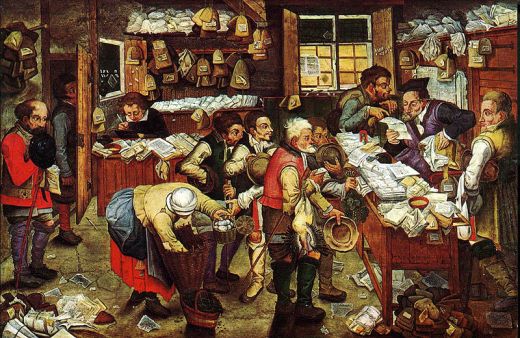
Image: The Tax Collector’s Office (1620-1640) Pieter Brueghel the Younger, courtesy of University of Southern California Fisher Museum of Art, Los Angeles