Make Marketing Messages Memorable

What is effective marketing in the 21st century? Communication technology has gone through so many game-changing upgrades—radio! television! Watson the IBM supercomputer!—but the essence of human beings hasn’t really changed over the centuries. The basics of buying and selling resources that we value, whether they are integral to survival or ego-boosting bling, are still governed by a group of fairly standard actions that comprise what’s known as the buyer’s journey. Circumstances and other factors that spark buyer interest and may lead to a sale haven’t changed much in about 8,000 years of civilization as we know it. I think it’s safe to say that buying and selling, and the marketing strategies designed to influence the process, are at their core about the same today as marketing was in Shakespeare’s England (early 1600s) or during the reign of the pharaohs.

Successful marketing campaigns have as their foundation good storytelling and the story must be distributed to potential buyers of the product or service. Marketing stories must appeal to prospective buyers and be accessible on media outlets (channels) that target prospective buyers follow and trust. Beyond those qualifiers, it’s incumbent upon sellers to create and distribute marketing content with a message that persuades potential buyers to stop, look and engage. Sellers need a marketing message that tweaks curiosity or strikes a familiar chord with those who experience it. How can you ensure that your marketing messages will consistently deliver? Read on to learn a few actions that will optimize the power of your marketing messages.

How are prospects meeting their needs now?

As usual, it makes sense to begin at the beginning. Before you can create trust inspiring, right-on-time marketing messages, it’s necessary to know what your customers are doing now — who or what are you competing against? You cannot make a battle plan until you know your opponent and the strengths, weaknesses and perceived value that’s made customers buy (until you arrived to shake things up)?

BTW, more often than you’d guess, your competition is neither a rival Freelancer nor a traditional business entity; your competitor could be inertia, AKA doing nothing. The status quo could be your client’s hiding place and coaxing him/her into the fresh air and sunshine of problem-solving could be a difficult endeavor. “Kicking the can” may have powerful defenders on your sale’s decision-making committee and one or more of them could have budget influence that can be weaponized and used to shut down spending or any move toward progress.

So, if one or two of the prospect’s decision-making committee members are comfortable with what’s being done now, you must demonstrate why deflecting what could be considered a reasonable problem-solving action, or doing the same dance with the same partner, is less effective and in the end more costly than bringing in your solution. To do that, you’ll need a marketing message that is powerful and persuasive. To figure out how to shape the narrative you need, start by exploring these issues:

  • Examine and analyze lost sales. When you lose a sale, diplomatically attempt to discover who your prospect decided to buy from, if possible. Perhaps even more important is to ask the prospect directly or ask someone who can speak for him/her, what shortcoming(s) motivated the decision to select another vendor. You must learn how you dropped the ball in order to fix the problem. Once you’ve identified lapses and/or weaknesses, you’ll decide on the most efficient corrective actions.
  • Examine and analyze successful sales. When the prospect hires you and becomes your client, discreetly inquire about their decision process. It’s seldom easy to learn the identities of competitors on your now-client’s shortlist but is a definitive way to confirm your competition. Equally valuable intel is learning which factors or characteristics of yours motivated decision-makers to bring you on board. What is it about you and your organization or skill set that makes you stand out?
  • Get input from your best customers. If your product or service didn’t exist, what would your customers do instead? Their answers will reveal the real-world alternative solutions you’re up against. To get started on building your case, consider these tactics:

Describe your value proposition, as your buyers define it

Once you have a good understanding of your typical competitors, identified weaknesses you must address and strengths that distinguish you and instill confidence in prospects, incorporate your findings in your marketing messages. Your story will be best served when you think beyond predictable product or service features; standing out in today’s hyper-competitive marketplace requires more than a recitation of product or service features and benefits. Put yourself in the prospect’s shoes and envision what s/he must achieve and what it takes to do so and use those insights to predict which of your product or service features and benefits to showcase. Develop a marketing message that will “paint a picture” that enables your prospect to “see” how your solution helps them to achieve their goals or please their customers. Adopt a “what’s in it for them” mindset as you customize your marketing message with a story that goes beyond generalities:

  • Superior customer experience (e.g., fast and uncomplicated new customer onboarding or the availability of end-user training and/or other post-sale support.
  • Expertise in a specific market or problem area.
  • Flexibility or customization that others lack.
  • A track record of success with companies similar to your target customers.

Edit marketing message talking points

Make it easy for prospects to remember (and also value) features and benefits by paring down your list and building your message on three or four powerful and persuasive talking points, so that you’ll avoid overwhelming prospects with too much information that is bound to get lost in the shuffle. A short list of strong value points makes a bigger impact than a long list of features. These 3-4 marketing message talking points become your core value proposition for you to use in all of your marketing materials. Choose your list of customized, high value talking points guided by these suggestions:

  • Relevance: Which benefits speak most directly to your audience’s most urgent goal or problem?
  • Uniqueness: Which of your strengths is most difficult for competitors to copy or claim?
  • Defensibility: How does your marketing message communicate a story that demonstrates in a clear and persuasive narrative that your solution and company are the best option for the client?

Customize messages for market segments

Your carefully selected and vetted marketing message should quickly resonate with your customers and prospects, literally “speak” to your audience so that its members can recognize the information they care about most. Adjust your core message based on who you’re talking to and where they are in the buying journey. Be sensitive to the need of different information or incentives that are useful to prospect as they progress through the buyer’s journey. Prospects who are establishing a familiarity with your company and its solutions are not the same as prospects who are in the process of making a final determination between two or three potential vendors. Supporting information should align with the questions a typical prospect has when progressing through the buyer’s journey.

  • Decision-makers: Emphasize high-level results, like return on investment for users of your product or service, or overall cost savings.
  • End-users: Focus on ease of use and practical features.
  • Awareness stage: Talk about common problems and introduce your solution.
  • Decision stage: Show clear proof and highlight what makes you stand out.

Message at every touchpoint

A messaging hierarchy helps you stay consistent across all channels — from your website homepage to sales meetings. It starts with your core value points, then moves into supporting messages and ends with evidence. Structure it like this:

  1. Value proposition talking points: The top 3-4 benefits you chose to highlight (above).
  2. Supporting messages: Additional advantages or benefits that reinforce why you core value proposition makes a (positive) difference for the prospect.
  3. Case studies: Real life experience helps a prospect understand how your service or product performs in the real world. Present performance metrics, share a case study or other stories that document and illustrate how you (and your team) provide solutions that solves problems, achieves goals and delivers on promises made.
  4. Technology: Demonstrate to your prospect that you are a capable and prepared professional who is comfortable with commonly used tech solutions by using an online calendar platform (such as Calendly) to schedule and confirm your sales meetings, as you reduce the incidence of missed appointments or cancellations—frustrating time wasters. Doing so demonstrates not only your knowledge and proficiency of useful technology, but also signals to prospects your intention to deliver a seamless and pleasant end-to-end customer experience.

Thanks for reading,

Kim

Image: ©National Aeronautics and Space Administration (NASA) 1972. Eugene Cernan, commander of the Apollo 17 mission and the last astronaut to walk on the moon, holds an American flag during his mission in December 1972. 

 

Trend Tracker Is Free Help from Yelp

Launched in 2014 at the platform’s 10th anniversary, Yelp’s Trend Tracker is receiving so much flattering business press of late that it feels like a relaunch (and I’m sure it is)! If you operate a small business and maintain an active Yelp account, whether or not you subscribe to Trend Tracker, Yelp is talking to you. If you’re a Freelance solopreneur who’s claimed your free Yelp listing and then dropped the subject, Yelp is talking to you, too. Or maybe you’re a self-employed professional, a Freelancer or SMB owner, who does not have an active Yelp account? Whatever the case, Yelp and Yelp’s Trend Tracker beckon with insightful and potentially actionable data that pertains to your industry and can support your mission to build a profitable and sustainable business entity.

What is Yelp’s Trend Tracker?

Trend Tracker is an AI-powered, cloud-based tool that monitors customer searches, reviews and interactions to identify trending topics in real time. Trend Tracker reveals and reports customer search patterns, behavior and emerging customer preferences across a broad array of industries. Trend Tracker harvests data from unique searches the Yelp platform receives each month (178 million in January 2025) and measures the frequency of specific phrases and topics used in those searches. This data sheds light on what you want to know, from customer purchasing trends to popular B2B and B2C services. Furthermore, Trend Tracker goes beyond search terms and also analyzes the text of customer reviews, to further clarify the picture.

It can literally pay to know this stuff because from time to time it may be worthwhile to respond to certain information. You may decide, for example, to update the key words in your content marketing material if Trend Tracker data indicates that target customers have begun to use certain terms when searching your product or service category.

Free market research for Freelancers and SMBs

Trend Tracker analytic insights are available free of charge—join the mailing list and you’ll receive data that is relevant and updated monthly and enables those who pay attention to access boots-on-the-ground marketing insights that can potentially help to promote your products and services more effectively. Supported by Trend Tracker, you’ll be positioned to detect and quickly respond to customer preferences, adjust marketing strategies and/or tactics to better align with shifting customer priorities and maybe even tweak your service or product line to reflect a significant shift in customer tastes.

When business decisions are guided by relevant, reliable data, decision-makers are more likely to achieve their intended outcomes. Decisions and actions that are guided by what matters to prospects and customers IRT will be immensely helpful to business owners. One of the biggest advantages of Trend Tracker is its ability to give you the heads-up on developing trends before they go mainstream and giving you time to update your position and be among the first providers to capitalize on emerging customer demand. Trend Tracker enables you to:

  • Identify emerging customer interests before they become mainstream
  • Adjust marketing strategies and tactics to respond to customer interests in a timely fashion
  • Create events and promotions that reflect developing trends
  • Improve your brand’s online visibility and search engine optimization with trending keywords
  • Stay ahead of competitors (who may not have access to reliable data-driven insights)

What else can Trend Tracker do for you?

So what’s trending that applies to you? Trustworthy intel is what’s trending and it applies to your entity in many ways. Trend Tracker data can even be a resource when you must conduct market research to evaluate your business planning, from the feasibility of scaling or expanding your venture to clarifying your decision-making as you verify, or rethink, a side hustle you hope to launch. News flash! Re: business planning, can we acknowledge that Freelancing does not exclusively pertain to B2B services such as marketing, website development, graphic arts and shooting and editing videos? Can we recognize that Freelance expertise can also be applied to a B2C service entity? In other words, could it be that upgrading home interiors is a more satisfying expression of your entrepreneurial talent than cybersecurity? That seems to be the case for the Property Brothers.

You may be interested to know that the Trend Tracker September 2024 issue reported that in 2024, home services produced record growth for business owners in that industry across the U.S. and drove an all-time revenue bonanza for the category. Trend Tracker data indicated that in 2024, home services were the fastest-growing segment of B2C services in every U.S. state plus Washington D.C. and was the top category for new business launches among all industry categories on Yelp as well. This still trending growth cycle is fueled by renter-friendly home upgrade projects. As many citizens come to recognize that attaining home ownership or trading up from starter house to a more spacious (and grand) residence is unaffordable, remaining in the current home for a longer period of time has become yet another New Normal reality.

As a way to make home feel more comfortable or look more stylish, people are investing in improvements that upgrade living spaces without upsetting the landlord. Another home services industry hot spot, this one pertaining to homeowners, is weatherproofing services that make homes more resilient to what seems like increasingly frequent extreme weather events. Trend Tracker data shows that Yelp users have increased searches for both renter-friendly and homeowner services—could responding to the growing demand become your side hustle or even your full-time Freelance or SMB enterprise? Aspiring business owners have set up shop as Freelance solopreneurs and SMBs to address those priorities, which resulted in big increases in Yelp searches in 2024 vs. 2023:

  • home organization (+362%),
  • peel and stick tile (+73%),
  • wallpapering (+41%),
  • snow removal (+36%)
  • home automation (+27%),
  • drapery installation (+11%)
  • waterproofing (+23%)

In sum, Trend Tracker can be a game-changer that might potentially have a direct impact on your ability to gain or maintain competitive advantage and monitor customer priorities—and maybe even launch a successful business or side hustle. Tara Lewis, who spent 15 years at Yelp helping businesses connect with their target customers and also served as its trend expert, advises that the best way to get started with Yelp’s Trend Tracker is to check out the latest trends noted in the monthly newsletter and pick one insight to test in your business this month. Lewis says that even a small adjustment can lead to noticeable improvements in brand visibility and sales revenue generated. She recommends the following:

  • Practice authenticity in trend-chasing. Don’t just follow trends; make them your own to help your business stand out.
  • Connect with valued customers through shared trending interests. Form meaningful connections with your community by creating events and social spaces that appeal to those who matter most.
  • Use Yelp Trend Tracker data to highlight what you already offer. Your business may be in tune with rising trends — adapt your marketing strategy to make these products or services more visible to customers.
  • Position your business for long-term trends, not just momentary fads. Some trends are fleeting; others reflect larger shifts in consumer behavior. Identify trends with staying power and incorporate them into your business vision.
  • Your brand’s unique personality is your trendiest asset. Lean into what makes your business distinctive to set yourself apart and keep customers coming back.

Thanks for reading,

Kim

Image: © Freepik

Time Is On Your Side

Last year (and maybe the year before as well), did it seem like it took forever for prospects to negotiate the buyer’s journey and finally make a purchase and become your client? Rest assured, it may have felt like a nightmare, but it wasn’t a dream. Responses of more than 18,000 B2B buyers who participated in Forrester’s 2023 Global B2B Buyers’ Journey Survey, and who were also Forrester clients, confirm that B2B buyers globally have become mostly both risk averse and price sensitive as they contend with economic uncertainty. Approximately one third of B2B buyers in North America and Europe, and more than a quarter of their counterparts in Asia Pacific, reported that they are significantly influenced by price when making purchasing decisions. Additionally, the buying process has become more complex than ever and purchasing delays are now common.

Leaning into caution seems to have begun in 2022 in the B2B sector, when inflation weighed heavily on everyone’s mind, causing buyers to carefully evaluate purchases and avoid what could be considered over-paying. The practice is still trending and its influence is documented in Forrester’s global B2B buying survey. Another notable survey finding was the role of purchase-focused decision-making committees, that include “product experts” who have a growing influence on B2B buying.

Amy Hayes, vice president and research director at Forrester, a world-renowned business research and advisory firm based in Cambridge, MA and author of the survey, summed up the trend in a candid comment, “Due to budget constraints and continued economic uncertainty, buying decisions are getting delayed.” Not only are buyer journeys lasting longer, but more people are on the bus and purchasing decision-making committees have grown larger and increasingly risk-averse. Purchasing criteria are subjected to increased scrutiny and due diligence rituals have become more detailed. Needless to say, the New Normal protocols are doing Freelance consultants no favors. So now what?

As you keep in mind that an elephant is a mouse designed by a committee, our mission today is to devise a strategy that can help you to successfully navigate this potential impasse. To enhance the prospect’s confidence in your product or service and also help expedite decision-making, it could be advisable for B2B sellers to showcase their offerings’ return on investment throughout the buyer’s journey. Moreover, identifying an attribute of your product or service that can be convincingly described as uniquely useful to prospects may enable you to pacify decision committee naysayers, who would otherwise be delighted to shoot down your sales proposal if they think it will make themselves look shrewd and in control. Not only that, the attribute you showcase may do a great job of setting you apart from competitors.

Let’s look at the bright side—those decision-making committee members can green-light your sale if you attach a value they can’t resist to your service or product. To win their confidence, you’ll need to wrap your product or service in a bullet-proof business virtue for which you can create a compelling narrative. Oh, and although B2B purchasing-focused decision-making committees have been shown to be price-sensitive, be aware that you cannot compete on price because that is a race to the bottom and you can only lose.

A comprehensive and convincing accounting of the strengths of your service or product is likely to be helpful and perhaps best summed up by the Google algorithm EEAT—experience, expertise, authoritativeness, trustworthiness—and could be the best recipe to win the consensus you’ll need. A good case study or two can demonstrate the ROI your service or product delivers to clients; a link to a webinar or podcast in which you are prominently featured can further demonstrate your expertise, showcase your thought leader status and convey your authenticity.

The Forrester survey also shows that in addition to spending conservatively, respondents made known the high value they place on an invaluable resource—time—and that this attribute can influence the outcome of buying decisions. This could be your silver bullet—how can you present time as a resource that your service or product brings to clients? Do that successfully and you will have discovered the secret sauce that helps you win more sales.

“How important is saving time to you and your team?”

Like marketing automation Software as a Service solutions enable businesses to devote less effort to routine tasks, B2B services or products that are developed with operational efficiency, user-friendly implementation and time reduction in mind deliver benefits that clients and prospects recognize and respond to. C-suite executives are keenly aware that increasing available time can, for example, allow the resource to be devoted to vital business functions such as business strategy assessment and development, innovation, scaling or expanding operations and/or examining the impact of the company’s customer experience or after-sale training and support. Enabling your clients’ success will, among other things, allow them to more efficiently respond and deliver value to their customers. You can position your clients to save their customers time and and also drive their satisfaction, loyalty, repeat business and referrals. When you make it known to prospects the potential of your product or service to increase the valuable resource that is time you may want to discuss:

  • Clearly communicate how your service or product aligns with the client’s perception of time. C-suite execs understand the importance of time and its value when choosing to implement a product or service, but they may not share that concern with members of the purchasing decision-making committee—that responsibility may be up to you, the seller. When discussing the performance and benefits of your service or product, be certain that time-saving capabilities are always considered.
  • Show that your product is easy to implement, install, learn and operate. Today’s companies compete on the basis of their ability to work in agile ways, innovate quickly and adopt new approaches in response to changing marketplace conditions. A product or service that enhances those capabilities by saving time is a unique benefit and valuable selling point that should be on the table when speaking with decision-making committee members.
  • Reduce time spent on execution, increase time for other tasks. Consider every internal process, task and workflow that your service or product will simplify, streamline, automate, or accelerate and how those attributes and capabilities work to increase time that can be spent on other imperatives. If possible, bring in experts and give everyone involved in the purchasing decision a seat at the table.

While research has shown that B2B buyers are responding to economic uncertainty by becoming both cautious and price sensitive in many instances, clients are often willing to pay a premium for services or products that they can implement quickly and easily, so they can more quickly move the team on to the next project. Time is a resource that can add significant value to a service or product, allowing you to anticipate client needs and drive profitability.

When products and services consider time reduction on behalf of clients, your solution can therefore function as a partner that helps them receive the rare gift time that can be applied to building a better business innovation, providing seamless customer experiences and optimizing client relationships. Enabling your clients’ success allows them to respond to and deliver value to their customers faster, potentially by saving their customers’ time and driving satisfaction and loyalty. Time is always money and it is useful to present it as a selling point for you to leverage.

Thanks for reading,

Kim

Image: © Shutterstockimagebank

LeadGen and Customer Acquisition in 2025

LocaliQ, a digital marketing platform that specializes in lead generation and multichannel marketing campaign management, and is a subsidiary of Gannett Publishing, surveyed more than 730 small business owners and marketers worldwide to get boots-on-the-ground perspectives on leadgen and customer acquisition marketing tactics SMB owners are using now and uncensored feedback on what’s producing the best results. The survey is a rich source of benchmarking and actionable insights that have the potential to inform your approach to leadgen and customer acquisition strategies and tactics this year.

In its first Small Business Marketing Trends Report, LocaliQ shares the results of a deep data dive that’s intended to help Freelance consultants and SMB owners successfully navigate the business landscape they can expect to encounter in 2025 by learning how their peers energize sales revenue by identifying leadgen tactics that promote customer acquisition.

The relevance of LocaliQ data is for many of you validated by the survey demographics—15% of respondents are soloprenuers; 31% have 2-10 full-time employees; 24% have a marketing budget that’s less than $500/ year (5% have no marketing budget); and 74% are based in Canada and the U.S. (all six inhabited continents plus New Zealand are represented). The survey was published in October 2024. How does the average Freelancer or SMB owner attract prospects?

Survey respondents do what you’d expect and it’s safe to assume that they use more than one leadgen tactic to implement their marketing /sales strategy. Social media marketing (free) is used by 52% of respondents; 47% of respondents use (paid) social media advertising; and 40% of respondents use search advertising, i.e., pay-per-click sponsored ads that appear in search engine inquiries. Other popular leadgen tactics are email marketing, used by 39% of respondents and content marketing, used by 33% of respondents. Online listings and directories (28%), display ads (24%) and traditional media (23%) are 20th century tactics and that gives them a similarity (IMHO); when combined, 75% of survey respondents use one or more of these older leadgen tactics.

As for the social media platforms used, it’s no surprise that Facebook dominates—76% of respondents use the platform for leadgen, promoting products and services and otherwise engaging with current customers and prospects. Instagram is used by 63% of survey respondents and LinkedIn, tailored as it is to B2B customers, is used by 43% of respondents. The data also showed that 29% of respondents use video marketing, a feature that is available on the above three platforms and also YouTube, which is used by 38% of respondents and recently rescued TikTok, which is used by 34% of respondents. Surprisingly X, a platform intended for Instant Messaging and other text communications, is used by 41% of respondents for social media marketing (X also hosts video sharing).

Now let’s talk turkey—when asked about their satisfaction (or disappointment) with the results of leadgen tactics, social media marketing and online listings/business directory users are satisfied with results—66% of social media marketing users and 61% of online listings/business directory users are pleased with their leadgen marketing results—still, each group also has a dissatisfaction rate of 15%. Furthermore, there is a rather large group of “neither satisfied nor dissatisfied” —meaning lukewarm?—users associated with those leadgen marketing tactics and 24% of online listing/ business directory users and 19% of social media marketing users joined the lukewarm group. Maybe it’s too difficult to measure leadgen results directly from social media marketing activity, whose conversation threads remain visible for years and likewise for presence on a business listing site or directory that a prospect might see many months after publication?

More clarity is derived from search advertising and it topped the list as the leadgen tactic most respondents are happy with, as evidenced by its 76% satisfaction rate (with 12% dissatisfied and 12% neither satisfied nor dissatisfied). A close second in popularity is video marketing, a leadgen tactic that has a growing user rate on every platform; in this survey, 74% of users are pleased with their video marketing outcomes and just 8% are unhappy (and 17% are neither satisfied nor dissatisfied). Short-form videos, like those on TikTok and Instagram Reels, continue to surge and 58% of respondents have either recently tried or would like to try the format.

Search advertising succeeds because it kicks in precisely when the purchasing motive is strongest and prospects are actively looking to buy a product or service that’s similar to yours. Readily available alternative options are waiting for them, as shown in search ads you’ve seen. Survey respondents also indicate satisfaction with results they’re finding with content marketing (75%) and advertising on social media platforms (73%).

The best source of leadgen is (drum roll) customer referrals! Almost 65% of survey respondents reported that customer referrals are the best leadgen sources. The influence of customer referrals is greatest (75%) for SMBs that have 10 or fewer full-time employees and have less influence in larger organizations—just 46% of businesses with 50 or more employees report that customer referrals are the best source of new customer leads.

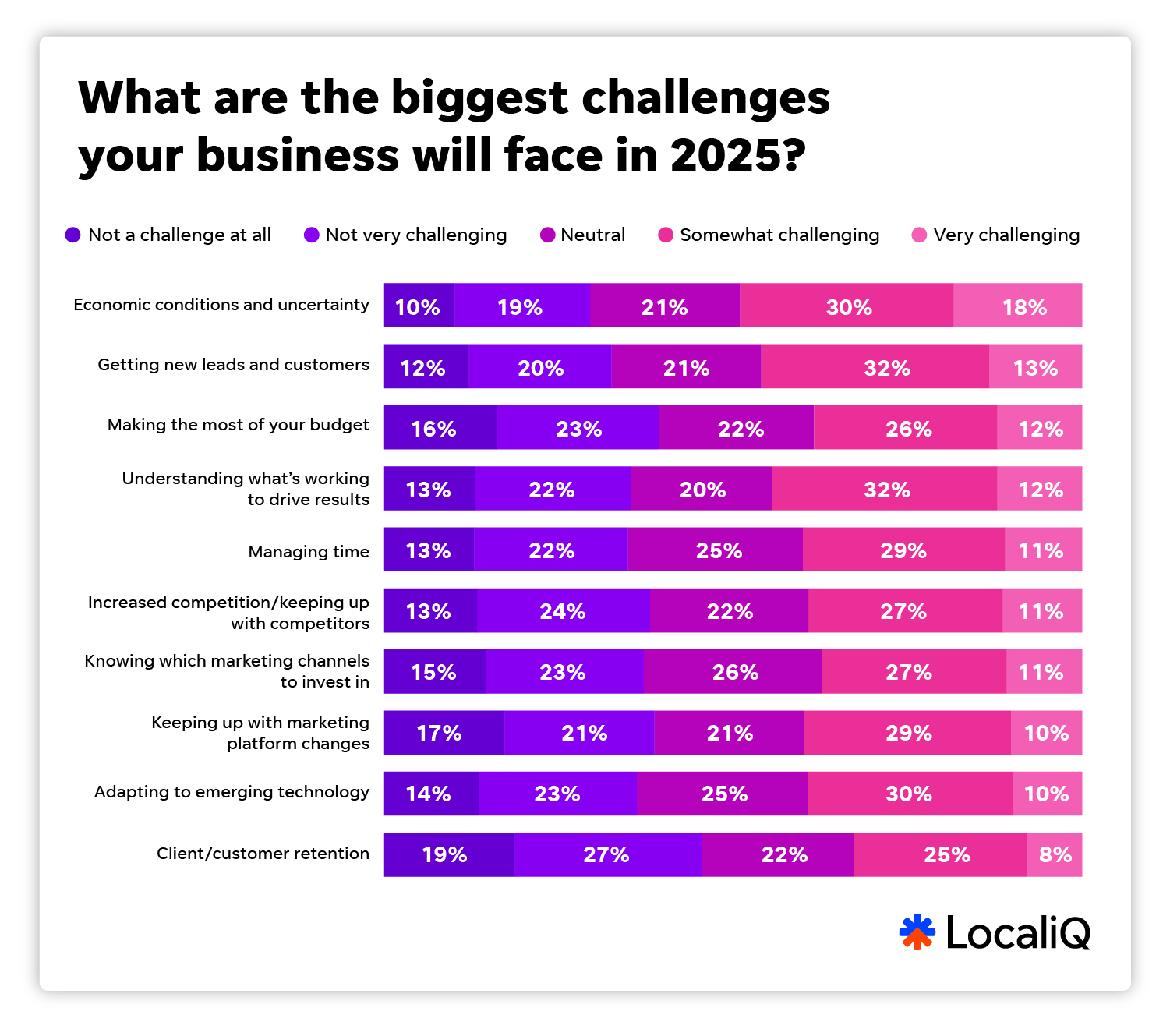
Major challenges anticipated in 2025

Freelance consultants and SMB owners know that in order to survive and thrive, a clear-eyed view of their economic landscape is necessary. Economic uncertainty, leadgen tactics that stimulate new customer acquisition and optimizing an (often modest) marketing budget are by necessity at top-of-mind. The ability to predict which marketing tactics can be relied on to produce the strongest return on investment is viewed as somewhat or very challenging for nearly half of survey respondents—44% are somewhat or very concerned about the capability of their chosen leadgen tactics to drive results. Adapting to new technology is a concern for 40% of respondents, who indicate they are somewhat or very concerned about keeping up. Furthermore, 45% of respondents are somewhat or very concerned about their leadgen tactics bringing in enough new customers and 48% are somewhat or very worried about economic conditions and uncertainty.

So, what are the recommendations for driving Freelancer and SMB success in 2025? There are no definitive answers and the suggestions offered below are not new and not rocket science. Your goal is to make money, but you could meet with headwinds for any number of reasons. Outcomes produced by your business strategies and tactics cannot be predicted but appropriate design, execution and performance monitoring on your part can be expected to yield at least modest success. Marketing and sales have a direct effect on customer acquisition and generating revenue, making these two closely related functions the money-making engine of a business venture and deserving of your intense focus. Just do it.

It’s helpful to monitor the performance metrics of marketing tactics and for that process, Google Analytics generates relevant and insightful data that enables you to evaluate your campaigns—at no charge. Sign up now! Along with leadgen/customer acquisition, make a point to promote customer referrals by asking your current customers if any of their colleagues or customers have the potential to become one of your customers. Also, create customer experience protocols that at every touchpoint anticipate and respond to customer needs end-to-end, from new or returning customer onboarding to after-sale training or other services. Finally, invite customer feedback by directly speaking with those who do business with you when possible. It’s good business to send out an email survey (maybe once a year), or chat with customers by way of social media; it’s important to learn what customers would like to see you do (or not do), so that you can optimize the experience of doing business with your company.

  • Be prepared to manage both the opportunities and challenges you encounter by being aware, being agile, being resourceful and being resilient.
  • Develop comprehensive marketing/sales strategies and implement with tactics you can expect to be effective. Regularly consult your website (and social media) performance metrics and make adjustments where necessary, to maximize performance.
  • Identify one or two local business associations and aim to attend one program per quarter as a way to obtain professional development and/or enhance your business acumen skills as you meet colleagues and engage in face2face networking that builds mutually beneficial relationships.
  • As soon as your budget allows hire an (outsourced) business accountant or bookkeeper to not only maintain the integrity and timeliness of your business financials and tax filings, but also to discuss and guide the potential business growth and expansion of your venture.

Thanks for reading,

Kim

Image: © kali9/ iStock