Milestones Are Your Reason for A Reset

Certain dates on the yearly calendar are noteworthy—birthdays, holidays and anniversaries, a new year or a new season, as well. The dates have meaning; they mark special occasions and hold a certain power. You might call them milestone dates. Some milestones merely mark the passage of time, but others suggest growth and development, an inflection point and the possibility of making a positive change. Those milestones beckon you to consider new options, new experiences, or a new perspective.

A particular milestone date or occasion may motivate you to do better and give yourself an upgrade. You might feel it’s time to press the reset button on some aspect of your life. You’re primed to open the door to new options and opportunities. You recognize that you’ve reached a psychological milestone and life is telling you to reassess and redesign, reinvent, or recharge some part of your life or some part of your business enterprise or career. Think New Year’s Resolutions.

This spark of inspiration is called the “fresh start effect.” It’s a psychological phenomenon that explains why milestones—the arrival of a new year, a birthday, or the first day of a new season—make you inclined to self-reflection. You feel the urge to take on beneficial new habits and drop an old habit that’s outlived its usefulness. You’re ready to attach jumper cables to your personal or professional life, start the ignition and make things come alive.

Because the fresh start effect is universal, your clients are likewise inclined to experience a restless feeling that creates a longing for something new and different. For that reason, milestones are an excellent time to make use of the prevailing zeitgeist and shake up a client-facing sector of your business. The strategy is powerful because you’ll align your company and its solutions with your customers’ existing expectations, rituals and rhythms.

Your mission is to position your brand to align with customs or expectations that your clients and prospects will likely experience when they think of your target milestone occasion. How might your service or product be perceived as part of their fresh start? Your goal is to not only meet their needs and wants, but also portray your brand as a timely, trusted partner during noteworthy moments in their lives. Milestone dates are the right time to stir the pot and offer up—what? An activity or information that aligns with your company and its services or products and simultaneously resonates with your clients and prospects to show them why they trust, relate to and value your brand.

Your potential milestone occasions could be the beginning of a new school year, the arrival of spring or fall, the anniversary of your business launch or getting your first paying client, or even Black Friday (U.S. readers know that’s the fourth Friday in November). This post was inspired by the arrival of the fourth quarter on October 1. 4Q is powerful because it closes on December 31, the end of the calendar year, and business owners and leaders are anxious to have a strong finish to the year.

Commemorate your milestones

The fresh start effect is a golden opportunity you don’t want to miss. Your clients and prospects can be positively influenced by milestone dates, even if the occasion is linked to your business and not a national holiday or change of seasons. It’s not a stretch to persuade your audience to take on a mindset that opens them up to change and new beginnings that happen to align with your company, products or services. In other words, don’t shy away from celebrating the anniversary of your company’s launch as your Founder’s Day and build a promotional campaign to celebrate it—and bring in revenue as you do!

Make your marketing message about a restart and transformation

Marketing messages that include a theme of renewal and transformation often resonate with audiences during fresh start milestone periods because your audience is already in a self-assessment and growth-oriented mindset. For example, presenting a new angle to your brand story to refresh client enthusiasm and promote engagement is among the milestone-themed campaigns you might choose to develop. To tap into this power, invite a client to give a testimonial—audio, video, or written—that describes how your product or service sparked meaningful change in the client’s business operations, whether it’s a small but powerful effect or a game-changer.  

You can get the ball rolling on client testimonials by creating a survey that asks questions such as, “How has our product or service made a difference in how you do business? Can you share a specific example?” These questions will focus testimonial responses on the tangible benefits and transformational power of your products rather than generic praise like, “Your product or service is awesome!” Often, you’ll even uncover surprising ways your product made a difference.

Alternatively, you (and your team, if that applies) can present a backstage story by creating a video of you on your way to give a presentation at a local business association, or to do volunteer work. Your clients may enjoy getting to witness an uncensored, up-close and person look that nevertheless illustrates your business acumen and, if philanthropy is the focus, your values and the importance of corporate social responsibility and giving back to your community.

Good stories are always about transformation. You want to position your service or product as a catalyst for your clients’ positive evolution and so that you can connect with them on a deeper, emotional level so that you will take on the role of guide in their journey. By presenting useful, or fun and always compelling information about your brand you’ll capture the attention and imagination of your audience and strengthen their bond with you.

Thanks for reading,

Kim

Image: A “Sweet 16” birthday party at The Crystal Ballroom in Daytona Beach, FL

Create Content That Delivers

You will agree that the internet is the leading source of information and entertainment for everyone on Earth who has connectivity. The global data and business intelligence platform Statista reports that in 2025 5.56 billion, approximately 65% of the world’s population, has internet access. To nearly every business entity on the planet, that means about 5.34 billion potential customers—many of whom are too young to launch a buyer’s journey, but some of whom might influence purchases their parents make—are available to receive online marketing information.

While the vast majority of the world’s internet users will become the customers of only a select few brands, the wide acceptance of digital communications gives marketers everywhere the green light to create and post a vast amount of marketing information and the digital space is now awash in content of every type—audio, video, images and text. Audience appetite for content, whether information or entertainment, shows no signs of abating. The number of digital content websites and platforms continues to proliferate and invite contributors to produce still more content, all of which beckons viewers, listeners and readers to show some love and click here, please!

Content saturation of the internet is an inevitable phenomenon. According to the nationally known content marketing expert Neil Patel, nearly 40 % of enterprise companies plan to increase their content marketing budgets this year. Freelance solopreneurs and smaller business entities will likewise continue, or perhaps increase, their content marketing activity as well, but the dominance of content presented by the multinationals can easily cause the comparatively modest content produced by small entities to be overwhelmed as if by a riptide. Freelancers are understandably frustrated with this occurrence. How can you become more visible when your content must swim with the whales—and sharks?

It’s a vexing problem for sure but there is a commonsense strategy, one that plays to your strengths and demonstrates resourcefulness and creativity. The best response to content saturation is to activate your problem-solving ability and devise a strategy that guides you to create content that not only resonates with your audience, but also positions you to gain and maintain the attention and loyalty of your target audience. Whether your information is intended for social media posts, or focuses on developing and promoting content featured in your webinars, weekly blogs, or monthly newsletters, be reassured that content perceived as valuable will be acknowledged and followed by your target audience. It’s just about guaranteed that content featuring information that is specific, practical and actionable will result in a loyal and thriving audience who will regard you as a trusted expert. So, your mission as a content producer is to learn what is meaningful to your readers, listeners and/or viewers and let their priorities guide your content development and distribution strategies.

Educate yourself by reading articles that discuss from local and national perspectives developing trends, pending legislation, competition, opportunities and other updates in your field. Producers of relevant content must also be consumers of relevant content! If producing content figures prominently in your marketing strategies (and I know that it does), you may find one or more of the following five suggestions able to enhance the value of your marketing content and also position your content to bring in a healthy ROI—which might include establishing you as a thought leader.

Relevant, realistic and relatable information

Content that your audience considers to be relevant and practical is more likely to be valued, implemented and shared. Gaining a reputation as a reliable and respected source of content by your audience will incline them to become your followers or subscribers. Content that your viewers, listeners, or readers consider potentially actionable and known to be trustworthy can also encourage loyalty to you, your content and your organization and may persuade some to become your customers. To create content that’s considered useful and trustworthy, and resonates with your audience, you must stay ahead of emerging trends in your industry and be aware of and responsive to the evolving preferences, priorities and concerns of your customers.

Actions are easy to implement and afford

Your audience should be able to envision the usefulness of the actions or strategies your content recommends, even if only a minority of them is prepared to implement your ideas now or in the near future. Individual circumstances will dictate what audience members decide to do, but any advice put forth in your content must inspire confidence.

Furthermore, your content should not recommend actions or strategies that involve implementation costs that many would consider expensive. I’ll go so far as to say that the average B2B content viewer is looking for ideas that can, with a minimum of time and fuss, be used to grow their customer list, streamline business operations and either save or make money—practical advice that can be implemented at no cost or low cost. While business expenses are inescapable, content creators win more fans by recommending actions that demonstrate recognizable value and are accessible and affordable to the majority of the audience.

Your content is your own creation

Rather than doing a copy/paste of another’s work, content creators should value their lived experience—victories won and battles lost, resilience found, the worries of sleepless nights and sudden inspirations—and share those stories with your audience in ways that will be interesting and useful to them. Producing content is usually time-consuming, but that is the price of authenticity and it is worth it. To give yourself a starting point for your creative process, search for trending topics in your field, or comment on an aspect of the most frequent internet search questions related to your marketplace sector that were made over the past week.

Links to expert 3rd party support

In this post I’ve referenced marketing expert Neil Patel and the global business information platform Statista. Demonstrating to your readers/listeners/viewers that key points of your content are supported by recognized nationally or globally respected thought leaders gives them reasons to trust and value the recommendations and insights offered in your content.

Avoid confirmation bias

Content that is valued and popular is shaped not by the creator’s preferences, but by the readers/viewers/listeners in the audience. A common tactic used to help creators avoid confirmation bias is to simply ask audience members what they want to see and hear now, so that you can ensure the relevance of your content. Every few months, you might create a short survey that encourages content viewers to express what matters to them. In a four or five question survey, you can also slip in one or two audience demographic questions—Are you self-employed or an employee? What is your main area of expertise?—and begin to build an audience persona, which will enable you to heighten your responsiveness to your audience.

  • Social media polls Your preferred platforms provide a convenient means to create and send a survey that will help you learn more about your audience. Social media platforms make it easy for you to engage and more effectively communicate with audience members by providing fully customizable forms that help you expand your reach and even grow your base of followers. Polls are equipped with analytical tools that will give you information on your audience’s age group, location, profession and more.
  • Online and email surveys. The most important part of conducting online surveys is knowing what you want to learn from each question, and to keep questions short and easy to answer. You can also create email campaigns to survey your existing client base and gain valuable insight about them. For a very basic customer survey, ClickInsights sets up a one-question, one-click email survey; create a more extensive survey at Survey Monkey.

Thanks for reading,

Kim

Image: © A Tokyo soba noodle delivery in 1956. Bettmann Archive/ Getty Images

LeadGen and Customer Acquisition in 2025

LocaliQ, a digital marketing platform that specializes in lead generation and multichannel marketing campaign management, and is a subsidiary of Gannett Publishing, surveyed more than 730 small business owners and marketers worldwide to get boots-on-the-ground perspectives on leadgen and customer acquisition marketing tactics SMB owners are using now and uncensored feedback on what’s producing the best results. The survey is a rich source of benchmarking and actionable insights that have the potential to inform your approach to leadgen and customer acquisition strategies and tactics this year.

In its first Small Business Marketing Trends Report, LocaliQ shares the results of a deep data dive that’s intended to help Freelance consultants and SMB owners successfully navigate the business landscape they can expect to encounter in 2025 by learning how their peers energize sales revenue by identifying leadgen tactics that promote customer acquisition.

The relevance of LocaliQ data is for many of you validated by the survey demographics—15% of respondents are soloprenuers; 31% have 2-10 full-time employees; 24% have a marketing budget that’s less than $500/ year (5% have no marketing budget); and 74% are based in Canada and the U.S. (all six inhabited continents plus New Zealand are represented). The survey was published in October 2024. How does the average Freelancer or SMB owner attract prospects?

Survey respondents do what you’d expect and it’s safe to assume that they use more than one leadgen tactic to implement their marketing /sales strategy. Social media marketing (free) is used by 52% of respondents; 47% of respondents use (paid) social media advertising; and 40% of respondents use search advertising, i.e., pay-per-click sponsored ads that appear in search engine inquiries. Other popular leadgen tactics are email marketing, used by 39% of respondents and content marketing, used by 33% of respondents. Online listings and directories (28%), display ads (24%) and traditional media (23%) are 20th century tactics and that gives them a similarity (IMHO); when combined, 75% of survey respondents use one or more of these older leadgen tactics.

As for the social media platforms used, it’s no surprise that Facebook dominates—76% of respondents use the platform for leadgen, promoting products and services and otherwise engaging with current customers and prospects. Instagram is used by 63% of survey respondents and LinkedIn, tailored as it is to B2B customers, is used by 43% of respondents. The data also showed that 29% of respondents use video marketing, a feature that is available on the above three platforms and also YouTube, which is used by 38% of respondents and recently rescued TikTok, which is used by 34% of respondents. Surprisingly X, a platform intended for Instant Messaging and other text communications, is used by 41% of respondents for social media marketing (X also hosts video sharing).

Now let’s talk turkey—when asked about their satisfaction (or disappointment) with the results of leadgen tactics, social media marketing and online listings/business directory users are satisfied with results—66% of social media marketing users and 61% of online listings/business directory users are pleased with their leadgen marketing results—still, each group also has a dissatisfaction rate of 15%. Furthermore, there is a rather large group of “neither satisfied nor dissatisfied” —meaning lukewarm?—users associated with those leadgen marketing tactics and 24% of online listing/ business directory users and 19% of social media marketing users joined the lukewarm group. Maybe it’s too difficult to measure leadgen results directly from social media marketing activity, whose conversation threads remain visible for years and likewise for presence on a business listing site or directory that a prospect might see many months after publication?

More clarity is derived from search advertising and it topped the list as the leadgen tactic most respondents are happy with, as evidenced by its 76% satisfaction rate (with 12% dissatisfied and 12% neither satisfied nor dissatisfied). A close second in popularity is video marketing, a leadgen tactic that has a growing user rate on every platform; in this survey, 74% of users are pleased with their video marketing outcomes and just 8% are unhappy (and 17% are neither satisfied nor dissatisfied). Short-form videos, like those on TikTok and Instagram Reels, continue to surge and 58% of respondents have either recently tried or would like to try the format.

Search advertising succeeds because it kicks in precisely when the purchasing motive is strongest and prospects are actively looking to buy a product or service that’s similar to yours. Readily available alternative options are waiting for them, as shown in search ads you’ve seen. Survey respondents also indicate satisfaction with results they’re finding with content marketing (75%) and advertising on social media platforms (73%).

The best source of leadgen is (drum roll) customer referrals! Almost 65% of survey respondents reported that customer referrals are the best leadgen sources. The influence of customer referrals is greatest (75%) for SMBs that have 10 or fewer full-time employees and have less influence in larger organizations—just 46% of businesses with 50 or more employees report that customer referrals are the best source of new customer leads.

Major challenges anticipated in 2025

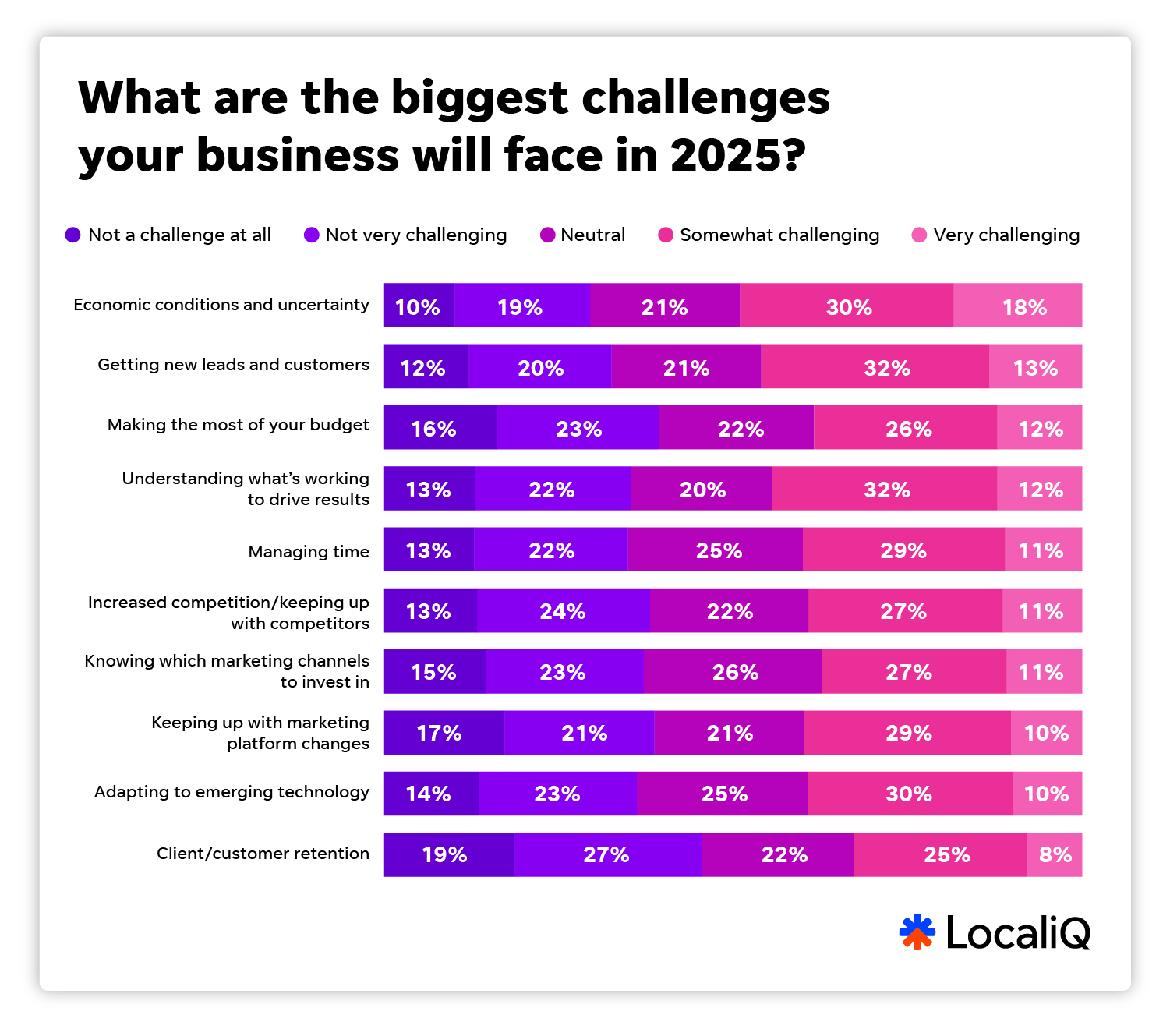
Freelance consultants and SMB owners know that in order to survive and thrive, a clear-eyed view of their economic landscape is necessary. Economic uncertainty, leadgen tactics that stimulate new customer acquisition and optimizing an (often modest) marketing budget are by necessity at top-of-mind. The ability to predict which marketing tactics can be relied on to produce the strongest return on investment is viewed as somewhat or very challenging for nearly half of survey respondents—44% are somewhat or very concerned about the capability of their chosen leadgen tactics to drive results. Adapting to new technology is a concern for 40% of respondents, who indicate they are somewhat or very concerned about keeping up. Furthermore, 45% of respondents are somewhat or very concerned about their leadgen tactics bringing in enough new customers and 48% are somewhat or very worried about economic conditions and uncertainty.

So, what are the recommendations for driving Freelancer and SMB success in 2025? There are no definitive answers and the suggestions offered below are not new and not rocket science. Your goal is to make money, but you could meet with headwinds for any number of reasons. Outcomes produced by your business strategies and tactics cannot be predicted but appropriate design, execution and performance monitoring on your part can be expected to yield at least modest success. Marketing and sales have a direct effect on customer acquisition and generating revenue, making these two closely related functions the money-making engine of a business venture and deserving of your intense focus. Just do it.

It’s helpful to monitor the performance metrics of marketing tactics and for that process, Google Analytics generates relevant and insightful data that enables you to evaluate your campaigns—at no charge. Sign up now! Along with leadgen/customer acquisition, make a point to promote customer referrals by asking your current customers if any of their colleagues or customers have the potential to become one of your customers. Also, create customer experience protocols that at every touchpoint anticipate and respond to customer needs end-to-end, from new or returning customer onboarding to after-sale training or other services. Finally, invite customer feedback by directly speaking with those who do business with you when possible. It’s good business to send out an email survey (maybe once a year), or chat with customers by way of social media; it’s important to learn what customers would like to see you do (or not do), so that you can optimize the experience of doing business with your company.

  • Be prepared to manage both the opportunities and challenges you encounter by being aware, being agile, being resourceful and being resilient.
  • Develop comprehensive marketing/sales strategies and implement with tactics you can expect to be effective. Regularly consult your website (and social media) performance metrics and make adjustments where necessary, to maximize performance.
  • Identify one or two local business associations and aim to attend one program per quarter as a way to obtain professional development and/or enhance your business acumen skills as you meet colleagues and engage in face2face networking that builds mutually beneficial relationships.
  • As soon as your budget allows hire an (outsourced) business accountant or bookkeeper to not only maintain the integrity and timeliness of your business financials and tax filings, but also to discuss and guide the potential business growth and expansion of your venture.

Thanks for reading,

Kim

Image: © kali9/ iStock

Content That Captivates

It is said that content is king—agree? I’ll bet you do. But are you aware that not all content is equally able to move viewers to respond to its verbal or visual messages? Most content does its job, which is to increase awareness of the brand within the target audience. But certain marketing content has a heightened impact on viewers; that content is perceived as uniquely relatable, credible, or even inspiring— it captivates. Captivating content has been known to persuade some who experience it to step into the buyer’s journey of the product or service it promotes. Content that captivates can motivate your prospects to actively explore the possibility of doing business with you.

Content strategy

Are you motivated to actively explore how to create content that captivates your customers and prospects? Then devise a content strategy, a plan that functions as a road map to guide the creation, delivery and management of marketing content that promotes your company’s sales and branding goals. A content strategy is the most important element of your content marketing campaigns. Without a strategy, you’re vulnerable to losing your way and becoming overwhelmed by the dizzying array of content possibilities that are available. While almost any form of content may be persuasive and also captivating, but not every format will effectively advance your sales and branding goals.

A content strategy is essential to the process of defining basic who, what, when, where and why questions that refine your understanding of marketing activities and distribution channels that your customers and prospects will gravitate toward. A well thought-out strategy will provide focus and direction to your content marketing activities and how and where you deliver your message. The questions below will help you identify content that will resonate with your target audience.

  • Who will view your content?
  • What solutions do content readers/viewers need, what goals must they achieve?
  • What types of content and which channels can be expected to attract readers/viewers?
  • What brand voice (tone and personality) can be expected to facilitate communication with your audience?
  • What goals do you want to achieve with your content?

Email marketing

Email marketing continues its reign as one of the most effective marketing tools available to transmit marketing messages and build trust in your products, services and brand. Moreover, email marketing campaigns are excellent generators of qualified leads and enable ongoing communication with customers, existing and lapsed, allowing you to nurture relationships and encourage repeat business.

Marketing emails are more likely to be read than other types of content and their average return on investment triumphs over other types of content. According to the Cambridge, MA inbound marketing giant HubSpot, email marketing communications are more likely to be read than all other types of content and have an average open rate of 46-50% and click-through rate of 2.6-3% — metrics that surpass the appeal of social media and all other forms of digital content.

Furthermore, because email marketing lists are opt-in and consist of those who want to hear from you, the email list itself is a valuable marketing tool that you can use to distribute additional communications, such as your blog or newsletter. For that reason, email list-building is an ongoing activity practiced by savvy marketers. Make a plan to grow your email list with these tactics:

  • Create a premium library: Promote your expertise and build your email list with a special offer that’s available only to those who sign up to receive a link—to a webinar or podcast you’ve participated in, a case study or e-book you’ve written, for example—sent in exchange for a name and email address.
  • Online subscriber forms: Your blog, website and social media accounts have a mechanism for visitors to add contact info and receive your published content or follow you.
  • Invite subscribers in-person: Whether you are on a sales call or, as discussed in the previous post, you attend a trade show or other in-person event, as you meet and greet you may find colleagues who would appreciate being added to your email list—subject to an opt-in, because you want their permission. If you teach or speak somewhere, make an attendee sign-up sheet available so that you can collect more contact info to grow your list.
  • Call-to-action: Invite those on your inbound marketing buyer’s journey to receive a free 30-minute consultation with you, to discuss their needs and goals and your company’s solutions. Invite those who would like to attend a workshop you’re scheduled to teach or panel you’ll moderate to RSVP by way of your CTA. When you decide to hold your own MeetUp, also discussed in the previous post, ask those who plan to attend to sign-up. All CTA responses can deliver contact info.

Webinars and podcasts

More than simply marketing content, these formats can be classified as professional development. With an engaging topic and a skilled presenter or host, these formats can generate a substantial audience. When the webinar or podcast topic relates to solutions your company offers, you can create a seamless transition into how viewers/listeners can solve their most pressing problems.

Webinars and podcasts can be even more effective when cross-promoted with other content, such as an e-book. Furthermore, webinar registrations are an excellent method of collecting email addresses and other information from qualified leads who are genuinely interested in not only the topic, but potentially your category of products or services. Webinars continue to be a popular digital content option and when promoted to the right audience, they can become far more engaging and attractive to qualified leads than a blog post covering the same topic would be.

Social media

By adding relevant, authoritative content, including videos, surveys, blogs and user-generated content such as customer reviews and testimonials to this very personalized content resource, you can effectively leverage social media to attract qualified leads.

According to a March 2024 report released by Forbes Magazine Advisor, 78% of prospects and customers research social media platforms first when seeking information about brands, a trend that demonstrates social media’s pivotal role as a leading source of brand-related content. Social media’s interactive nature allows prospective customers to get behind the scenes and learn backstories that provide an informative and intimate experience that can foster a deep connection with a brand.

Social media promotes community-building, a bonding among customer peer groups whose members participate in discussions, post product reviews and happily share their brand experiences. Social media platforms are where brands can interact with customers in real time, to foster a sense of community around their products or services with a goal of building and nurturing relationships.

Marketers join in and participate in groups and conversations, responding to comments and messages they receive and facilitating meaningful communication with their target audience. By enhancing the influence of this highly personalized format by posting content that engages and captivates, you can leverage your brand’s social media presence to deliver qualified leads.

Video

Video has emerged as a leader among content marketing formats. The power of video marketing reflects a growing customer preference for visual and auditory storytelling that gives the format great influence in capturing audience engagement. When marketing video is used in tandem with other digital marketing formats—marketing emails and social media posts, for example—their sales conversion rate is substantively enhanced. Product demos and explainer videos, case studios, testimonials and videos of your previous podcasts and webinars provide opportunities to enhance the inbound marketing power of your company website.

Video marketing has proven to be highly effective and 95% of marketers observed an increase in brand awareness when using the format. As a result, 90% of marketers credit their successful lead generation campaigns to video content and 87% link the format to sales revenue growth. The viewer engagement rate for marketing videos posted to YouTube in 2024 is 5.91%.

In particular, short-form video content is especially adept at gaining audience attention—attention spans are brief and viewers don’t always have the time or patience needed to watch longer videos. It’s been shown that marketers have 2.7 seconds to capture audience attention with your video. While engagement is valued and viewers want to learn about your company, they want to learn fast. BTW, 75% of video views occur on mobile devices, so optimizing for mobile viewing is crucial.

Within its abbreviated time frame, video content can deliver enticing visual options that captivate your audience and keep them coming back for more. You can record yourself in an explainer video or product demo discussing how your solution solves problems and supports the achievement of customer objectives. Or you may want to record customer testimonials or even record a case study, podcast or webinar—content you can upload to your website and social media accounts or invite browsers to request in exchange for contact info that builds your email list. You can also film a live event.

Live videos are in-the-moment exciting and authentic and especially well-suited for generating engagement in the viewing audience, creating relationships and building the brand. You can use the live video tool available on your social media apps to announce a new product or service or show viewers new items from your product line. Because there is little to no editing done, live videos often have a raw and edgy look; however, you’ll need a space that you can keep quiet and private as you record your live video. Furthermore, if live streaming is your intention, you’ll also need the right technology.

Now here’s a surprise—the arrival of silent videos. When you think about it, you’ll realize that many people watch videos in public spaces: waiting in line at the bank or grocery store, taking public transportation, or even while in a company meeting. Earbuds may not be handy or politically correct; it’s been reported that 92% of users watch videos with the sound off. Silent videos solve the problem so you can communicate your message without audio and make the visual component of the video the main focus. Close caption text (subtitles) allows you to make the most of the visuals and incorporate on-screen captions for necessary text info.

If your budget allows, speak with a marketing company to discuss your goals and the type of video that can be expected to deliver your desired ROI. Remember that your video can be posted to multiple platforms, from your website to email marketing communications, your newsletter, blog and social media accounts. If budget is an issue, or if you’re confident of your creativity, by all means grab your smartphone or tablet and experiment with making a video in-house. Taking an online tutorial is sure to be helpful and there are dozens to choose from. Here’s one you might like.

Thanks for reading,

Kim

Image: © The Richard Avedon Foundation. Model Stephanie Seymour wears Chanel in a 1990 photo by Richard Avedon (1923-2004)

Maximize Email Marketing ROI

Email marketing campaigns continue to generate solid returns on the time and money spent to produce them and for that reason the format remains among the most effective marketing strategies one can undertake. Email itself is a tremendously popular communication tool as evidenced by a Statista report that shows as of August 2023, 4.73 billion people globally use email. Better still for marketers, 61% of consumers prefer to hear from companies they’re interested in by way of email.

The emails you compose for campaigns require thought, as does all of the marketing content you produce for publication. As always, your objective is to devise clear and concise messages that have an easily recognizable purpose that resonates with email recipients. Your core theme is the most important component of the email, but there are other factors that shape and influence its impact. Below are eight important actions you can take to enhance the success of your email marketing campaigns and improve the odds that your customer outreach will produce the results you need and, best of all, nurture relationships with your clients and prospects.

1. Irresistible subject line

It’s more than likely that those on your mailing list receive dozens of emails each day. How do you convince these busy people to click on your message? Seduce them with your subject line! Maybe it’s amusing or maybe it’s a tad outrageous, but it’s definitely an eye-catching hook that makes the recipient curious enough to click and read.

2. Concise compelling message

Be mindful of the length of your email. Convey your thoughts succinctly. Express your message in simple language and avoid business jargon. For in-depth discussion of a topic, write a short introductory blurb, an abstract, and link to the details.

3. Call-to-action

What would you like your email readers to do, now that you have their attention? Your email needs a purpose—otherwise, why are we having this conversation? You might ask recipients to click a link and leave their contact info, so that the reader can, e.g., RSVP to attend the workshop you’ll teach, schedule an appointment with you, receive the link to a podcast where you were a guest, buy your book, or vote on election day.

4. Image or video

Readers respond to images, whether still or video, that illustrate the purpose of your email campaign. If you include a video, three minutes is your target maximum length.

5. Easy-to-follow layout and graphics

Use spacing and images to break up big chunks of text and make longer emails less intimidating. Choose one font style and use it consistently throughout the email. The idea is to visually please the recipient and literally tempt the eye to linger, look— and read.

6. Cleaned up address list

Holding on to customer email addresses from years ago is understandable — growing an email list is challenging. However, email data becomes obsolete at an average pace of 23% annually, so it makes sense to regularly monitor the accuracy of your mailing list. Check the bounce rate and either delete or correct invalid addresses. When more than 2% of emails bounce back, your company begins to look like a spammer to inbox providers and your emails will be sent to spam files as a result.

7. Follow-up with customers

Getting a reply from one of your subscribers is email marketing gold. Whether they’re writing back to share feedback or ask a question, it shows they care and want to further communicate with you. What’s more, replies are good for email deliverability as inbox providers see them as a sign of trust. Ensure you respond to all emails. Ignoring a message from a customer is unacceptable.

8. Document results

Along with the overall bounce rate and the identity of undeliverable emails, study your campaign open rate and check to see who opens, or doesn’t open, your emails. Use your email analytics and tracking to measure the success of campaigns and make data-driven improvements. Hint: monitor the open rate to discover which topics have the largest percentage of recipient opens and let that guide your content choices.

Thanks for reading,

Kim

Image: © Keystone View Company (1902). A Letter from Pat in America Young Irish woman reading a letter from a relative in America to an older woman outside of a thatch-roofed stone cottage.

Client Testimonials: Cheerleaders for Your Business

As you ambitiously devise and implement leadgen campaigns and branding strategies designed to keep your sales pipeline filled with prospects that you hope to convert into a few sales, it is easy to lose sight of a basic fact of marketing—your clients are the best promotional resource you’ll ever have. Satisfied clients can become your cheerleading squad and they have more credibility with prospects than any marketing tactic you could ever devise.

Today, there is so much sensory overload noise in the marketplace that Freelancers and other business owners are often best served by peer-2-peer testimonials to persuade prospects that doing business with your company is a safe bet. Unless you can afford to buy an ad during the Super Bowl, nothing has more credibility than from the trenches client testimonials, referrals, or case studies.

So how can you recruit a client to publicly recommend your products or services without seeming to overstep a boundary? Basically, you ask the right clients, you make it easy to say yes, you make the ask at the right time and you make sure that the end result makes the client and his/her organization look good.

Ask the right client

Obviously, your first job is to know which of your clients would make a good recruit for a testimonial ask. Recall clients with whom you worked over the past 2-3 years and for whom you’ve done an exceptional job in terms of beginning to end customer experience, delivering the solution and meeting, if not exceeding, all expectations. Most of all, the client has to recognize and value what you did on his/her behalf. In other words, ask clients who have plenty of good things to say about your company and the work you do or the products you sell.

Timing

Timing takes more than one form. One factor is, how far into the past can you reach to make an ask? Will it be awkward to ask a client with whom you worked, say, four years ago? The answer, I think, is that it depends. If you maintain contact with past clients, e.g., sending December holiday cards and perhaps also sending announcements about your appearances on webinars or podcasts, it will be easier to reach out and ask for a testimonial.

Another timing issue is to avoid the client’s busy season, or the end of the fiscal year, when the client may have deadlines to meet. To the best of your ability, avoid making the ask when your client faces time-sensitive, pressing work responsibilities.

The ask

The window between your last interaction with the client and when you plan to ask for a testimonial will impact your choice of communication. If it seems right to approach a client soon after the work is completed or the product purchased, including your testimonial ask in a post-sale client satisfaction survey will be perceived as a natural progression. Email the survey and encourage your client to share feelings about working with your organization, the products that were purchased, or the services provided.

Invite the client to provide more specific, detailed comments in the Testimonial Template that you embed in the survey. Note that comments may appear on your company website and social media sites.

To approach a client with whom you worked a year or more ago, it may be more appropriate to first call and discuss the testimonial ask and then follow-up with an email to confirm, with your Testimonial Template attached.

If your client prefers to make a video testimonial and you have the skills to record and edit the video, which should probably be no longer than 6-8 minutes, arrange to meet for the shoot. Alternatively, you might set up a videoconference call and record an interview with the client as s/he discusses the positive experience and great results obtained from working with you. Audio-only testimonials can also be recorded and they are likewise compelling. When using the audio or video options, send the Testimonial Template a week in advance and send it again 48 hours ahead of the recording session.

Questions and quotes

Help clients to endorse your products and services by including a few open-ended questions in your Testimonial Template to get the ball rolling. Devise simple, direct questions that put the client in story-telling mode and will yield good quotes.

Ask the client to briefly detail the goal that had to be achieved or problem solved and why there was a need for the products or services that were purchased. Also ask the client to divulge if s/he previously used another company to obtain similar products or services and to provide insight into what motivated him/her to explore your company. Remember to ask the client to share reasons why your organization was chosen and not another. Finally, urge the client to discuss the experience of working with your organization, with an emphasis on expectations and benefits derived.

Client benefit

Your testimonial will be posted on your company website and on one or more social media channels—-remember to link the text, audio, or video back to your client’s website. Let the client know that you’ve provided these valuable back links by sending links to all platforms on which the testimonial appears. Informing clients whom you approach for a testimonial that you’ll provide this sort of publicity may yield a “yes” for your ask and put your venture on the road to obtaining the best endorsements available.

Thanks for reading,

Kim

Image: Cheerleaders in 1920s America

A Call to Action

Content creators—-producers of marketing, sales, or advertising content and sometimes speeches, too, must remember that at the conclusion of the artfully told story that’s been delivered in words and/or pictures, it is imperative that you tell the viewer what to do next. Content creators must remember to include an irresistible, inevitable, Call to Action. Fail to do so and the content creator hasn’t done the job.

A Call to Action beckons a potential prospect to do something—-learn more, get this, click here—-that will bring him/her into deeper engagement with the product, service, or idea that’s being promoted. Once the content has made the case, demonstrated the desirable characteristics and therefore the value of what is being promoted, the Call to Action functions to reel in the convinced and the curious.

Step this way, sir! Websites, content marketing posts, videos, television commercials, movie trailers and those postcards that fall out of magazines are but a few examples of where viewers and listeners will encounter a Call to Action designed to entice.

A political action group may write an article on the importance of voting in the next election. The article will likely close with an inspiring CTA message about the privilege of voting and include a link to a voter registration site. A company website may contain two or more CTAs, perhaps appeals to opt-in and receive a weekly blog, RSVP for a webinar, or request a free 30-minute consultation.

Getting started

Before writing your CTA, decide what action you’d like potential prospects to take and what they’ll gain by doing so. Once you know what you want them to do, you can think about how to say it. The best CTAs are short, encouraging and use active verbs that speak directly to the viewer. Remember that the CTA is your closer, the culmination, the purpose, of the pitch you’ve made.

Write your CTA in a font that’s somewhat larger than the other text and use a bold color to make it eye-catching. Lead in with a brief but tempting phrase that persuades viewers to click and subscribe, browse products, opt-in to receive information, attend an event, or take any number of actions.

The next step

CTA buttons are available on Google My Business and the Facebook business page. Most, if not all, email marketing, i. e. blog and newsletter hosting platforms, have always contained opt- in capability to follow or subscribe and an opt-out to unsubscribe. Content creators can easily embed CTA buttons or hyperlinks into a website, blog post, social media site, newsletter, or marketing email. Visibility will be key, so along with bigger and brighter text, place the CTA at eye-level and in most cases, on the landing page. Viewers should not need to scroll to find it.

The CTA should feel like a natural progression of what the prospect has just seen, heard, or read. Whether s/he will be able to obtain more information about using a product or service, listen to a webinar, or attend an event, ensure that your CTA is consistent with the message in your content. A benefit that conveys value, the appearance of low-risk and a sense of urgency are standard ingredients of the well-crafted CTA.

  • Schedule my free consultation
  • Click and get a 30 day free trial
  • Download my free ebook
  • Renew now and save $10
  • Contact us
  • Take the Pepsi Challenge

Thanks for reading,

Kim

Image: Before he became the 43rd President of the United States (2001-2009), George W. Bush was head cheerleader at the exclusive prep school Phillips Academy in Andover, MA (senior year 1963-64).

Quick Tips: Increase Traffic to Your Website in 30 Days

“I know I could bring in lots more business if only I could get people to my website!” Do you hear the sound of your own voice in this lament? There may be more than a grain of truth in that statement. I’ll wager that at least 20% of those who visit a B2B website are doing research in advance of making a buying decision (according to the 80/20 Rule, that says on average a bus gets 80% of its sales from 20% of its customers).

When you greet site visitors with compelling content that supports decision-making, along with a respectable number of site visitors, a typical B2B Freelance service provider should be able convert window shoppers into paying customers about once or twice a year. That would be a victory for many Freelancers and small business B2B entities. But first, you’ve got to persuade prospects to come and look at the display window that is your website.

The first quick and overall most effective website enhancement strategy to put in motion is to create a compelling landing page that attracts and holds the attention of, in particular, self-identified prospects who are looking to buy what your company sells. Links to content marketing posts, videos and relevant updates are how your intriguing and persuasive content is brought to site visitors’ attention.

When site visitors are greeted with content that entices them to read posts and page through the site, the behavior nurtures the buying process. On your landing page, provide links to your blog, newsletter, case studies and/ or white papers. If you have video testimonials from happy clients, include a landing page link. If you have speaking engagements, list those as well on the landing page.

Your next fast-acting and free site traffic enhancement strategy is to maximize the visibility of the content you’ve posted there. If you know that your target clients trust and visit certain social media platforms, then establish a presence on those platforms. From time to time, do join conversations on trending topics to which you can speak intelligently (say, the PPP loans) but primarily, you’ll cross-promote selected content marketing posts and videos from your website onto social media and extend your reach.

Facebook, Instagram, LinkedIn, Twitter and YouTube are the usual suspects but if some of your content seems appropriate for the ephemeral, one day only lifespan featured on SnapChat (and your target clients include Millennials/ Gen Z), then upload and monitor the results.

If readers and viewers appreciate your content, they’ll visit your website at some point. This is a great way to continually fill the top of your sales funnel (TOFU) and ease a few into the middle (MOFU) as well.

Serious shoppers do online searches from their keyboard and voice searches on mobile phones through Siri and Alexa. While single keywords get all the attention in SEO, descriptive phrases used by those looking for information about your business category, known as long- tail keywords, are far more effective in putting your company into search results than single keywords.

The goal is to get your company into the top 10 (page 1) of search results and increase the chance that a prospect will see your website and click. It’s worth a try, but be advised that smaller companies rarely get page 1 placement.

Start by brainstorming possible search phrases that a prospect might use when looking for your service and make a list. Next, go to Google and type those long- tail keywords into the search box and examine the search results. Which phrases are relevant for your business? Try also your long- tail keywords on http://Soovle.com and http://ubersuggest.org which open the door to search engine results other than Google.

When you discover which phrases bring up companies that match with yours, ease them into your content (three long- tail keywords in one 1000 word post max). Overuse of keyword phrases will help neither your content nor your credibility.

Finally, installing an AI-powered chat bot is another great website enhancement that you can use to increase website traffic, indirectly. Chat bots encourage and enable website visitors to ask questions and almost immediately receive answers through Natural Language Processing, that simulates a Live (but limited) conversation. Chat bots help visitors save time, so benefit derived is that bots combat website abandonment as they assist the decision-making process.

A web developer can install your chat bot but you can DIY if so inclined. Omnichat, The WordPress chat bot is a plug-in option available for owners of WordPress websites. Chat bot analytics will tell you who has used the bot and delivers a second ROI by allowing you to harvest emails to build your contact list. You’ll also learn the most frequently asked questions that will guide you to expand or refine the answers provided.

Thanks for reading,

Kim

Image:

Optimize Your Virtual Events

Videoconference technology has emerged as the savior of the pandemic era. In the midst of the disruption, if not near destruction, of numerous formerly multi-billion dollar industries, notably restaurant, hotel, wedding, airline and fitness, virtual communication has helped all of us to function and survive. I suspect we’ll all agree that face2face interaction is preferable, but videoconferencing has done an admirable job of helping us weather the storm.

Videoconferencing has greatly expanded online distance learning and allowed schools to continue educating students. Wedding planners are helping couples stage small ceremonies that allow potentially hundreds of guests to witness and virtually join the festivities. Fitness instructors and trainers are coaching their devotees via laptop webcams in living rooms and kitchens and ballet instructors are doing the same for their students.

Managers are holding video meetings for their teams. B2B sales professionals are introducing new products and services to prospects by way of video sales calls. Conference planners are scheduling and producing everything from panel discussions to district meetings. It’s all good, but it’s time to pay attention to videoconference production values and the viewer / participant experience. Things can go wrong and the program can go down in flames. As with face2face events, an action plan is needed to optimize your virtual event so that objectives will be realized.

Let’s start with the basic technical set-up. Virtual events are nearly always viewed on a small screen—tablet or laptop–and for that reason virtual event content planners, producers and speakers would be wise to think of television. Whatever the purpose of your program, be it a classroom lecture, B2B sales call, music lesson, or company meeting, content planners and producers should visualize a small screen perspective as their guide.

If the budget allows, hiring an event technology manager will be money well spent. Event tech managers will ensure that the sound, lights and background set are appropriate for the occasion. Placement of the laptop is integral to locating the most flattering camera angle for the speaker. Two or possibly three microphones may be used to adequately capture the speaker voices. Lighting is everything in show business and the event tech will position the lighting so that the set is neither too dim or too bright and speakers are not in shadows. The set background must also be considered. Having a bookcase in view is always a plus, as are a couple of healthy plants or modest floral arrangements. The company name and logo should also be visible, but its presence need not overwhelm.

Regarding the presenters, panel discussion participants are typically seated, whether all are in a room together and socially distanced or reporting in from remote locations. It is usually preferable for featured speakers to stand while delivering their presentation, since standing telegraphs energy and allows the speaker to use body language that is more communicative and engaging.

Next, think of shaping and delivering program content in a way that will connect with and hold the attention of its virtual audience. Psychologists have documented that virtual events tax our attention span because they’re literally difficult to watch for extended periods of time. Experienced producers of virtual events recommend building in some sort of a diversion about every 20 minutes, to keep everyone’s brain comfortable during the proceedings. Explore the options and learn to use the special features available on your videoconferencing platform. Polls, yes/no questions and small group chatrooms (breakouts) make the viewing experience more enjoyable for audience members. An event tech manager can be helpful with this process as well.

Pace the event content flow by breaking it down into 20 or so minute chunks and interspersing the text with interactive activities that draw in audience members and make them part of the show. Speakers and other performers have always used certain tactics to engage live audiences and now in the 21st century, speakers, event content planners and producers are discovering new, tech-based tactics to win over virtual audiences. It’s show business history in the making, folks.

Finally, there is the increasingly common hybrid classroom or special event to master, where part of the audience is live and the rest are viewing the proceedings virtually. Hybrid events pose a challenge, but they are not insurmountable. If it’s in the budget, renting or buying one or more big screens will create a more immersive and rewarding experience for both virtual viewers and the on-site audience. Interaction between face2face and virtual participants could create exciting possibilities. Q & A, simultaneous polls, contests and games can get them talking to each other as they watch the action happen live. Confer with your event tech manager and find out how to optimize the experience.

Thanks for reading,

Kim

Photograph: Kim Clark

Optimize LeadGen and CRO

Digital marketing company HubSpot has recently released data that examined the importance of Lead Generation and Conversion Rate Optimization in the success of building and tracking marketing campaigns. Effective marketing brings in paying customers by way of increasing company name recognition and communicating the value of its products and services. Building loyalty, which encourages repeat business, and encouraging customer referrals are other important benefits derived from marketing activities.

If the desired objectives are not consistently being achieved then something needs to change, be it the basic approach (inbound or outbound), the type of outreach (blog, newsletter, social media posts, case studies, print ads), platforms used (LinkedIn, Facebook, SnapChat, etc.), or the messaging. The HubSpot survey found that just 22% of businesses are satisfied with the sales conversion rates of their marketing campaigns.

Calls to Action that address a solution that is meaningful to target audience readers will deliver the best quality leads and enhance the sales conversion rate produced by the sales funnel. The most effective calls to action incorporate popular search terms and increase sales funnel conversion rates by 87%. Anchor Text, i.e., highlighted and often paragraph heading text, that includes a search- friendly call to action can increase leadGen by 93%.

On the other hand, sounding too sales-y is a turn-off. Remember best practices as you create headlines and anchor text that deliver information and maybe a surprising statistic, too.

The Pareto Principle, commonly known as the 80/20 Rule that was introduced by Italian economist Vilfredo Pareto in 1896, continues to hold up. First, when writing articles titles matter and the data revealed that 80% of online visitors get no farther than the article’s title and just 20% delve in to read.

Note to content marketers—-do key word searches and help yourself create clever article titles and anchor text to present calls to action that address problems your readers want to solve. BTW, 36% of readers are drawn to headlines and Anchor Text that includes a number.

Videos continue to be valuable marketing tools because they deliver results. Marketers reported that their companies received 66% more qualified leads when videos are used in marketing tactics. Most video platforms will allow a copy-paste-embed of your leadGen form into the video. Lead conversion rates derived from video content are about 40%. Furthermore, 54% of consumers of digital marketing content reported that they’d like to see more video content and 88% of marketers reported that they’re satisfied with the leadGen and sales conversion performance associated with video marketing tactics.

Oh, and you can ignore your English comp or journalism professor and communicate with your content readers in the second person—-you! Readers want to be spoken to, they respond to personal appeals.

Finally, HubSpot survey data officially verified that marketers want more followers and subscribers for online content, as a way to increase the number of leads (and conversion to sales). HubSpot recommends that you create a Feature Box to guide reader eyes to your company’s opt-in offer and when you do, that metric will increase by 51%.

Thanks for reading,

Kim

Photograph: Kim Clark