B2B Sales Best Practices

In our last post we examined a few B2B marketing best practices, basic strategies and activities that have earned a reputation for dependably producing successful outcomes; marketing strategies and activities augmented by AI-powered technology have proven to be especially effective. Marketing best practices are routinely followed by those who are considered leading marketers—a savvy and practical lot who avoid the miscalculations of strategies that are, unfortunately, associated with marketing laggards. Marketing leaders know that strategies and activities grounded in best practices are capable of not only producing your organization’s personal best year-end revenue and profit, but also generate business momentum that can propel you into a very happy 2026.

Now that we’ve taken a dive into marketing and learned what’s likely to inspire prospects to ask that you schedule a sales conversation, we can next examine what can be said to represent B2B sales best practices, in particular as they apply to Freelance professionals and small business owners. As always, the goal is to produce healthy revenue and profit results and avoid being seduced by strategies that make sense for, perhaps, an enterprise national or multinational corporation but are probably unattainable for smaller entities. In our continually evolving B2B marketplace, it’s necessary to recognize when to follow traditional B2B basic business practices and when (and which) of the dizzying array of new technologies are capable of facilitating your revenue and other business goals.

Navigating the complexity of B2B purchase decision-making 

B2B sales cycles are typically much longer than their B2C counterparts. The purchasing approval process often requires input from influential stakeholders and it is standard for multiple decision-makers to be involved. Complicated negotiations may be needed to reach agreement on pricing, payment terms and logistics before a sale can be approved. As a result, it is common to meet not just with the project team leader, but with a decision committee when you are invited into a sales conversation.

So—let’s figure out how to survive the lion’s den and earn a chance to rack up as much sales revenue as possible before the 2025 finish line. As usual, the best sales techniques follow a “work smart and keep it simple” philosophy. An effective sales process focuses on more than a financial transaction—the necessity of relationship building, the customer experience and also repeat business and referrals that grow the client list remind you that your sales strategies and skills are building blocks of long-term business growth and are integral to future-proofing your organization. The five steps detailed below are sure to help you improve your sales performance:

  1. Whenever possible, schedule face2face sales meetings to facilitate relationship building opportunities. Teleconferences are useful and very convenient but when possible, especially for the first meeting, find a time and place that will enable all participants to attend in person. Furthermore, it will also benefit you to schedule a face2face meeting at what you anticipate will be the meeting during which you expect to clinch the sale. Facilitating good communication and encouraging transparency and collaboration are easier to achieve in face2face interactions and make it easier to both encourage the sale and plant the seeds of a good client relationship.
  2. In-person meetings provide a forum for you and the decision team to get to get comfortable enough to share relevant information and build trust. The intimacy of in-person interactions are the fastest way to learn what really motivated the prospect’s team to seek out and evaluate your company’s solution. It’s much easier to bring this type of info to the surface when all players are in a room together. Face2face meetings encourage the development of communication and trust whose depth will surpass a merely transactional agenda. Like marketing leaders, sales leaders want to add to their roster clients who are willing to bring repeat business and make referrals to your company. BTW, you can also make referrals for your clients, an action that is certain to strengthen your business relationships.
  3. Sales meetings are typically the setting in which you receive previously undisclosed info that reveals why your prospect is willing to resolve a certain pain point by seeking a solution (that you hope to provide). The prospect’s team might divulge false starts, frustrations and failures that were the outcomes of other solutions. You can move the discovery forward by developing a list of open-ended questions that may encourage decision team members to talk, so that you can actively listen and take notes. Obtaining a clear understanding of client motives, goals, past experiences and concerns will allow you to personalize a solution that addresses what matters to the prospect.
  4. Prospective clients in most cases are concerned with maximizing value for the spend. Therefore, you are advised to focus on the dependable benefits of your solution’s outcomes and results, rather than reciting a list of features that are associated with the service or product.
  5. It is often said that half of life is about showing up; the other half is about the right kind of follow-up. If you’re waiting anxiously for an answer that concerns the proceedings of a recent sales conversation, by all means reach out and make contact. Your job is to add value to the communication and not bring pressure. Good meeting notes will help you to diplomatically present information that addresses client needs and priorities and moves the sale toward a successful conclusion. Maybe you can send a case study that was not previously discussed, or there is an add-on or upgrade that is not costly in terms of time and/or money for you to provide, but will bring value to the client and make your solution more attractive?

Sales skills are critical for B2B sector Freelancers and SMB owners. Those who sell are the revenue engine, making periodic professional sales skills training a must-do. If you’re the company’s one-person sales team, you’ll be much more successful when you sharpen your ability to persuasively and clearly articulate your product or service value proposition/unique sales proposition, refine your responses to prospect questions and objections so that you instill confidence—and close deals in a way that builds client relationships. Keep in mind that utilizing sales best practices tactics alone will not ensure success in the hypercompetitive B2B sector. Producing sales revenue and profit that achieves your targets will also require that you stay abreast of the evolving expectations of your clients and prospects and updated on industry developments and trends.

  1. Instituting an efficient sales system is essential for B2B sector Freelancers and SMBs. A CRM (customer relationship management) system that helps you to monitor leads, sales offers being considered and prospective client interactions should be a part of your sales system. You should establish an inbound sales pipeline that helps you visualize your sales process and identify areas where you can improve. Refer to your marketing buyer persona and use that profile as a snapshot of the client(s) you’re selling to, so that you can tailor and personalize your sales process to fit their needs and expectations. 
  2. Freelance consultants and SMBs operating in the B2B sector must develop a sales strategy.  Your sales strategy will guide you to identify reasonable and attainable sales revenue goals and identify potentially useful sales distribution strategies. Might facilitating website online ordering of certain of your products or services be attractive to your clients and persuade them to do more business with you? Your sales strategy will also guide you to identify principle competitors and learn how to persuasively articulate your unique sales proposition.
  3. Make your sales pitch simple and easy for the client to envision how your solution can be incorporated into the workflow and operate in the real world. Provide information about how your solution can meet the prospect’s specific needs—that is, benefits and outcomes— rather than the ins and outs of service or product features.
  4. Recognize and introduce opportunities to up-sell to premium level service or cross-sell add-on services or accessories. If your service or product line does not currently feature options to “trade-up” or ‘add-on,” consider how you can include such options. For example, designing an “economy” level service may attract interested prospects who are on a budget but are motivated to become buyers. On the other hand, those who have more expansive needs and a budget to match may be ideal candidates for up-selling to premium service/product options, or add-ons.
  5. In 2025-2026, the payment options you offer to prospects can be presented as a competitive advantage. As fintech expands what’s possible, know that buyer expectations are shifting toward flexible, personalized payment terms. Furthermore, cybersecurity and other risk-mitigating considerations are at top of mind. Confirm that your current payment options meet buyer expectations of payment transaction security and give yourself another pathway to encouraging sales and developing good business relationships.

Thanks for reading,

Kim

Image: © Rido/Dreamstime

Back to Basics: Best Bets for a Robust Year End

When B2B marketing decision-makers were asked to name their most effective B2B marketing best practices, it was discovered that those who followed best practices recommended by their industry peers produced revenue and profit results for their organizations that showcased them and the companies for whom they work as leaders. By contrast, B2B marketers who did not consistently adhere to those highly recommended best practices finished the study period as laggards, who did not achieve desirable revenue and profit targets. B2B marketers who apparently had little faith in the power of those highly recommended marketing best practices produced lackluster revenue and profit results for their companies. B2B marketers whose organizations emerged as revenue and profit leaders not only produced higher revenue and profit growth but also achieved better client retention and growth of the company’s client roster.

Forrester, the global research and advisory company headquartered next door to Boston in Cambridge, MA, revealed in a 2025 marketing survey a sharp divide between B2B leaders and laggards based on responses from 1,060 marketing decision-makers. Forrester researchers compared a cohort of leading marketers, who consistently applied recommended marketing best practices, which ranged from cross-functional in-house collaborations to client-based personalized marketing strategies. Forrester researchers also identified a cohort of lagging marketers, who fell short where leading marketers and their companies excelled. The business outcomes were clear—leading marketers, who closely followed recognized marketing best practices, rewarded their organizations with significantly stronger revenue and profit metrics, plus a robust client list that was augmented by improved client retention.

As marketers and all business leaders and owners struggle to adapt to seismic changes that have rocked the global economy for 20+ years, and especially since the 2020-2022 pandemic era, the necessity of future-proofing their business entities has become obvious. The Forrester survey indicates that applying well-known marketing best practices requires is an essential component of a resilient business entity. Additional marketing best practices that nurture high-growth companies include the use of AI-powered tech solutions that among other key functions can be used to design personalized marketing campaigns and tactics and also facilitate alignment between marketing, sales and operations.

Maximize marketing

Marketing teams will do well to reacquaint themselves with marketing fundamentals to navigate this era of lengthened B2B sales cycles, economic instability marked by cautious spending habits, lay-offs at leading multinationals (e.g. Amazon and Starbucks) and rising B2B buyer expectations. Develop marketing campaigns that emphasize the unique sales proposition of your service or product. Provide opportunities for buyer engagement that answer questions, educate, build community and inspire brand loyalty. Furthermore, synchronize strategic and operational alignment with your sales and marketing activities—not an easy task since prospects are quite comfortable conducting digital research of your services or products (and also your competitors’) before seeking info from your team. The change in power dynamics has caused a disruption in the usual alignment between marketing and sales functions—and for 61% of B2B prospects, that’s how they like it, according to a 2024 survey conducted by Gartner Research.

  • Develop a buyer’s journey that provides appealing responses to the typical prospect’s initial curiosity and questions about your products and services by building a marketing/ sales funnel that anticipates needs. The number of touchpoints in a B2B buyer’s journey that results in a sale varies according to industry; as you build your company’s sales/marketing funnel, information generated by AI-powered client research is your best way to learn the information that prospects desire most, end-to-end.
  • Use AI-powered customer relations management to identify client groups that have a preference for certain of your services and/or products and use the intel to devise marketing campaigns and strategies to purposed to increase your market share.
  • Keep it simple by creating marketing messages that focus on user outcomes; include AI-identified personalization data at every client touchpoint to enhance the customer experience and encourage purchases.

Productivity over market expansion

Discovering a niche market that’s worth a gamble—that is, worth the resources you’d invest to develop it—is no doubt high on the wish-list of nearly all Freelance consultants and business owners. However, Forrester survey marketing leaders did not necessarily think the “grass is greener” and chose not to chase what might be a mirage.

Marketing leaders kept their feet firmly planted on the ground and instead maximized resources and advantages already in hand to deliver their revenue and profit targets. A big plus was that leaders worked for companies that invested in AI-powered tools and applied that resource to strategies they could expect to maximize productivity and drive business growth. Marketing leaders incorporated client insights, never lost sight of brand promises and used those benchmarks to strengthen their marketing messages. Those messages described and emphasized product and service solution outcomes, and went beyond merely listing product or service features, to help prospects envision precisely how the products or services would achieve important objectives (and make purchasing committee members look good).

This strategy can be depended on to encourage buyer engagement and trust, which boosts the likelihood of a purchase and, post-purchase, promotes client retention that grows revenue, profit and client lists. In fact, Forrester data showed that revenue generated by leading companies consisted mostly of existing, rather than new, clients. Market penetration means how well your product or service sells; increasing sales within the existing marketplace is much easier for Freelancers and small business owners than either creating new services or products or entering new markets.

  • Agile business strategies are a competitive advantage that help you adapt to changing business circumstances and maintain, or even grow, your client base, revenue and profit
  • Accurately identify your strongest competitors to learn how to more advantageously position your service or product in the marketplace—confirm your best customers and also refine your messages to obtain more selling opportunities and close gaps that inhibit sales
  • Muti-channel marketing optimizes communication with prospects. Create a presence on platforms that clients and prospects visit and trust to maximize engagement activities, broadcast marketing messages, build brand loyalty and create more purchasing opportunities
  • Collect and utilize first-party data to enhance personalization, engagement, loyalty and sales

AI-powered tech tools to enhance efficiency and outcomes

Employing AI-powered marketing automation can provide numerous operational efficiencies that enable deep-dive research that supports insightful data-driven decision-making that delivers the results you need. AI-powered software is the ticket to obtaining client insights that are timely and trustworthy.

  • AI-powered predictive analysis gives reliable feedback re: client behavior, helping you to devise personalized and effective marketing strategies and campaigns
  • Marketing campaign personalization is maximized and might include, e.g., dynamic email marketing that auto-adjusts in response to real-time client engagement metrics
  • Client segmentation supported by AI marketing allows you to consider an array of client characteristics—demographics, purchase history, industry, or content preferences, for example—to better understand purchase patterns and motivations
  • Chatbots, virtual assistants and/or autonomous AI agents that manage end-to-end client interactions, including problem resolution, order processing and appointment scheduling, can be made available to ensure that your company reliably provides 24/7 customer service that enhances the customer experience and boosts your brand reputation
  • Integrate AI marketing automation with customer relations management to synchronize marketing, sales and customer service functions

Maintain a client-centric focus

You’ve heard this before and apologies for repeating myself! It’s just that basic marketing best practices have demonstrated conclusively that they reliably produce the results B2B marketers need. The vast majority of best practices marketing strategies and tactics, while reconfigured to resonate with current technology and client priorities, concerns and habits, have not been made obsolete. Inbound marketing, outbound marketing, content marketing, guerilla marketing and social media marketing remain effective today, although integrating them with current advanced technology and maintaining a focus that keeps client goals, priorities and pain points at top of mind will yield the best outcomes.

  • Invite client feedback by inviting or initiating personal conversations, consistent and relevant social media posts created to encourage replies and/or creating a short survey that’s sent to clients you’ve worked with over the past four or five years, to learn what they perceive as your company’s strengths and weaknesses. It is instructive to obtain insight into how client needs and expectations evolve over time, so that you can use the info to improve your product-market fit, or also hear their thoughts on what competitors offer, or get the heads-up on shifting concerns or priorities
  • Identify your typical prospect’s most important goals, business drivers and pain points that trigger a need for your category of business solutions
  • Develop a client buyer persona, a profile that represents your ideal buyer. If you have more than one significant target client group, you are encouraged to develop a buyer persona for each. A detailed buyer persona helps you to objectively envision how to personalize your strategies and campaigns by developing timely, relevant and engaging content for each client segment.
  • Provide excellent end-to-end customer service, from onboading to after-sale support

Thanks for reading,

Kim

Image: © Omar/Salaam Times. Afghan women weave a carpet in Injil District, Herat Province, Afghanistan on September 28, 2022.

Is It Time for a Price Increase?

We’re here to talk about pricing today, a favorite subject of mine, but I admit the process is tricky. Pricing is more important than you might think because if you don’t get it right you either won’t sell much, because prospects and customers feel you’re too expensive, or you’ll sell but won’t make as much money as you could, because you’ve priced too low. Pricing B2B services can be a challenge. You can’t walk into a couple of stores or check on line and comparison shop your competitors, so competition-based pricing doesn’t work. Value-based pricing is the best option for B2B services.

So that you can at least maintain, if not increase, profitability in these unstable times, business leaders and owners would be wise to evaluate the pricing of their products and services and make adjustments when necessary. Revenue and profit are tied to more than sales volume. The most important driver of sales revenue, after ensuring that production or acquisition costs are covered by the price, is the value that clients assign to your products and services. I suppose that’s another compelling reason why B2B services are most successfully priced according to the value and ROI they bring to your customers.

Conducting basic market research will help you discover or confirm the purpose, must-haves, priorities and ROI that drive the confidence in and sales of your products and services. As usual, knowing the customer means everything. Whether you get them on the phone or take them out to lunch, speak to three or four of your best clients to determine which outcomes and benefits, tangible and intangible, matter most. You want to obtain insight into how your products or services bring ROI to clients. Once you understand what your offerings enable clients to do, align your price with the value they bring. Furthermore, include in your marketing messages those benefits that clients with whom you’ve spoken indicated are the most highly prized.

When announcing price increases, it may be useful to explain your increased costs and how long it’s been since your prices have been adjusted. Don’t shy away from highlighting how much your clients have raised their prices. For clients who may be struggling, consider “grandfathering” to continue the pricing for the product or service they buy most often. You could also soften the blow of price increases by designing product and service options to accommodate price-sensitive clients. No-frills, economy versions of your offerings may be welcomed by some. Consider also indirect price increases, such as adding surcharges for expedited shipping, longer payment terms, rush orders and for performing small projects.

Charging one price for your products and services is, in fact, limiting for both you and your clients. The buying decision may be simpler, but it leaves no room for clients to upgrade and you to bring in additional revenue from upselling.

Thanks for reading,

Kim

Image: The banker from the board game Monopoly ™, which was patented by Parker Brothers in 1935.

5 Ingredient Recipe to Make a Profit

It is useful to simplify and de-mystify processes that are prone to confuse or intimidate, frustrate or overwhelm.  Stripping complex processes down to their basic ingredients allows a clear picture to emerge and reveals how the gears and levers really work.  It is then easier to understand how to build out, alter, or sustain as needed.  A recipe (or formula, if you will) can de developed and codified.

Just like your favorite cookie or potato salad recipes, there are recipes that can be used to develop a profitable business enterprise. Let’s look this profit-making ingredient list:

LEADS

That is, prospects. Those individuals who consider doing business with you.  You may meet them in person anywhere and if they pose serious questions about your business that seem to make follow-up discussion appropriate, then consider that person a prospect.  If someone visits your website and pages through in search of information about your products and services, those visitors are also prospects.

CONVERSION RATE

Prospects who do business, whether they purchase a product or sign a contract for your company to provide a service.

AVERAGE DOLLAR SALE

You can calculate the average sale on a monthly, quarterly, or annual basis.  Divide the accounts receivable amount by the number of hours invoiced.

AVERAGE NUMBER SALES

Depending on your business, you may have only two or three projects in house at a given time.  Intangible service providers often have bigger ticket sales (projects) that are fewer in number than tangible service or product providers.

PROFIT MARGIN

This metric will be much easier to determine in a retail business, where wholesale acquisition costs or product production costs are readily verified.  Service providers must estimate their wholesale cost to produce that which is sold to clients.  If you provide graphics services or shoot videos, what does it cost you to provide the service? That estimated amount will be deducted from the hourly or project rate that you bill the client and that will reveal the profit margin.

  1. Leads X Conversion rate = Clients
  2. Clients X Average Dollar Sale = Revenue
  3. Revenue X Profit margin = Profit

Consider this example.  In your business, you, your newsletter or blog, social media accounts and your website make contact with an average 20 leads a month and you manage, on average, to convert one in every five of those prospects into a paying client, giving your organization a 20% conversion rate.

Leads (20) x Conversion rate (20%) = Clients (4/month) 

A reasonable estimate of the wholesale value of your time —-considered your production expense—to provide one of your services is $40.00/hour.  You typically bill at $65.00/hour, meaning that your hourly net income is $25.00/hour.

To calculate your profit margin, determine the amount of revenue (before deducting expenses) that your business earned during the calculation period.  For this example, we’ll have you bill those four clients a total of 100 hours/month, as 25 hours each per month, invoiced at your usual $65.00/hour for a total of $6500.00 gross revenue (sales) earned monthly. You invoice each client $1625.00 a month. Your $25.00/hour net income amounts to $2500.00 in a typical month.

Clients (4) x Avg. Dollar Sale ($1625)  =  Revenue $6500.00

The profit margin is calculated by dividing the monthly net income of $2500.00 by the gross monthly revenue (sales) of $6500.00 to reveal a monthly profit margin of 38.46%.  The profit (in contrast to either gross or net revenue) is calculated by multiplying the profit margin of 38.46% X  the gross revenue (sales) of $6500.00, that equals $2500.00/ month profit. You may recognize that figure as your monthly net income!

Revenue ($6500.00) x Profit margin (38.46%) = $2500.00

So there you have it.  As you can deduce, proprietors of service businesses that see few clients each month can, after doing research that helps determine a reasonable wholesale cost of your labor when providing services, can really impact profit by appropriately pricing services offered.  An increase of just $5.00/hour will add $500.00/month to the four client, 25 hours/month per client, total of 100 hours/month scenario presented here.

You’d invoice each client at $1750.00 per month, rather than $1625.00, and your monthly gross revenue (sales) would be $7000.00, a nice improvement over $6500.00/ month. To account for the inevitable fluctuations in Freelancer earnings, I estimate that for 10 months/ year one can reasonably expect to earn at the projected level shown here.

Thanks for reading,

Kim

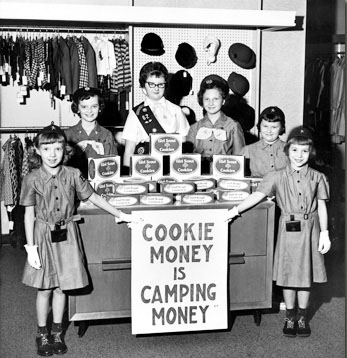
Photograph:  © Girl Scouts of America, circa 1960

Launch 2017 With Strategic Planning For Your Business

Happy New Year! My wish for all my readers is that 2017 will be filled with good health, good choices and prosperity and a year where you recognize opportunities and successfully move forward to attain what will benefit you.

Part of the process of realizing your goals may involve strategic planning. The process of strategic planning encourages business leadership teams to ask (the right) questions about the value that the business creates and sells at a profit, which is a reflection of its vision and mission.  The goals, objectives, business model and guiding principles (that is, culture and values) are likewise impacted by the organization’s vision and mission. Below are six strategic planning and positioning principles to enhance your planning.

Principle 1:  Sustained profitability

Economic value and the conditions for generating profits are created when clients value your product or service enough to pay more than it costs the business (you) to produce and provide it.  Strategic planning is all about Defining  business goals and objectives and devising strategies and action plans with the thought of ROI, in particular long-term ROI, in mind.  Assuming that profits will be inevitable when sales volume and/or market share are the most accurate measurements of success is not the best way to approach the matter.

Principle 2: Value proposition

First, be certain that what you consider to be the value proposition—that is, the most desirable benefits—matches what clients consider to be the value proposition. Be aware that strategy is not about offering services or products that will be all things to all prospective clients.  Businesses are in need of strategies that allow the venture to compete in a way that allows it to effectively and efficiently deliver what clients consider the value proposition.

Principle 3: Competitive advantage

The unique and desirable benefits that sustain the value proposition must be reflected in and supported by strategy that shapes them into a sustainable competitive advantage.  The successful enterprise will differentiate itself from competitors through the products or services offered, how those are packaged and/or delivered, customer service practices, branding, pricing and so on; those unique features and practices will matter to current and prospective clients.  Still, the company’s business model will likely resemble that of its rivals.

Principle 4: Choices and priorities

Resources are inevitably finite and choices about your products and/or services must be made, in order to define what is necessary and possible and therefore, a priority.  Some  product or service features will not be offered, so that the benefits (priorities) that clients have chosen as highly desirable can be optimized.  These priorities are what sets the business apart from competitors and define the brand.

Principle 5: Flow

Choices and priorities must be baked into the strategies that you and the leadership team devise, to enhance and enable the consistent  delivery of the value proposition. These strategies will be both stand-alone and interdependent, like dominoes.  Choices made to define the target customers that the business will pursue also impact product design and by necessity will impact choices that determine the manufacturing process and its cost.  Choices that determine what will be included in a service will be influenced by the expected target customers and will impact how that service is delivered and priced.  Choices about product positioning and branding will impact where the product is sold and the marketing strategy.

Principle 6: Direction

The late style icon Diana Vreeland, who served as editor-in-chief at both Vogue and Harper’s Bazaar Magazines, once said that “elegance is refusal.” A company must define its unique value proposition and that will eventually cause certain potential choices to be declined, because they are contrary to the brand.  The product or service lines can be altered to satisfy customer demands over time and business models can be adjusted to reflect current or anticipated market conditions.  Nevertheless, the vision and mission must be upheld to maintain brand awareness and trust. Strategic direction will guide that process.

Thanks for reading,

Kim


The Most Profitable Small Businesses

What was your Fiscal Year 2015 net pofit margin? Did you reach your projection? Are you solvent and able to manage your accounts payable, business and household? Were you able to buy useful and comprehensive medical and dental insurance?  Were you able to deposit $10 K  or more into your retirement account? Did you travel to some nice location during the year and reward yourself with a vacation?

If the answer to two or more of those questions is no,  I respectfully suggest that you think about your Freelance consulting venture.  If you were able to put $7500 into your retirement account but you’ve not taken a real vacation in 5 years,  it does not raise a red flag in my estimation.  But if you have trouble paying bills, you have only the cheapest health insurance available and you infrequently or never pay into your retirement fund,  then you need to devise a way to make more money.  One of your options may be not just to tweak your business model and engineer a pivot. You may need to go into another type of venture altogether, one with greater profit-making potential.

Take heed– Sageworks, a financial data service located in Raleigh, NC, analyzed the net profit margins of 16,000 small businesses that earned less than $10 million between September 2014 and August 2015.  The average net profit across all industries in that time period was  7.2%.

Note that this list of top performers consists almost entirely of Freelancer-friendly service industries.  Despite the challenges of selling services, especially intangible services,  to either B2B or B2C clients,  Sagework’s list demonstrates that it is possible  to make money as a self-employed service provider.

Some industries are more soloprenuer-Freelancer friendly than others.  Accountants/bookkeepers, real estate sellers, lawyers,  landlords,  health  practitioners (physical therapists, chiropractors, podiatrists, etc.), graphics/industrial designers and architects/(structural) engineers are all able to operate a one-person shop quite well, perhaps with a single employee to provide administrative help.  Physicians, I’m sorry to say,  can no longer maintain a solo practice in big cities.

Educational requirements and professional credentials pose a formidable barrier to entry for several of these high-yield business opportunities, with medicine, dentistry, law, architecture, engineering, chiropractic and accounting (CPA or certified financial analyst) leading the list.  In contrast, real estate sales requires only the right relationships,  a license to do business and no real selling skills if you are in a hot market.  If someone with a real estate broker’s license brings you into the business,  you can work under the umbrella of that person’s credential.

I confess that I look askance at the stated prospects for attorneys.  There have been many mergers between big law firms and as a result, many lay-offs. I’ve personally known a couple of lawyers who had a hard time finding employment and when it was obtained, the job was an assistant district attorney that pays maybe $50 K a year.

I’ve read about lawyers with degrees from Ivy League schools (UPenn and Columbia) saddled with six figure debt and no job.  I recently read about a young lady who sued her (accredited but undistinguished) law school,  claiming that the advertised post-grad job statistics are false and also charging that the career services department was useless. She lost her case,  but I suspect that her argument is valid nevertheless.

From a former employee of a very prestigious law firm who was let go four or five years ago (and started her own profitable boutique firm),  recent law school grads who were hired by prestigious firms over the past couple of years have been subjected to a shocking bait & switch game—from a law firm, no less!  An offer letter is sent, in which the new hire learns that s/he will not start the dream job for two years.  Oh, and the salary will be $20K less than was originally negotiated.

While some attorneys do quite well, like my friend, many  self-employed lawyers in solo or small enterprises struggle as the big firms shed employees. Welcome to the new normal. Below are the small businesses that in the U.S. that on average have the healthiest profit margins.

Thanks for reading,

Kim

Business                                                                                   Net profit margin

Accounting / Bookkeeping                                                             18.4%a

Real estate sales                                                                                15.2%

Lawyer’s office                                                                                   14.5%

Dentist’s office                                                                                  14.4%

Landlords                                                                                             14%

Health practioners (chiropractors, etc)                                      13.3%

Physican’s office                                                                                13%

Business or technical consulting                                                   12%

Graphic and industrial design                                                         11.4%

Administrative services (billing, etc.)                                           11.3%

Architectural / structural engineering services                          11%

Real estate oproperty services (landscaping,cleaning, etc.).  10.1%


Pricing Primer for Freelance Service Providers

“The business world is driven by the desire to increase three elements: market shares, sales revenues and of course, profitability. Pricing is the key player in any strategy concerning the growth of these three goals.”   Mohammed Nosseir, Senior Marketing Adviser, Simon-Kucher & Partners, Middle East

Determining the pricing structure for intangible services provided is a real challenge for Freelance consultants. What is the value of our time and expertise in the open market? What if we promote our services, set the price and no one hires us? Should we lower our project fees? Can we ever raise prices?

Clients are motivated to spend as little as possible for the products and services that they require. However, they are known to pay premium prices when they “feel” that a particular product or service delivers exceptional value. That value can mean an expert solution to a business challenge; a long-lasting product that performs very well with little maintenance; the ability to meet a deadline; or other factors that have meaning to the decision-makers.

Often as not, different clients will have different priorities that define what is valued. It is the Freelancer’s job in the initial face-to-face client meeting to figure out what the client feels is important. That knowledge will achieve two objectives:

  • You will know the expectations that must be met (or preferably, exceeded) to justify a premium price.
  • You will know how to price, based on the time or other resources that will be devoted to meeting and exceeding client expectations and you will grasp the urgency of client needs, which impact your price.

Most likely, there are standard benchmarks and signifiers of high-value service in your industry and they should be incorporated into your marketing and operations, along with other value-addeds layered on as necessary. Knowledge of what competitors do would be most helpful as well, but it is very difficult to learn how competitors deliver their services or price them. Nevertheless, it is advisable to choose three or four to research. Visit websites to learn what services your competitors offer and how those services are described and packaged. Then, you can better identify potential competitive advantages for what you have and find a way to describe your goods.

It may sound like an obvious no-brainer, but part of your premium value-added that will be reflected in your pricing strategy should be your positive attitude and willingness to help prospective clients find the best solution to their business needs. Friendliness and the aim to genuinely want to offer good service go a long way in life and in business. Showing a good work ethic is likewise important.

For example when on an assignment, pay attention to emails. While I don’t recommend that one should be obligated to answer emails that a client dashes off at 3:00 AM (unless this is an urgent and high-revenue project), check emails through 10:00 PM and resume at 7:00 AM. If you can anticipate client needs, so much the better, They’ll think you’re a hero and will be happy to pay for the pleasure of doing business with you.

Step by step, client by client, focus on exceeding expectations on every project, building the trust and confidence that lead to a respected brand (reputation) as you do. You will receive referrals from satisfied clients (and you can also make referrals to your clients, enhancing your brand each time you do). Good brands create good word of mouth and that supports and justifies premium pricing.

As Mohammed Nosseir concludes, “Pricing has been, and will continue to be, the most complicated element in the marketing mix family…A proactive pricing structure will help companies…to maximize their profitability.”

Thanks for reading,

Kim

High Impact Brand Appeal

Business researcher, businesswoman and author Wendy Lipton-Dibner is a highly successful woman who has led highly successful enterprises and has made lots of money by not focusing on money. Yes, that is correct. This brave iconoclast says that the right product or service and a business model that is not quite like what they teach in business school, is the blueprint for building a long-lasting and lucrative business venture and she has the data to prove her claim.

Lipton-Dibner studied 1000+ organizations that covered a wide spectrum: global, small business, for-profit and not-for-profit. She has also operated several business enterprises herself. What her research revealed runs counter to the holy grail of business management, which is 100% focus on generating profit. From product development to customer service, it is taken as gospel that minimizing costs and maximizing sales are the things to do and every aspect of a business must be aligned around the singular goal of making money.

Yet Lipton-Dibner discovered that the most successful and long-lived companies are those that “make a difference” in the lives of their customers. Think of the distinctive, sometimes revolutionary experiences created by Disney, Ford Motor Company, Microsoft, Hermes and Whole Foods Markets. Each of those companies offers products or services designed to help their customers lead more fulfilling, efficient, productive, healthier and/or enjoyable lives. She asserts that there are two types of business enterprises: those that focus on making money and those that focus on making a measurable impact on people’s lives and it is the latter approach that makes the most money.

Ethical growth strategies that position the company to make a positive impact on the lives of customers reap the most success, especially over the long-term. So how can a Freelancer or small business owner integrate this philosophy into his/her operation? As always, everything begins with the customer.

Ask current and prospective customers how your product or service and its delivery mechanism might be adjusted in ways that would make it more user-friendly. Can you design and deliver the ideal customer experience from start to finish and make those who do business with you so happy that they’ll tell co-workers and colleagues, who may eventually become your customers as well? That is the power of your brand appeal and impact.

As you make the changes that will give your customers The Best Experience Ever, you may find that certain adjustments in your business model, operations processes, quality control, or service offerings may need updating and that is to be expected. You’ll also learn how to refine your marketing messages and sales strategy along the way, because you will be much more tuned-in to what resonates with your customers, promoting trust in what you do and making customers happy to do business with you.

Wise fiscal management of your enterprise will continue to be a requirement, but centering your strategies and actions on  the pursuit of the biggest profit margin and net profit often does not pay off in the end. Finding the balance between what it takes to gain and keep customer loyalty and the necessity of sustaining a money-making enterprise is the road to success.

Thanks for reading,

Kim

The Break-Even Analysis: Find the Pricing Sweet Spot

To continue the topic of pricing,  in this case pricing a new product or service,  it is a must to know when fixed costs will be covered by unit sales at a given price and determine when in time the item or service breaks into profitability.  Performing a break-even analysis will reveal how many units must be sold,  or how many times the workshop must be delivered,  at a given price,  before production costs are behind you.  Integral to that question is unit selling price.  Costs are recouped faster when selling at $100.00 rather than $50.00.  Also related to pricing is what customers expect and agree to pay.  Appropriate pricing can increase profits faster than increasing sales volume.  One can sell fewer items and make more money per item.  Conducting a break-even analysis is Step 1 in locating your ideal price range.  Here’s the Break Even Volume (BEV) formula:

Fixed costs                                                      Fixed costs

BEV     = ______________________________        =         __________

Revenue per unit – Variable cost per unit                         Unit margin

Let’s add some numbers to the formula and assume that the fixed costs associated with delivery of your service is $5, 500.00: $1,700.00 went to the graphic artist for Power Point slides; $1,300.00 paid to the wordsmithing wizard for marketing collaterals used for promoting the service; and $2,500.00 for the wholesale value of your labor,  the time you spent crafting the intangible service.  These costs are fixed because they will not change,  no matter how many times the service will be delivered.  Variable costs associated with service delivery would be printing hand-outs for participants ($50.00) and the advertisement placed in an industry newsletter read by the target audience ($400.00),  meaning that the unit variable cost =$450.00.  If the service is priced at $750.00,  the profit,  or unit margin,  is $300.00 each time the service is delivered at that price.

$5,500.00

BEV     =        _________     =   18.33

$300.00/unit

At a per unit price of $750.00,  the service must be delivered 18+ times before a profit will be made.  From there,  a series of  “what if”  scenarios can be floated.  Chiefly,  what are competitors charging or is there a spike in demand that makes the product more valuable and can you increase the price?  Also,  can you lower fixed costs and obtain graphics services for a couple of hundred dollars less?  What if the marketing collaterals text was produced in-house by you and not outsourced?  How much will that increase the price of the time you spent developing the service,  another fixed cost?

Let’s say that you find graphics services for $1,500.00 and ask a marketing communications wizard to edit text that you write yourself for $800.00 (your personal labor increases: 6 hours writing at $50.00/hour = $300.00 + $2,500.00 = $2, 800.00).  Now,  the fixed cost is $5,100.00 and you think that $950.00 is a price that clients just might accept.  The variable costs will remain unchanged at $450.00,  because your printer is good,  his price is right and you’ll definitely need to advertise since you may want to charge more for the service.  At a unit price of $950.00,  the unit margin would be $500.00.   As shown,  by raising the price of the service by $200.00,  fixed costs are covered by delivering the goods 10+ times,  rather than 18+ times.

$5,100.00

BEV=             ________      =   10.2

$500.00/unit

As you can see,  the impact of other values such as increased advertising or higher quality materials or labor,  can also be assessed for impact on the pricing sweet spot and timeline for reaching BEV.  When bringing a new product or service to market,  take steps to identify the ideal pricing structure.

It is also useful to calculate the profit margin,  that is the percentage of sales revenues retained after all expenses are paid,  for each product and for the total line.  From the P & L Statement,  divide net profits by total sales revenues  (bottom line divided by top line).


Thanks for reading,

Kim

expert_author_1


Business Model Tune-up

You’ve written a business plan—now what?  Kim is the midwife who helps you take your business from the drawing board to reality in  “Business Plans:  The Next Steps”.   Bring your completed business plan and join Kim and a group of hopeful entrepreneurs in round robin discussions where you’ll get a critique of your business model;  smart marketing/PR/social media advice;  insights into sales channels that make sense for you and your customers;  and advice on financing options in today’s economy.  Wednesdays March 13,  20  &  27  5:30 PM – 7:30 PM at Boston Center for Adult Education  122 Arlington Street  Boston.  Register at  http://bit.ly/Zd9dqR  or call 617.267.4430 class ID 9074.

A cloud of worry and paranoia envelopes business leaders and other decision-makers and in their role as B2B clients,  they become more fickle and gun-shy every day.  They brag about postponing projects and declining to spend money.

To survive and thrive,  it is therefore  essential for Freelance consultants and other business owners  to make an annual assessment of the company’s business model and evaluate how the organization can deliver the right services in the right way and demonstrate to clients that the value you bring improves the bottom line and makes clients look smart to the higher-ups.

The business model is the blueprint for the process your organization follows to connect with clients,  deliver services and make and sustain a profit.  The business model reflects what you believe about what clients need and value,  the way in which those needs ought be addressed and solutions delivered and what clients will pay to obtain those solutions.   Additionally,  the business model shows the business leader how to make his/her organization function efficiently for leader and clients. Perfecting it is the cornerstone to success  (along with a healthy dose of good fortune!).

The most direct way to check up on your business model is to take a good client to a restaurant for some combination of libation and/or meal at the conclusion of a project,  when the client’s trust in you is high because you’ve delivered the goods and exceeded expectations.  You will likely be able to persuade your client to open up and tell you what’s going on in the organization as regards challenges and opportunities,  plans for the future,  services that are valued and the preferred method of delivery for those services.

You are certain to learn all sorts of useful information that will tell you how you might refine,  adjust,  package or price your services.  Knowledge of your client’s priorities and concerns is the first step to winning the project that does the work to address them,  says Alexander Osterwalder,  co-author of  “Business Model Generation” (2010)  and founder of The Business Model Foundry  http://www.businessmodelgeneration.com

Knowing how your clients can get the job done without you is also useful (although painful!).  As I mentioned at the beginning,  your real competition may not be another Freelance consultant but the client,  who decides to table the project indefinitely or do it in-house.  That’s not easy to counteract.  Your only defense is a solid business model that helps you position and promote your solution as preferable in some vital way.

Flexibility in your business model is a necessary feature if you expect your business to make a profit.  The need to adapt to shifting client preferences may require you to selectively experiment and reconfigure the services you offer,  or how you package and promote them.

Updating the keywords you use in marketing campaigns and online and print collateral will help clients and prospects to visualize where your services might have a place within their organization,  so stay up-to-date with industry concerns and buzzwords.  Keeping abreast of client needs allows you to successfully adapt your business model and promotional message,  keeping your organization competitive and able to stay profitable.

Thanks for reading,

KIm