What Do You Spend to Get a New Customer?

Do you know how much you spend, on average, to convert a prospect into a paying customer—attracting the prospect’s attention, educating the prospect about your brand, your services and your products, instilling confidence and building trust—and making a sale? Have you tallied up the combined cost per customer of your marketing campaigns, selling expenses, referral programs, customer onboarding and the like and calculated the average amount of the marketing spend that supports the growth of your customer list—and your revenue, as a result? What kind of a return on investment are you getting from your marketing campaigns and sales strategy?

You may not know in the moment your company’s average customer acquisition cost, but it would be a good idea to update it (or figure it out) and keep that number in mind, because your CAC is a metric that reveals an important story about how your business functions. Customer Acquisition Cost is a key performance indicator, although not necessarily in the way many business owners and leaders think. CAC shines a bright light on the performance of company operations and outcomes, including the business model, which is the essential plan for making money. The metric also reveals the effectiveness of your overall marketing strategy, which reflects your marketing acumen and, in the end, can make a credible prediction of your organization’s potential for profitability and expectations for growth and scalability.

CAC is a metric that can be benchmarked against an industry standard and it’s a smart idea to research your industry’s average CAC and use the benchmark number as a guideline. Learning the CAC benchmark for your industry will enable you to identify a reasonable dollar amount for your marketing and sales budgets and help you avoid either overspending or underinvesting on marketing activities—which you rely on to bring paying customers into the business.

Familiarity with the CAC benchmark in your industry also enables you to evaluate your performance as a marketer. For example, if your company’s CAC is significantly higher than industry average, it could indicate problems with your marketing strategies or sales strategies and practices—-you’re spending money but not bringing in enough customers, or not the right customers, to generate a healthy marketing ROI. On the other hand, if your CAC is rather low as compared to the industry benchmark, it suggests that you may be under-funding marketing. If that’s the case, then theoretically you could assume that spending more on marketing would bring in more customers that fit your definition of ideal. In other words, CAC reflects the effectiveness of your marketing practices and can help you set realistic goals, as well as identify where you need to do better.

Calculate CAC by dividing total marketing and sales expenses by the number of new customers you’ve brought to the business within a given period—annually or quarterly, for example. Because many businesses serve more than one customer segment, it will make sense to separately calculate CAC according to customer segments, which could be based on demographic factors and might also involve differences in sales cycle length or competitive landscape. Incidentally, B2B entities typically have a longer sales cycle and tend to have a higher average CAC than B2C companies.

You’ll also want to segment your spend on the marketing channels you use—e.g., email marketing, social media advertising, customer relations management software subscriptions, and/or attending trade shows—and calculate the corresponding CAC figures. But what does understanding CAC really do for you? CAC is about documenting, analyzing and tracking over time the amount you spend on various customer segments, plus your marketing channels and sales strategies, that are used to convert prospects into paying customers.

There is also the matter of a customer’s average lifetime (revenue) value. You already know that a campaign to bring in a new customer costs at least 5x more than what you must do to retain an existing customer. Nevertheless, you may want to calculate the average amount of revenue that will flow to your business over the length of time that a customer does business with your organization. The question is addressed by calculating Customer Lifetime Value, a metric that is foundational to long-term revenue growth. Additionally, CLV factors into CAC, because it determines the return on investment (ROI) of the customers you acquire.

Calculate CLV by multiplying the Average Purchase Value x Purchase Frequency x Average Customer Lifespan. For instance, if you provide subscription services or have customers on a retainer agreement, you can calculate customer lifetime value by multiplying the amount of the subscription or retainer fee by the length of the subscription or retainer contract (purchase frequency) to arrive at CLV for one customer for one year (CLV is typically calculated on a one-year time frame).

Another useful metric is the CLV: CAC ratio, which compares Customer Lifetime Value (CLV) to the Customer Acquisition Cost (CAC). The ratio documents the revenue an average customer brings to your business, as compared to what was spent to acquire that customer. A desirable CLV: CAC ratio should be at least 3:1, meaning that every dollar of marketing spend will result in three dollars of revenue generated by a customer. A ratio less than 3:1 indicates your company’s marketing efforts are producing less than stellar returns, while a ratio far in excess of 3:1 suggests that you could produce more revenue growth with an increased marketing spend.

Make a point to benchmark your CAC against industry averages and to understand what good marketing and sales performance looks like. Here’s how to get started on figuring out your company’s CAC:

  • Define customer acquisition process and goals.

Make a comprehensive assessment of you acquire customers—paid social media ads, organic social media outreach, thought leadership, e.g. public speaking, hosting a podcast, and/or publishing a newsletter, word-of-mouth and referrals? Have you developed an inbound marketing/ sales funnel to capture prospects who search online to find a B2B Freelance professional services provider in your category? Next, decide what represents a realistic customer acquisition goal for your organization—how many active customers can you reasonably expect to have on your roster in a typical year?

  • Segment your CAC by different variables

Consider how to segment your customers, keeping in mind customer demographics and accounting for the marketing channels and options you employ. Get comfortable with the fact that your CAC for certain channels might be higher than your benchmarked industry average, which means that you’re spending more to acquire customers through those channels. By segmenting your CAC, you can identify the best and weakest performers in your marketing and sales strategy and optimize your resource allocation accordingly by dropping certain options and increasing your investment in better performing channels.

  • Document your marketing and sales budget

Once you’ve chosen your CAC segments, you can look at what each of them costs—identify and quantify all costs directly related to acquiring new customers. These may include advertising, content creation, SEO, social media, email marketing, webinars, CRM software and/or buying your way into business association events that allow you to network effectively. You can use tools such as Google analytics, Facebook Pixel, or HubSpot to track and measure the performance of your different channels and campaigns.

  • Select your time period

Decide on the time period for which you will calculate your CAC—quarterly or annually should make sense for your business. You need to match your marketing and sales expenses and your new customers to the same time period for your CAC calculation.

  • Calculate your CAC

To calculate your CAC, divide the total amount of money spent to finance your marketing and sales activities by the number of customers you acquired in a given period, and apply customer segments that reflect demographic groups and the primary marketing channels you use.

  • Research your industry CAC average

To benchmark your CAC, compare your number with the industry averages for your niche, product or service and target market. Because  CAC can vary widely depending on the industry, the business model, the product, the target market, and the marketing channels used. Therefore, it is essential to benchmark your CAC against relevant and reliable sources of data, such as industry averages and competitors.

  • Compare CAC: CLV ratio

CAC alone does not necessarily indicate a revealing story about the health of your business, but the story will be more telling when you look to CLV and learn the average amount of revenue that you generate from a customer over the span of the business relationship. Be sure to follow-up with an examination of the CAC: CLV ratio, which tells you the amount of revenue generated per money spent on marketing and sales functions. A common rule of thumb is that your LTV should be at least three times your CAC. This would indicate that you have a positive ROI from your marketing and sales efforts.

Finally, keep in mind that CAC is not a static metric and remember that it can and will vary when impacted by various factors, such as certain fluctuations in your industry, organic changes in your product or service lifecycle, marketplace changes, especially changes in the competitive landscape or pricing. You will be wise to monitor and analyze your CAC regularly and adjust your marketing and sales strategies accordingly. 

Thanks for reading,

Kim

Image: © Chestnut Hill College, Philadelphia, PA

LeadGen and Customer Acquisition in 2025

LocaliQ, a digital marketing platform that specializes in lead generation and multichannel marketing campaign management, and is a subsidiary of Gannett Publishing, surveyed more than 730 small business owners and marketers worldwide to get boots-on-the-ground perspectives on leadgen and customer acquisition marketing tactics SMB owners are using now and uncensored feedback on what’s producing the best results. The survey is a rich source of benchmarking and actionable insights that have the potential to inform your approach to leadgen and customer acquisition strategies and tactics this year.

In its first Small Business Marketing Trends Report, LocaliQ shares the results of a deep data dive that’s intended to help Freelance consultants and SMB owners successfully navigate the business landscape they can expect to encounter in 2025 by learning how their peers energize sales revenue by identifying leadgen tactics that promote customer acquisition.

The relevance of LocaliQ data is for many of you validated by the survey demographics—15% of respondents are soloprenuers; 31% have 2-10 full-time employees; 24% have a marketing budget that’s less than $500/ year (5% have no marketing budget); and 74% are based in Canada and the U.S. (all six inhabited continents plus New Zealand are represented). The survey was published in October 2024. How does the average Freelancer or SMB owner attract prospects?

Survey respondents do what you’d expect and it’s safe to assume that they use more than one leadgen tactic to implement their marketing /sales strategy. Social media marketing (free) is used by 52% of respondents; 47% of respondents use (paid) social media advertising; and 40% of respondents use search advertising, i.e., pay-per-click sponsored ads that appear in search engine inquiries. Other popular leadgen tactics are email marketing, used by 39% of respondents and content marketing, used by 33% of respondents. Online listings and directories (28%), display ads (24%) and traditional media (23%) are 20th century tactics and that gives them a similarity (IMHO); when combined, 75% of survey respondents use one or more of these older leadgen tactics.

As for the social media platforms used, it’s no surprise that Facebook dominates—76% of respondents use the platform for leadgen, promoting products and services and otherwise engaging with current customers and prospects. Instagram is used by 63% of survey respondents and LinkedIn, tailored as it is to B2B customers, is used by 43% of respondents. The data also showed that 29% of respondents use video marketing, a feature that is available on the above three platforms and also YouTube, which is used by 38% of respondents and recently rescued TikTok, which is used by 34% of respondents. Surprisingly X, a platform intended for Instant Messaging and other text communications, is used by 41% of respondents for social media marketing (X also hosts video sharing).

Now let’s talk turkey—when asked about their satisfaction (or disappointment) with the results of leadgen tactics, social media marketing and online listings/business directory users are satisfied with results—66% of social media marketing users and 61% of online listings/business directory users are pleased with their leadgen marketing results—still, each group also has a dissatisfaction rate of 15%. Furthermore, there is a rather large group of “neither satisfied nor dissatisfied” —meaning lukewarm?—users associated with those leadgen marketing tactics and 24% of online listing/ business directory users and 19% of social media marketing users joined the lukewarm group. Maybe it’s too difficult to measure leadgen results directly from social media marketing activity, whose conversation threads remain visible for years and likewise for presence on a business listing site or directory that a prospect might see many months after publication?

More clarity is derived from search advertising and it topped the list as the leadgen tactic most respondents are happy with, as evidenced by its 76% satisfaction rate (with 12% dissatisfied and 12% neither satisfied nor dissatisfied). A close second in popularity is video marketing, a leadgen tactic that has a growing user rate on every platform; in this survey, 74% of users are pleased with their video marketing outcomes and just 8% are unhappy (and 17% are neither satisfied nor dissatisfied). Short-form videos, like those on TikTok and Instagram Reels, continue to surge and 58% of respondents have either recently tried or would like to try the format.

Search advertising succeeds because it kicks in precisely when the purchasing motive is strongest and prospects are actively looking to buy a product or service that’s similar to yours. Readily available alternative options are waiting for them, as shown in search ads you’ve seen. Survey respondents also indicate satisfaction with results they’re finding with content marketing (75%) and advertising on social media platforms (73%).

The best source of leadgen is (drum roll) customer referrals! Almost 65% of survey respondents reported that customer referrals are the best leadgen sources. The influence of customer referrals is greatest (75%) for SMBs that have 10 or fewer full-time employees and have less influence in larger organizations—just 46% of businesses with 50 or more employees report that customer referrals are the best source of new customer leads.

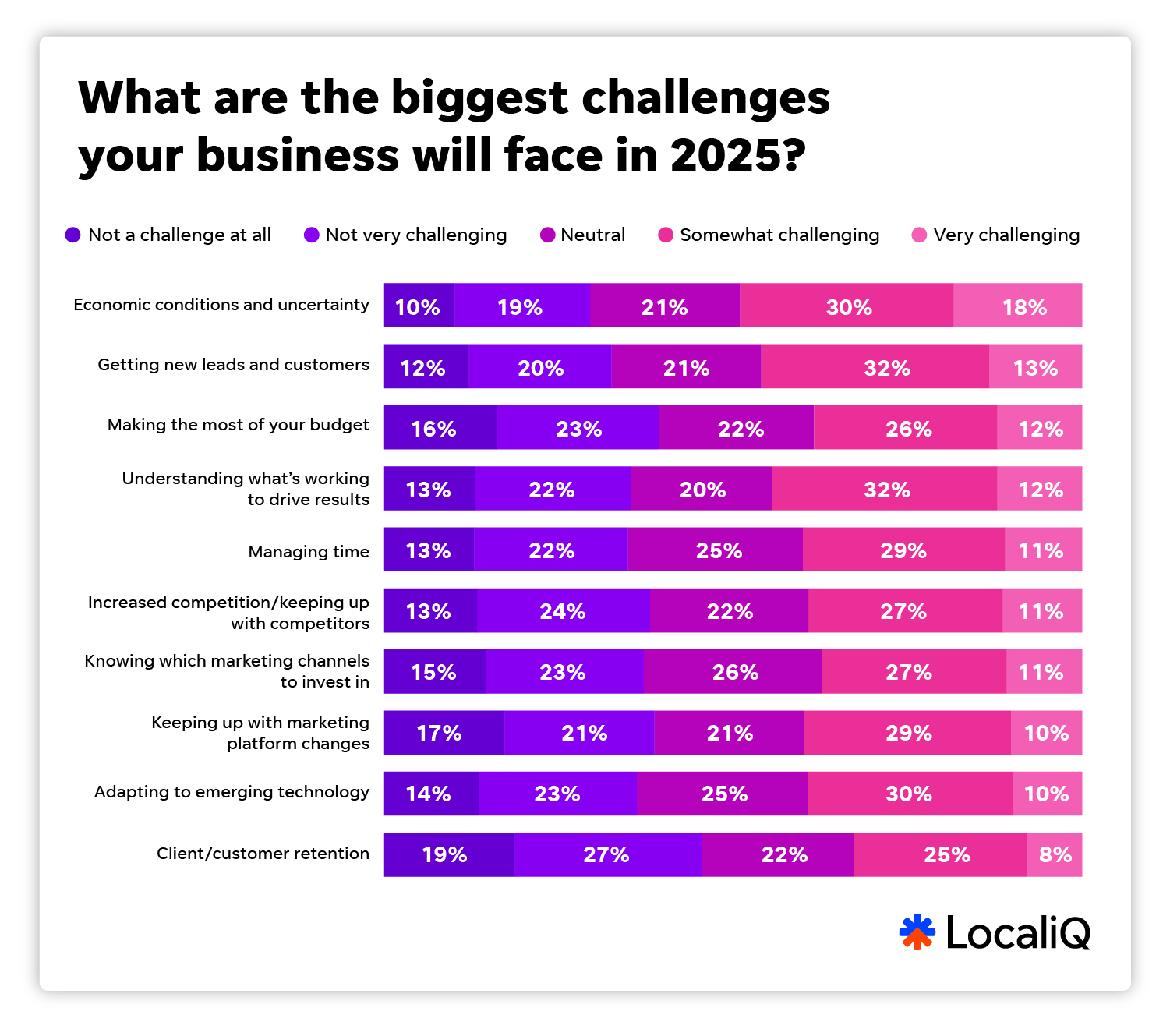
Major challenges anticipated in 2025

Freelance consultants and SMB owners know that in order to survive and thrive, a clear-eyed view of their economic landscape is necessary. Economic uncertainty, leadgen tactics that stimulate new customer acquisition and optimizing an (often modest) marketing budget are by necessity at top-of-mind. The ability to predict which marketing tactics can be relied on to produce the strongest return on investment is viewed as somewhat or very challenging for nearly half of survey respondents—44% are somewhat or very concerned about the capability of their chosen leadgen tactics to drive results. Adapting to new technology is a concern for 40% of respondents, who indicate they are somewhat or very concerned about keeping up. Furthermore, 45% of respondents are somewhat or very concerned about their leadgen tactics bringing in enough new customers and 48% are somewhat or very worried about economic conditions and uncertainty.

So, what are the recommendations for driving Freelancer and SMB success in 2025? There are no definitive answers and the suggestions offered below are not new and not rocket science. Your goal is to make money, but you could meet with headwinds for any number of reasons. Outcomes produced by your business strategies and tactics cannot be predicted but appropriate design, execution and performance monitoring on your part can be expected to yield at least modest success. Marketing and sales have a direct effect on customer acquisition and generating revenue, making these two closely related functions the money-making engine of a business venture and deserving of your intense focus. Just do it.

It’s helpful to monitor the performance metrics of marketing tactics and for that process, Google Analytics generates relevant and insightful data that enables you to evaluate your campaigns—at no charge. Sign up now! Along with leadgen/customer acquisition, make a point to promote customer referrals by asking your current customers if any of their colleagues or customers have the potential to become one of your customers. Also, create customer experience protocols that at every touchpoint anticipate and respond to customer needs end-to-end, from new or returning customer onboarding to after-sale training or other services. Finally, invite customer feedback by directly speaking with those who do business with you when possible. It’s good business to send out an email survey (maybe once a year), or chat with customers by way of social media; it’s important to learn what customers would like to see you do (or not do), so that you can optimize the experience of doing business with your company.

  • Be prepared to manage both the opportunities and challenges you encounter by being aware, being agile, being resourceful and being resilient.
  • Develop comprehensive marketing/sales strategies and implement with tactics you can expect to be effective. Regularly consult your website (and social media) performance metrics and make adjustments where necessary, to maximize performance.
  • Identify one or two local business associations and aim to attend one program per quarter as a way to obtain professional development and/or enhance your business acumen skills as you meet colleagues and engage in face2face networking that builds mutually beneficial relationships.
  • As soon as your budget allows hire an (outsourced) business accountant or bookkeeper to not only maintain the integrity and timeliness of your business financials and tax filings, but also to discuss and guide the potential business growth and expansion of your venture.

Thanks for reading,

Kim

Image: © kali9/ iStock

First Up for 2024: Get A Tagline!

As you brainstorm ways you might market your business in 2024—content you’ll produce, an updated list of keywords you’ll add to your website and social media, the panels, podcasts and webinars you’d like to appear on, the guerilla marketing campaign that might grow your customer list—you may eventually get the bright idea to create a tagline. A tagline, also known as a company slogan, may not receive priority status as you consider marketing strategies and tactics; however, you know that dozens of powerful taglines have figured prominently in the marketing campaigns of companies they represent, companies that billions of Americans and others have used for decades.

A clever and appealing tagline can become enormously popular and go on to play a role in popular culture, as it encourages current and prospective customers to use and refer the products or services it represents. Developing an effective tagline will strike a personal or even emotional chord in current and prospective customers that moves them to perceive your brand as more than just another provider of goods and services.

The tagline defined

So, what is a tagline? It’s a short, memorable phrase or sentence that sums up the essence of a company brand, products and/or services. A good tagline succinctly distills and communicates what the brand aspires to be known for and what differentiates it from competitors. It is influenced by the company vision and/or mission statement, as well as the value proposition and brand reputation but rather than presenting a lengthy and ponderous statement to describe the company, the tagline wraps those serious intentions in one brief and catchy phrase that keeps the company at top-of-mind mind for future buying decisions by reminding customers and prospects why they should choose to do business there.

A tagline can even become synonymous with the brand. Float like a butterfly, sting like a bee elegantly captured the strength, athletic prowess and engaging personality of boxer Muhammed Ali (ne Cassius Clay, 1942-2016) and stands as a brilliant example of an ideal tagline.

What makes a good tagline?

A tagline can be a powerful marketing tool and although it will most likely take time to create the right one for your entity, it could be well worth the effort. It would be best to use your tagline to identify what your business does and highlight its benefits to current and prospective customers. Why not create a rough draft and keep the following in mind as you brainstorm possibilities?

  • Brief: Your tagline doesn’t need to cover every aspect of the business or explain your company values. It should be brief, unambiguous in describing the essence of the business, likeable and easy to remember.
  • Clear: Creativity makes your tagline unique, but you don’t want to be so creative that the intended audience misses the point. The wording must be clear, concise and immediately understood.
  • Memorable: Since the best taglines have but a few words, make every word count. Your tagline should be memorable for its creativity, uniqueness, or other positive aspect that inclines customers and prospects to remember and like it.
  • Reps the brand: The tagline should communicate the core of the brand identity. It should succinctly convey the brand image and voice, whether that’s upscale and formal or frugal and casual.
  • Customer-centric: While the tagline refers to the company, its focus should be on the customer and what the company can do for them, for example, save time and/or money, be trustworthy and dependable, give great service, or be convenient. “Have it your way.” (Burger King)
  • Relatable: A successful tagline has a personal appeal and speaks to the customer on an emotional level as it expresses the benefits of what the company’s products and/or services can do for them.

Short and simple

An effective tagline is direct and to the point, brief, uncomplicated, engaging and easily remembered. Aim to use no more than 10 words. A good tagline rolls off the tongue, is properly descriptive of the company’s purpose or benefits and is easy to remember. A useful way to test your tagline in development is to ask your friends, family or even new acquaintances and ask whether they understand what your company does and their overall impression of its message. “I ❤️NY” (Empire State Development Services)

Relevant to customers and prospects

The best taglines are about the customer, not about the company. A tagline focused on your company could possibly cause customers to wonder how it relates to them. By focusing on current and would-be customers, you’ll more effectively promote brand recognition and loyalty. Be sure to incorporate your company’s brand voice and persona. Avoid making promises in their tagline, which will put the focus on the company, and emphasize benefits instead.Breakfast of champions” (Wheaties breakfast cereal)

Make your tagline match your brand

A tagline, like a logo, helps to define your brand. Ensure that the style, brand voice and other elements of your tagline match the style, voice and other aspects of your logo design. Because your tagline will be part of your overall branding, you’ll want the tagline to reflect your company’s personality. “Where’s the beef?” (Wendy’s)

Who’s your competition?

Knowing your competition is an important consideration of effective marketing. Study the marketing tactics used by your most prominent direct competitors and examine their taglines for both inspiration and to understand what not to do. Use the marketing of competitors to identify the elements of your company that differentiate it from the three or four who are closest. This could refer to the customer service, customer experience, and/or the comprehensiveness of your products and services (e.g., one-stop shopping) that differentiates and would be advantageous to convey in your tagline. Ensure your tagline sounds distinct from your competitors and larger brands around the country that your customers are likely to know as you communicate your competitive advantage and value proposition. “We try harder” (Avis Car Rental)

How you help customers

Think about how your company or products and services help your customers. How do your solutions solve or avoid problems, help achieve objectives, or make life easier and more enjoyable? Make a list of the ways you provide tangible and intangible benefits to customers, as well as any statements your business makes relating to them.

If your business is growing, consider your entire range of services or products. What value are you delivering to your customers? Think about what your products mean to people in their day-to-day lives, and list all the positive adjectives you can think of that relate to the core promise. “It keeps going and going and going…” (Energizer batteries)

Positive vibe

A considerable body of research shows that negative statements generally don’t sell well, whereas positive messages are conducive to brand building over the long term. Because taglines reflect the brand over time, keep your tagline positive and focused on benefits that customers seek out, depend on and appreciate. Avoid a vague reference to the good things that your company provides and make it unabashedly specific, descriptive of what drives your customers do business with you. “Yes we can” (2008 Barack Obama presidential campaign)

Thanks for reading,

Kim

Pulling Out of A Slump

It can be argued that periodic downturns are endemic to the business cycle. Companies large and small will eventually suffer through a downturn, a slump, in sales revenues and profit. A slump is always worrisome but some are seasonable and therefore predictable. That means you can prepare.

Landscaping services expect the demand for lawn and garden maintenance to drop during the winter months. To supplement cash-flow and position the company for year-round customer value, owners of landscaping concerns are known to retool for snow removal when gardens are dormant.

But for most businesses, unfortunately, a slump will occur unexpectedly and for no immediately obvious reason, such as the appearance of a competitor or a difficult economy. If the struggling business is to survive, corrective action must be taken soon. Reversing a sales trend that’s negative or flat is a formidable challenge, a high-stakes test of the resoucefulness and strategic vision of the company leadership. A turnaound, rather a bigger deal than a pivot, may be needed to turn the tide. Or not.

Freelancers typically do not have the financial wherewithal to bring in a management consultant to diagnose the problem and recommend solutions. Freelance consultants need a Do It Yourself remedy and that’s what we’ll talk about today. As usual, the solution you seek will probably be found in data and knowledge you already own and have access to. Your company’s Key Performance Indicators (determine which ones tell the story) and revelations shared by your customers will most likely steer you to both the correct diagnosis plus cost-effective strategies to halt the slump and stimulate revenue.

When to respond

A slump may be a sudden or gradual phenomenon and caused by any number of factors, including a national or regional economic downturn, the introduction of a compelling new technology, a large-scale health crisis, even a vote in your state legislature. If your top line gross revenues show a decline of 10 % or more (or flatline) for three consecutive months and you are unable to understand why revenue is dropping, recognize that your business is in a slump and you cannot ignore the problem.

The cause

If you’re in a slump, it’s important to identify the cause (single or plural). Did something happen in the industry, or in the local or national economy (like a widespread or a war)? Has business been adversely impacted by the shift to Work From Home, because your customers are no longer in the office five days a week and connecting with them has become difficult? Whatever the cause may be, it’s important to know what went wrong and decide if a work-around would make sense, or if a fundamental change should be made. In some cases, it will be necessary to assess your entire operation. It will be wise to consider the following possibilities:

  • Evolving customer tastes or priorities
  • Business model weakness
  • Powerful competitor
  • Economic factors

The cure

You will likely find that customer feedback is essential to the discovery process. Seeking out the wisdom that your customers can provide will guarantee that you’ll develop a more nuanced and sophisticated understanding of the marketplace and that understanding will lead to an effective solution. A more nuanced understanding of the marketplace can also help you to develop products and services that customers actually want and need.

When preparing to reach out to your customers, make contact through various channels—emails, call-outs in your blog or newsletter, calls-to-action posted to your website and social media platforms. Customer surveys and invitations to join (30-60 minute) conference or video calls can yield a wealth of boots-on-the-ground insights and you’ll be almost certain to obtain actionable information. Reddit, Twitter, Facebook and LinkedIn are ideal venues for this type of research. For example, Twitter Spaces is a feature that allows users to create a chatroom-like environment with a group of people.

Keep in mind, however, that while customer feedback can be very helpful as you search for the cause of your business slump and can as well be very useful as you engineer a pivot or a turnaround for the business, blindly following customer suggestions is not recommended. The customers’ money is not on the line and neither do they see the big picture of the business and its challenges-—you do. Have the confidence to use your own judgment and expertise to make what you interpret as the best decisions for your entity.

In sum, good KPI data and customer feedback should be essential components of any business’s intention to understand and resolve a significant business challenge. An assessment of business conditions, industry trends and customer feedback re: their priorities, goals and preferences can inform any tweaking of products or services you might undertake, the pivot or turnaround you may follow to pull the business back from the brink and position your venture for the greatest success its ever experienced.

Thanks for reading,

Kim

Image: © AF Archive/Alamy. John Dimech (as Daud) struggles to escape quicksand in Lawrence of Arabia (1962).

On Becoming an Expert

Can we agree that competition for the eyeballs, ears and wallets of prospective customers in both the B2B and B2C sectors has resulted in near-intolerable noise in the marketplace? As a result, the 70% or so of Americans who are Freelance solopreneurs or small business operators face an uphill battle to get noticed by those who might become your customers. So the big question is—-what strategies might you employ to persuade prospects that you are The One? In the B2B sector, perhaps the most effective way to gain trust and sign contracts is to present yourself as an expert throughout the buyer’s journey and particularly in decision-making conversations.

To win clients, Freelance consultants have to be the smartest ones in the room, or at least make everyone think they are. On the other hand, you can’t look like a smart-aleck know- it-all because diplomacy matters. Just keep in mind that successful Freelancing is about inspiring trust and confidence and building relationships. Everything you do must support those objectives, which are the pillars of your business. Let’s look at some pivotal moments in a sales conversation where you can reveal your expertise and win over prospects.

Problem-solver not sales rep

Rule #1 of sales is to sell the customer how s/he wants to be sold. The way that prospective customers, especially in B2B, want to be sold is to first, connect with a problem-solving expert who’ll listen and learn what s/he needs to achieve and then recommend potential solutions that are tailored to the prospect’s objectives. High pressure sales pitches have no place in the scenario and are best left in scary memories of the 20th century.

Question, listen, diagnose

Think like a doctor and listen well to accurately diagnose the problem or objective the prospect must resolve or achieve. Ask open-ended questions that encourage the prospect to open up and talk. Your questions should aim to uncover the frustrations associated with the problem, the importance of achieving the objective and the impact of either on the prospect’s business. Ask questions to also discover if the customer has attempted to “self-treat” and attempt to solve the problem in-house. As the prospect tells the story, you’ll envision potential solutions that your organization can provide.

BTW, if you realize that you’re not a fit, it will reflect well on you to make a referral to a colleague or even acompetitor. Do that and you’ll enhance your credibility and brand. You might even get some business from this prospect in the future, either directly or through a referral.

Share experiences, show empathy

Let the prospect know that you are an seasoned problem-solver who has successfully resolved knotty problems before and helped customers achieve mission-critical, high profile goals. As an expert, you have valuable industry experience that prospective customers will be reassured to hear. A short, well-told war story or two will increase your perceived value. Moreover, your anecdotes will help the customer to feel more comfortable to spill the tea and tell you what’s really going on. Plus, it’s a great relationship- building technique.

Talk just enough

Another sales rule is that the seller talks just 15% of the time. In a sales meeting, the floor belongs to the prospect. You’re there to ask the right questions, share a good war story or two to give the prospect confidence in your abilities and judgment and then suggest a couple of possible solutions.

Through your questions, you will control the conversation and the sale. Follow this rule and prospects will respect you as a trusted expert, one with whom they’d be happy to do business.

Thanks for reading,

Kim

5 Genius Questions for Your Customer Survey

Every business owner or leader must study his/her customers (or potential customers for those in start-up or new product launch mode) and gather as much potentially useful information about them as possible. The first and greatest commandment of business is “know thy customer” and the research must continue for the life of the business. We can never stop learning.

The important matter of measuring customer satisfaction and customer loyalty became the life’s work of Frederick F. Reichheld, now an Emeritus Director of the Boston, MA consulting firm Bain and Company, also the founder of its Loyalty practice and author of The Ultimate Question: Driving Good Profits and True Growth (2006). Reichheld reported that it took two years of studying customer satisfaction and customer loyalty survey responses and correlating those responses to actual customer behavior—i.e., purchases and referrals made and then linking customer behavior to growth—to discover that a single survey question can reliably predict sales revenue growth.

The big reveal question does not directly address either customer satisfaction or customer loyalty. Rather, it simply inquires about customers’ willingness to recommend a product or service to someone else. While other factors besides customer loyalty play a role in driving a company’s growth—economic or industry expansion, a product or service line that reflects the needs and tastes of current and prospective customers, good financial management and so on—repeat business and good word of mouth are indisputably two of the most important drivers of sales revenue growth and in general, no company can be profitable without them.

Loyal customers talk up a company to friends, family and colleagues. Their recommendations are among the truest demonstrations of loyalty because the customer puts his/her own reputation on the line when making them. Customers will risk their reputations only if they feel intense loyalty.

The customer experience is, I am certain, another significant factor in a customer’s willingness to recommend a business and many actions contribute to that experience. Marketing Departments point survey questions toward metrics they control, such as brand image, pricing and product features and benefits. But a customer’s willingness to recommend a business is also connected to how well the customer is treated by the front line employees—are they friendly (but not intrusive)? Are they helpful?

According to Reichheld’s findings, customer loyalty differs subtly but substantively from customer satisfaction. Gauging loyalty by way of the usual customer-satisfaction survey questions is not helpful. His research indicates that customer satisfaction lacks a consistently demonstrable connection to customer behavior and growth. Reichheld says it is difficult to identify a sufficiently strong correlation between high customer satisfaction scores and outstanding sales growth. “The question ‘How satisfied are you with (company X’s) overall performance?’ is a relatively weak predictor of growth,” he says.

One of the main takeaways from Reichheld’s research is that companies can keep customer surveys simple. The most basic surveys, providing that the right questions are asked, can allow companies to obtain timely data that is actionable. Reichheld goes so far to assert that a customer feedback program should be viewed not as “market research” but as an operating management tool. Below are five of Reichheld’s survey questions.

  • How likely is it that you would recommend (company X) to a friend or colleague?
  • How likely is it that you will continue to purchase products/services from (company X)?
  • How strongly do you agree that (company X) makes it easy for you to do business with it?
  • If you were selecting a similar provider for the first time, how likely is it that you would you choose (company X)?
  • How satisfied are you with (company X) overall performance?

Thanks for reading,

Kim

Photograph: (l-r) Phyllis Povah, Rosalind Russell and Joan Crawford in The Women (1939). Sales girl Crawford is showing her customers the fictitious fragrance “Summer Rain.”

Shaping the Customer Experience

For all products and services, from the lunch you buy at a favorite restaurant to the purchase of a luxury automobile, the experience of the buying process matters more than ever, it seems. “Service with a smile” barely scratches the surface today. Buying a product or service has officially become a journey, a series of experiences that Freelancers and business owners must create and perfect. There are three phases:

  • The pre-purchase experience, when prospective customers browse advertisements, search company websites and scrutinize social media feeds and online reviews to obtain information about product/ service choices and prices to confirm or modify their expectations.
  • The purchase itself, when product or service choices are finalized, size and color are selected and payment is made. All aspects of the purchase process must be convenient and seamless.
  • The post-purchase experience, as needed, where typical customer service matters such as the (on-time) delivery date will take place and resolution of questions or problems must be quickly and expertly resolved.

As you and your team take steps to design a website that keeps browsers visiting pages and has a good (sales) conversion rate, present across social media channels a story-telling narrative that engages visitors and builds credibility and has excellent and reliable customer service protocols, below are a few things to keep in mind:

Customers want information  The pre-purchase phase continues to grow in importance.  Prospective customers want to know about you and also your competitors, so that comparisons can be made and the product or service that appears to offer the best value will be purchased.

The buying process may begin with an advertisement that you placed.  If your product or service piques interest, the pre-purchase phase will progress to a visit to your company website.  While on the website, social media icons will be clicked and the story you tell on those platforms will be read with interest.  Pre-purchase research often concludes with a visit to online reviewing sites, such as Trip Advisor and Yelp, to confirm the value of your organization, product, or service.

Customers want convenience.   It is imperative that doing business with your organization will be no-stress and easy.  If you don’t have the best turkey sandwich in the neighborhood, you can make up for it by being very convenient for customers to buy from you, online or in person (even as they complain about your product or prices).

Master logistics.  Especially if yours is an e-commerce business, your website must be fully operational as well as easy to navigate, with an intuitive flow.  Last week while shopping for client holiday gifts, I found a lovely little shop that sells very nice air plants, housed in interesting containers and in the right price range.  But the website was down and I didn’t have time to visit the store.  Sadly, I could not buy from my small business colleague. Why the owner felt it would be a good idea to re-do a website in mid-December is beyond me.

Once an order is placed, there is the (outsourced) delivery system on which you depend. Your delivery service will be compared to Amazon, so it’s advisable to take every step to ensure that merchandise deliveries meet customer expectations. If items are out of stock, make sure that you are able to give a very good approximation of when the item(s) will be available.  Finally, packing must be expert to eliminate the chance of damage during transport.

Technology.  There’s no need to splurge on every technology product that’s available, but do invest in those tools that will make a noticeable difference in the ease of doing business with you, in the pre-purchase, purchase, or post-purchase phases of the buying process.  Make it easy to browse, make it easy to get questions answered, make it easy to buy, make it easy to arrange and receive delivery, make it easy to resolve problems.

Timely communication.  The trick is to communicate with customers only when they will perceive the contact as beneficial. Depending on your business, that could be once a month or once a quarter.  Signing customers up for a monthly or quarterly newsletter is an excellent way to keep customers up-to-date about new products or discounts on your products or services. Remember to give an opt-out choice.

Information that you’ve included in your newsletter can be recycled through your social media platforms and website.  During the December holiday season, send cards to customers, including lapsed customers with whom you’ve not received an order in five years.

If there’s been a problem with your product or service, or if a product is out of stock, quickly contact the customer and if the problem is serious, or the customer is upset, a telephone call is recommended.

Building and sustaining a profitable business takes planning and careful execution.  Providing a superior buying experience that carries through the three buying process phases will bring customers to your organization and promote referrals, which continue to be the most effective form of advertising.

Thanks for reading,

Kim

Photograph: Chefs at Sushi Sho Saito in the Akazaka district of Minato, Tokyo

5 Customer Survey Questions That Work

Every once in a while, it makes sense to address your client feedback metric, so that you will receive some lived-experience insight into your operation’s strengths and weaknesses.  You need to learn what can be done better, which service delivery or other operational processes might be simplified and what clients would like to see more of.

The smartest way to begin the client feedback process is to decide what you want to know and what purpose that information will serve.  Are you trying to develop new products or services, so that you’ll be able to give clients what they want before they know they want it? Or is business dwindling and you’re in damage control mode, attempting to win back clients?

Some market research questions are best explored through the eyes of clients and others around the conference table with your leadership team (or maybe your front-line staff, who have loads of on-the-ground experience that they’d love to share). Let’s examine when it makes sense to query your clients and when you’ll learn more from in-house research.  Given below are five standard yet very clever survey questions, some that apply to clients and others that apply to you and your team:

  1. What are the challenges that clients (in a given industry or category) are facing?
  2. Which of these problems is our organization equipped to address?
  3. What solutions are we offering now and what can we/should we add, re-tool, or quit?
  4. How effective are our solutions—what do clients most often hire us to do?
  5. What do we do next?

Note that questions 1 and 4 would best be put to your clients and that questions 2, 3 & 5 involve business strategy and would be addressed in-house, once you’ve spoken with selected clients to figure out questions 1 and 4.

How you conduct the client survey deserves some thought, as well. It might be best for Freelance consultants and small business owners to run a low-key survey by setting up an environment that enables comfortable and candid conversation.  Consider making the process informal and perhaps even seemingly impromptu.  Larger companies may feel comfortable running a formal focus group, perhaps facilitated by an outside market research firm.

Question 1: What are the primary challenges facing your client’s organization?

Whether the client comes to you or you go the client, start by asking a “how are things going in your office” question, or inquire about the next big project or objective (whether or not it would involve your organization). Find out what’s going on and let the client talk.

Questions 2 and 3: Which challenges do you want to solve? How will that be done?

Given the expertise and resources you have, coupled with the client’s inclination to contract for the necessary billable hours, which additional client challenges might you be asked to take on (or what can you cleverly propose to be hired to do)? Can your organization successfully deliver the desired outcomes, or will you need to subcontract some portion? Can you learn how clients are managing these responsibilities now? Is there a competitor who gets hired to do that work , or is nothing being done because the client isn’t sure what to do, or lacks the budget to complete the job?

Question 4: Have our solutions satisfactorily resolved the clients’ challenges?

What project did the client hire you to do? What are the projects that your organization is most often hired to do? How does do clients feel about your performance—is your expertise and ability to deliver the service trusted and respected by clients? Does it seem that you’ll receive more business from several of your clients, on a similar project or another type?

Question 5: What do you do next, based on client responses?

Now here is the judgment call for you and the team. The essence of the process is interpreting the data compiled.  What can you realistically do, based on the responses from clients in questions 1 and 4 and the opportunities and strengths within your organization, as noted in questions 2, 3 and 5?

Remember, it is most likely possible to beta test a new or re-tooled service  with a trusted client who would receive a reduced project fee in exchange for helping your organization to perfect the business model.

Thanks for reading,

Kim


Fatal Flaws in Your Business Plan

A business plan is the blueprint, or road map, that guides aspiring entrepreneurs as they build their business venture. Business plan writing is about getting the details right as you keep in mind the big picture.  I’ve taught business plan writing since 2008.  I was invited by the program manager of an SBA-affiliated women’s business development  organization to teach a 20 week course that met once a week for three hours and students wrote their plan week by week.

A couple of years later,  I developed a six hour workshop that does not ask students to write their plan but rather, I present material that shows them the information that will be included in a good business plan: a marketing plan (including customer identification, branding and pricing), financial projections, operations processes and other elements.  We talk about how to do research and how the information discovered will help them build a successful business and if desired, attract investors as well.

When envisioning a potential business concept or writing a business plan, it is possible that unrealistic expectations or flawed thinking could influence the process.  Sometimes, one is just so excited about the great business idea that has surfaced that the adrenaline “rush” distorts clear thinking, such as the ability to see potential stumbling blocks that would require precautions to avoid.  Below are a few scenarios that entrepreneurs-in-the-making should beware.

Unrealistic expectations about the need and value of your products or services

While it is sometimes true that starting a business with yourself as the profile that represents the target customer is a smart idea, since you understand the value and availability of that product or service,  you may misinterpret the size of the market and the traction that can be achieved beyond a select group of true believers.

Insufficient information about target customers

Whether or not the target customer is modeled on you, research must be done to verify the number of potential customers who have the money and motive to do business with you,  regardless if this is a B2B or B2C enterprise in the making. You must identify the need for your products or services—what problem will you solve, what solution will you provide?

Furthermore, you must understand the buying process—who is the usual decision maker (the COO or the head of maintence?),  how will purchases be made and what is the tolerable price range? Lastly, from whom are your potential customers obtaining these products and services now? You must also identify and investigate competitors.

Vague about how to access customers

Especially in the B2B sector, access to customers is everything.  Some fields really are a closed shop. You may know who the ideal customers are,  know and describe well how your products and services fit their needs and know how to price and deliver them.  But if potential customers do not have the confidence to do business with you because you have not received an endorsement from a source that they trust, you will starve.

Overestimating cash flow

Usually, a business does not achieve desirable gross sales, and hence will not show a net profit, in its first year of operations.  Businesses that require high start-up costs especially will require a longer ramping-up period. The business plan must acknowledge the potential for negative cash flow and demonstrate how fixed and variable expenses will be met during that period.  One must know how inventory will be financed,  how payroll will be met and how the store or office rent will be paid.

When writing a business plan,  conservative financial projections are strongly advised.  Acquisition of paying customers may take longer than you expect and the size of their purchases may initially be small and infrequent.  Moreover, it is entirely possible for a venture to be profitable on paper and still suffer from cash-flow problems, because customers do not pay their bills on time.

Underestimating start-up costs

Developing a reasonable estimate of how much it will cost to get the venture up and running is essential.  If certain permits must be in hand, if certain tools or equipment are must-haves, then you must know the costs of securing all of the above.  If you’ll need to hire employees,  it’s essential that you have a good idea of the staffing needs up front (you can always hire more as customers increase).

“Magical thinking” business model

The business model is the design for how your venture will become profitable.  Well thought-out interactions between marketing, financial and operational processes will promote and sustain profitability and you must map out how these will occur. The business model describes the core fundamental actions of the venture.

The value proposition of your products or services will be described.  The resources that your enterprise will have to promote and defend the value proposition— the intellectual property that you’ve developed,  or patent rights, key relationships, or capital—will be accounted for.  Sales distribution channels will be detailed.

Getting to Plan B, a 2009 book by Randy Komisar and John Mullins, describes key business model components and advises business plan writers to segment the business model chapter into sub-headings such as:

  • The revenue model,  which describes what you’ll sell, the marketing plan and how you expect to generate revenue.
  • The operating model, which will detail where you’ll do business and how the day-to-day will function.
  • The  working capital model, meaning your cash-flow requirements.  Cash-flow means that you’ll know when money will be in hand to meet expenses like rent and payroll. It is subtly distinct from revenue.  The business can generate adequate revenue and still suffer from intermittent cash-flow problems.

Your business model keeps you organized and your priorities realistic. Matters such as quality control,  collecting accounts receivable,  inventory management and identifying strategic partners mean much more than your number of Facebook followers, for example. Best of luck to you as you work to launch your new business!

Thanks for reading,

Kim

Business Model = Profit Engine

Hatching an idea for a business involves much more than inspiration.  Your entrepreneurial idea must also include a strategy for making the idea profitable. That strategy is known as the business model. The function of a business is to provide products and/or services that help clients solve their business or consumer needs.  In addition, your business must work for you  and generate a reliable and abundant revenue stream from which you derive your annual income.

Before we go any further, let’s clarify the meanings of business model  and business plan.  Your business plan  is a document in which you describe the mission of your business; the target customers; the marketplace and competitive environment in which it will operate; its marketing, financial and operations plans; and the legal structure it will be given.

Your business model  will detail how the venture will attain and sustain profitability. The cornerstone of a good business model is a competitive analysis, which will help you verify target markets (customer groups) and establish your expected value-added in the presence of enterprises that offer similar products and services.

The primary element of your competitive analysis is customer knowledge, something that regulars to these posts know that I encourage frequently.  Information-gathering is a vital and ongoing business function.  James King, Director of the New York (state) Small Business Development Center, notes that “…customer purchasing patterns change rather rapidly and if you’re not ahead of your customers, you’re not making sales.”  Along with your selection of products and services to provide and customer acquisition strategies, operational aspects — that is, the process of how your products or services will be delivered — must meet the often fluid expectations of customers and will therefore figure into your venture’s business model.

Once you’ve developed a proposed business model, find a trusted potential customer or business owner or colleague and ask for a review.  Discovering and closing immediately obvious gaps is something you’ll want to do before your business is up and running.

King recommends that aspiring entrepreneurs “Sit down with someone who doesn’t have a vested interest and ask that person to poke holes in your model. If they do a good job, you’re going to be better prepared for any eventuality. The more risk you can eliminate, the higher the probability that you’re going to be successful.”

One is advised to revisit the business plan and business model every couple of years, or at least when changes in your industry, local business environment or technology have the potential to impact your sales revenue or how your do business. This practice will also give you the benefit of reviewing your projections as regards expected vs. actual target customers and allow you to refine planning for growth and expansion, as you create strategies for sustainable business success.

Thanks for reading,

Kim