Client Relationship Building 2025: 10 Holiday Gifts @ $40 or Less

The December holiday season presents an excellent opportunity to demonstrate to your clients that you appreciate the value they bring to your business. In fact, it can be argued successfully that your clients are your business—what would you have without them? Not billable hours and revenue, that’s for sure! Can we agree that in the waning days of November, Freelance professionals have some shopping to do, no matter how modest your budget? No Freelancer can let this occasion pass without showing gratitude for the business clients have done with you—and subtly encourage them to contact you in the new year and make a referral or two, as well.

In our hypercompetitive B2B marketplace, where buyer expectations continue to rise, it was found that78% of companies reported that thoughtful December holiday gifts given to clients improve their retention rates and promote stronger business relationships. It was also found that approximately 62% of business owners feel that the quality of gifts given is important and that holiday gifts can increase client lifetime value (by promoting client loyalty and retention).

Boxing up some generic “gift” will not suffice in our hypercompetitive B2B marketplace, where buyer expectations continue to rise. Today’s B2B clients expect a holiday gift that demonstrates thoughtfulness, relevance and quality. They want to know you’ve considered their preferences, industry and company culture. Consider your December holiday gift and card as an integral component of your marketing strategy.

When putting together your marketing budget for the new year, you may even want to make holiday gifting a line item, to ensure that you’ll have the funding to make an impression that aligns with the customer experience your company provides and its brand reputation. Your holiday gift needn’t be extravagant— over-doing it will likely leave the wrong impression. You want to find the sweet spot between professional and personal, memorable and appropriate, impressive and budget-friendly. You also want to present your clients with a gift they want to use. To that end, I’ve combed through numerous websites and discovered 10 items that should help you express this important element of your marketing strategy.

  1. Expandable Packing Cube Set – Medium/Large $34.95

Organization is integral to travel preparation and the REI Co-op Medium/Large Expandable Packing Cube Set makes it easy to pack—and find—items in your luggage. The set includes one medium and one large packing cube that can expand or compress by three inches to adjust packing volume as needed. Mesh on top lets you see what’s inside and there’s a handle to allow for easy carrying. FYI, the REI Co-op brand is certified to The Climate Label. The company funds efforts to reduce carbon emissions across its business and supports climate projects around the world.

2. Stay Cool Adjustable Laptop Desk $39.00

Clients who work from home or travel for business will appreciate this practical and attractive bamboo portable workstation desk. Its adjustable height and tilt settings accommodate laptops from 11 to 16 inches. There’s enough workspace to keep a notebook, mobile phone, or drink within reach and the anti-slip surface with cup holder indent keeps drinks and devices in place. A built-in side drawer keeps office essentials like pens and earbuds organized. The Stay Cool Adjustable Laptop Desk is also designed with ventilation holes and a pair of built-in USB-powered fans to help maintain your laptop’s temperature and prevent its hot surface from disrupting the workflow (USB to USB-C adaptor required.)

3. Stonewall Kitchen Holiday Sampler $34.95

Perfect for pleasing all sorts of palates and elegantly packaged in a white-and-green gift box that features a festive winter design, the Stonewall Kitchen Holiday Sampler gift set contains mini-sized versions of six Stonewall best-sellers: Wild Maine Blueberry Jam, Raspberry Peach Champagne Jam, Holiday Jam, Red Pepper Jelly, Maine Maple Champagne Mustard and Caramelized Onion Mustard. This ready-to-give gift box is a perfect holiday gift.

4. Mongolian Cashmere Gloves $29.90

Your clients will be happy that you’ve taken a hands-on approach when you gift them with lovely and practical Mongolian Cashmere Gloves. The gloves have a long cuff that make wearers feel extra cozy on a cold winter day. They are made of good quality cashmere that is incredibly soft, long-lasting and three times as warm as wool. They are also sourced sustainably and ethically.

5. Holiday Hygge Gift Box $40.00

Made by BeyondGiftsCo. and sold on Etsy, the Boho Mini Holiday Hygge Gift Box is a warm and wonderful winter care package that will sustain the recipient when the snow piles high and the cold wind blows. The Boho Mini contains items that make those fortunate enough to receive one feel good on a cold and wind-swept day: a nice mug, tea (inside a burlap bag), a gold tea spoon, cozy socks, salted caramels and a holiday-themed wood ornament.


6. Ice bucket $39.20

Elevate entertaining with the timeless elegance of the Asti Ice Bucket. Designed in 1972 by Sergio Asti and crafted from 100% recycled plastic and fully compostable, this sustainable design is a true work of art. Its versatile use as an ice bucket, storage container, or even a vase makes it a must-have for any occasion. Works by the late Sergio Asti, Italian-born industrial designer and architect, can be found in the permanent collections of the Museum of Modern Art and the Cooper Hewitt Museum in New York City, the Philadelphia Museum of Art and the RI School of Design Museum in Providence, RI.

7. Tabletop Dwarf Lemon Cypress (Cupressus macrocarpa Wilma Goldcrest) $28.95

The Tabletop Dwarf Lemon Cypress adds a festive touch of nature’s elegance that illuminates holiday decor. The narrow, bright green foliage has a subtle lemon scent and its compact size make it perfect decoration for small spaces, such as tabletops, mantels, buffet tables, or a centerpiece. The pre-wrapped, gift-ready Tabletop Dwarf Lemon Cypress is a memorable client gift that keeps on giving.

With proper care, the plant can retain its vibrant color and health throughout the season and beyond, bringing good cheer to your client’s home or office. Designed to require minimal maintenance, your client can enjoy the Dwarf Lemon Cypress indoors during the holidays and then move it to a patio or plant it outdoors when spring arrives. Your client will be delighted with this gift for years to come—and experience a happy feeling about your brand time and again!

8. Blanket Scarf $14.97

This luxuriously oversized Italian-made Blanket Scarf is true to its name: it’s part scarf, part blanket and made in Florence, Italy from warm and super-soft woven fabric. Including its 4 inch fringe, the Blanket Scarf is 30″ w x 90″ h, made of 100% acrylic and makes a stellar festive statement when the weather turns chilly. You may add your business name and logo, beautifully embroidered monogram for a personal touch by emailing WSIB2BGift@wsgc.com.

9. Cheery Umbrella $22.99

Classy coverage through wind and rain, your clients will be happy to be protected from the elements by the wide, waterproof and wind resistant shield of a Cheery Umbrella. Drawing inspiration from the timeless wooden cane umbrellas but with a modern flair, this rain gear is will add comfort and style to dreary wet weather days.

10. Scout Soft Tote Cooler $39

Pleasure Chest is the perfect size for small family outings, road trips, or a 12-hour work shift—this tall, square cooler is a great shape for stacking containers. Stash napkins, utensils, or chocolate bars (no judgement!) in the outside pockets for quick access. Remember to take ice packs! Because it squishes flat in a suitcase, your client will love the Pleasure Chest for travel—and it makes a great leave-behind hostess gift. Please note that an additional 5-7 days of processing time will be added to your order due to personalization, regardless of shipping method.

  • 9″ W x 12.5″ H x 9″ D
  • Weight: 0.8 lbs
  • Handle drop: 12.5 “
  • Holds up to 30 lbs.
  • Foam insulation layer helps to keep contents cool (ice packs recommended)
  • Fits: 12-oz cans: 15 | skinny cans: 18 | 16.9-oz. water bottles: 8 | wine bottles: 4-5
  • Two exterior pockets: one zip (front) and one slip (back)
  • Heat-sealed, food-safe liner
  • Reinforced straps with velcro fabric handle wrap
  • Zips closed

Happy Thanksgiving to those of you who celebrate. To everyone, thanks for reading!

Kim

Image: Filene’s Department Store (Boston, MA) toy department, 1938

A Strong Financial Foundation Is the Launchpad for Growth

Here’s the scenario: business is good, and growing—sales revenue is up as compared to last year, clients are happy and their number is growing. So what’s the problem? For some reason, business is not making a profit. What’s wrong?

This puzzling and frustrating problem is more common than you think. It could be that expenses or debt payments are eating you alive, but there might be a less obvious problem—your financial management leaves something to be desired, so you’re unable to find and fix the money leaks. Let’s take a look at the usual suspects.

Do you invoice clients in a timely fashion, say, within 14 business days after completing a project? Are invoices paid within 30 days of receipt—or is 60 days the more likely payment timetable? Do you keep up with accounting/bookkeeping functions and complete the business financial statements—Income Statement, Cash-flow Statement and Balance Sheet—within 14 business days of the next month? Most of all, do you review the financial statements and analyze the info so that you are aware of the story your business financial data is telling you? Do you act on that information by making adjustments in how you operate—trimming expenses, adjusting prices, invoicing on time, for example? Beyond that, do you have a business budget and do you operate within it?

The moral of this story is that businesses do not always fail because of a product-market mismatch or an aggressive competitor who gobbles up market share. Sometimes a business can be a victim of its own success and grow faster than its financial foundation can support. The weak points are often either cash-flow deficiencies caused by late client payments, which may be a result of slow invoicing, unwieldy debt and expense payments, poor pricing strategy, or inadequate working capital. Fear not, my friend—with a bit of disciple, you can control most of these issues.

Money is the lifeblood of the business and along with sales revenue, you want to focus on building up enough working capital: that is, the amount of money that remains after business liabilities are subtracted from business assets (see your Balance Sheet). Working capital is liquid, meaning it’s available to float you now. You also want to promote good cash-flow, so that you can stay on top of accounts payable and, if applicable, payroll (whether for 1099NEC or W2 employees)—ideally, without dipping into the working capital fund. Your intentions to grow, expand and/or make capital improvements or upgrades to your business depend on the amount of available working capital, which is supported by revenue and cash-flow. If necessary, working capital can be used to pay operating costs while you’re waiting for the accounts receivable to be paid. That said, keep in mind that business growth plans cannot be viable unless adequate working capital is available to put things in motion. In other words, getting your financial house in order, step by step, is integral to facilitating the business growth that you envision. To that end, below are financial management practices that you may find effective.

Accounting–Staying on top of accounting/bookkeeping functions will keep you fully apprised of your company’s financial condition. You know that it’s not possible to effectively plan or manage the company without accurate financial records that provide information that you can review, analyze and use as decision-making guideposts. If your monthly revenue exceeds $2000, you might have the wherewithal to hire a bookkeeper or business accountant to prepare the monthly financial statements and the quarterly and annual tax filings. Personal referral is probably the best talent search method, but social media or NextDoor can also be helpful sources. However, don’t be afraid to do your own bookkeeping! Taking on the financial management of your company, even if only for a year or two, will give you numerous valuable insights that you would otherwise never obtain. You might investigate Quicken Simplifi to start the process.

  • Ensure that all transactions are recorded—every business lunch, every office equipment expense, each fee paid to attend a business networking meeting or professional development session, all client invoices. Document every spend, every month.
  • Ensure that transactions are correctly categorized.
  • Can every payment you receive be cross-referenced to an entry in the books?
  • Are monthly Profit & Loss and Cash-flow Statements and the Balance Sheet completed and closed out within 14 business days of the next month?

Accounts Receivable–A joint study conducted by SCORE, the Small Business Association mentoring program and the financial services company U.S. Bank revealed that as many as 82 percent of startups and small businesses fail due to poor cash-flow management. Sending an invoice is a wonderful feeling, but you hold your breath until payment is received. You need to get paid within 30 days in order to control and predict cash-flow. Business plans cannot be made until you can confirm the amount of available funds. Help yourself by invoicing in a timely fashion and also by discussing the invoicing schedule with every client and following it.

  • Is anticipated revenue (i.e., accounts receivable) linked to agreed-upon project milestone payments or, if you sell a product or service via subscription, are subscription renewals linked to accounts receivable? Are invoices promptly, perhaps automatically, sent according to contracted agreements?
  • Is the status of receivables updated once they are collected? Is there timely follow-up on unpaid invoices (e.g., reminders are sent on day 45)? Automated reminders will be a helpful method to implement a formal accounts receivable follow-up process.
  • If you have the type of business where extending credit to customers is the norm, have you developed a standard set of credit terms and customer credit limits?

Forecasting and budgeting–Planning, budgeting and forecasting are central to financing the company’s operations and short- and long-term goals. When forecasting and budgeting, you will be greatly assisted by software such as QuickBooks, Quicken, or other financial software solutions.

Forecasting is the process of making informed predictions about future business outcomes. The process can involve projections for specific business metrics, such as sales growth, or for industry changes, or recommending how you will be best positioned to navigate the economic landscape in which your company operates. Forecasting uses your company’s historical data and analyzes current market conditions to make predictions as to how much revenue your organization can expect to earn over the next few months or years. Companies use forecasting to support the development of business strategies. Historical company data is analyzed so that patterns can be recognized and used to predict future outcomes. While forecasting consists of estimates of future conditions and possible outcomes, the process can encourage you to consider a range of potential scenarios and in that way position the company to capitalize on potential outcomes that appear most likely to occur or prepare the company to adapt to potentially challenging conditions if they arise. Forecasts are usually updated as new information becomes available, to promote accuracy and relevance.

Budgeting details how the financial plan will be carried out each month and addresses items such as revenue, expenses, debts and anticipated cash-flow. A budget is a forecast of revenue and expenses over a specified future period, typically one year, and details how the financial plan will be implemented each month. The budgeting process can be challenging, particularly if clients don’t pay on time and undermine cash-flow, or if sales revenue is intermittent or your sales cycle is long. It is acceptable to adjust your budget to reflect the actual amount of revenue received or compare actual financial statements to determine how close they are to meeting or exceeding the budgeted revenue and expenses. Once the budget period has ended, it is essential that you compare the forecasts to the actual numbers. It is at this stage that you’ll discover whether the budget aligned with the expected expenses and revenue.

  • Operating Budget: The operating budget includes the expenses and revenue generated from the day-to-day business operations of the company. The operating budget also represents the overhead and administrative costs directly tied to producing the company products and services.
  • Cash-flow budget: A cash-flow budget helps determine the amount of cash generated by the company during a specific period. The company’s inflow and outflow of cash is critical because timely payment of expenses is dependent on cash that is both generated and available. Monitoring and encouraging the collection of accounts receivables helps you forecast the income that is due in a particular period.
  • Strategic Forecast: A spark of inspiration may strike like lightening and you might be amazed by your own creativity. If you’re serious about bringing your brilliant idea into reality, you’ll test its potential viability with strategic forecasting; the goals you pursue be both realistic and most likely attainable. Strategic forecasting is integral to making that determination. In Step I, you’ll determine whether your goal should be a primary or secondary target and whether it is short-term (e.g., one year) or long-term (e.g., three years) initiative and address the question of what the business aspires to achieve by pursuing this goal. Next, you’ll define the market conditions that the company operates in, to further evaluate the capabilities and resources needed to take on the goal. In Step 2, you may find it helpful to categorize the strategies you’ll use to pursue your goal into functional strategies and operational strategies. Functional strategies refer to the action plans and tactics you’ll use to implement the strategies; operational strategies focus on resource allocation used to achieve the goal. If your goal passes muster in Step 3, you can then develop your strategy roadmap. A successful strategy will anticipate challenges that are endemic in today’s fast-moving economic environment and will integrate risk management and an agile approach that bakes in the ability to adjust your strategies as new trends, opportunities and—to be realistic—obstacles appear.

Pricing–how you price your products or services is based on factors such as market demand, customer behavior, competitors and market position. Identifying a pricing strategy capable of driving revenue and maximizing profit without alienating customers is critical; identifying the pricing sweet spot your service or product can be challenging. Begin your pricing strategy by determining your pricing objectives, e.g., maximizing profit, increasing market share, or stimulating client acquisition. 

Remember that pricing influences your ability to pursue, and achieve, business goals because it determines the sales revenue and is, in most cases the primary, if not sole, contributor to working capital and profit—the engine that keeps your entity solvent and sustainable. When evaluating potential business goals, examine and, when necessary, adjust your pricing to enable the company to generate sales revenue that’s capable of providing the financial foundation that will facilitate your ability to achieve the growth, scale or expansion goals that you envision.

Give yourself reliable data and insights that enable informed pricing decisions, rather than relying on intuition or outdated market info when determining prices. Avoid methods inclined to produce ineffective pricing strategies that are unlikely to access the full revenue generation possibilities of your services and products.

Finally, be aware that clients may be willing to pay a premium for services or products that possess what they feel is a desirable differentiating characteristic. A unique characteristic may be perceived as a competitive advantage that sets your service or product apart from what is offered by other vendors—sustainability, for instance. Furthermore, clients are not infrequently willing to pay a premium to do business with a brand they consider trustworthy or prestigious. Below are pricing strategies and factors to keep in mind.

  • Cost-plus pricing is based on the cost and value of the time and effort (talent) required to develop your B2B solutions, or source/manufacture B2B or B2C products. From there, a profit margin that target clients will presumably accept is added, to create the selling price.
  • Value-based pricing is particularly attractive in that it reflects the maximum amount clients are willing to pay, and minimizes the focus on service or product production or acquisition coat, which might be difficult to calculate when developing B2B solutions.
  • Tiered pricing targets different customer segments and may produce additional revenue from those willing to pay a premium for upgrades and add-on features, or offer volume discounts to attract clients who have higher consumption rates.

Thanks for reading,

Kim

Image: Quentin Metsys (Flemish, 1465/1466-1530) The Money Changer and his Wife (1514) courtesy of the Louvre Museum in Paris, France.

LeadGen and Customer Acquisition in 2025

LocaliQ, a digital marketing platform that specializes in lead generation and multichannel marketing campaign management, and is a subsidiary of Gannett Publishing, surveyed more than 730 small business owners and marketers worldwide to get boots-on-the-ground perspectives on leadgen and customer acquisition marketing tactics SMB owners are using now and uncensored feedback on what’s producing the best results. The survey is a rich source of benchmarking and actionable insights that have the potential to inform your approach to leadgen and customer acquisition strategies and tactics this year.

In its first Small Business Marketing Trends Report, LocaliQ shares the results of a deep data dive that’s intended to help Freelance consultants and SMB owners successfully navigate the business landscape they can expect to encounter in 2025 by learning how their peers energize sales revenue by identifying leadgen tactics that promote customer acquisition.

The relevance of LocaliQ data is for many of you validated by the survey demographics—15% of respondents are soloprenuers; 31% have 2-10 full-time employees; 24% have a marketing budget that’s less than $500/ year (5% have no marketing budget); and 74% are based in Canada and the U.S. (all six inhabited continents plus New Zealand are represented). The survey was published in October 2024. How does the average Freelancer or SMB owner attract prospects?

Survey respondents do what you’d expect and it’s safe to assume that they use more than one leadgen tactic to implement their marketing /sales strategy. Social media marketing (free) is used by 52% of respondents; 47% of respondents use (paid) social media advertising; and 40% of respondents use search advertising, i.e., pay-per-click sponsored ads that appear in search engine inquiries. Other popular leadgen tactics are email marketing, used by 39% of respondents and content marketing, used by 33% of respondents. Online listings and directories (28%), display ads (24%) and traditional media (23%) are 20th century tactics and that gives them a similarity (IMHO); when combined, 75% of survey respondents use one or more of these older leadgen tactics.

As for the social media platforms used, it’s no surprise that Facebook dominates—76% of respondents use the platform for leadgen, promoting products and services and otherwise engaging with current customers and prospects. Instagram is used by 63% of survey respondents and LinkedIn, tailored as it is to B2B customers, is used by 43% of respondents. The data also showed that 29% of respondents use video marketing, a feature that is available on the above three platforms and also YouTube, which is used by 38% of respondents and recently rescued TikTok, which is used by 34% of respondents. Surprisingly X, a platform intended for Instant Messaging and other text communications, is used by 41% of respondents for social media marketing (X also hosts video sharing).

Now let’s talk turkey—when asked about their satisfaction (or disappointment) with the results of leadgen tactics, social media marketing and online listings/business directory users are satisfied with results—66% of social media marketing users and 61% of online listings/business directory users are pleased with their leadgen marketing results—still, each group also has a dissatisfaction rate of 15%. Furthermore, there is a rather large group of “neither satisfied nor dissatisfied” —meaning lukewarm?—users associated with those leadgen marketing tactics and 24% of online listing/ business directory users and 19% of social media marketing users joined the lukewarm group. Maybe it’s too difficult to measure leadgen results directly from social media marketing activity, whose conversation threads remain visible for years and likewise for presence on a business listing site or directory that a prospect might see many months after publication?

More clarity is derived from search advertising and it topped the list as the leadgen tactic most respondents are happy with, as evidenced by its 76% satisfaction rate (with 12% dissatisfied and 12% neither satisfied nor dissatisfied). A close second in popularity is video marketing, a leadgen tactic that has a growing user rate on every platform; in this survey, 74% of users are pleased with their video marketing outcomes and just 8% are unhappy (and 17% are neither satisfied nor dissatisfied). Short-form videos, like those on TikTok and Instagram Reels, continue to surge and 58% of respondents have either recently tried or would like to try the format.

Search advertising succeeds because it kicks in precisely when the purchasing motive is strongest and prospects are actively looking to buy a product or service that’s similar to yours. Readily available alternative options are waiting for them, as shown in search ads you’ve seen. Survey respondents also indicate satisfaction with results they’re finding with content marketing (75%) and advertising on social media platforms (73%).

The best source of leadgen is (drum roll) customer referrals! Almost 65% of survey respondents reported that customer referrals are the best leadgen sources. The influence of customer referrals is greatest (75%) for SMBs that have 10 or fewer full-time employees and have less influence in larger organizations—just 46% of businesses with 50 or more employees report that customer referrals are the best source of new customer leads.

Major challenges anticipated in 2025

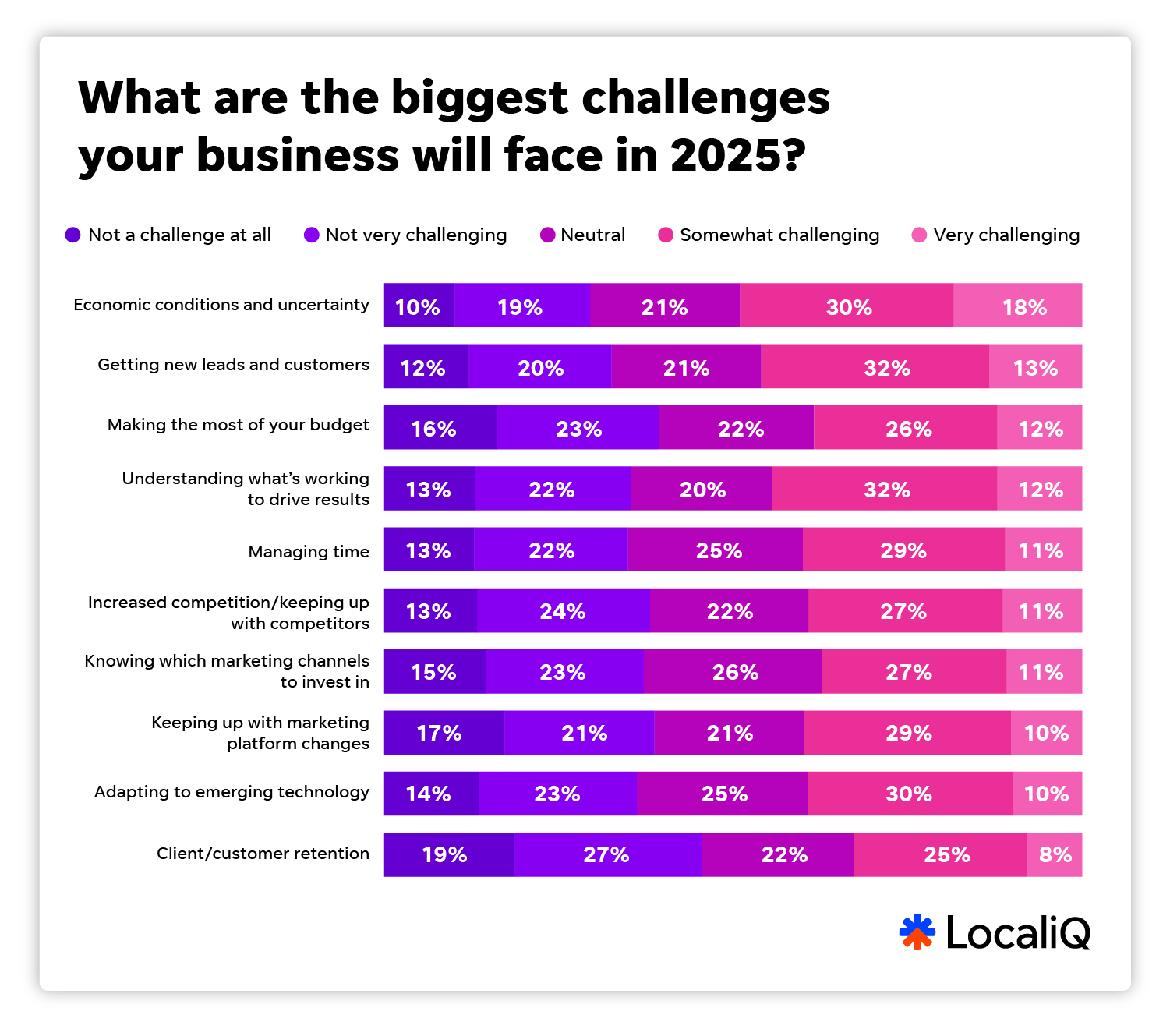
Freelance consultants and SMB owners know that in order to survive and thrive, a clear-eyed view of their economic landscape is necessary. Economic uncertainty, leadgen tactics that stimulate new customer acquisition and optimizing an (often modest) marketing budget are by necessity at top-of-mind. The ability to predict which marketing tactics can be relied on to produce the strongest return on investment is viewed as somewhat or very challenging for nearly half of survey respondents—44% are somewhat or very concerned about the capability of their chosen leadgen tactics to drive results. Adapting to new technology is a concern for 40% of respondents, who indicate they are somewhat or very concerned about keeping up. Furthermore, 45% of respondents are somewhat or very concerned about their leadgen tactics bringing in enough new customers and 48% are somewhat or very worried about economic conditions and uncertainty.

So, what are the recommendations for driving Freelancer and SMB success in 2025? There are no definitive answers and the suggestions offered below are not new and not rocket science. Your goal is to make money, but you could meet with headwinds for any number of reasons. Outcomes produced by your business strategies and tactics cannot be predicted but appropriate design, execution and performance monitoring on your part can be expected to yield at least modest success. Marketing and sales have a direct effect on customer acquisition and generating revenue, making these two closely related functions the money-making engine of a business venture and deserving of your intense focus. Just do it.

It’s helpful to monitor the performance metrics of marketing tactics and for that process, Google Analytics generates relevant and insightful data that enables you to evaluate your campaigns—at no charge. Sign up now! Along with leadgen/customer acquisition, make a point to promote customer referrals by asking your current customers if any of their colleagues or customers have the potential to become one of your customers. Also, create customer experience protocols that at every touchpoint anticipate and respond to customer needs end-to-end, from new or returning customer onboarding to after-sale training or other services. Finally, invite customer feedback by directly speaking with those who do business with you when possible. It’s good business to send out an email survey (maybe once a year), or chat with customers by way of social media; it’s important to learn what customers would like to see you do (or not do), so that you can optimize the experience of doing business with your company.

  • Be prepared to manage both the opportunities and challenges you encounter by being aware, being agile, being resourceful and being resilient.
  • Develop comprehensive marketing/sales strategies and implement with tactics you can expect to be effective. Regularly consult your website (and social media) performance metrics and make adjustments where necessary, to maximize performance.
  • Identify one or two local business associations and aim to attend one program per quarter as a way to obtain professional development and/or enhance your business acumen skills as you meet colleagues and engage in face2face networking that builds mutually beneficial relationships.
  • As soon as your budget allows hire an (outsourced) business accountant or bookkeeper to not only maintain the integrity and timeliness of your business financials and tax filings, but also to discuss and guide the potential business growth and expansion of your venture.

Thanks for reading,

Kim

Image: © kali9/ iStock

Design Social Media Content to Fit Your Goals

News flash—creating social media content that advances your company marketing goals may demand more attention than you might’ve guessed. Checking social media accounts might be something you do while having lunch—why not log into Facebook to see what’s up?—but the “free” resource known as social media works best when you are strategic when using it. Effective marketing in any format demands precise planning.

Keeping a strategy in mind as you develop social media marketing content means that all posts—text, images, audio, video—will be designed to work in concert. That’s your recipe for social media that clearly communicates talking points, tells the story, follows the strategy and delivers the desired return on investment. So whether the plan is to promote brand awareness, cultivate customer relationships, or facilitate customer service, for example, there is documented evidence that well-executed social media campaigns are able to deliver the results you want. Your job is to create the right content and post on platforms your audience trusts and follows.

If your company maintains a presence on more than one site, keep in mind that content posted on multiple channels may be tailored to fit the unique strengths of each platform used, but content will be most effective when aligned across channels. You want to ensure that you communicate a unified message to the audience on all platforms used. Unaligned, inconsistent messaging can confuse audiences and undermine brand credibility.

Budget

Let’s start with money, the ultimate commitment. A financial investment is worthwhile for companies that are serious about social media marketing because a well-developed strategy that has the potential to achieve marketing (think revenue) goals can be realized only if all aspects of the content match your aspirations. If your marketing goals require a high-performing social media campaign, the strategies that get you there must be enabled by the right budget. Can you strike a balance between the funding needed to support the campaign you want and a financial commitment you can tolerate?

If the money is there, you might decide to hire a social media specialist to produce all text and image content. If your budget is modest, or you prefer to copywrite the text yourself, you could focus your spend on audiovisual elements and invite a pro to shoot and edit the visual elements.

Authentic

Today, “raw,” unscripted content sets the standard for what’s considered authentic and credible—i.e., trustworthy. Cinema verite is where it’s at and conversations and actions that feel scripted and rehearsed are a turn-off. Your followers want to see a slice of life—tear off the band aid, peek behind the curtain, get the view from backstage.

So, if you’re scheduled give a talk at a business association program, your social media audience may find it interesting to watch you getting ready to take the stage. Recruit a friend or ask your social media specialist, if you’ve hired one, to video you en route to the venue. Your commute to the venue can be filmed and you can supply background info about the organization during the ride. If the sponsoring organization allows, you can also be shown meeting the host, being introduced and walking to the podium to launch your presentation. If allowed, your talk can be filmed in its entirety and short clips can be edited to use in future marketing collaterals.

Interactive

Rather than waiting for your social media audience to make the first move, recognize that they will probably need a compelling invitation from you as motivation to engage with your content. The good news is that invitations to interact with your audience are not difficult to design.

For example, some of your viewers may agree to take a quick survey or poll that gauges their feelings about a particular topic (which may not directly involve your products or services). Social media users often enjoy opportunities to connect with the brands they follow. From time to time, just be sure to include a question or two about what they’d like to see added to your line, or what might make a useful upgrade for your product or service. Your audience will feel more connected to your brand if they feel as if they’ve contributed to your company’s product development.

Soft sell

The hard sell no longer works. The soft sell, like soft skills, is the new champion of today’s marketplace. Instead of coming on like a carnival barker on the midway and shouting “Step right up, folks!” the preferred approach employs social media platforms as a conduit to current and prospective customers who would like information about your products, services and you and your company. Customers, prospects (and influencers, if you’ve caught the eye of one) would like to get to know you. They often don’t trust or respond to aggressive sales tactics. A smart sales strategy is designed to cultivate a steady stream of customers and prospects who engage with your content and then make purchases and referrals, give testimonials and become brand cheerleaders, too.

Avoid over-sharing

It is true that being reliable and predictable—consistent—is reassuring and you should keep that in mind as you post content to your chosen platforms. But how do you know how often to post? Two posts a month is probably too little; two posts every day of the week is definitely overkill. You want site visitors to see worthwhile information—not always serious, sometimes amusing, always interesting and never a waste of time.

You don’t want your content (and company) to be perceived as annoying and irrelevant, a burden that clogs their feed with filler. Working with a good social media professional can help you determine how often you should post and how you might diversify your content to enhance interest and keep viewers coming back.

Call-to-Action

Remember to include a call-to-action in your social media content. It’s a feel-good to see great numbers when reading the statistics of your site’s impressions and views, but you won’t get your full reward unless followers are asked to do something—take an action—so you’ll receive a tangible result of some sort.

Your CTA completes the social media experience by inviting your audience to click a link and—-watch a video, request a free 30-minute consultation, register for a webinar or course. The CTA allows you to both collect and measure the ROI of your social media marketing campaign. You’ll be certain that your campaign goal is reached—brand awareness and brand loyalty enhanced, customer relationships nurtured, names added to your customer list (through the sign-up), warm leads created.

Thanks for reading,

Kim

Image: © Rex Features. British actor Sean Connery (August 1930 – October 2020) with Anthony Sinclair of Anthony Sinclair Suits, his Savile Row tailor in London, during the 1960s James Bond movie era.

Close- Up: Revenue and Profit

Does the thought of managing finances more complicated than your household budget fill you with fear and loathing? You are not alone! Many share that sentiment but in the world of Freelancing, getting your arms around the management of company finances comes with the territory. Outsourcing your bookkeeping and accounting functions can be a smart move that allows you to focus on client acquisition and retention or other things that only you can do, for example, but you cannot afford to be in the dark about what’s happening with your money. You can’t plan and execute a marketing campaign or an expansion strategy until you know how much money will be available to carry it through.

You can ask your bookkeeper or accountant to suggest a reasonable budget for your plan, but it’s better if you have the answer before you ask the question. In order to know how much money you’ve got, you’ll need to get comfortable with reading your Income Statement, also known as the Profit and Loss (P&L) Statement. The P&L details all the money that is earned (sales revenue) and expenses paid, e.g., rent, utilities, professional association dues, or payroll.

Financial management is a big topic so today we’ll limit our focus to money that comes into the business—revenue—and the money that remains after expenses are paid—profit. The two categories are very similar and are frequently used interchangeably by those of us who are not accountants or bookkeepers, but there is a subtle difference between the two and it makes sense for Freelancers to grasp what each term says about your entity.

Revenue

Revenue is money generated through the sale of products and services plus other money-making activities that take place within the business. The initial tally of revenue indicates what’s been generated before expenses are deducted. Calculate revenue by using this equation:

Revenue = Price x Quantity sold

Sales generated when clients pay for your products and services, along with other income streams if applicable, is classified as revenue derived from normal business operations. However, since a business may generate revenue from different sources (income streams) it’s useful to consider each line of business separately, so that you can scrutinize how each performs. When you separate revenue by source and type you’ll quickly see which is lucrative and which is lagging—and you’ll be positioned to make smart business decisions.

So if you begin to regularly teach a class in addition to your Freelance consulting work, you can record that revenue separately, as it’s own income stream. If you also sell a tangible physical product in addition to your intangible B2B services, you can record revenue from your tangible products and intangible services separately. Or maybe you own a restaurant? If so, you’ll separate and analyze each revenue source by categorizing your menu offerings: side dishes, main dishes, appetizers, nonalcoholic and alcoholic beverages.

As well, you can separate your revenue into operating and non-operating sources. Operating revenue represents sales from a company’s core business. For instance, in a restaurant, operating revenue is derived from the sale of food and beverages to customers.

  • Annual Recurring Revenue

Another category of revenue that you would be wise to record and examine separately is known as annual recurring revenue (ARR). ARR is revenue that is associated with subscription agreements or other contractually dependable, expected revenue streams. Documenting ARR is critical because it provides companies with a predictable revenue stream. There is nothing sweeter than money you can depend on!

  • Non-operating Revenue

Non-operating revenue is sort of like selling an add-on—it’s revenue earned from sources outside of the primary (core) function. So in your hypothetical restaurant, non-operating revenue might represent sales of loyalty program cards, gift cards, branded T-shirts, or mugs, for example. Non-operating revenue might be unpredictable or mostly seasonable (associated with Valentine’s Day, or whatever) and is considered nonrecurring. Selling an asset is also categorized as non-operating revenue. Maybe you bought a non-fungible token (NFT) art work that’s now worth big money and you’ve decided to sell?

Revenue vs. Income

For an intermezzo we can also consider income, which in the world of accounting is distinct from revenue, despite the obvious similarities—-both categories mean money in your pocket. Recall that revenue represents money earned from core business operations, that is, the sale of your products and services and also ARR and money classified as non-operating revenue. Income is the money that (thankfully!) remains after all fixed (operating) and variable (sales, marketing, professional development, etc.) expenses have been paid. Income has more in common with net profit, or earnings, than with revenue.

Profit

Profit describes the total gain (or loss) of money that a business has at the close of the period (e.g., month). As is the case with revenue, there are various aspects of profit to calculate and consider. Gross profit, operating profit and net profit are three metrics recorded on your P&L Statement. In general, profit is calculated by subtracting the total fixed and variable expenses, taxes and calculated amortization and depreciation values from total revenue. Calculate profit by using this basic equation:

Profit = Revenue – Expenses

  • Gross profit

The amount of money brought in from the sales of products and services, minus the acquisition or manufacturing costs of the products or services that were sold, is known as gross profit. The number reflects the Cost of Goods Sold (product or service acquisition or production costs, including direct labor) but does not reflect the impact of fixed or variable expenses. Calculate gross profit by using this equation:

Gross Profit = Revenue – Cost of Goods Sold (COGS)

The interim assessments of profit, in addition to gross sales revenue (also called the top line) allow you to scrutinize the numerous expenses incurred between the top line (gross sales revenue) and the bottom line (net profit) and expose points of profitability weakness (i.e., worrisome expenses) in the acquisition or production of the solutions you sell, all of your fixed and variable costs and even taxation, of your business. In fact, if your top line number is strong but your bottom line number disappoints, an adjustment of COGS or fixed or variable expenses could remedy the problem.

  • Operating profit

Operating profit is the next step in the P&L progression toward the big reveal that is net profit, the bottom line. It’s similar to gross profit but includes three more categories of expenses. Calculate operating profit by using this equation:

Operating Profit = Revenue – COGS – Operating Expenses – Depreciation – Amortization

Depreciation and amortization are also values you’ll want to understand as one who manages money, even if you outsource to a bookkeeper and/ or an accountant. Depreciation reduces the actual value of equipment or vehicles due to time or use—wear, tear and age. This calculation puts a numerical value on the asset’s cost versus its operating and residual value.

Amortization refers to the value of intangible assets, such as patents or trademarks and is calculated in the same way that depreciation is calculated. Both of these accounting methods exist to spread out the cost of assets over their useful lives and provide a more accurate picture of a company’s expenses and profits.

  • Net profit

Net profit is the final assessment of actual profit and it’s calculated by subtracting all fixed and variable expenses, plus taxes, amortization and depreciation, from your total revenue. Net profit illustrates the overall health and profitability of the entity. It is the final word and is found on the bottom line of your P&L Statement. You can calculate net profit by using this equation:

Net Profit = Gross Profit – Total Expenses – TaxesDepreciation – Amortization

Differences between revenue and profit

These very similar values are calculated in different ways and each tells a somewhat different story. Revenue reflects your company’s sales and market share growth. Profit is the company’s indicator of financial health. Another difference between these two values is the potential for fluctuation throughout the year. Revenue is prone to fluctuate from month to month because it is subject to marketplace demand which, for example, can be seasonal. In contrast, profit tends to remain more stable over time.

Finally, net profit earnings may also be known as net income or net earnings. Net earnings may be the most important number on your P&L Statement not only because it comprehensively shows the company’s total earnings performance but also, the value is carried over to your company’s Balance Sheet and Cash-Flow Statement.

Thanks for reading,

Kim

Find Opportunity in Adversity: Surviving Inflation and Slowdowns

It appears that Freelancers are having another moment although, as usual, it could be a mixed blessing. As we discovered when the coronavirus shutdown was waning and business began to slowly pick up, there are both roses and thorns to contend with. Still, economic fluctuations are nothing you haven’t seen before and you probably survived (but maybe not without suffering a few sleepless nights).

What distinguishes Freelancers and other independent business owners from employees is your plucky resilience and wily resourcefulness. Those traits are in your DNA and that’s why you struck out and created your own venture. However, you’re also a realist and well aware that neither boom times nor tough times last forever (although—surprise!—recessions and other economic downturns linger nearly twice as long as upswings).

Because a Freelancer’s income is often unpredictable you know that planning ahead with careful budgeting, sensible spending and, in flush times, building up savings to cushion cash-flow interruptions are absolute necessities. When either unexpected adversity or opportunity arises, you also know when it’s time to:

  • Assess what appears to be an opportunity or obstacle
  • Prepare to pivot, if it makes sense, to either expand into a new market or customer group or tweak a product or service to make it more appealing to what customers want now

Forward-thinking Freelancers also work hard to bring in multiple clients and develop additional revenue streams, so that there will be a way to cushion the shock of a lost client.

It is interesting that Inflation and the threat of recession have the potential to simultaneously add and delete clients on your roster. According to a June 2022 Wall Street Journal article big companies, including Twitter, real-estate brokerage firm Redfin and the cryptocurrency exchange Coinbase have in recent weeks rescinded job offers made to candidates —-now that’s ugly. Google, Meta (Facebook), Oracle and Tesla have imposed hiring freezes that will be in effect through calendar year 2022.

Bloomberg News brings good news to Freelancers in its report of a survey conducted by gig work clearing house Fiverr. The survey showed that 78% of business leaders said they are more likely to hire Freelancers, rather than full-time employees, as long as economic conditions remain uncertain. Furthermore, economic uncertainty has motivated 85% of US companies to implement a hiring freeze during the current downturn and 78% plan to lay workers off, according to the Fiverr survey.

The current economic climate has Freelancers working in more than 80% of the companies represented by survey respondents, more than 1,000 owners of medium to large businesses. Those companies are currently hiring Freelance experts like you to get the work done and Fiverr reports that it has seen an increase in demand on its platform, especially from large businesses.

Thanks for reading,

Kim

Image: Gas pump prices in Hingham, MA (cheaper than Boston!)

Good Questions Are Your Best Sales Strategy

Many factors influence a B2B sale, including egos and power struggles, budget allocation and politics, trending industry fads and the success or failure of what’s been done before. But as you know, Freelancer friend, you can only control what you can control.

To obtain some measure of control you need information, because knowledge is power. To determine whether there is a sale here for you, you’ll need clarification of the factors listed below, which are known to influence B2B sales. Knowing if there was a recent attempt to reach the goal or resolve the problem before you were contacted is also useful intel, as is knowing if the prospect is actively considering another solution (that would be provided by someone else).

  • Define the problem or goal and learn if it’s high priority or urgent
  • Understand what the prospect wants you to do and when it must be completed or delivered
  • Is the prospect talking to a competitor?
  • The decision-maker
  • Estimated budget

The most efficient way to get the backstory on your sale and create for yourself a realistic chance of winning is to ask questions that bring out the answers you need. Phrase the questions in words that feel natural for you. I think what’s listed below will both lead you to more sales and quickly eliminate those who present themselves as interested but are just not that into you.

1. What led you to contact me/ respond to our outreach?

2. Is getting this project done/ product installed an immediate priority? When would you like to see it completed/ made available?

3. Have you been using a solution (i. e., a product or service) that isn’t working? What fell short of your needs?

4. What. are three key outcomes you want to occur when the goal is reached/ problem is resolved?

5. What other options are you currently considering?

6. Which department in your company will be the end users of the product/ or who will be my contact as the service is implemented?

7. What kind of support/ training/ post-sale service would your team like to receive as the solution is being implemented or when the product is purchased?

8. Are you the person who decides the budget for this project and has funding been allocated?

9. Based on what you’ve told me, I think my organization can help you achieve your objectives. I’d like to work with you! What is your decision-making process like?

10. Is there anyone else who might appreciate having a conversation about this solution? Anyone else I might speak with?

Thanks for reading,

Kim

Image: Judy Holliday (standing) has a couple of incisive questions for her husband (Tom Ewell) and the other woman (Jean Hagen) in Adam’s Rib (1949, directed by George Kukor and starring Spencer Tracy and Katharine Hepburn).

Figuring Out How to Take a Vacation

Summer is here at last and for many, thoughts turn to taking time off to relax and have fun.  Vacations make us feel good but they’re slipping from the grasp of an increasing number of workers, most notably the country’s 57.3 million Freelancers (2017 data), who receive no paid vacation benefit.  In fact, we pay twice for our vacations.  The first hit happens because we stand to lose money when we don’t work. The second hit occurs when paying for the vacation itself, if we choose to travel. Vacations are an expensive proposition for us.  Yet, they are an investment in our well-being and they are worthwhile.

Numerous studies show that we become psychologically healthier, we have a more positive outlook on life and we’re more resilient when we regularly take vacations. We’re also more productive, better problem solvers and more inclined to create and achieve business and personal goals.  It’s been amply documented that uber analyst Sigmund Freud was especially fond of vacations and he took great pleasure in personally planning his family’s annual summer get aways.

I’ll take my usual mini-vacation this summer and with some advance planning, I’ll bet you can, too.  No matter when you’re able to get away for a few days, or even if you opt for a “stay-cation” and take local day trips or just unplug from the daily grind, planning will be the key.

Step One of your vacation planning is to consider your business cycle so you can arrange to slip in a vacation during the usual slow periods.  In most industries, the Christmas to New Year’s Day period is very slow and the final week or two in August is almost as dormant.  However, for wedding planners and those who participate in that industry, summer vacations are out of the question because it’s your busiest season.  If you’re an accountant, celebrating Valentine’s Day at Punta Cana is something you’ll never do, because it’s tax season from January – April.  If you are in certain retail businesses, then traveling is out of the question between October 1 and Christmas Eve.

When you see a gap in your schedule of projects, pounce. “Stay-cations” are of course a lot easier to fit in.  You just have to do it.  Maybe you can schedule a spa “stay-cation” that’s spread out over three or four days, when you’ll schedule a massage one day, a mani /pedi the next, a facial the day after and so on?  You might also visit a museum or find a free outdoor music performance nearby.

Step Two entails your vacation budget.  Wherever you’d like to go, you probably already have an idea of the cost.  Research the price of air fare if you must fly and compare traditional B & B, airbnb and small hotel room rates.  Start setting aside funds that will get you to your preferred destination several months in advance.

Step Three will find you plotting out your work load, to ensure that all projects are completed by their deadlines and all milestones reached as promised.  In some instances it will be necessary to inform certain clients (a month in advance) that you’ll be away for a few days but ideally, you’ll schedule the vacation when you know you’ll be between projects.

Create a spreadsheet with all project tasks listed, with milestone and deadline dates noted, so you can plan and pace your work load 4 – 6 weeks in advance of your vacation date.  Do you publish a blog or newsletter that would appear while you’re on vacation? Add your content marketing to the spreadsheet as well, so you’ll have time to write posts and schedule them for automatic publishing on the desired dates.  You may need to work a few nights and weekends to ensure that all work is completed, but you’ll have something to look forward to, right?  While you’re at it, make a post vacation to-do list that will be ready for you when you return, to give yourself a stress-free re-entry.

Finally, take care of your accounts receivable so that cash-flow will not be interrupted, a very important matter when paying for a vacation.  Ready all invoices, attach to the appropriate emails and save as drafts.  On invoicing days, go into your phone and send from anywhere in the world.

So get away from it all and enjoy yourself! Even if your schedule and budget won’t allow you to spend two weeks in Buenos Aires or Marrakesh, taking one or more short vacations throughout the year is also beneficial, according to a 2010 study published in the Journal of Applied Research in Quality of Life.  The study researchers queried 974 Dutch vacationers and found that the excitement and anticipation associated with vacation planning delivers more of the psychological and physical benefits than the vacation itself and those benefits are multiplied when vacations of any length are taken throughout the year.

Thanks for reading,

Kim

Photograph: ©  Rachel Landau

Go with the Flow, a sand sculpture designed and built by Melineige Beauregard of Quebec, Canada for the 14th Annual Revere Beach International Sand Sculpting Festival (2017) in Revere, MA

Speeding Up Your Sales Pipeline

How wonderful would it be if your prospective clients would just hurry up and make a decision about if and when they’ll give you a sale? Even if 80% decline, as predicted in Pareto’s 80/20 rule, think of the time and aggravation that you’d be spared.  There’d be no more chasing so-called prospects who either can’t or won’t green-light a sale for you.  Your numbers would probably increase, if for no other reason than you’d stop wasting time on lost causes and look for better possibilities.

Getting a commitment to either fish or cut bait in maybe a week or two is a fantasy, but learning how to get better at qualifying prospects is within reach and here are four tips to help you do just that.  Implement these tactics and you’ll move prospects through your sales pipeline faster than ever before.

1. Sell to the decision-maker

Is the person who you think is the prospect really the prospect? Does this person have the authority to make the decision and approve the budget? If not, there will be no sale until and unless you get in front of the real decision-maker.

Especially in B2B sales, a gatekeeper or other lower-level employee could be enlisted to find out the details and then report back to the actual decision-maker.  Alternatively, the decision could be made by a committee of senior staff members, one of whom may be speaking with you, but s/he alone cannot give the green-light without getting agreement from other committee members.

In either case, you’ll need to get around the stand-in, learn the identity of who has the most influence and focus your attention on addressing that person’s hot buttons, so that the sale can move forward at a faster pace.

Step One in ferreting out the identity of the real decision-maker is noticing the job title of the person with whom you’re speaking.  If s/he ranks lower than Director or Vice President, most likely there’s someone in the background pulling the strings.  Unless you’re selling office supplies, ask the stand-in if s/he is able to directly approve the budget and if there are others who might like to directly ask you questions about your product, service, or project.  Be respectful of feelings, but do encourage the participation in the sales process of the one who can sign the check.

2. Discover what worries your prospect

Get a big-picture understanding of your prospect’s most urgent and top-of-mind challenges and near-term objectives, as they apply to what you can bring to the table in terms of a product or service.  What does your prospect think will happen if the product doesn’t get purchased or the project doesn’t get done?  How will company leaders feel when the problem is resolved and objectives are achieved?

Learn as much as possible about what your prospect wants and how committed s/he is to achieving goals and resolving issues.  Ask “what” and “how” questions to discover these key insights.

3. Confirm that your solution is a fit 

Ultimately, all salespeople want to close deals. But ironically, it’s sometimes better to walk away from a potential sale if the product or service isn’t a good fit for either you or the prospect.  Pushing for a sale that won’t bring about the best outcomes never ends well and it should be avoided, even when you’re desperate to do business.

In these situations, your objective is about getting to “no” faster.  Then you can move on and pursue other prospects who may be better positioned to buy from you.  It’s  preferable to speed inappropriate prospects through the pipeline and devote the time saved to identifying and meeting with qualified prospects who might say “yes.”

To ensure that your product or service can solve the problem or help the prospect meet a goal, ask pointed questions and listen well to determine whether your solution will produce the best results and be cost-effective in the long run.

4. Learn the prospect’s timetable

Is there an urgent need or deadline that compels your prospect to take action and implement a solution quickly? If you know that to be true, you can most likely expedite the sale (and get the price you want, as well).  Ask questions to help yourself evaluate whether the prospect could be ready to do the deal in a week or two, or in months.

One important line of questioning should concern available funding for the proposed sale or project.  In some cases, the prospect would sincerely like to move forward, but there is insufficient political support in the organization for his/her agenda.

The information will allow you to adjust your expectations for the sale and decide if you should continue to pursue, pick up the thread in a few months, or close the book on a pipe dream.

Thanks for reading,

Kim

Image: Portrait of Evdokiya Nickolayevna Chesmenskaya (1780) by Jean-Louis Voille (1744 – 1806) courtesy of the State Tretyakov Gallery, Moscow

Your Marketing Plan Is Meaningless Until You Assign A Budget

Oh, how you love to talk about planning—your business plan, financial plan, vacation plan and what I think is most often discussed—your marketing plan.  Congratulations to you if you’ve drawn up an official marketing plan for your venture.  But if you intend to transfer your plan from the page to reality, you must assign it a budget.  Somehow, that practical reality is sometimes glossed over.  Ask a Freelancer or business owner what the company’s annual marketing budget is and you’re likely to be met with a blank stare or incoherent stammering.  That is not the ideal response, my friend! So today, let’s learn how to estimate a reasonable budget for a B2B annual marketing plan.

Laurel Mintz, founder and CEO of Elevate My Brand, a Los Angeles digital marketing agency, has developed what she calls “marketing math,” to help her clients determine what would be  a realistic B2B marketing budget range for their organizations.  According to Ms. Mintz:

New companies in business for one to five years would be wise to allot 12 – 20 % of  gross or projected revenues on marketing activities.

Established companies in business for more than five years are advised to commit 6 – 12 % of gross or projected revenues to marketing activities.

Those figures seemed rather hefty, at least they did to me and maybe you agree.   According to Laurel Mintz,  if a new business generates just $35,000 in after-tax bottom line revenues, she nevertheless feels that the owner should devote $4,200 – $7,000 annually to a marketing budget.  Ouch! I mean, how does one pay the living expenses and taxes and health insurance when in the salad days of a start-up?

Think of it like this—no one said that self-employment, whether Freelance solopreneur or entrepreneur, was going to be either easy or inexpensive.  Just like you set aside money for other vital expenses, marketing deserves a budget, too, because without marketing you could wind up presiding over a stunted venture that never gains traction and never fulfills its potential.

Marketing activities, whether innovative or predictable, give the venture a needed push into target markets.  Marketing promotes the expansion of prospective clients who will flow into the sales funnel, distinguishes the organization from competitors, establishes and promotes the brand, justifies the pricing structure and keeps the enterprise at top of mind and positioned to beckon clients and referrers.

Now for the cold water—there are no guarantees in marketing and the ROI is notoriously tricky to quantify.  But realize that marketing is all about testing and that means (calculated) risk.  If you approve a certain sum of money to devote to the year’s marketing activities, you might achieve all of your marketing campaign goals, or do twice as well, or only half as well as you projected

Risk is real in marketing, but it’s mitigated by your awareness of how your clients have been known to respond to the marketing tactics that you can afford.  Research shows that if you conduct marketing  activities that resonate with your target clients and are within budget, then over time,  the marketing campaigns will enhance the bottom line and your brand.  Treat marketing activities as an investment that will surely pay off and allocate funds each year.

Marketing  campaigns are all about planning, budget and execution.  If meager finances make you feel that the budget formula given here is too risky for your venture, then focus on planning and execution and roll out “sweat equity” campaigns that utilize tactics that cost time instead of dollars, such as content marketing, face to face networking and social media.  Just do it.

Thanks for reading,

Kim

Director and actress Ida Lupino on the set of The Hitch-Hiker (1953)                    Photograph courtesy of RKO Pictures/ Photofest