
LeadGen and Customer Acquisition in 2025

LocaliQ, a digital marketing platform that specializes in lead generation and multichannel marketing campaign management, and is a subsidiary of Gannett Publishing, surveyed more than 730 small business owners and marketers worldwide to get boots-on-the-ground perspectives on leadgen and customer acquisition marketing tactics SMB owners are using now and uncensored feedback on what’s producing the best results. The survey is a rich source of benchmarking and actionable insights that have the potential to inform your approach to leadgen and customer acquisition strategies and tactics this year.

In its first Small Business Marketing Trends Report, LocaliQ shares the results of a deep data dive that’s intended to help Freelance consultants and SMB owners successfully navigate the business landscape they can expect to encounter in 2025 by learning how their peers energize sales revenue by identifying leadgen tactics that promote customer acquisition.

The relevance of LocaliQ data is for many of you validated by the survey demographics—15% of respondents are soloprenuers; 31% have 2-10 full-time employees; 24% have a marketing budget that’s less than $500/ year (5% have no marketing budget); and 74% are based in Canada and the U.S. (all six inhabited continents plus New Zealand are represented). The survey was published in October 2024. How does the average Freelancer or SMB owner attract prospects?

Survey respondents do what you’d expect and it’s safe to assume that they use more than one leadgen tactic to implement their marketing /sales strategy. Social media marketing (free) is used by 52% of respondents; 47% of respondents use (paid) social media advertising; and 40% of respondents use search advertising, i.e., pay-per-click sponsored ads that appear in search engine inquiries. Other popular leadgen tactics are email marketing, used by 39% of respondents and content marketing, used by 33% of respondents. Online listings and directories (28%), display ads (24%) and traditional media (23%) are 20th century tactics and that gives them a similarity (IMHO); when combined, 75% of survey respondents use one or more of these older leadgen tactics.

As for the social media platforms used, it’s no surprise that Facebook dominates—76% of respondents use the platform for leadgen, promoting products and services and otherwise engaging with current customers and prospects. Instagram is used by 63% of survey respondents and LinkedIn, tailored as it is to B2B customers, is used by 43% of respondents. The data also showed that 29% of respondents use video marketing, a feature that is available on the above three platforms and also YouTube, which is used by 38% of respondents and recently rescued TikTok, which is used by 34% of respondents. Surprisingly X, a platform intended for Instant Messaging and other text communications, is used by 41% of respondents for social media marketing (X also hosts video sharing).

Now let’s talk turkey—when asked about their satisfaction (or disappointment) with the results of leadgen tactics, social media marketing and online listings/business directory users are satisfied with results—66% of social media marketing users and 61% of online listings/business directory users are pleased with their leadgen marketing results—still, each group also has a dissatisfaction rate of 15%. Furthermore, there is a rather large group of “neither satisfied nor dissatisfied” —meaning lukewarm?—users associated with those leadgen marketing tactics and 24% of online listing/ business directory users and 19% of social media marketing users joined the lukewarm group. Maybe it’s too difficult to measure leadgen results directly from social media marketing activity, whose conversation threads remain visible for years and likewise for presence on a business listing site or directory that a prospect might see many months after publication?

More clarity is derived from search advertising and it topped the list as the leadgen tactic most respondents are happy with, as evidenced by its 76% satisfaction rate (with 12% dissatisfied and 12% neither satisfied nor dissatisfied). A close second in popularity is video marketing, a leadgen tactic that has a growing user rate on every platform; in this survey, 74% of users are pleased with their video marketing outcomes and just 8% are unhappy (and 17% are neither satisfied nor dissatisfied). Short-form videos, like those on TikTok and Instagram Reels, continue to surge and 58% of respondents have either recently tried or would like to try the format.

Search advertising succeeds because it kicks in precisely when the purchasing motive is strongest and prospects are actively looking to buy a product or service that’s similar to yours. Readily available alternative options are waiting for them, as shown in search ads you’ve seen. Survey respondents also indicate satisfaction with results they’re finding with content marketing (75%) and advertising on social media platforms (73%).

The best source of leadgen is (drum roll) customer referrals! Almost 65% of survey respondents reported that customer referrals are the best leadgen sources. The influence of customer referrals is greatest (75%) for SMBs that have 10 or fewer full-time employees and have less influence in larger organizations—just 46% of businesses with 50 or more employees report that customer referrals are the best source of new customer leads.

Major challenges anticipated in 2025
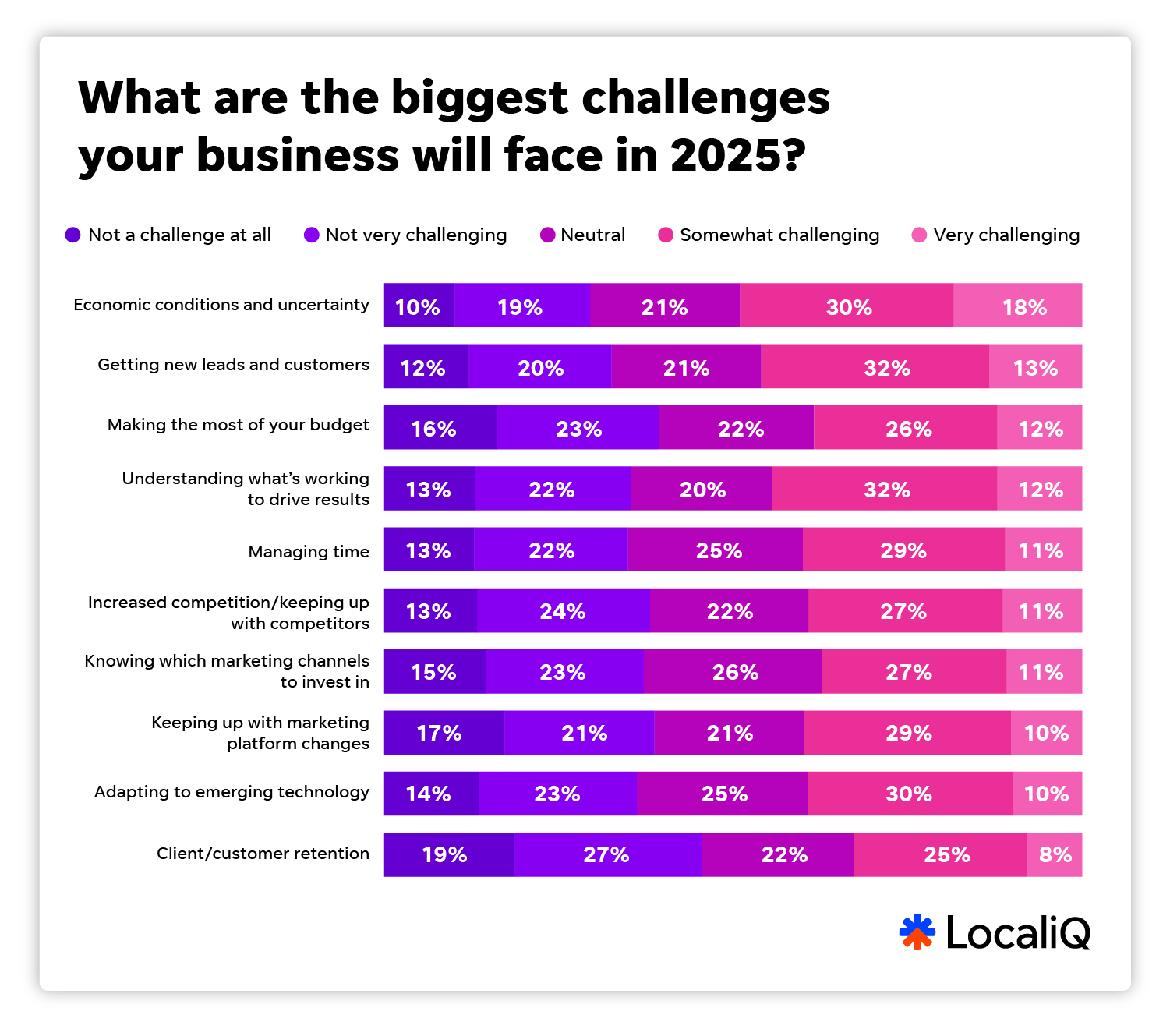
Freelance consultants and SMB owners know that in order to survive and thrive, a clear-eyed view of their economic landscape is necessary. Economic uncertainty, leadgen tactics that stimulate new customer acquisition and optimizing an (often modest) marketing budget are by necessity at top-of-mind. The ability to predict which marketing tactics can be relied on to produce the strongest return on investment is viewed as somewhat or very challenging for nearly half of survey respondents—44% are somewhat or very concerned about the capability of their chosen leadgen tactics to drive results. Adapting to new technology is a concern for 40% of respondents, who indicate they are somewhat or very concerned about keeping up. Furthermore, 45% of respondents are somewhat or very concerned about their leadgen tactics bringing in enough new customers and 48% are somewhat or very worried about economic conditions and uncertainty.

So, what are the recommendations for driving Freelancer and SMB success in 2025? There are no definitive answers and the suggestions offered below are not new and not rocket science. Your goal is to make money, but you could meet with headwinds for any number of reasons. Outcomes produced by your business strategies and tactics cannot be predicted but appropriate design, execution and performance monitoring on your part can be expected to yield at least modest success. Marketing and sales have a direct effect on customer acquisition and generating revenue, making these two closely related functions the money-making engine of a business venture and deserving of your intense focus. Just do it.

It’s helpful to monitor the performance metrics of marketing tactics and for that process, Google Analytics generates relevant and insightful data that enables you to evaluate your campaigns—at no charge. Sign up now! Along with leadgen/customer acquisition, make a point to promote customer referrals by asking your current customers if any of their colleagues or customers have the potential to become one of your customers. Also, create customer experience protocols that at every touchpoint anticipate and respond to customer needs end-to-end, from new or returning customer onboarding to after-sale training or other services. Finally, invite customer feedback by directly speaking with those who do business with you when possible. It’s good business to send out an email survey (maybe once a year), or chat with customers by way of social media; it’s important to learn what customers would like to see you do (or not do), so that you can optimize the experience of doing business with your company.

  • Be prepared to manage both the opportunities and challenges you encounter by being aware, being agile, being resourceful and being resilient.
  • Develop comprehensive marketing/sales strategies and implement with tactics you can expect to be effective. Regularly consult your website (and social media) performance metrics and make adjustments where necessary, to maximize performance.
  • Identify one or two local business associations and aim to attend one program per quarter as a way to obtain professional development and/or enhance your business acumen skills as you meet colleagues and engage in face2face networking that builds mutually beneficial relationships.
  • As soon as your budget allows hire an (outsourced) business accountant or bookkeeper to not only maintain the integrity and timeliness of your business financials and tax filings, but also to discuss and guide the potential business growth and expansion of your venture.

Thanks for reading,

Kim

Image: © kali9/ iStock

A Call to Action

Content creators—-producers of marketing, sales, or advertising content and sometimes speeches, too, must remember that at the conclusion of the artfully told story that’s been delivered in words and/or pictures, it is imperative that you tell the viewer what to do next. Content creators must remember to include an irresistible, inevitable, Call to Action. Fail to do so and the content creator hasn’t done the job.

A Call to Action beckons a potential prospect to do something—-learn more, get this, click here—-that will bring him/her into deeper engagement with the product, service, or idea that’s being promoted. Once the content has made the case, demonstrated the desirable characteristics and therefore the value of what is being promoted, the Call to Action functions to reel in the convinced and the curious.

Step this way, sir! Websites, content marketing posts, videos, television commercials, movie trailers and those postcards that fall out of magazines are but a few examples of where viewers and listeners will encounter a Call to Action designed to entice.

A political action group may write an article on the importance of voting in the next election. The article will likely close with an inspiring CTA message about the privilege of voting and include a link to a voter registration site. A company website may contain two or more CTAs, perhaps appeals to opt-in and receive a weekly blog, RSVP for a webinar, or request a free 30-minute consultation.

Getting started

Before writing your CTA, decide what action you’d like potential prospects to take and what they’ll gain by doing so. Once you know what you want them to do, you can think about how to say it. The best CTAs are short, encouraging and use active verbs that speak directly to the viewer. Remember that the CTA is your closer, the culmination, the purpose, of the pitch you’ve made.

Write your CTA in a font that’s somewhat larger than the other text and use a bold color to make it eye-catching. Lead in with a brief but tempting phrase that persuades viewers to click and subscribe, browse products, opt-in to receive information, attend an event, or take any number of actions.

The next step

CTA buttons are available on Google My Business and the Facebook business page. Most, if not all, email marketing, i. e. blog and newsletter hosting platforms, have always contained opt- in capability to follow or subscribe and an opt-out to unsubscribe. Content creators can easily embed CTA buttons or hyperlinks into a website, blog post, social media site, newsletter, or marketing email. Visibility will be key, so along with bigger and brighter text, place the CTA at eye-level and in most cases, on the landing page. Viewers should not need to scroll to find it.

The CTA should feel like a natural progression of what the prospect has just seen, heard, or read. Whether s/he will be able to obtain more information about using a product or service, listen to a webinar, or attend an event, ensure that your CTA is consistent with the message in your content. A benefit that conveys value, the appearance of low-risk and a sense of urgency are standard ingredients of the well-crafted CTA.

  • Schedule my free consultation
  • Click and get a 30 day free trial
  • Download my free ebook
  • Renew now and save $10
  • Contact us
  • Take the Pepsi Challenge

Thanks for reading,

Kim

Image: Before he became the 43rd President of the United States (2001-2009), George W. Bush was head cheerleader at the exclusive prep school Phillips Academy in Andover, MA (senior year 1963-64).

Factors to Include When Planning to Launch a Business

In a recent 7 day span, I was invited to judge two pitch contests for entrepreneurs who had successfully completed a 13-week business plan writing workshop presented by a woman-centric business incubator and business development center that has operated in New England for 25 years (and is also an SBA affiliate). The entrepreneurs were either in start-up or scaling (i.e., expansion) mode.

I was excited to be a judge and privileged to meet nearly two dozen forward-thinking, focused, resourceful and determined women who expect nothing less than success and are taking decisive steps to bring it about. Based on the business concept pitches I heard, I encourage those who are evaluating whether to launch a business venture to include the following information:

  • Name and describe your product or service and the problem(s) it will solve
  • Identify your best customer groups and explain why those customers will pay for your product or service
  • Identify your primary competitors, list the competitive advantages that your product/ service possesses and explain why customers will prefer your offerings
  • Create a business model that outlines how you’ll acquire customers, where and how the product/service will be delivered and how the business will make money
  • Explain why you are qualified to make the proposed business successful
  • Develop a business strategy and marketing plan that includes:
    • sales and distribution strategy
    • pricing strategy
    • product positioning strategy
    • branding strategy
    • content marketing strategy strategies
    • social media strategy
    • PR and advertising strategy
  • Detail the business pre-launch and launch (start-up) costs
  • If investors or borrowing will sought, present a (realistic) break-even analysis and 24 month revenue projections (P & L and cash-flow)
  • Detail the potential investor return and the loan payback schedule


Thanks for reading,

Kim

Photograph: Launch of the Hubble Space Telescope April 24, 1990

The Art of the Sale: How Marketing, Branding and Advertising Help Revenues

Today, I respectfully offer you a tutorial. Our inquiry will focus on the essence of doing business: selling. The purpose of starting a business is to generate sales, produce revenues and earn a profit.  If a business cannot generate a certain threshold of sales, business expenses cannot be paid and the owner’s investment will be negatively impacted. To curtail mounting debts, the business must close.

Over the past 10 years or so I’ve noticed, sometimes with amusement and other times with dismay,  that the word selling seems to make people feel uncomfortable.  I noticed that frequently, aspiring business owners and Freelance solopreneurs, who must find customers and earn money that is derived from the exchange of money for the products or services that their ventures would produce and provide, avoided the word sell. Instead, the word market was substituted.

Many self-employed professionals are uncomfortable with the process of selling, so they’ve decided to banish the very word. It’s as if selling is now perceived as crass or pushy. That is a shame.  The sales profession is one of the oldest on earth and honorable. Selling is one of the foundations of civilization and selling skills are among the most useful anyone can have; it is the ultimate transferable skill.  Selling makes the world go round, because we wouldn’t have much of a world without it. The ability to sell is far more valuable than the ability to code (yes, really!).

So we can agree that the success of a business is dependent upon sales?  Now, let’s go back to the process of marketing.  The American Marketing Association defines marketing as:

The activities and processes for creating, communicating and delivering information about products and services that have value for customers. Marketing is a set of processes that are interconnected and interdependent with other business functions aimed at achieving the interest of (prospective) customers.

Marketing consists of using information, in words or pictures, to promote products and services and persuade potential customers to make purchases.  Customers have an array of motives that drive their purchases.  Marketing campaigns are designed to appeal to the motives of selected customer groups (e.g., parents, young professionals, adolescent males) that research has shown are potential customers for the product or service in question.  The purpose of marketing is to communicate with and appeal to targeted customer groups and persuade them that (your) products and services will satisfy one or more of their needs or desires.

So we can agree that generating sales is dependent upon marketing campaign promotion that is directed at the most promising customers for your products and services? I hope we can also agree that marketing and sales, while on the same continuum, are not one and the same.  Let’s move forward on the path and consider branding.

Branding campaigns are designed to enhance and expand marketing messages by differentiating and distinguishing the reputation of products and services available in the marketplace.  Products, services and individuals can, through an effective branding campaign, acquire a powerful reputation, recognition and loyalty among customers, fans and the general public.  That reputation is known as the brand.

A company logo is usually associated with products that have acquired sufficient popularity and sales to be considered a brand. That logo is instantly recognized and conveys the essence of the brand to its loyal fans, as well as those who may not use the product.  The product name itself will come to symbolize a powerful brand, as does Coca-Cola.

Now let’s take your marketing and branding messages to the public and that brings us to the next stop along the marketing continuum, advertising.  There are more ways to advertise than ever before, thanks to the digital age,  but do not underestimate the value of traditional methods.  The century-old medium that is radio remains a highly effective advertising tool, as do billboards.  Taxi cabs and city buses (and bus stops) announce local events, such as the circus coming to town.  Newspapers and magazines continue to be packed with eye-catching ads.

Content marketing, which many call the new advertising, continues to grow in influence.  It’s approach is indirect and it is presented as relevant information.  Content marketing is stealth advertising that uses primarily written information conveyed in blogs and newsletters to provide information about topics that would be of interest to prospective users of the products or services sold by the company.  The purpose of content marketing is to build an audience of regular readers who trust the source (you) and would feel confident enough to do business with you.

Then there are the social media platforms that are now in the mix. Regardless of the name social media marketing, when used for business purposes it is advertising: the Instagram photos of your wedding venue, the video clip of you accepting an award at the Rotary Club, the webinar posted to your website and LinkedIn profile.

If your marketing strategy and campaigns have been effective and enabled the development of a trustworthy brand and memorable advertising campaigns, your business will attract paying customers. Your business venture will generate sales and you can declare yourself a winner.  Let’s sum up our tutorial:

MARKETING:  How you envision and describe your company. The verbal, voice and visual messages used to promote your products or services. The business owner identifies the market positioning strategy for the company, based on populations predicted to  become customers: mid-market, luxury, or bargain, hipsters, seniors, adventure travelers.  Product positioning impacts all marketing campaigns and messages, the branding strategy and advertising choices.

BRAND:  The company reputation, what it is known for. How others perceive your company.

ADVERTISING:  How and where you portray and describe your company to the public: in print or digital, visual or audio formats placed in Popular Mechanics, Harper’s Bazaar, subway stations, flyers tucked onto car windshields, or Twitter.  Advertising usually costs money.

SALE:  The ultimate goal and final step of the marketing process.  The exchange of money (or another valuable item or service) for the purchase of a product or service.

Thanks for reading,

Kim

Photograph of Cher by Richard Avedon (1986)                                                                 Courtesy of the Ogden Museum of Southern Art in New Orleans, LA

Get Your Arms Around Content Marketing

Was it two or three years ago that the term  “Content Marketing ” entered the marketing lexicon?  I first addressed the subject in March 2013  https://freelancetheconsultantsdiary.wordpress.com/2013/03/05/content-marketing-is-the-new-ad-copy .  Back in the day,  advertising strategy focused on which publications would reach the most potential customers at a price the business could afford.  Depending on your business,  traditional advertising can still deliver the desired ROI,  but Content Marketing cannot be ignored.  It is the conduit to engaging with customers on a granular level.  Through it,  we are able to reveal our understanding of customer priorities and challenges,  build trust and credibility as a result of that understanding and demonstrate how and when they might benefit from using our products and services  (and in that order,  BTW).

KISSmetrics CEO Neil Patel defines Content Marketing as  “…the way for a business owner to educate your customers and potential customers about your products and services.  The goal is to offer tips,  help and education about anything that can be helpful to a customer.  This kind of information can be shared in the form of a blog, white paper, webinar, video or social post.  The opportunities are endless.”  Michael Brenner,  a Forbes Magazine Top 40 Social Media Marketer and head of strategy at NewsCred,  points out that  “Small businesses don’t have the luxury of massive ad budgets…they need to drive brand awareness and (sales) leads with limited resources.  Content Marketing is a great way for small businesses to do both.

Great.  Now let’s get you started on creating Content that’ll do some good.  First,  define the Content you should create,  i.e. the Content that your customers value,  presented in a way that will make them tune in to your message.  Think carefully and from the customer’s viewpoint about the reasons that they use your product or service: what are they trying to achieve and what information would they appreciate as they strive to examine and resolve that process?  Chatting with customers about their business goals and challenges and getting a better handle on where your products or services fit in will give you some guidance.

Shelly Kramer,  CEO and founder of V3 Integrated Marketing,  insists that you will benefit from applying what you learn from your research to your strategy and,  just as important,  commit it to writing.  “Write down your strategy.  The key is to tie your overall business goals and objectives into your Content Marketing strategy”,  she says.  Kramer is very astute as she reminds Freelancers and business owners to remember the big-picture marketing strategy for the enterprise and incorporate Content Marketing,  including social media,  in that picture.  “Social and Content have to work together in order for you to be successful….you can’t have success with Content without a robust presence in the social media space and….understanding the role that fresh,  relevant Content and social media channels play.  There is great Content being published on corporate blogs on a daily basis that no one ever sees.”

Next,  choose your delivery system.   Do customers visit your website often?  Then maybe posting a white paper once a month or writing a weekly blog will work for you.   Are customers part of your LinkedIn group,  Facebook fan page,  or do they follow your business on Twitter?  Add those icons to your email signature block and your website to make social media connections that alert customers to your Content an easy process.   A monthly newsletter is another great Content Marketing strategy.  It’s the savviest form of email marketing  (include an opt-out feature).

Fresh and relevant are your operative words,  as Kramer notes.  Volume,  value and variety are your other guideposts.  Brenner says “(Volume)….starts with this notion that you need to be present in our always-on,  always connected world.  The second thing is value.  Your Content has to be good.   I always recommend that brands identify what they want to talk about and then make every effort to produce as much valuable Content around those topics as often as possible.  The final tip is about variety.   People (and search engines)  reward those brands that deliver value in multiple ways,  so think about text-based articles,  videos,  SlideShare presentations,  research reports  (white papers) and all the different things we consume across the digital,  social and mobile web.”

How do you measure ROI and recognize success?  Patel offers 3 specific steps:

  • Track Content views
  • Use Google Analytics (free) to track which types of Content drives visits to your website
  • Measure your search traffic

Patel advises “You have to give it time.  Don’t expect great results in 3 months or 6 months,  but you will see traction.  Within the first 3 months you should see more traffic to your site.   Within a year you should start to see good results and an opportunity to monetize traffic on your site.”  Patel concludes  “Good Content Marketing builds trust.  If someone trusts you,  they are more likely to buy your products and services and more likely to tell their friends and family.”

Thanks for reading and Happy Thanksgiving,

Kim

Content Marketing Is the New Ad Copy

Several times this year,   you will be presented with opportunities to advertise your Freelance consulting services in a print or online publication.  You probably belong to at least one professional networking organization,  whether it’s one that caters to peers in your field,  or a local business association.  The organization will have a newsletter and a directory and you will be asked to make the decision about buying an ad.  What should you do?

The answer is to confirm your budget after checking out the rate card and jump on it if you’re able.  Consider the advertising opportunity as an extension of whatever content marketing you produce.  If you don’t write a blog or newsletter,  then ads are  your content marketing and you must make the most of them.

Consider who will see the ad.  If potential clients are members of the organization,  then you definitely want to advertise in newsletter and directory.  Additionally,  there is  a second audience for your advertisement,  the organization big shots.

Placing ads with the newsletter and/or directory of the right organization will cause the big shots to look upon you more favorably.  They will likely reward you with valuable opportunities for exposure.  In exchange for your ad,   you can expect to be invited to moderate or speak on a panel or receive some other showcasing opportunity.  You may even be nominated to become an organization big shot yourself.  It’s a political thing and if you can scrape together the budget,  you are advised to join in.

Frame your approach to the ad in terms of content marketing,  that ubiquitous new term for advertising copy.   Content marketer and ex- advertising executive  Barry Feldman says that first,  determine what potential clients need to know about where and how your services fit into their business needs and then decide what action you want them to take on the road to hiring you to solve those needs.  Those pillars shape your ad copy,  i.e. the content marketing message.

Your content must be compelling,  communicating the story and providing  information that matters to prospective clients,  even if the audience consists of your peers and not prospects.   Peer organization big shots may be good referral sources,  so take the time to produce persuasive content.  Because life has become a barrage of marketing messages emanating from various media,  create content that makes your ad pop.  Spotlight three or four primary services maximum,  so potential clients and referrers will not become confused about what you do.  Hire a graphic artist to design a sleek and eye-catching ad.

Be authoritative,  never arrogant,  and perhaps be  a bit provocative as you concisely describe the challenges that cause clients to hire you and the unfailingly excellent results that you deliver.  Weave in terminology that clients use,  so that content will resonate.  Remember the call to action,  to inspire prospects to call you when in need of your kind of services.   After they’ve read your ad and decided they might want more info,  what do they do? You must tell them.

Maybe they send you an email or give you a call,  which gets a conversation going.   Maybe they go to your website and fill out a short questionnaire to get the ball rolling.  Generating prospective client follow-up,  also known as in-bound marketing,  entices prospects to commit to evaluating the fit between your services and their needs.  Most ad viewers won’t take the plunge,  but if even one does you will be on the road to good ROI for ad dollars spent.  If you get invited to a meeting with your prospect,  you will be 85%  of the way to a contract.

As I’ve said before,  social media gets all the headlines,  but tried and true forms of advertising are still able to deliver results.  Advertisers must approach ad copy as content marketing now and aim to teach as much as sell.   From the Mad Men era to the new millennium,  if you tell the story in a way that grabs prospective clients,  you will get the sale.

Thanks for reading,

Kim

New Facebook Ads Up the Social Ante

Recently,  I taught a business plan writing class and one of my students,  a talented home baker originally from Mexico who specializes in Latin American confections  (her pecan balls are wonderful!)  and wants to upgrade her hobby into a formal licensed pastry catering business,   spoke of her business promotion success with Facebook and Twitter.  On her personal Facebook page,  Mariela utilizes the Fan page for her cakes and other desserts,  featuring attractive photos of the goodies.  Additionally,  she tweets maybe three times a day about what she’s making for the parties she sometimes caters,  new recipes she’s trying out or other baking topics.

To her great surprise,  Mariela received a response to her tweets from an employee of a huge US sugar company,  who tweeted to ask whose sugar she uses when baking  (she does use that company’s sugar).  Also,  a popular local blog in her town tweeted to ask if they could write an article about her.  So maybe it’s time to take another look at your social media strategy and think about how the benefits of Facebook and Twitter might help you get on the radar screens of prospective clients who would ordinarily be beyond your reach?

To grease the wheels of that process,  Facebook will soon announce a new premium ad format that will radically transform traditional online banner advertising and replace it with ads that potentially will become  “conversations” about the advertised product or service.  According to sources with inside information,  Facebook will make the new ads social by allowing Friends of the advertiser to Like the ad and make comments. 

The new Facebook banner ads will not exclusively contain the usual content written by the business and reading like a commercial,  but also endorsements personally written by Friends of the business,  who know and trust the products or services being touted.  These exciting new ads promise to be personal and active,  not finite and static.

When page visitors view an ad and decide to click the Like button or enter a comment in response,  those actions will be added to both the advertiser’s page and to the News Feeds of the poster’s and advertiser’s Friends.  Pictures of Friends who have Liked the ad or have made a comment will also be incorporated into the ad.  The goal is to start a conversation between Friends and Friends of Friends,  with comments traded back and forth,  spreading credibility and brand visibility far beyond the advertiser’s usual reach.  As a result,  the whole advertising process will become organic and based on who knows and trusts the advertiser.

To verify the process,  Facebook tested the new ads and found they produced 40%  more engagement  (meaning clicks,  comments and Likes)  and are 80%  more likely to be remembered by viewers.  Best of all,  Facebook claims that viewers of the new ads are four times more likely to follow-up and/or purchase products / services when they see their Friends interacting with the ads. The new ads are set to promote the coveted  “word of mouth”  that is widely seen as the most effective form of advertising.

The data have convinced Facebook execs that the hyper-social ads will have a substantially better conversion rate for advertisers than traditional print or online ads.  The top brass believe that ads  “written”  by those who know the products and services best will convey trust and credibility in a way that traditional advertisements cannot.  The company is expected to discontinue its traditional banner ads and offer current advertisers replacement with the new format.

I was unable to find any cost data on the new interactive ads.  If even a couple of your business clients are inclined to follow Facebook,  the new ads could be a very savvy way of spreading the good word about your services and giving those who don’t know you well the confidence to hire you based on the endorsements of people they know and trust.  I’ve thus far avoided Facebook,  but I plan to pay attention to this new ad format.

Thanks for reading,

Kim

Your Ad Here

While we’re on the subject of making the most of what you’ve got and monetizing resources wherever practical,  let’s talk about renting out advertising space in your virtual world.  We’ve all seen the sponsorship promos, banner ads,  hyperlinks and ad words on the websites,  Facebook pages,  blogs and newsletters of nationally known Freelancers.   Some of you may also have seen advertisements or hyperlinks on a colleague’s  site.  As everyone digs deeper for revenue,  we might see a lot more of same.

I’ve spotted banner ads on the sites of three Freelancer colleagues who specialize in PR,  marketing and executive coaching.  The good news is that all chose advertisers whose product line is complementary to their business.  The not-so-good news is that two of the three websites no longer look classy.  In this case,  it’s seller beware.

That said,  if you select your advertisers well and refrain from overloading your site with ads,  you can always try this on for 6 months.  The money you make will no doubt be useful.  Placing ads on your website will create a small and steady cash flow that can make a real difference in your ability to sleep nights. 

The first thing to consider is what you have to offer your new prospect,  the advertiser. The number one criterion of ad placement is the presence of the desired demographic.  Sign up with Google Analytics and  demonstrate to advertisers that your e-world attracts a large and loyal following of people who can potentially become their customers.  The amount of traffic on your site will also help you to determine advertising rates.

Next,  confirm that your site hosting platform will support advertising.  For example,  if WordPress hosts your website,  be aware that like this blog,  it’s probably operating on the  .com side,  which is free,  upgraded and backed up regularly and very user friendly.  It will be necessary to migrate to the  .org side,  which is an open source,  customizable hosting platform that offers more advanced options,  such as the ability to support what is entailed in advertising.

If the concept still looks feasible,  then decide where the ads can be placed.  Look at your home page and measure the available space.  Is there room for a banner ad or two,  or will the less intrusive text option be more to your liking?

If you have a content management system and you’re good with graphics,  experiment with your home page layout and eliminate or relocate certain text and photos to create more potential ad space.  Think right side or bottom of page for banner ads.

Research shows that ad words are best used on sites that generate huge traffic.  They are a pay-per-click option with a low response rate,  so big numbers are needed to make ad words profitable for both parties.

Now it’s time to give serious and careful thought to the types of businesses that you would be comfortable having as advertisers.  Give still more thought to your sales pitch.  As always,  it will be imperative to define what’s in it for them:  the right demographics and a popular site. 

Establishing a flat monthly rate based on the size of the ad,  with discounts given for multi-month commitments, is the easiest payment structure.  See the rate card and ad contract of a local newspaper for guidance.  You can set up a PayPal subscription for billing and payments.  You are further advised to set up a separate account for each advertiser,  so that site stats can be checked and ad start and end dates can be reviewed.

However,   it may be wiser to sign up with an online advertising management company.  Certain basic features of ad management are free,  but it may be worth paying for additional  features like billing.  That way,  if an advertiser cancels and you forget to take the ad down,  you won’t find yourself giving away free space.  Agencies to investigate include Etology,  Commission Junction,  Adbrite and Linkshare.

Because businesses are always in search of an effective way to reach customers and enhance brand awareness,  ads and sponsorships within the virtual world continue to proliferate.  Some businesses even provide a special link,  sometimes to a particular website page,  so that they can track advertising performance on your site.

It is imperative to consider the possible impact that virtual ads could have on your business.  For those who provide a certain type of product or service for a certain clientele,  including ads on a website will be a delicate balance.  The painstakingly cultivated perception of value and quality could be undermined by the presence of ads on either a website or newsletter.  Take care not to cheapen your brand in exchange for a few extra dollars a month.

Thanks for reading,

Kim

Building Credibility: A Brand Advancement Ad Campaign

Freelancers know that silence = death and visibility promotes business viability.  To that end,  we craft an expert elevator pitch to serve as our verbal package and take that on the road,  hoping it will open doors for us.  We position ourselves as experts by speaking,  teaching,  attending conferences and writing a newsletter or blog.  We attend selected networking events and business association meetings so that we can connect with prospective clients and colleagues.

The next step in this process is to upgrade visibility to credibility,  for that is the way to convert prospects into clients.  As you brainstorm strategies that might advance your  brand and build credibility,  examine the benefits that a print media campaign can deliver. 

Print media are still very much with us and I would argue,  still effective,  despite significant inroads by the various (and sometimes free) online media.  Print ads can be costly,  but if you can find the budget,  this option can be worth your while.  Begin to assess your priorities:

1.  The objective.  Decide what you would like to accomplish.  Do you want to establish credibility among clients and B2B peer referral sources?  Are you announcing a new product or service?  Do you want to stimulate business within a new target market?

2.  The audience.  Who must you reach to accomplish your objectives? Which publications are read and respected by that audience?

3.  The budget.  Visit publication websites and peruse the rate cards.  See also the demographic data:  circulation,  distribution,  special issues that might benefit your  objectives,  etc.  What size ad can you afford to place for how many times during the year?

Additionally,  you may decide to mail a postcard to a professional group to which important clients belong—if you can obtain an address list.  Mailings are expensive,  although printing costs have dropped dramatically over the years.  It is possible to mail at bulk rate,  which is much slower but much cheaper.

Placement

If you belong to a chamber of commerce or similar business association,  consider advertising in its newsletter (whether print or online), which will be published at least quarterly.  Ad rates are typically reasonable and it’s usually read by members.

If your objective is to build your credibility among colleagues and therefore stimulate B2B referrals,  and/or to announce a new product or service,  this will be an excellent ad placement choice.  Newsletter advertisements are a great way to remind fellow members of who you are and what you do.  When you attend association events,  it is likely that colleagues will mention your ad and ask questions about your business.  Referrals could follow. 

It may also be possible to place ads in the newsletters of professional associations to which clients belong.  Whether your objective is to enter a new market,  announce new products /services or build credibility,  these publications likewise make excellent ad placement choices.

Depending upon your target market and budget,  neighborhood newspapers or the local business newspaper will also provide excellent ad placement options that will help you to achieve your brand advancement and credibility building objectives.

Message

Whatever your objective,  remember that there is power and elegance in simplicity.  Express your product and service features,  benefits and tagline (if you have one) using terminology that will grab your audience.  Use clear and compelling language that sells your core services and portrays you as a competent and reliable professional.  Use that refrain in all ad placements.

Design

Hire a professional (or a student) to devise a good visual concept,  even if your ad will be text-only and business card size.  Your ad must look sleek and professional—just like you!  The style of your business card will be the starting point for the development of a graphic style for your ad.  Use the colors,  logo (if you have one) and graphic look in all  ad placements.

Frequency

Consistency is key in advertising:  the message,  graphic style and frequency of the ad must be repeated again and again.  Studies have shown that ads don’t register with the target audience until they have been seen at least three times.  Budget your ad placements to appear several times throughout the year,  at least bi-monthly.  One time only ads are a waste of money.  It is better to appear in one publication 4-6 times a year than in two publications 2-3 times a year.

Thanks for reading,

Kim


Starting A Business? Consider Your Marketing Strategy Part II

The marketing plan integrates all activities that are required to reach the customer,  from defining the position,  image and promise of  value that form the brand identity, to the style of  product packaging, to where and how the product or service is sold.  It can be argued successfully that the marketing portion of your business plan is the most important.  Investors and lenders will surely take an in-depth look.  Let’s float some ideas on how to create some buzz for what you’re selling.

THE ADVERTISING AND PROMOTIONAL STRATEGY

The time tested way to get the word out to broad swaths of potential customers about the debut of your business and the advantages and benefits offered by your products and services is through advertising. The advertising methods that you choose will depend upon the customer, the business you will enter and your budget.  Think carefully about how you can reach customers in cost-effective ways.

Be prepared to do an advertising roll-out, step by step, to introduce your business to potential customers.  You’ll start with business cards and a brochure or contact sheet (for Freelancers). You may also have a website, or you may wait a few months until you can budget that project.  Depending on your business, you may do a leafleting campaign to announce your opening and place promotional fliers in selected locales.

You might do an open house. You might offer discount coupons. You might give away an inexpensive branded promotional item to your first 50 customers. You may take out a small ad in a local newspaper or in a business group newsletter, or place a banner ad on a website that is popular with your target customers. You could start a blog! Brand identity will guide your advertising and promotional activities.

If you have some money to work with, you may decide to hire a PR firm.  If you can find a PR person who 1). has contacts in your industry and 2). will actually produce the results they promise, then by all means sign on.  Getting articles written about you in print and online publications or even a coveted guest spot on local TV is a wonderful way to spread the word, establish credibility and expertise and bring in clients.

But be advised that PR people often oversell.  In all likelihood, if you sign up for the economy plan, they’ll do nothing for you except take your money.

So create your own PR.  Networking will be a big part of your promotional activities, so read the article in this blog and work on your Expert Elevator Pitch. You would be wise to join a few professional and business organizations like the chamber of commerce and at least one or two others. You need to get the word out about your business and start filling your sales pipeline with clients.

You need info on happenings in your industry and business environment. You need to meet colleagues and yes, competitors. This latter group can be very helpful. They can tell you pitfalls to avoid. They can tell you the backstory about suppliers and vendors.  They know your customers better than you do.  If they’re nice, don’t be too proud or too shy!

Social networking will also be an important part of your promotional strategy.  Depending on your business  MySpace, LinkedIn, Twitter and/or Facebook will give you an online presence in addition to your website.  See the article Your Personal Brand Part II for tips on creating the right online presence.

Finally,  developing an advertising calendar will be very helpful.  It looks good in the plan and is a practical way to budget advertising dollars and ensure that you include all advertising options that both reach your target customers and make sense for you.  It will remind you to place seasonal ads when appropriate and meet advertising deadlines.

I’ll be back next week with Part III of Marketing, the final segment.

Kim