Defensive Marketing

In sports and in business, well-planned and executed strategies and tactics are necessary to win the day. Some sports or business plays or strategies come from the Offensive side. Those strategies are proactive—-the opening salvo, aggressive and attacking, putting out a direct challenge to the competition.

Introducing a new product and all the activities related to the launch are an example of Offensive Marketing. One might also think of push marketing tactics, e.g., email marketing that announces a new product or service.

Your company is in expansion mode, perhaps entering a new market or geography and battling for the attention and support of new customers.

In contrast, Defensive Marketing strategies and tactics, on the playing field or in the board room, are designed and utilized to protect your turf. Tactics and strategies are reactive. When responding to an attack, whether it’s the other team positioning itself to chip away at your lead or a competitor cutting into your market share, assume a Defensive stance and take steps to protect what has been achieved. Position your entity to maintain or reestablish dominance.

When a Defensive Marketing strategy is required, the company objective is to retain clients and market share, to refine product positioning messages, strengthen customer relationships, or enact other reparative therapy. Crisis communications, i.e., the response to a public set-back or scandal, is a classic Defensive Marketing move.

Depending on what a business needs to achieve, marketing strategies that work from an Offensive or Defensive stance can be employed separately or simultaneously. In the coronavirus business climate, that our politicians seem inclined to prolong, Defensive Marketing rules the day.

Everyone is hunkered down, if not outright shut down. Nevertheless, those businesses allowed to operate are doing just that, even if employees are working from home. The companies have budgets. Some are hiring Freelancers.

Just because many companies have curbed their spending doesn’t mean that they don’t have a modest budget available for certain types of high-value projects, as owners and leaders define it.

Put on your thinking cap—-What might motivate your clients to spend money these days? Chances are they’re working hard to protect what they’ve built up over the months that preceded the shutdown. It’s likely that your clients are shoring up systems and resources and reaffirming relationships with their customers. Your clients are probably positioning their organization for long-term success.

The question is, how can we Freelancers package, describe and promote our organization to effectively communicate to current and prospective clients that we can assist their Defensive Marketing campaigns?

To predict how your services might fit into the picture, take time to think objectively about the client’s business and what could be considered logical long-term objectives that could reap benefits over the next 5 or so years.

Nurturing and promoting their most important, biggest selling products or services is a safe bet, as is protecting and/ or upgrading business continuity processes and also insurance, disaster recovery systems in nearly every stripe, from hardware and software to the physical plant. However, some organizations might go on the Offensive and begin making some surprisingly aggressive moves as they pursue customer acquisition.

Keep in mind that scaling back on what is considered spending on nonessentials should not be mistaken for the cessation of spending. The organizations could be merely reflecting the economic or political climate and allowing their expenditures to reflect the new normal.

Good customer knowledge and relationships, along with agility and adaptability, will support proprietors of Freelance consultancies as we respond to yet another set of difficult business conditions. Our clients are either thinking of what must be done today to get their business back in motion, or looking at how the distant future might look and how they can engineer safe passage. Defensive Marketing strategies will predominate.

Thanks for reading,

Kim

Photograph: Kim Clark. The Boston Common tennis court.
Rethink the Customer Experience

Well now this seems obvious, doesn’t it? Like the divide between BC and AD, the au courant paradigm shift is Before Coronavirus and After Coronavirus. Navigating life and business will change in ways that we cannot necessarily anticipate.

It is safe to assume that our clients are anxious to get back to the office and into the driver’s seat, to work on generating profits. But it’s probably also safe to assume that clients are uncertain about how to make things happen again.

In the After Coronavirus world, their reliable golden touch business model may no longer make the cash register ring. What were once considered business best practices may no longer apply. There may be new public health regulations to follow, such as the number of employees who can work on site at a given time, or the number of customers who can enter the premises, all in observance of social distancing.

Many businesses have lost a great deal of money as they simultaneously paid employees, rent, insurance, utilities, software licensing fees and other fixed expenses. The owners/ leaders are relieved that the doors are open again but there can be confusion about what “open for business” will look like now, at least in the short term. Added to the list of worries may be the possibility that certain employees might continue to work from home until further notice and the impact that will have on productivity, work flow and team communication.

In the After Coronavirus business environment, nearly every operation will undergo a shakeout and no one can predict the length of that period or the needs of the business as the new normal unfolds. As a result, the client experience that your organization has dependably provided will have to shift in response. The usual benefits linked to the usual client touch points have already lost their relevance and luster.

As noted in previous posts, trust, dependability and communication will be among your most valuable intangible competencies and may I also suggest that you add good listening skills to your toolkit? Listening, empathy, trust, dependability, flexibility, agility and big-picture thinking are the qualities and skills that will help you to help your clients rebuild. Listen actively and figure out your strategy.

Face2face meetings I think will be most useful as you refresh client relationships, but there are also ways to make virtual meetings both fun and profitable.

Surprise and delight your client by adding a personal touch to a virtual meeting with a take out order that arrives 10 minutes before the meeting start time. Send over something tasty, be it afternoon tea complete with scones or gourmet pizza and Italian sodas. Deliver the same menu to yourself and your team. When the videoconference goes live, tah- dah! everyone will share a meal and a memorable experience, whether simple or elaborate.

Your services may also need to adapt to the new universe that your clients now inhabit, so do your best to customize your offerings. Furthermore, your usual payment payment schedule, if not the pricing itself, may need to be adjusted. While keeping an eye on one’s own revenue and cash-flow needs, do what is possible to encourage sales and make pricing attractive.

As your clients rebuild, they bring you with them. None of us will get through these trying times alone. Collaboration and cooperation are the way.

Thanks for reading,

Kim

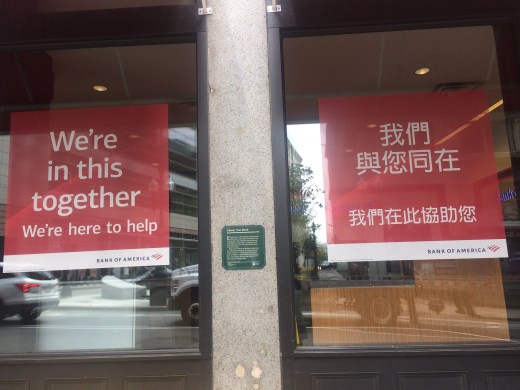
Photograph: Kim Clark. Bank of America office on Washington Street in Boston, MA 02111.

Press Release: To Send or Not to Send?

I’m impressed! You have news that you’d like to share with the world, with a particular emphasis on those who are potential clients and referral sources for your business venture, and you are sophisticated enough to think outside the box in an old-school way and consider sending—-ah ha!!—a press release. Yes, a press release remains a relevant tool, the standard route to media outreach.

While most everyone else chooses to make big announcements by way of social media you, sophisticated Freelancer friend, understand the reach and power of traditional media outlets, be it radio, neighborhood newspapers, or digital-format regional business magazines. Social media is great outreach but there are times when you want to get beyond your followers and obtain third-party support that implies objectivity and real world legitimacy.

Be aware that a press release is a marketing and sales tool. The idea is to communicate a message to customers and prospects through the vehicle of a print or online article, adding the authority and credibility of the publication to the message.

Before you go online and remind yourself how to write a press release—Who, What, When, Where, Why and How—first ask yourself these two questions and follow a couple of pointers. These may sound stringent but they’ll help you make a rational decision regarding media outreach for your organization.

  1. Am I newsworthy? Do you or your company that regularly receive media attention? If so, then you are newsworthy. Press releases by larger, established, household-name companies receive more attention than smaller companies and startups. Have you or your enterprise received any media attention at all? If so, that puts you at an advantage. Or, have you served on the board of your local chamber of commerce, library, or neighborhood business association? Are you a long-term and active member of a neighborhood group, school, Rotary Club, or place of worship? In other words, are you well-known in your community and can you leverage your renown to persuade an editor or reporter that you have sufficient name recognition among the media outlet’s readers or listeners that would motivate them to learn more about you?
  2. Is my story/announcement news? To get your message communicated through the publication, you’ll need to convince a reporter or editor that your message (or the story surrounding it) is newsworthy. Your story must have the potential to appeal to the readership of the publication, or listening audience if podcast or radio. So if your goal is to fill seats at a conference, don’t send a press release. The most important element of a press release is that it’s helpful to reporters, by offering them news of interest to their audience. Journalists don’t care to help fill seats at your conference.                                                                                                3. Write like a reporter   If your press release looks and feels like a real article, reporters will often just file it as a story with minimal editing. Therefore, it’s up to you to make sure that your press release looks and feels like a real news item. Avoid using business jargon.                                                     4. Call media outlets to confirm interest in your story Before sending a press release, call all media outlets on your wish list and ask to speak to the (business) appropriate editor or reporter. Do yourself a favor and read 3 – 4 issues to familiarize yourself with the types of stories that are carried and the names of reporters who cover your topic. Then, contact the reporters that you really want to cover the story. Mention that you’ve read their stories and name at least two. If you reach an editor, still make it known that you are familiar with other stories in your category.

Thanks for reading,

Kim

Photograph: (circa 1988) Phil Donahue (L) and candidate for president George H.W. Bush on The Phil Donahue Show.

How B2Bs Use Social Media

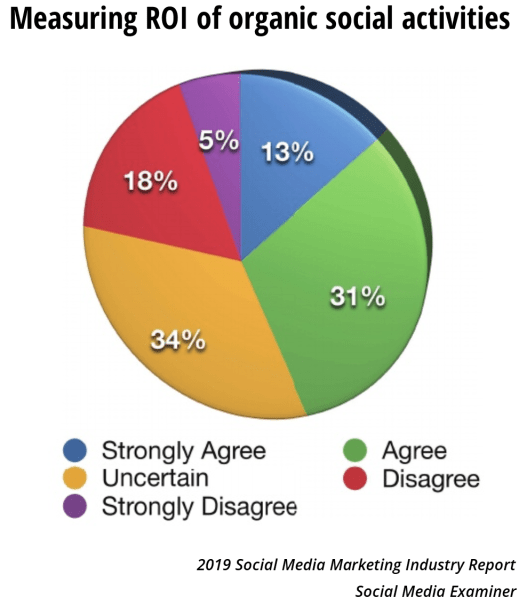
Take a look at the pie chart above. In response to the question, “I am able to measure the return on investment (ROI) for my organic social media activities,” only 44% of marketers in a recent survey that examined the use of social media in the B2B and B2C sectors agreed they were able to measure the performance of their organic social activities. This challenge has plagued marketers since the format appeared. Social media marketing is now included in most marketing strategies, yet a demonstrable ROI still eludes many. In my experience as a Freelance marketing professional, business owners and leaders still haven’t figured out how to effectively use the medium, measure its success or, for that matter, establish reasonable expectations for its benefits.

The wrong platforms are used. Content doesn’t fit platform. Investments are made in platforms that customers do not follow. Postings, after an initial burst of energy, appear only erratically after four or five months. Most of all, in an effort to both save money and simplify, social media all-too-often becomes  the company’s marketing strategy, rather than one component of the strategy.

The 2019 Social Media Marketing Industry Report, released by Social Media Examiner, surveyed more than 4,800 marketers with the goal of understanding how they use social media to grow and promote their organizations. for the past five years, the top benefits derived from social media are increased exposure in the marketplace and increased website traffic. Company exposure grew to 93% (from 87% in 2018) and website traffic improved to 87% ( up from 78% in 2018). Lead generation increased to 74% from 64% in 2018 and, most importantly, sales rose to 72% from 2018’s 53%, solidly demonstrating that B2B and B2C marketers see positive results derived from investment in social media. https://www.socialmediaexaminer.com/social-media-marketing-industry-report-2019/

Facebook remains the number one social media platform for both B2C and B2B marketers, who together account for 94% of business use on the platform. When B2C and B2B are examined separately, however, LinkedIn takes the number two spot for B2B, at 80%, while the number two B2C pick is Instagram, at 78%. Facebook and Instagram were the top two favorites of marketers overall in 2018.  

YouTube is still the number one video channel for marketers (57%) and Facebook’s native videos hold second place (50%). When the survey separated B2C and B2B responses, B2B marketers were found to choose LinkedIn native videos, while B2C marketers preferred Instagram stories and Facebook native videos. 

Of the platforms marketers regularly use for social media ads, Facebook is far and away the number one choice but once again, when separating B2B and B2C, the results show that B2B marketers use more LinkedIn ads while B2C marketers favor Facebook and Instagram ads.

Now, let’s look more deeply into 2020. A serious contender, at least in the B2C space, will be TikTok, an already massive platform beloved by Generation Z and Millennials. Launched in 2016, the site has more 500 million + active users worldwide; over one million of its 15 second videos are viewed every day. In January 2020, Statista reported that 37.2 % of TikTok users are age 10 -19, 26.3 % are age 20-29 and 16.7 % are age 30-39.

TikTok now has a shopping feature called “Hashtag Challenge Plus” that allows users to browse products that are associated with a sponsored Hashtag Challenge, all without leaving TikTok’s platform. Customers have now spent $50 million on TikTok purchases and 42% of all TikTok revenue now comes from the USA.

Did someone say influencer marketing? In 2020 and beyond, it’s safe to say that global brands whose customers skew to tweens and young adults will seize upon TikTok to spread their brand voice, engage with audiences and attract younger consumers, the golden key to future sales.

Thanks for reading,

Kim

A 360 Degree View of Your Brand

I recently gave a talk on branding, a term that we know gets used quite a bit, but I wonder if Freelance consultants and business owners fully understand what a brand means and how the brand can be put to work in service of the business? It is vitally important to first, recognize certain identifying characteristics of the business, which need not be complex or unique, and then spin those characteristics into a mythology or a story, a brand narrative or creation story, that is then packaged and marketed as a brand, destined to become a powerful selling tool.

Depending on your business, you might even build a brand around your location. Maybe you own a restaurant, or a hardware store, in Idaho. Common impressions that Idaho natives and Americans in general have about Idaho—rugged, outdoorsy, resilient, folksy, friendly, mountainous, beautiful—can be used to build a distinctive and compelling brand narrative. The essence of Idaho can become a defining characteristic of the brand.

Other branding possibilities are grandmas recipes (restaurants), the size of the establishment (large and comprehensive or small and curated), the longevity of the business, the number of generations that the same family has owned and operated the business, prestige clientele, expertise in a niche market, or superb customer service.

The function of a brand is to communicate. The brand is the reputation of the business. What a business leader must decide is the primary message that should be communicated and how to articulate that message.

What can the brand tell current and prospective customers? The brand tells them what to expect when doing business with you and your company—the available products and services, that the business can be trusted to deliver what they expect it to deliver, for starters. Branding is about reassuring. Branding is about consistency, predictability, trust, dependability, familiarity, the customer experience and comfort.

If the business owner or leader does it right, the brand will become habit-forming and the list of repeat customers will grow. Customers will be motivated to refer their friends, family and colleagues to the business. They will endorse the business on rating sites like Angie’s List, Yelp and Trip Advisor.

When examining and/or refreshing the brand, remember that the brand is two-sided. There is the internal brand and the (better-known) external brand. The internal brand represents what the business owner and leaders feel describes the brand. The external brand is how the business is perceived by the public, i.e., customers. The internal brand is self-image and the external brand is reputation.

It’s easier to start the brand examination internally—what do you, business owner or leader, want your organization to be known for? What do you interpret as its competitive advantages? What do you see as the value proposition or distinguishing characteristics?

The external view can be assessed by talking to customers, whether the best customers or occasional users of the products or services. In both cases, it’s important to ascertain what has persuaded them to do business with you. What brought them to your establishment, how do they feel about the experience and was the problem solved or objective achieved? Who is motivated to do business with you again and why? Who will not do business again with you and why?

In this way, business owners and leaders can determine what customers and prospects consider to be the defining competitive advantages and selling points. Conversations, face-2-face or by social media, and customer surveys are among the useful ways to learn what makes a difference and keeps customers coming back—or drives them away. If something can be summed up in a clever tagline, so much the better. Most of all, the business must promote what customers value most and express that message in language and symbols that will resonate.

When the value proposition, i.e., the value that the products or services will deliver to customers, perceived competitive advantages and selling points have been recognized and articulated, the business owner and leaders can confidently spread the word by way of promotional channels that customers and prospects trust and put the brand to work for the business.

Thanks for reading,

Kim

Photograph: Dwayne Johnson, aka “The Rock,” whose approach to branding has both a physical and professional dimension.

Elevator Pitch: Master Class

Every Freelancer has an elevator pitch, but few of those pitches are as effective as they could be. My own could use some work, to be honest. Freelancers are hunters and we thrive only when we bring in clients who trust us with lucrative and/or long-term projects. Arguably, the most important facet of a Freelancer’s skill set is the ability to quickly assess whether that interesting someone we’ve just met might have the potential to green light our next payday.

Street smart Freelancers anticipate the opportunity inherent in every meeting by using our hunter’s instinct to take aim and expertly deliver an elevator pitch that gets bells ringing in the head of a listener. In the conversation that’s sure to follow, these Freelancers ask a handful of smart questions designed to quickly weed out window shoppers, tire kickers and those whose needs do not align with our skill set.

The hunt starts with the pitch and Freelancers must build it with precision and deliver it in 30 seconds. The biggest mistakes Freelancers make in elevator pitch content are: (1) merely stating their skill set or job title, rather than giving a brief description of the problems they solve for clients and (2) failing to communicate the value they provide, the practical application of their expertise, that makes a persuasive case for working with them.

Skills or functions?

“I’m Bob Rossi, a business lawyer who also edits a digital business management magazine.” The information is accurate but Freelancer Bob has not expressed what is uniquely worthwhile about his business, he has not presented a story or any information that might persuade a listener to take notice. Expecting his job title to interest the listener is unrealistic because that alone doesn’t necessarily help anyone understand why s/he should care who Freelancer Bob is and envision how his products or services might be useful.

Whatever your job title and skill set, there are most likely dozens, if not hundreds, of highly skilled professionals who do some version of the same thing. There are many types of lawyers and business writers in the world. The successful hunter-Freelancer knows how to present a tidy little narrative of an elevator pitch that puts the listener at its center. In this much more compelling version, the Freelancer succinctly (1) names his/her specialty— the kind of work that you do best or most often (or your most popular product)— and how you add value; (2) identifies the types of clients you usually work with; and (3) gives three or four examples of article topics that regularly appear in the magazine (marketing, sales, finance and tech, perhaps).

“Hello, I’m Bob Rossi. I help business start-ups solve their management and legal issues, including LLC, incorporation and partnership set-ups. I also edit a nationally known monthly digital business management magazine that addresses topics that are important to business owners, entrepreneurs and self-employed professionals, primarily finance, marketing, sales and tech.”

It’s critical to wordsmith an elevator pitch that will convince the listener to pay attention and, if your timing is right, think of how s/he can use your know-how and imagine bringing you into a project that needs to get done in the near term. A money-making elevator pitch can convert a listener into a prospect who wants follow-up, who will say “take my card and shoot me an email, or call me at around 5:00 PM on a Tuesday.”

Finally, like the old joke says, “How do you get to Carnegie Hall? Practice!” Nothing sounds worse than clumsy delivery of an elevator pitch. You will be dead in the water and the VIP will never give you a second chance. Like an actor or an athlete, Freelancers must constantly rehearse and refine the elevator pitch, working it so that it slides off the tongue effortlessly. Because we never knows when a fortunate encounter with a VIP will occur, practice your elevator pitch often. Edit and edit again, until the wording is perfect and the cadence natural. Learn to step up to the plate on a moment’s notice with confidence, energy and enthusiasm and hit a home run every time.

Thanks for reading,

Kim

Photograph: ©TV Guide. Deluca (Giacomo Gianniotti) delivers his elevator pitch to Meredith (Ellen Pompeo) in Season 15, Episode 9 of Grey’s Anatomy.

Keepin Up with Expectations

The question “What do my customers want?” is maybe even more confounding than the 3000 year old Riddle of the Sphinx. Guessing incorrectly in either case brings the same fate—death (of the business, if not the owner). I suppose we can lay it all at the feet of digital innovation, which has raised the bar on customer expectations. Customers now expect the same level of end-to-end prompt, seamless performance and service from the small and mid-size companies that they still (thankfully!) patronize as they receive from well-funded and staffed multinational corporations. The little people must now work smarter, be evermore creative and resourceful and OMG hustle if we want to be viable.

According to a 2018 Salesforce CX Report, where 6,700 B2B and B2C buyers answered survey questions on technology, trust and the customer experience, 80 % of responders feel that the buying experience a company provides is as important as the products and services it provides. The report also found that if customers are dissatisfied, they’re ready to jump ship—75 % agree that it’s easier than ever to take their business elsewhere. So just because your customers are cozying up to you now doesn’t mean that they won’t look over your shoulder to see who else is in the room. https://c1.sfdcstatic.com/content/dam/web/en_us/www/assets/pdf/datasheets/trends-in-integrated-customer-experience-salesforce-research.pdf

The State of the Connected Customer, a 2019 Salesforce survey of 8,000 B2B and B2C buyers, found that customers will switch brands for what they perceive as a better customer experience. The survey concludes that customers expect good-to-great experiences from companies they know or would like to try out. The report also shows that trust and company values are important building blocks of customer relationships. https://www.salesforce.com/content/dam/web/en_us/www/documents/infographics/2019-state-of-the-connected-customer-infographic.pdf

At the same time, customer expectations are continually shifting as a result of their ongoing interactions with the world around them. For business owners and leaders, this means that in order to get a handle on creating the most desirable customer experience it is necessary to reexamine / reevaluate the customer experience at our organizations, this time from the customer’s perspective.

By way of understatement, customer expectations are not always predictable. How a customer judges their experience will not always align with what business owners and leaders have assumed about the experience their company provides. According to a 2017 report compiled by the uber consulting firm Accenture, 73% of B2B buyers want the customer experience to resemble that of a B2C company. https://www.accenture.com/_acnmedia/PDF-60/Accenture-Strategy-B2B-Customer-Experience-PoV.pdf#zoom=50

We also know that the personal touch is highly valued. In 2015, The Harvard Business Review reported that companies that successfully master the art of personalization for their customers can reduce customer acquisition costs by as much as 50 %, increase revenue by as much as 15 % and increase the effectiveness of marketing dollars spent by up to 30 %. https://hbr.org/2015/11/how-marketers-can-personalize-at-scale

The fact is that the customer experience is impacted by customer expectations and those expectations play a significant role in how our customers perceive and judge our organization. Customers today expect the companies with which they do business to know their preferences and they want those preferences reflected in every interaction, whether online or face-2-face. 

What business leaders can do

First, recognize and define what the ideal customer experience in your organization looks like and take steps to ensure that the standard is consistently met. Remember to assume the viewpoint of the customer and guard against internal bias. Second, stay abreast of market research that reports on your industry to discover trends and evaluate what your organization can afford to do and what it can’t afford to not do, in response. Third, guarantee that all customer-facing staff understands the value of delivering a first-rate customer experience and empower staff to support the delivery of that first-rate customer experience. Training is often necessary to show organization leaders how to create an empowered culture for employees and teach customer-facing staff how to graciously and effectively meet (reasonable) customer expectations.

Creating a superior customer experience at your organization requires significant planning and flawless execution. Be aware that every facet of your organization has a contribution to make as you respond to your customer’s evolving expectations. As you prepare your organization to study and improve the customer experience provided, consider how customers and prospects might view your company’s website content and functionality, sales distribution methods, payment systems, content marketing, social media, sales distribution, business hours and other factors that directly or indirectly impact the buying and customer experience at your organization.

Happy New Year and thanks for reading,

Kim

Photograph: © Richard Termine for The New York Times. Samantha Barks (center) in the Broadway musical Pretty Woman (2018).

Getting Clients: The Reboot 2020

For us freelancers to find reliable, long-term clients is a job unto itself and not an easy one. We have no choice but to invest thought and time into showing prospective clients and those who might refer us to prospective clients why we could be the best choice for providing the solution(s) for their problem.

To get ourselves inspired and off to a running start in the New Year, let’s review how we might best package and promote ourselves and our services to prospects, potential strategic partners and referral sources and update how to stand out and appear highly competent, trustworthy and an overall good hire for the Next Big Project.

KNOW YOUR NICHE

It can be so tempting to not want to limit ourselves to a specific niche, but the truth is, “If you’re talkin’ to everybody, you’re talkin’ to nobody.”
The biggest mistake that Freelancers make when going out on our own is that we try to be all things to all people. But when we create a niche, we can more effectively express what we do for our clients and how those clients benefit. That helps those who know and trust us to make referrals on our behalf. A clearly defined and easily described niche service or product is also easier to market to potential clients, because the message is easy to articulate and understand.

GETTING CLEAR ON CLIENTS

Getting clear on your niche and how we serve our clients is only step one. The real magic happens when we learn to consistently communicate in a way that resonates with target client groups. Speaking their language makes all the difference. Do you want to stand out to prospects? Know your ideal client!

It is to our advantage to be clear and concise about whom we can help and why. Tell (don’t sell) the story and talk just like you’d talk to a colleague. Embody the tone and attitude of one who cares, who understands their pain and can help them. Paint the “after” picture, i.e., the picture of their future after working with you. Offer credentials and tell client success stories that speak to their unique needs and concerns. In short, be all about your client.

INSIDE THE CLIENT VIEWPOINT
Christy Geiger, founder of Synergy Strategies Coaching and Training in Austin, TX https://synergystrategies.com/, says that one of the most difficult challenges in marketing is to identify and articulate one’s unique value and then sell that value to prospective clients.

Christy recommends that we flip the message and describe our service fromthe client’s perspective. Rather than presenting a list of self-promoting attributes that paint you as Mr. or Ms. Wonderful, discuss instead how your expertise ensures that clients are able do what they need to do and achieve goals and objectives.

MARKETING CREDIBILITY

As a Freelancer, the best way to stand out from competitors is to build your marketing around our credibility. Content marketing is very useful for this mission. Produce content that will help both bring visibility to your products and services and it help to establish you as an expert in your industry.

KNOW YOUR COMPETITION

Research others who provide products and/or services similar to your organization. What do they offer, what do they charge (if you can determine that)and how do they differentiate themselves in the marketplace? Then, ask yourself what could be realistically portrayed as valuable differences between your operation and those of your closest competitors? How might you be able to successfully distinguish yourself, your business practices, your qualifications, your products and/or your services and how might you persuade clients that these attributes make you the preferred provider?

CASE STUDIES

When clients hire us Freelancers, we expect that there will be a “discovery phase,” when they check us out—visiting our LinkedIn profile and social media presence, finding and reading articles we may have written and media quotes or features, for example. They’ll visit our websites and peruse our client list to find out who (else) they know who’s worked with us. To verify our work ethic, they may have a good talk with the referring party, if that was how the parties were introduced, or they may just call one (or more) of the clients on our list and discuss the quality of the results of the deliverable.

Freelancers can help both ourselves and our prospective clients reduce by sharing two or three well-written and descriptive case studies that demonstrate what we do, how we do it and the (exceptional!) results that we produce.

EASY TO DO BUSINESS

We Freelancers wear many hats. We’re the Chief Marketing Officer, the Vice President of Product Development, the Director of Sales, the Comptroller and company President. Our products and services may be excellent, but we would be advised to employ business practices and customer service protocols that make it is easy for customers to access what we have to offer. Setting up online purchasing or appointment booking, returning inquiries promptly and following-up as promised make a big difference. If customers have to jump through hoops to work with us, they will go elsewhere.

Thanks for reading,

Kim

Photograph: Steve McQueen (1930 – 1980), the “King of Cool,” in The Thomas Crown Affair (1968).

10 Great Client Gifts for Under $25.00

Hello all, have you bought your holiday client gifts yet? What are you waiting for? The clock is ticking. I bought mine yesterday afternoon (whew!).

Any and all clients for whom you do ongoing work, regardless of how small the billable hours, deserve an acknowledgement from you at this time of year. A client who gifted you with a big invoice this year definitely deserves a gift. Everyone with whom you’ve done business for the past five years deserves a holiday greeting card.

Devising client outreach tactics that skirt the appearance of a sales pitch is one of the indications of a well-designed marketing strategy. The best thing about the holidays is that we don’t have to dream up an occasion and fret over how to deliver the message—the occasion is self-evident. I invite you to browse these 10 practical, business appropriate and inexpensive gift options, which I hope will quickly solve your search.

1. Tech Compatible Gloves $24.00 A meaningful gift for those who live in a cold climate! Now your client can maximize efficiency and work on his/her devices wherever and whenever, whatever the weather, thanks to the knit-in touch-screen capability on the thumbs and index fingers of the gloves. Wear them alone when it’s not too cold and slip them into another pair of gloves on colder days. https://www.rei.com/product/873158/smartwool-liner-tech-compatible-gloves?cm_mmc=aff_AL--40661--55097-_-NA&avad=55097_c180e7139

2. Vinluxe Pro Wine Aerator $23.50 For those who like wine, a wine aerator is used to expand the wine’s surface area, allowing air to mingle with the wine. An aerator forces air to be circulated through the wine, resulting in a wine with more of an aromatic profile and softer tannins. It’s an alternative to swirling the wine. An Andre Lorent product, the Vinluxe was rated one of the top seven wine aerators in 2019 by the California Wine Advisor. https://www.andrelorent.com/

3. Hamilton Beach Electric Kettle $24.99
The kettle holds 1-liter (almost 34 ounces) and it’s stainless steel. It will heat water even faster than a microwave! For safety, the kettle has auto shut-off with boil dry protection features and for convenience, a water-level window. There is also a removable mesh filter and the heating element is concealed. https://www.hamiltonbeach.com/1-liter-stainless-steel-electric-kettle-40998

4. Anker Wireless Power Station  $16.99 
If you know someone who is constantly watching something on their phone, give them this stand that also doubles as a wireless charger. It works at 10W for Samsung phones and 5W for iPhones. sleek and practical, the Anker wireless charger will look great on your client’s desk. https://www.amazon.com/dp/B07DBXZZN3/ref=as_li_ss_tl?SubscriptionId=AKIAJO7E5OLQ67NVPFZA&ascsubtag=991011980-2-1278882471.1575921784&tag=shopperz_origin1-20

5. Southern Sampler Gift Box   $23.95
This sampler includes our most popular items: a World Famous Praline, Milk Chocolate Bear Claw, White Chocolate Bear Claw, Glazed Pecans and Peanut Brittle. Yummy! https://www.riverstreetsweets.com/product/Southern-Sampler/Gourmet-Gift-Boxes-and-Assortments

6. Business Card Holder/Desk $20.75 Here’s a nice desk item that is practical, versatile and unique—a business card holder with picture frame, to serve a dual purpose in a way that your client will appreciate. Available in rosewood or cherry wood finish. You Personalize your gift by laser engraving the card holder with the client’s company logo. Dimensions: 4″ x 2 3/4″ x 3 3/4″ https://www.e-corporategifts.com/Pop-Up-Business-Card-Holder-and-Frame.html

7. Cheese Board $19.95 This slate cheese board is the perfect size for your client’s office. The board features natural edges and velvet mounting to protect counter tops. It comes with food safe soapstone chalk to note the type of cheese, or write a message for your guests. An innovative take on a staple product for your home. Food-safe. Natural slate. Soapstone chalk. Dimensions: 8″ x 16″ https://www.greatgatherings.com/entertaining-essentials/barware-serveware/slate-cheese-board

8. Sponge Holder $24.00 Challenge: how to add flair to storing a mundane cleaning tool? This cheeky yet practical kitchen or bathroom accessory is made of decorative beach stones and a base cut from salvaged granite, connected by three aluminum posts that hold your sponge in style. The durable rubber bottom pad protects surfaces from scratches. This elegant holder also makes a great wallet valet, inviting cocktail napkin holder, or artful mail caddy. Handmade by Arra David and Anne Johnson in Windham, NH. https://www.uncommongoods.com/product/sea-stone-splash-sponge-holder

9. The Bullet Pen $22.95 Writes at any angle, even in Zero Gravity. Simply the most versatile pen ever made. This amazing pen is constructed of raw, unfinished brass. Over time, each pen will develop an unique patina as it responds to its environment, the owner’s body chemistry and the way s/he handles the instrument. Writes at any angle, even in Zero Gravity. It is simply the most versatile pen ever made. The pen also will write in extreme temperatures from -30F to 250F. Each Fisher Space Pen is precision assembled, hand tested in the USA and carries an unconditional lifetime guarantee. http://www.mypilotstore.com/MyPilotStore/sep/4551?gclid=EAIaIQobChMIlOSu—h5gIVRNyGCh14PQPlEAQYASABEgJNPfD_BwE

10. MagLite Pro Mini Flashlight $25.73 We’re over budget here (sorry!) but this is a great little gift—introducing the all new Mini MagLite Pro LED Flashlight. MagLite is based in California and makes its entire product line in the U.S.A (all right!). The Mini has the latest generation LED that makes its beam super bright. Turn on and focus the light by simply twisting its head. A black polypropylene belt holster and 2AA alkaline batteries are included. https://www.homedepot.com/p/Maglite-Black-2AA-Pro-Mini-LED-Flashlight-SP2P01H/203457057

Thanks for reading,

Kim

Photograph: © Houston Ballet. A 2015 performance of The Nutcracker by The Houston Ballet Company

Google Says You Are What You EAT

Freelancers and business owners must do whatever is possible and practical to promote our ventures and one perennial item on our marketing to-do list is the matter of Search Engine Optimization. Basically, that means how does our website fare in the all-important Google page ranking? Just the other day, I received an email marketing notice that examined whether email marketing or blogging was more effective for increasing Google page ranking and the answer was blogging (so I guess these folks will no longer send marketing emails?)

Google’s ever-evolving algorithms are a source of OCD -level obsession for many Freelancers and business owners. Big-budget companies spend thousands of dollars annually to follow the formula that will keep their business in the top 10 (i.e., page one) of Google searches. In February of this year, Google actually released a white paper that addresses the ranking issue, framed as an explanation of how they fight disinformation. In short, Google claims that we are what we EAT.

E-A-T in Google-speak stands for Expertise, Authoritativeness and Trustworthiness. This concept is discussed is detailed in its Quality Raters’ Guidelines. Demonstrating good EAT both on your website and social media platforms can potentially improve your company’s ranking. An excerpt from the report says, Our ranking system does not identify the intent or factual accuracy of any given piece of content. However, it is specifically designed to identify sites with high indicia of expertise, authority and trustworthiness (EAT).”

At the heart of the ranking system is a category of businesses that Google defines as Your Money or Your Life (YMYL). Introduced in 2014, its purpose is to protect those searching for medical, legal, financial, or safety-related articles and websites, along with other information deemed vital. Attorneys, physicians, dentists, mortgage brokers, banks and eCommerce sites are placed in the YMYL category, since consumers often must divulge personal information and payment details on those websites.

But let’s get to the meat of this thing, i.e., what does Google suggest we do to elevate page ranking? See below:

  1. Quality content
    YMYL industries are monitored because they impact people’s health, happiness, or finances and Google wants to ensure that these websites give enough information to make an informed decision possible. If you’re in this category and motivated to re-do your website, take care to tell prospective customers what they need to know about your products or services, so that an informed decision can be made and be concise as you do.
  2. Optimize your ‘About us’ page. Google will likely use your About us page to assess your team’s EAT. Include in About us:
    – History of your business
    – Notable team members, their photos, bios, qualifications and awards
    – Business awards, nominations and other recognition
    – Positive press about the business
    – Company values
  3. Reputation management
    Third-party endorsements that appear to be unbiased are a must. You may be very active online, frequently posting updated content on your website and social media platforms in an effort to convince prospects that your business is reliable, but your claims will not be adequately persuasive unless they’re supported by customers who’ve done business successfully with your company. Case studies are an excellent way to describe the customer journey and give detailed insight into how your business provides solutions that work.

    To boost visibility in search engines, make connections with online news sites and industry blogs and ask if they’ll quote you or link to your company’s blog or white papers. Forget about buying backlinks. Only submit your URL to reputable sites that have earned good online results. Signing up with Help A Reporter Out (HARO), a free service where members receive invitations every day to give a quote to a media outlet, is a good idea. I’ve been quoted twice in 12 months.
  4. Website’s security
    Google absolutely must be assured that searcher information will be safe when they visit a website. Having an up-to-date SSL certificate is important to them. While an SSL certificate is not a legal requirement, if there is a data breach on your site and your company is sued, your LLC or incorporation status may not protect you, since not having the SSL certificate could be called negligence. Be advised that 86.73% of the top 20 websites in Google search results use https:// (have an SSL certificate) and not just http:// in their web address. The SSL protects all user information submitted to the site. For the user, credit card and personal informational are protected and for the website owner, user login details are protected. Not all SSL certificates are equal, meaning the free services found online aren’t necessarily trustworthy. Check your website security (accurately, for free) by entering the URL into an SSL checker will help pick up any potential problems. In fact, Google sees non-secure websites as irrelevant and even flags them in their algorithm system. The less relevant your website, the farther down you are on the results pages and the less your company is seen. If you’re considering saving money by creating a free website, you may want to think again. Unless an SSL certificate comes with your domain (if you’re registering one), you’re most likely not going to have an encrypted website. Penny wise, pound foolish. The best thing you can do is go with a trustworthy website developer who can provide everything you need, from (maybe) hosting to (definitely) website design and content all at once. If your site is up and running, check security at no charge https://www.ssllabs.com/ssltest/ or https://www.thesslstore.com/ssltools/ssl-checker.php

Happy Thanksgiving and thanks for reading,

Kim

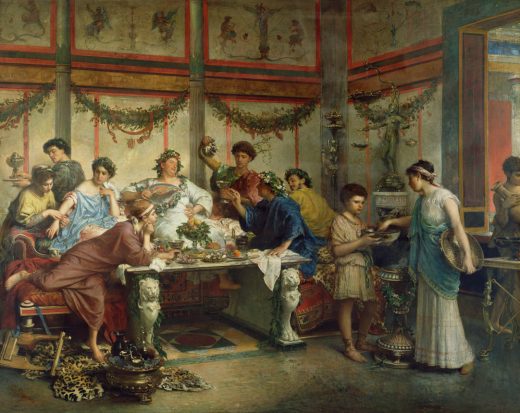
Image: Roberto Bompiani (Rome 1821 – 1908) A Roman Feast (late 1800s) courtesy of the J. Paul Getty Museum, Los Angeles, CA