Freelancers and the Vacation Dilemma

HoneyBook, an online business and financial management platform that serves entrepreneurs and Freelancers, conducted a survey of self-employed Americans and the results were depressing, yet not entirely surprising. The survey polled 800 + independent U.S. workers in May and June 2019 and found that while the Freelance economy provides flexibility, a factor routinely prized by the self-employed, 92% of Freelancers work on vacation and 60% of that cohort do so because they feel they must.

According to Freelance Forward 2023, an annual survey of Freelancers and other independent workers conducted since 2013 by Upwork, the online talent marketplace that connects Freelance talent with companies in need of their expertise, there are now approximately 64 million U.S. workers participating in the Freelance economy and they’re well aware that taking time off results in lost income, as reported in the five-year-old Honeybook survey. 1099NEC workers do not qualify for paid time off, whether for illness, holidays, inclement weather, or vacations. The 92% who feel compelled to work while officially off- line stand as irrefutable evidence that either fear of disappointing clients or fear of economic difficulty caused by lost revenue drives the practice of working during vacation. While 85% of Freelance Forward 2023 participants reported that the future of Freelancing is bright, caution reigns.

Furthermore, the Honeybook survey also found that 43% of Freelancers who vacation do not divulge their plans with clients; moreover, 41% of Freelancers hide from their intimate partner or vacation companions the client work they feel obligated to do while vacationing. Also, the data revealed a gender gap: 65% of female Freelance consultants reported they have felt the need to hide work they do while vacationing from their significant other and/or family, compared to only 41% of men — highlighting the fact that women feel more pressure than men to deprioritize their careers so that they can be fully available for their families.

Former Upwork CEO Stephane Kasriel, who is now head of Commerce and Financial Technologies at Meta, recognized that hesitancy to take time off for vacations is widespread and not limited to Freelance consultants and other independent workers. He pointed out that many American workers, whether full-time W2 employees or full-time or part-time Freelancers, often do not take the vacation time that they deserve (and W2 employees will be paid to take). Mental health professionals and leadership development coaches have long publicized the need for workers to physically and psychologically refresh themselves by stepping away from work to relax and/or take part in enjoyable activities with family or friends.

“Truly logging off is a common challenge for most professionals today, ” Kasriel said. “The Honeybook study surveyed self-employed respondents; other research, including data produced by Glassdoor, shows that the average employee who receives paid time off will have only used about 54% of available PTO in the past 12 months and of those who do take PTO, the majority don’t log off completely,” he went on to say. To remedy the dilemma, Kasriel suggested a few easy to implement vacation planning strategies that Freelance professionals can adopt to help themselves occasionally step away from work to relax and enjoy themselves for a few days.

7 steps to enjoying a relaxing and stress-free vacation

1. Know that it’s good to take vacations. Time off provides many health and productivity benefits, including improved energy, creativity, focus and decision-making ability, along with limiting the possibility of burnout. Putting aside work responsibilities every so often helps you become a more effective worker.

2. Create a vacation fund. Treat vacation time as an investment in you and plan for it in your business budget by earmarking what you consider a manageable amount to set aside each month to fund your annual vacation. Consider saving $100 a month for 12 months to finance a modest one week vacation. Do that and when the time comes to put down client work for a week, you’ll enjoy your vacation without worrying about taking on debt to pay for it.

3. Schedule vacations strategically. If there is a seasonal rhythm that influences your business cycle, or if you know of an important project that’s on the horizon, schedule your vacation in a way that enhances your ability to meet all milestones and the target completion date and enable yourself to completely avoid work responsibilities while you are officially out-of-office. Remember also that your vacation does not have to happen in July or August—every season has a unique appeal!

4. Roll in anticipated time off when calculating your project rate. Since Freelancers have no paid time off, consider this strategy—throughout the year, discreetly insert into project proposals additional hours that gradually allow you to accrue paid time off, via your project fees. An annual total of two to three weeks (10 – 15 business days per year) can function as your paid time off, buried in billable hours.

5. Give clients an early heads-up and firmly set expectations and boundaries. If it makes sense to let clients know that you’ll be off-line for a week or two, communicate that info immediately after confirming your vacation dates. In all communications — phone, email, text, in-person or video meetings — share upfront that you won’t be available or checking email while vacationing and remind clients again one week before your departure. Schedule meeting time to discuss the status of your projects so that everyone is on the same page and you won’t need to discuss work while vacationing.

6. Create an out-of-office auto-reply and turn off alerts. While you’re away, use technology to confirm that you are unavailable during specified dates. Remember also to turn off message notifications so that you can enjoy your vacation without constant interruptions.

7. Hire a virtual assistant. Virtual assistants aren’t as costly as you think. The going rate is about $8 an hour and many services do not entail lengthy contracts, hourly minimum amounts, or set-up fees. Delegating administrative tasks to someone else will allow you to focus instead on having a good time with your friends or family.

Thanks for reading,

Kim

Image: Dreamstime

Bidding Tactics: Let Prospective Clients See Your Best

An invitation to submit a proposal for an upcoming project is always a big deal. You’re excited and want so much for your bid to be accepted but even if you don’t make it this time, the opportunity to be a serious contender for a contract is always a vote of confidence. The bidding process itself is your opportunity to shine. At every facet of your proposal package, you have a chance to make a favorable impression. Step by step, you can give your prospect reasons to say yes to you!

You win the prize by telling the story of your company in a way that communicates your expertise and dependability. Your strategy is to first anticipate the questions that project decision-makers can be expected to have about a candidate and second, provide information that is likely to make the decision-makers feel confident that your organization is right for the role. In sum, you want to package and present your company in a way that radiates credibility.

First, you must decide whether or not you will submit a proposal for the assignment. It is important that you understand the company and the project before immersing yourself in developing a proposal. A reading of the project specifications will confirm if the assignment is a fit for your organization. A tour of the company website will familiarize you with the company’s products, services, mission and values and indicate whether you’ll be comfortable working closely with this company.

It’s also advisable to ask your contact at the organization to share with you the primary goals of the project, so you’ll gain a perspective of what the project means to company leaders. Finally, ask your company contact to share with you the metrics that will be used to measure project success. These insights will help you to decide whether or not to submit your proposal.

If you decide that this is a go, you want to give the decision-makers for the project every reason to select your proposal. Below are documents and other information to include in your proposal package that answer nearly every question about your entity, products and/or services and as it communicates your Experience, Expertise, Authoritativeness and Trustworthiness and advances a narrative designed to please the project decision-makers (and also the Google algorithm).

Capability Statement

Capability Statements are used to evaluate and weed out contract applicants, so submitting one that’s eye-catching and presents your company’s strengths can be the difference between winning and losing an assignment. Furthermore, a Capability Statement can help you to identify and describe your core competencies and unique value proposition.

Succinctly introduce yourself and your company’s products and/or services and tell the project decision-makers your story—exactly what your organization can do for them and why your organization is the best option. Your story must clearly demonstrate that you (and your team, if applicable) are capable and prepared to produce the deliverables on time and within budget, happy to provide excellent customer service and a pleasantly memorable customer experience.  Below are attachments that can accompany your Capability Statement and enhance its impact.

  • Bio
    A personal introduction to you, your (usually one page) bio will provide a concise overview of your most relevant educational and professional qualifications and accomplishments.
  • Client List
    If you have prestigious, high-profile clients in particular, list them (unless there is an expectation of client confidentiality). If you have very few clients, add jobs and your employers, projects and volunteer work, focusing on assignments and posts that relate to the project you would be hired for.
  • Portfolio
    Include relevant and persuasive samples of your work, to demonstrate that you are qualified and can be expected to excel in the role. 
  • Testimonials
    Ask those with whom you’ve worked closely, whether clients or those who have supervised you. Three to five recommendations is ideal.
  • Workflow
    This section shows clients you have a process, a system for writing and working on projects. It tells clients you’re a professional and gives them clear expectations. Most important, as they read it, they begin imagining what it will be like to work with you.
  • Schedule of Estimated Investment
    AKA, your pricing. Prospective clients will be interested in the scope of products and/or services that your company offers and the range of your fee schedule.

Once you’re hired (and you will be hired because you are the best candidate!) you can take a few steps to streamline and enhance your on-the-job performance:

  • Task Prioritization Begin by identifying your most critical tasks and deadlines. To-do list tools, project management apps (e.g., Asana or Trello), or time management techniques like the Eisenhower Matrix can help you prioritize effectively.
  • Project Calendar develop a project calendar to visualize deadlines and milestones for your your project. This helps you allocate time appropriately. For example: A Freelance digital marketer can create a calendar to manage social media campaigns for the client, ensuring posts are scheduled strategically and are uploaded according to plan.
  • Time Management Time management is the engine of successful Freelancing. Learn to allocate your time wisely and pace yourself to ensure that you maintain the energy, concentration and creativity that are the foundation of your professional expertise.
  • Time-Tracking Tools Utilize time-tracking apps (e.g., Clockify or My Hours) to monitor how you spend your work hours. This also helps identify areas where you might be losing productivity.
  • Communication Maintain timely and clear communication with your clients. Keep the project point person informed about your workload, progress, achievement of milestones and any potential delays or obstacles.

Regularly Update Your Portfolio Periodically refresh the content of your online profile with updates that display the most current examples of your best work and simultaneously demonstrate the demand for your products and/or services. Writers will provide links to recently published articles and those who’ve worked on a big project or worked with a prestige client will document the experience to verify your professional expertise and the power of your brand.

When to Say No Avoid taking on too many projects simultaneously and overextending yourself. Politely decline offers that you can’t accommodate without compromising the quality of your work. Effective management of your Freelance assignments is essential for sustaining success and maintaining a healthy work-life balance. By prioritizing tasks, managing time efficiently, staying consistent and handling multiple projects strategically, you can thrive in the Freelance sector.

Thanks for reading,

Kim

Image: © Shutterstock Asianmaninterview.jpg

Social Media Marketing: Hacks that Help

There are now more than 5 billion social media users worldwide who participate on several platforms, making the practice a marketing juggernaut that provides countless opportunities for B2B and B2C businesses in every industry to connect with customers and prospects. Once limited to developing brand awareness primarily in B2C industries, the influence of social media on businesses global and local now impacts customer experience, sales strategy, product development, content marketing strategy, competitive intelligence and more.

Because time means money where business is concerned it should come as no surprise that the timing of social media posting is sufficiently consequential to have piqued the interest of marketing researchers. Think about it—when planning to contact a customer or prospect, do you not consider what might be the best time to reach out? You probably avoid making important phone calls, or perhaps even sending an email, on Monday mornings or Friday afternoons. It’s a guessing game, but you aim to reach out when you expect your customer or prospect to be in a receptive mood, so your message will receive the consideration you feel it deserves. A similar approach to timing applies to social media posting. I first reported the best times to post on five platforms in June 2020. https://freelancetheconsultantsdiary.wordpress.com/wp-admin/post.php?post=20744&action=edit

When posting content on social media, the most important goal of marketers is to maximize the number of viewers who see their content. Platform algorithms prioritize engagement and posts that quickly attract attention are typically shown to more users, giving high engagement content an algorithmic boost that helps it to be seen by even more viewers.

A study of the Best Times to Post on Social Media in 2024 conducted by the social media marketing entity Sprout Social examined six platforms—Facebook, Instagram, LinkedIn, Pinterest, TikTok and X (Twitter)—to measure the influence of time on the potential reach of posts. Posting content on days and times shown to be popular with viewers may help increase the audience for that content and amplify the clout of your social media marketing campaigns.

But a word of caution—before scheduling posts to reflect your platform’s peak engagement times as identified below, compare Sprout Social results with your company’s social media data analyses. You may discover that your target audience is not uniformly aligned with the data presented here.

Best Times to Post on Facebook

  • Mondays from 9 a.m. to 12 noon
  • Tuesdays from 9 a.m. to 2 p.m., also at 5 p.m.
  • Wednesdays from 9 a.m. to 3 p.m., also at 5 p.m.
  • Thursdays from 8 a.m. to 2 p.m., also at 5 p.m.
  • Fridays from 9 a.m. to 11 a.m.
  • Best days to post on Facebook: Mondays through Thursdays
  • Worst days to post on Facebook: Sundays

With 3.05 billion active members per month, Facebook is the most widely used social media platform in the world and utilized by 89% of marketers worldwide. Facebook ties with Instagram for the distinction of social media platform that generates the highest marketing ROI, at 29%. The platform is an excellent showcase for online content of every type, from images and videos to live streams and audio content.

Best Times to Post on Instagram

  • Mondays from 11 a.m. to 2 p.m.
  • Tuesdays from 10 a.m. to 4 p.m.
  • Wednesdays from 9 a.m. to 4 p.m.
  • Thursdays from 9 a.m. to 1 p.m., also at 2 p.m.
  • Fridays at 11 a.m.
  • Best days to post on Instagram: Tuesdays, Wednesdays and Thursdays
  • Worst days to post on Instagram: Sundays

Instagram is a free photo and video-sharing app and social media platform that now has 2 billion monthly active users. Owned by Facebook (Meta) since 2012, Instagram is the place to share images, videos, reels and live streams. Instagram ties with Facebook for the distinction of social media platform that generates the highest marketing ROI at 29%.

The key to Instagram is that it is based on visual content. The photos and videos you upload will appear in your followers’ feeds, where they can like, comment, or share your visual post. The more likes or comments you get, the more “relevant” your post becomes and the higher it is placed in followers’ feeds.

Best Times to Post on LinkedIn

  • Tuesdays and Wednesdays from 10 a.m. to noon
  • Thursdays at 10 a.m.
  • Fridays 9 a.m. to 12 noon
  • Best days to post on LinkedIn: Tuesdays through Thursdays
  • Worst days to post on LinkedIn: Weekends

With over 1 billion members in 200 countries and regions, LinkedIn is the Mount Olympus of B2B communication for both the 1099 and W2 sets, who can share their expertise as they generate warm leads, announce new products and services, find co-marketing partners, investigate new employment opportunities, or attract talent to hire. Furthermore, users have found an ideal environment for professional storytelling, facilitated by LinkedIn Videos, and professional development at LinkedIn Learning.

Best Times to Post on Pinterest

  • Mondays: 2 p.m to 4:00 p.m and 8:00 p.m. to 9:00 p.m.
  • Tuesdays: 2 p.m. to 4 p.m. and 8:00 p.m. to 9:00 p.m.
  • Thursdays at 3 a.m.
  • Fridays: 3:00 p.m.
  • Best days to post on Pinterest: Weekdays
  • Worst days to post on Pinterest: Weekends

As of April 2024,  Pinterest has 89 million users in the United States and generated a a 7.5 % growth in users between 2022 and 2023, putting its growth rate ahead of Facebook, YouTube and Instagram. Pinterest is known as the platform where users research and discover DIY projects and inspiration products often focused around lifestyle ideas, home décor and recipes.

Women aged 25 to 34 years comprise the largest share of Pinterest’s global audience and the platform presents companies with creative opportunities to expand their community and build brand awareness. Brands that use the platform appreciate Pinterest’s benefits, in particular spotting emerging trends, building brand recognition and authority and driving website traffic. Pinners, as platform users are called, search for inspiration on this virtual mood board and curate their space.

Best Times to Post on TikTok

  • Tuesdays from 4 p.m. to 6 p.m.
  • Wednesdays from 9 a.m. to 11 a.m., noon, and 2 to 6 p.m.
  • Thursdays from 9 a.m. to 11 a.m. and 2 to 6 p.m.
  • Fridays from 4 p.m. to 6 p.m.
  • Best days to post on TikTok: Wednesdays and Thursdays
  • Worst days to post on TikTok: Sundays

With TikTok comes a whole new playbook for B2B social media marketing. Today, you can’t develop a social media strategy without considering TikTok. B2C brands led the way but as the platform has matured, it’s been recognized as a desirable resource for B2B marketers as well. Keep the following suggestions in mind when formulating your TikTok B2B marketing campaigns:

  1. Be authentic: Authenticity matters on TikTok. B2B brands will do well to showcase their unique personality, culture, guiding values and expertise. Share behind-the-scenes peeks, stories of the company founder(s) and employees and other relatable content.
  2. Find your niche: Identify your target audience and create content that resonates with them. Whether it’s tech enthusiasts, entrepreneurs, or industry professionals, tailor your content to their interests.
  3. Interact with the community: Engage with other TikTok users by participating in challenges, responding to comments and collaborating with influencers. Building a community around your brand is essential.
  4. Educational content: B2B companies can benefit from posting educational content. Share product demos, explain complex concepts, or provide industry insights. Remember that authenticity matters more than polished video production values.

Best Times to Post on X (Twitter)

  • Mondays from 10 a.m. to 12 noon
  • Tuesdays from 9 a.m. to 3 p.m.
  • Wednesdays from 9 a.m. to 3 p.m.
  • Thursdays from 9 a.m. to 3 p.m.
  • Fridays 10 a.m. to 12 noon
  • Best days to post on X: Tuesdays through Thursdays
  • Worst days to post on X: Sundays

X (Twitter) is the platform to monitor breaking news and trending topics and voice your opinions in up-to-the-minute conversations that align with your brand values and show customers and prospects what matters to you. X doesn’t offer the array of posting options that build engagement as do Instagram or Facebook. Rather, X focuses on conversation threads, replies, mentions, microblogging and enticing readers with eye-catching results from a survey you’ve conducted.

Twitter has a new name, but it’s still the place to express uncensored opinions. To increase audience engagement consider Twitter polls, which allow you to pose a question in a tweet, invite respondents to choose one of four possible answers to the question and will send the poll results to you, to announce and invite discussion. Polls are a great way to stimulate audience engagement because they’re quick and fun.

Polls are also a mechanism to invite uncensored feedback from customers about their preferences and therefore augmenting the validity of your market research—in the development phase of new products and services or customer service protocols for example. Polls are not a substitute for traditional market research, but they’ll provide quick and useful insights.

Thanks for reading,

Kim

Image: © Gala-Salvador Dalí Foundation. The Persistence of Memory “Melting Clocks” (1931) Salvador Dali, courtesy of The Museum of Modern Art, New York, NY. Dali portrait by Lies Wiegman (1961), retroactively colorized, courtesy of The Dali Museum, St. Petersburg, FL © Gala-Salvador Dalí Foundation

Give Me A Break!

Ambitious people work hard. Their to-do list is too long—and they wouldn’t have it any other way. They are achievers and they have mountains to climb. They are always flat-out crazy busy and cannot afford to waste a single moment. Working hard, working smart (hopefully) and working nonstop defines being productive, as they see it. Productivity is the engine of ambition. To the hard-working ambitious, this is a no-brainer, right?

It seems that many, if not most, ambitious people buy into this mind-set. To show the world (and themselves) that they are not slackers, they may brag about sleeping just four or five hours at night, because they have so much work to do. Others brag about waking up at 5:00 AM, so that they can wring as much productivity as possible from the day. Working 10 or 12-hour days and maybe skipping lunch, too, is standard behavior for members of the Hard Working Club; even vacations can include a Dropbox file filled with documents to review and a list of emails destined to populate their send file.

If the above scenario describes you, please know that I admire your ambition, work ethic and determination to succeed. To keep you on your path, I respectfully offer an observation—in order to sustain your ability to work hard and smart and maximize your productivity so that you can take aim at the ambitious goals you want to achieve, you must effectively manage your energy, concentration (i.e., focus) and endurance, mental and physical. Proper management of energy has nearly as much impact on productivity as the time spent working on your task.

Recall an instance when you finally had time to work on a task that was hanging over your head, but you put it off because you were too unmotivated or exhausted to do it. What your brain and body were telling you was that every once in a while, it is beneficial to stop working and rest. Rest periods—breaks—during your working day are more powerful than you might realize. In fact, rest breaks can improve productivity because they allow you to replenish your physical and mental energy.

A period of at least 10 minutes, during which you stop working and engage in a restorative activity (or inactivity) helps your body and mind to relax and refresh. Fatigue undermines concentration, creativity and endurance. Ignore that reality and you can find yourself unable to focus or perform well. Habitually pushing yourself to work through fatigue is not a sign of discipline or determination. Ignoring your human needs is counterproductive and can lead to burnout, a condition associated with unfortunate physical and psychological consequences.

By contrast, taking short breaks throughout the workday will restore your energy and help you maintain the physical and mental endurance needed to maximize your productivity. Taking breaks also supports the healthy self-regulation of your emotional state and behavior—that is, your mood—to promote positive interactions with others. When over-tired, we are vulnerable to responding to others in ways that are reactive—brusque or irritable—and we’re prone to taking frustrations out on others.

So, to stay at the top of your game, take a few micro-breaks throughout the day. Those respites can be as brief as 10 minutes in duration, but they matter. Just as micro-stresses might accumulate at work, micro-breaks can help you counter the negative effects. Below are examples of how and when you can incorporate restorative, productivity-enhancing breaks into your crazy busy workday.

1. Give yourself permission to take breaks.

Challenge the assumption that you’re too busy to take a break—you can’t afford to not take a break! Instead of leaving it to chance that you’ll find a few random minutes to squeeze in the rest you need, be as intentional about restoring your energy as you are about working hard and being productive. When you get into your car to begin a journey, you must have fuel in the tank. Taking a break during your workday is like going to a filling station to get the fuel needed to reach your destination.

2. Schedule breaks and set reminders.

Schedule blocks of time during the day when you’ll step away from work-related activity and do something that allows your mind and body to relax, so that you can replenish your physical and cognitive energy. You can let your biorhythms guide your break time and schedule a rest period when science predicts that your energy is at its lowest — in mid-to-late afternoon.  Research shows that our energy is typically lowest at around 3:00 P.M. You might try giving yourself 15-minute breaks at mid-morning and mid-afternoon, plus a 30-60 minute lunch break. Adjust the timing as you see fit.

If you’re inclined to get lost in your work and ignore the physical or cognitive hints that signal it’s time to rest a few minutes, install a pop-up alert on your desktop or phone to encourage you to stop working for a few minutes. Having a visual cue on your workspace screen, maybe a coffee mug, or an image of someone walking a dog or in a yoga pose, is a practical and entertaining reminder that break time has arrived. There are several apps designed to do this and some are free.

3. Build on bio breaks.

The breaks we must all take are the bathroom breaks. You can build an add-on to one or more of your bio breaks by “stacking,” that is, developing a new habit by attaching it to an existing habit or behavior. So, after your bio break, add your preferred relaxation or exercise activity. In this way, you pair something you want to do (or should do), with something you must do, such as visiting the bathroom. After your bio break, it will feel easier to transition to a 10–15-minute break that you devote to practicing deep breathing, meditating, climbing a stairwell or, for a longer break, taking a walk or run.

4. Batch email and other communications.

It can be tempting to use a few spare minutes when you have them to quickly respond to email or Slack messages, to make what could be an avalanche of mail more manageable. Yet, blocking out specific times in your workday for responding to emails is not only an efficient use of time, the practice also makes it easier to develop the habit of scheduling time exclusively devoted to breaks that do not include some form of work. It is in your interest to enable yourself to periodically relax and refresh, to sustain your energy and work at peak productivity.

5. Maintain meeting boundaries.

If possible, do not allow yourself to be trapped in meetings that exceed their allotted time frame (admittedly, this is easier to enforce when you preside at the meeting). If you are not the convener or meeting leader, be proactive about defending your boundaries by communicating in advance that you have another commitment that follows the meeting and therefore, you must observe the adjournment time indicated on the agenda and make your exit. Setting the expectation from the start that you will leave a meeting on time subtly encourages other attendees to be sensitive to the need to adjourn promptly.

It’s imperative to exert control over your time. When meetings exceed their projected adjournment time it can cause you to join your next meeting late, which is disrespectful and possibly disruptive to those attendees. Moreover, being late adds stress to your day. Most people will appreciate your stated intention to leave the meeting when the expected conclusion time arrives because respecting time often benefits them as well. In the event that you arrive late to your next meeting, spending just 15 seconds to take three deep breaths can help you focus, feel more prepared and be fully present.

6. Your go-to routine for unexpected breaks.

When possible, take advantage of unexpected breaks that occur when a meeting adjourns early or, conversely, starts late. Whether you listen to music, stretch your neck and roll your shoulders, or engage in a breathing exercise, creating in advance an easy to do and remember relaxation routine will allow you to use unanticipated breaks to your advantage. When it happens, embrace the serendipitous gift of time and use it to reduce stress and replenish your energy.

Thanks for reading,

Kim

Image: © Bettmann Archive, Lunch Atop a Skyscraper photographer unknown, September 1932. Iron workers take a lunch break 800 feet above West 49th Street during the construction of NBC Studios at 30 Rockefeller Plaza.

What Creating Value Means Now

https://neilpatel.com/blog/create-value-in-b2b-markets/

When providing B2B products and services is the focus of your business, it has always been necessary to create, demonstrate value as a means to attract and retain customers. Perceived value, often delivered as convenience, simplicity or cost saving, is a time-honored motivating factor in this sector. Of course you understand this basic calculus but like everything else, as business conditions, technological advancements, shifts in population, or the cost of living are impacted by various factors, then how value is perceived will also evolve. To complicate matters, you can also throw in the question of how value can be not only created, but also maintained and expanded. To dive into this subject, I turned to marketing savant Neil Patel.

As I knew he would, Neil Patel provides a practical explanation of how the potentially confusing matter of B2B value might best be approached and delivered when instability is the order of the day. To start, he segments customer buying behavior into five areas and labels them as “particularly important for B2B markets since these customers are keenly aware of and interested in anything that gives them an edge or adds to their success”.

  • Response – The knowledge that someone understands your problem and is ready to solve it
  • Service – The ability to clearly spell out the details while eliminating all of the risk (or perceived risk). Can also affect the credibility and trustworthiness of the company depending on how well they handle service-related needs.
  • Quality – A consistent formula that results in well-made products or services that help the customer achieve their goal(s)
  • Price – An assigned value that’s clear, practical and competitive
  • Time – The product or service is dependable, has a sensible learning curve, demonstrates clear return on investment in a shorter period

Having identified factors that were identified as decisive in both his corporate practice, which includes global players such as Amazon, Intuit and Microsoft, as well as the work he does with much smaller B2B entities, he discovered an uncomfortable truth—B2B customers aren’t going to tell you what they want. In fact, they may not immediately recognize, or are unable to describe, the value that will activate their Buy Now button. Your prospects cannot paint a picture of what they’re really looking for and that makes it very difficult for you to offer reasonable solutions that might be evaluated. But the good news is that Patel recognizes that the five decisive factors that govern perceived B2B value can be measured and they can be impacted and improved.

You Are More than Your Product or Service

All of these things add to the core value of the product and/or service, making it so much more. Companies that fail to demonstrate the benefits of these things in ways that customers can understand and appreciate will find themselves hard-pressed to justify the value of their product – particularly where price is concerned.

Notice that there’s one (very important) factor I’ve left out of the value puzzle – trust. Trust supersedes all of the other motivations in this list – however, it’s not something that can be outwardly measured. If you don’t have the customer’s attention, you can build up all of the other facets as much as you like, and you’ll get absolutely nowhere with them. But building trust centers on ensuring that you have the rest of the factors presented in a way that’s relatable, understandable and most importantly, actionable.

All that will happen only when the five critical factors are in place and leading you to create value thar customers will recognize, when they see it.

All of these things add to the core value of the product, making it so much more. Companies that fail to demonstrate the benefits of these things in ways that customers can understand and appreciate will find themselves hard-pressed to justify the value of their product – particularly where price is concerned.

So Why Is So Much of “Creating Value” Focused on the Price?

A lot of discussions about creating value center on price – but this perspective is misleading at best. The truth is, all of the other four facets of value-building: response, time, quality and service, make it possible to justify the price. If the customer isn’t on board with any one of them, you’ll have a hard time closing the sale.

Competing on price alone is a race to the bottom for B2B companies

So how to you make sure that the customer doesn’t simply hinge on price? Follow these steps:

Discover What the Customer is Willing to Pay For

Notice I didn’t say “discover what the customer is willing to pay”. You can uncover a great deal about what a customer values by simply talking to them. They’ll make it abundantly clear if you ask the right questions, especially where previous vendors are concerned. Everything from technical support and training to white-label options is on the table here, and when you find a collection of things that’s high on their priority list, you can:

Hit All the Right Buttons

B2B buying decisions are rarely made by one person. You’ll need to have the whole C-suite, marketing, sales and other executive members of the team on board – and all of them value different things. Don’t hesitate to demonstrate how your product or service can affect a priority of the marketing department, save hours of time for sales and otherwise provide demonstrable ROI to the C-suite. With this in mind, perhaps most importantly, you should:

Sell the Results, Not the Features

Don’t just tell them about the benefits, let them envision the outcomes for themselves. Always remember that the first use of your product or service is in your customer’s mind. When you can communicate the ROI they get in real, measurable ways – whether that return is in profits, time saved or anything else the customer values, you’ll have their attention and most likely their name on the client roster.

Never Stop Improving

Finally, even if you’ve created a fine-tuned money-printing Value Machine, your work is still not done. Even though you’re not competing purely on price, if a competitor can demonstrate that they provide similar (or superior) benefits at a lower price, you’ll find yourself on the defense. In order to continually outperform the competition, it pays to have a finger on the pulse of not only trends within your industry, but trends within your customers’ industries as well.

Thanks for reading,

Kim

Image: Work crew drilling through solid rock to create the Panama Canal, Panama, 1906 (Everett Historical)

Why, When and How to Delegate

WHY? Because you have a boatload of things to do and there aren’t enough hours in the day to complete them all. Because you may not have the expertise or inclination to do everything that needs to get done. Because removing certain tasks from your plate will improve your productivity and also lower your stress level.

The best leaders know how to delegate. There is an art to delegating, though, and to do it well takes practice. Some leaders resist delegating because they assume it will take as much time to explain to someone how to do what needs to be done as it would to do it themselves. Others are so buried in work that they’re unable to recognize what only they, the leader, can do and what someone else can do.

Those who have employees should also realize that delegating certain tasks to the team represents skills-building opportunities for them. Delegate selected tasks and you acknowledge the expertise within your team and demonstrate your trust in their professionalism. Employee job satisfaction will increase, as will the quality of work they do, because your employees will feel valued and respected.

Delegating can be a win-win for all, but upfront planning and maybe also a tutorial will be necessary. Furthermore, you’ll need to decide who you’ll delegate to and why.

WHEN? First, take an honest look at your to-do list and the timetables involved. Do you have the time and bandwidth to do it all? Then, determine which tasks can be called executive functions that only you can do, like meeting with clients or writing proposals and contracts. Next, acknowledge your primary skill set and own up to those tasks that you simply hate doing.

Now you’re ready to figure what you might delegate. Rather than muddling through and forcing yourself to take on what you either don’t do well or hate doing, do the smart thing and delegate to employees or to a Freelancer who has the expertise needed.

Bookkeeping, graphics, payroll and video meeting tech help are often outsourced. Do you have an important client proposal to prepare? If you’ve been invited to submit a proposal that may win you a new client, ask a team member who has a talent for creating data presentation graphics to turn the numbers you’ll include in the financial section into easily understood and visually interesting charts and graphs. Train a team member who has an affinity for technology to run and manage the tech requirements for videoconference meetings and webinar.

HOW?

Communicate expectations

Be specific about what you would like to be done. If there is a deadline attached, make it known. Create project milestones to help guide and pace the project and ensure that the final deadline is achieved. Commit directions to writing, so that everyone understands and you remember what you asked for. Verify that the person(s) to whom you delegate understands what to do, the process you would like him/her to follow and the deadline for completion. If you delegate to a team, appoint a project leader.

Provide resources

Empower the person or team to whom you delegate and give them full access to all necessary information, budget, authority and all necessary support to come through for you. Provide the context of why their work is integral to the overall success of the larger project, if that is what is delegated, or explain why the routine task you have now passed along may seem mundane but is nevertheless vital to operating or managing the company.

Verify and give feedback

Ask questions about the progress of the work and examine what has been done. If a mid-course correction is needed, show patience as you point out what must be redone and why. Were your directions not understood, or were the required tools or resources not made available? If everything is going well, be generous with your praise.

Thanks for reading,

Kim

Image: Chefs training in the culinary arts program at the University of Hawaii

Strategies to Manage Stress

The American Psychological Association defines stress as “any uncomfortable emotional experience accompanied by predictable biochemical, physiological and behavioral reactions.” Stress is part of daily life, as we know. Not all stress is bad and in fact, stress that induces the “fight or flight” response to a potentially dangerous situation is necessary for survival.

But chronic stress that results from an inability to eliminate or control an overwhelming or upsetting set of circumstances may precipitate serious health and behavioral complications, including hypertension, obesity, drug or alcohol abuse and depression.

Self Care

Busy people, whether highly stressed or not, are wise to set aside special time several days each week to devote to self-care. The activities can take the form of cross-training—-kick-off Monday with a run, swim, bike ride, or power walk, Tuesday for yoga or tai chi, Wednesday weightlifting at the gym, Thursday at home for prayer or meditation and Friday can belong to boxing or ballet.

Exercise, meditation and prayer have been confirmed through scientific research to deliver more benefits than I can remember, but among them are improved energy/ stamina, improved self-esteem, lower blood pressure, improved joint mobility, enhanced mood, improved cardiac functioning and a decreased incidence of stress. In other words, everything we need in the physical, cognitive and psychological realms gets better when we move our body and nurture our soul.

Eat well

Good nutrition supports one’s physical health. Maintaining a balanced diet enhances energy, stamina, cognitive functioning, the immune system response and helps the body defend itself against toxic stress. There will be times when deadlines or other intense situations might derail healthy eating habits and fried food bingeing rules.

Refuse to succumb to that temptation over the long- term. Get back on track ASAP and eat simply prepared fresh food, homemade or takeout, to feel, work and even sleep better. When faced with high-level physical, cognitive, or psychological demands, overdosing on sugar, salt and fat could leave one vulnerable to a crash of some sort, because unhealthy food does not adequately nourish.

Caffeine and alcohol are also not your friends when their intake surpasses a certain threshold. Listen to your body. A 20 ounce coffee or tea may get you going in the morning and a glass or two of wine, or a couple of cocktails, may help you to relax in the evening. Jittery feelings, heart palpitations and inebriation are warning signs and if they appear, dial back.

Sleep well

When starting or leading a business, there will be times when burning the midnight oil, if not burning the candle at both ends, will be the story of life. The opportunity and ability to sleep could easily be diminished. Yet it is advisable to guard against long-term sleep deprivation.

Arm yourself to take on difficult challenges by keeping your diet healthy and continuing with exercise and other forms of self-care (e.g., massage or energy work) that provide the stamina, cognitive functioning and decision-making ability that enable peak performance. Getting the work done makes it a lot easier to sleep and maintain a defense against the harmful effects of stress on the body and the psyche.

Medical and psychological researchers have published dozens, if not hundreds, of studies that document the relationship between inadequate sleep and stress. Sleep, like food and drink, is a biological need and we cannot survive without it (but the precise reason is unknown). The National Sleep Foundation has confirmed the long-held consensus that the average adult requires about eight hours of sleep/day. Teens may need 10 hours/ day. Some adults can perform well on just six hours/ day.

If sleep difficulties are the result of the stress related to getting things done, an executive coach may be able to identify ways to resolve workflow and time management issues that will make the to-do list more manageable, improve productivity and make falling asleep and sleeping through the night possible.

While you’re working on rectifying conditions that may be causing toxic amounts of stress, I recommend what I call The 90 Minute Rule, that pulls together a few NSF recommendations: 1) Evening workouts should conclude at least 90 minutes before bedtime, to allow the body to relax. 2). Dinner should be consumed at least 90 minutes before bedtime, to allow the body to digest. 3). Take a bath or shower 90 minutes before bedtime to promote the release of melatonin, a hormone that encourages sleep.

Delegate/ outsource

The struggle to get the work done is sometimes stress-producing, as noted in the preceding paragraphs. Learning to prioritize is integral to time management. An examination of projects and tasks that only the business founder/ leader is equipped to do is Step 1 of time management. The founder/ leader can then delegate other tasks to team members, if employees have been hired, or outsource to Freelancers or other business specialists, in the absence of staff.

Just say no

Saying no is occasionally necessary, even when it disappoints someone. Saying no may enable you to better manage time, energy, or other resources and become more productive.

Say no to enforce your boundaries. Say no to what you feel is unacceptable. Say no to honor your values, self-respect, or priorities. Say no to stress.

Thanks for reading,

Kim

Photograph: Kim Clark. Practitioners of Falun Gong, a spiritual philosophy with roots in China and derived from Buddhism, meditate on Boston Common.

Your Technology Recovery Plan

We’ve been tethered to our tech devices over the past few weeks and they enabled our productivity in many ways. However, now that several states are in the process of cautiously discontinuing quarantine protocols, I think it’s time for us to rethink our heavy tech dependency. Too much of a good thing can lead to unfortunate consequences.

Unzip Zoom

I suspect that those who shifted from going to the office to working from home were particularly entangled in videoconference technology, which can eventually send team members into diminished productivity (or maybe just annoyance) if overdone. Well meaning managers inexperienced in the mechanics of leading an entirely remote team are known to hold many meetings and because videoconferencing technology exists, some managers will hold a (probably Zoom hosted) meeting every morning at 9:00 AM, for example, so everyone will be in the loop and, especially, the big bosses will know that your boss is getting the work done (or doing a good job at making it look that way!).

Despite the technology’s surging popularity, there is no need for every meeting to be a videoconference call. Audio only conference calls remain useful, especially when they are of less than 30 minutes duration. Furthermore, the matter at hand might be resolved in a two paragraph email. Resist the temptation to use video calls as your default communication tool because that’s not what it was designed to be.

Moreover, no one who is working from home should on a regular basis feel the need to assess the Home & Garden Magazine readiness of their home/ office space whenever they need to talk business. Not only that but your home may not have the best WiFi service. Your neighbors are also working from home, participating in videoconference meetings while their children are home schooling lessons on Skype or Google Hangout. Your internet signal could slow down or freeze up. Videoconferences are pressure and one does not always need to take it on to get the job done.

Physical over digital

As was discussed in the last post, suggest a face2face meeting with your VIP and arrange to have at least a beverage on the table when you meet. Oh, it’s been so long since we’ve been able to grab a coffee or whatever and sit down at a table and talk. Oh, how powerful that simple ritual is and how we took it for granted until it was gone!

Now that it is, or soon will be, within our grasp again, why not pay homage and invite a client you’re reconnecting with to meet you for ice cream now that warmer days are here? Surprise and delight!

Daily tech break

Rest your eyes and hunched shoulders and schedule two 30 minute tech tool breaks every day (unless you’re on project deadline). Believe it or not, taking a couple of short breaks during your work day is a time management technique that boosts energy, concentration power, creativity and productivity. We all need to periodically unplug and refresh ourselves physically, psychologically and emotionally because resting is necessary.

Pencil and paper

It’s also possible to walk one’s use of technology all the way back and periodically remind yourself of the charms of paper and pencil. The next time you (and your team or client, for that matter) need to brainstorm ideas or make a list, pull out a sheet of paper and a pen and write in longhand. Whether you’re in a face2face or videoconference meeting, don’t be afraid to go low tech old school every once in a while. You can use the white board in your office and plot a timeline in longhand. When you’ve completed it, take a picture with your phone and send it around. The raw, in the moment look of your notes will be the soul of creativity and authenticity.

Finally, you can cut back your screen time and reclaim the lost art of reading a physical book or newspaper. Every Sunday I buy the paper and read it in sections throughout the week. My eyes and brain appreciate the break; I enjoy it and find it relaxing.

Whenever I grab something to eat, I almost always also grab something to read as well. If I want to share an article with someone, I go online to find the link and copy/ paste, reminding myself that technology maintains its advantages.

Thanks for reading,

Kim

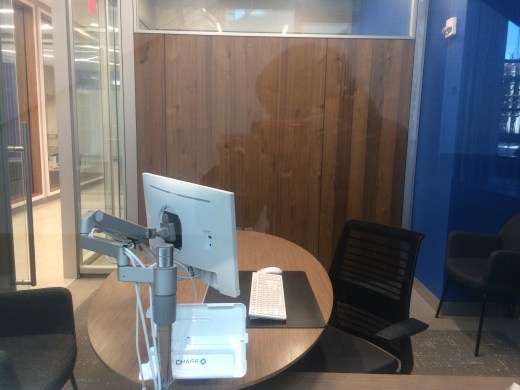
Photograph: Kim Clark May 19, 2020. Office at Chase Bank 800 Boylston Street Boston, MA.

Challenges That Impact the Solopreneur Enterprise

There are always challenges associated with operating one’s own business venture. Some challenges are formidable while others are merely annoying.  Many are common and probably inevitable.  Anticipation and preparation are the best defenses and can mostly be addressed in your business plan and its subsequent updates.

TIME CONSTRAINTS

Employees can, on occasion, walk into their office, close the door, and choose to be non-productive for most of the day.  Solopreneurs do not have that luxury.  We must meet or exceed the expectations of clients and prospects every time and hit a home run whenever we walk up to the plate.

Solopreneurs are often faced with a lengthy daily to-do list— client work to perform, a meeting to attend, a workshop to develop, a class to teach, an event with probable networking potential to attend.  Furthermore, there are business operations to maintain, such as financial management, marketing, prospecting and customer service. Every item is mandatory.

Over time, fatigue and a sense of being overwhelmed can develop.  Even depression can manifest. The successful Solopreneur must learn to manage and prioritize routine tasks and in fact consider removing some from the plate through outsourcing.  The judicious use of technological tools that save both time and money is smart management, as they help business processes and customer service operate seamlessly.

Click  here  and  here  to assess no-cost and low-cost apps that not only record the time you spend on project work, but also invoice clients and in some instances, accept accounts receivable payments online.

FOUNDER’S SYNDROME

The reality of a single-person shop is that services that generate billable hours cannot be delivered unless the founder is on the job and able to produce them. That means, if you’d like to attend a multi-day skills training session or take a one or two week vacation, be certain to allow adequate time to make key preparations that will help you to discreetly step away from center stage for a few days.

Tasks that you’ve outsourced, e.g. invoicing or bookkeeping, can continue as pre-arranged, but the production and delivery of the services that are the business must be put on hold until you return.  Learn how to prepare your business for your absence (in this case, a vacation) when you click here.

HOW TO GROW

You work alone and that is why you are called Solopreneur.  To promote the expression of your creativity and ingenuity, it will be wise to remove certain routine tasks from your plate, as noted above.  Grow your organization by giving yourself adequate time to concentrate on the money making functions of a business owner: client acquisition and retention, recognizing potential new revenue streams, including niche markets you might enter, effective and timely business strategies to implement, collaborations, beneficial partnerships and networking.

If you elect to continue to perform all administrative tasks as you work to grow and sustain the business, quality control might become an issue.  Spreading oneself too thin is inadvisable and may result in sub par work, diminished customer service, poor decision-making and fatigue. It is far more preferable to spend the money on outsourced help so that you can maintain or enhance the expectations of your brand.

In closing, I reiterate that when you write a business plan, you will be encouraged to acknowledge and prepare in advance for most of the business challenges mentioned.  The initial marketing plan, financial plan and business model will keep you from falling prey to client list, money management and growth challenges.

Thanks for reading,

Kim

Image: Mosaic depicting the Amazon queen Melanippe, courtesy of the Haleplibahce Museum in Urfa, Turkey.


Time-Tracking Options for Freelancers

We’re back with a review of more time-tracking services that are especially useful for Freelance consultants. Accurately documenting the time spent on project assignments is important in many ways, primarily to ensure that billable hours charged to clients are correct.  Plus, most time-tracking services will generate an invoice that you can click and send and some will also allow you to accept online payments with bank-level security.

In addition, time-tracking services generate useful reports that show the number of hours you spend on certain types of assignments, information that is useful when creating proposals for projects that you’d like to take on, since it will be necessary to predict the time you expect to spend on the proposed project, which will impact your pricing and determine whether it will be most advantageous for you and the client to choose an hourly rate or project fee payment arrangement.

Harvest

Track time spent on projects easily and efficiently with Harvest, even when you need to follow several projects that contain different tasks that are priced differently. Furthermore, when coordinating a team project, you’re able to assign and time-track various tasks within a project for specific team members.

Reporting is a strength: raw time sheet data will be presented in a visual summary that depicts how your time or the team’s time has been utilized, with key project metrics collated into intuitive reports. The service also generates professional-looking invoices based on your project fee or hourly rate, as determined by the time you’ve logged.  Click and send invoices to clients and receive online payment, confident that site security is bank-level.

Harvest is free for one person to track maximum two projects/month and $12 for one person to track an unlimited number of projects/month.  Harvest

RescueTime

Freelancers who’d like to document how they’re spending time when working on a project and who are not kept on a short leash by a manager will appreciate RescueTime.  It’s not possible to send reports to your client, but you can nevertheless track your time and obtain an accurate picture of your productivity.  You will also receive detailed reports that show you the apps and websites you visited.

As well, RescueTime will record time spent on email and the amount of time you linger on any website. If you’d like to limit the time spent on non-work related websites, then ask the system to block your browsing on any chosen site after a certain amount of time.  Further, you can set goals to inspire yourself to stay on schedule with your project. The premium service plan also allows tracking of off-line time for activities such as telephone calls and meetings. RescueTime Lite is free and RescueTime Premium costs $9.00/month, or $72.00/year.   RescueTime

Tick

Each time you submit a time entry, Tick updates your project and task budgets in real time and reports back to you.  If you regularly track time against an hourly rate determined budget, or a project fee that involves an important deadline or penalties for late completion, then Tick may be your ideal time-tracking solution. It’s also possible to track time on multiple projects simultaneously.  While the service can be used by a solo Freelancer, it is especially suited for a team.

Tick is free if a single user employs the service for one project per month, $19.00/month for an unlimited number of users who’ll track a maximum of 10 projects/month and up to $149.00 /month for an unlimited number of workers to time track an unlimited number of projects.   Tick

Toggl

If you neglect to click the session start button, the service will allow you to enter your working time after the fact, which is helpful for those who are very busy and prone to forget. The service is structured with a team in mind, but it works well for solo professionals.

The service works on all devices, desktop and mobile. Helpful analytic reports will be generated, so you’ll get the big picture of where your time is spent, depending on your assigned tasks.  There is a free version, plus Starter and Premium.  The $9.00 /month Starter package appears to give the best value to Freelancers.   Toggl

Klok

Most helpfully, the service lets users recall and analyze data from previous projects, information that enables you to develop proposals for future projects that will more accurately reflect the time needed to reach key milestones and achieve deadlines. The historical time-tracking data will also help you to price at a level that is fair to both you and the client.

The basic package includes a visual display of your time as you work, plus screenshots, exporting of time sheets, dashboard reporting and invoicing all for a one-time purchase price of $20.00 for up to three users.  Klok Cloud Sync, Klonk Pro and Klokwork Team Console are also available.   Klok

Happy Thanksgiving and thanks for reading,

Kim

Photograph: Orloj, the famous 15th century astrological clock in Prague, Czech Republic