Hello Freelancer friend and thank you for coming back to continue our examination of how Freelancers who are just regular folks can leverage our know-how to generate a sufficient income in the 21st century knowledge economy. For most, it is an uphill battle.
One very ambitious (and possibly overwhelming) monetization strategy is to write a business book that will either:
- tell your business creation story— how you overcame adversity and persevered until you prevailed, or breezed through every door and stumbled into lucrative assignments
- function as a how-to guide that details how the reader can become a more proficient and successful public speaker, financial manager, business strategist, Freelance consultant, or the like
A business book is an evergreen PR tool and door opener. Authors are often asked to give quotes to journalists and content producers, are more often invited to speak at business or professional association meetings, receive more adjunct teaching opportunities and are considered more qualified than non-authors by potential clients.
Podcasts are another promotional strategy, one that is more accessible than writing a book. Ideally, podcasts will position a Freelancer to monetize his/her knowledge or skills and it’s not necessary to create a series that will attract thousands of listener downloads and a gaggle of advertisers. For at least a handful of podcasters, several of their strategically selected guests have become clients. However, in order to make that transition, one must be the host of the show and not merely a guest.
Yet, if one appears as a guest on enough podcast shows and moves up the food chain to appear on popular shows, it will be reasonable to apply that achievement to the pursuit of paid speaking engagements. Preferably, speaker circuit bookers will find you, but it would nevertheless be worth your while to initiate contact. You could possibly receive offers in the $250 – $750 per talk sector. You won’t get rich, but you might create a modest revenue stream and enhance your ability to attract big-budget clients to your core business. Along with your podcast appearances, become a panelist or moderator at conferences sponsored by neighborhood business associations, chambers of commerce, or professional associations, to hone your pubic speaking skills and enhance your presence and brand.
Finally, there is the growing popularity of creating and presenting online courses. If you are an experienced teacher and comfortable in front of the video camera, you may want to brainstorm a course or two to create and present. Essentially, this means you must identify a problem and then design a course to solve it. Click the link and get information on how to create your online course
In closing, I don’t see much of a solid business model in the new economy brand and knowledge monetization game, I’m sorry to say, and maybe that’s why so many Freelancers are struggling. As I see it, a business model is similar to the template for a franchise. The template is not as precise as a mathematic formula, but given similar business conditions and customer demographics, one can produce the desired outcome. In other words, if you buy a CVS or Dunkin’ Donuts franchise, you will make money if the store has the right location and management. Unfortunately, our fortunes in the 21st century knowledge economy are not so predictable.
Dorie Clark (no relation), author of Entrepreneurial You (2017) and frequent contributor to the Harvard Business Review, advises Freelance consultants to follow these steps to monetize our knowledge and brand:
- Cultivate an inner circle. From this group, one receives feedback and encouragement. If some in your circle are well-connected, they may provide important client referrals and open other doors for you as well.
- Build an audience. This is how you launch your monetization strategy. Announce the roll-out in your blog or newsletter, on your website and on social media and YouTube. The goal is to become visible.
- Build your community. As your audience grows, you must encourage them to talk to each other and connect around your concept. The community will initially be nurtured online, probably through Facebook and Twitter. Eventually, you will solidify your community support with ticketed face-to-face gatherings where you are the featured speaker.
- Build trust. Your community has to trust and respect you. Continue to create content that they find relevant and be careful in what and how often you attempt to sell to them.
Thanks for reading,
Kim
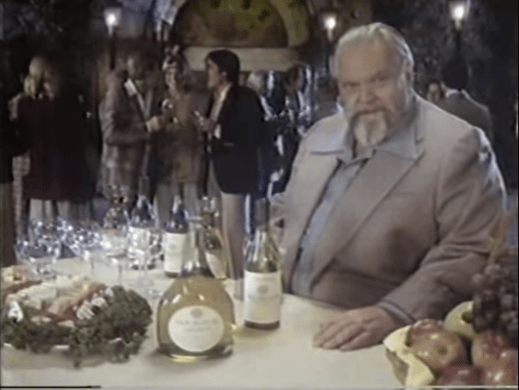
Image: Screenshot of Paul Masson Wines advertising campaign. Academy Award winning writer (Best Original Screenplay 1941, Citizen Kane), producer, director and actor Orson Welles was the Paul Masson Wines (of California) brand ambassador from 1978-1981.

 Freelancetheconsultantsdiary's Blog