Freelancing Future of Work 2026 and Beyond

In case you hadn’t noticed, how and where many Americans work—the work environment—has changed significantly, especially since the 2020-2021 coronavirus pandemic era. Twenty years ago there were employees, most of whom worked within the IT industry at companies such as Cisco Systems, Google, IBM, or Microsoft, who were allowed to telecommute (as it was known) maybe once or twice a week. Co-workers who were based in different parts of the country (and sometimes on different continents) would periodically hold meetings and the proceedings were transmitted by satellite feed, which, while usually shaky, enabled teams to communicate and share information, make plans and agree on execution and desired outcomes.

Back in the day outsourcing arrived, a solution fueled by employee downsizing, a practice that in the aftermath of the 1987 stock market crash and recession became increasingly common. Outsourcing emerged as a strategy to address the need to replenish depleted labor talent pools without incurring costs associated with (re)hiring full-time employees—-better to avoid paying for health insurance, sick and vacation time and retirement funding. So, out with employees and in with the contractors.

In other words, while several alternative working options in America simmered beneath the surface for decades, it wasn’t until the 2020-2021 coronavirus pandemic that the doors blew off as business leaders recognized the necessity to immediately provide practical and effective solutions to keep their organizations alive and profitable. Enter the remote work force and a huge validation for Freelance professionals. Who knows how to do Work From Home better than you?

How we worked before has been transformed into what historians may one day label the most impactful labor movement since the Industrial Revolution. The transformation of how many people work, that is, the future of how we will work, is represented by Freelance professionals. In 2026, Freelance employment can no longer be called a mere trend—it is a phenomenon that impacts all 3.38 billion workers on planet Earth. The number of Freelance professionals continues to expand and justify the way we work now and will likely continue to work well into the 21st century.

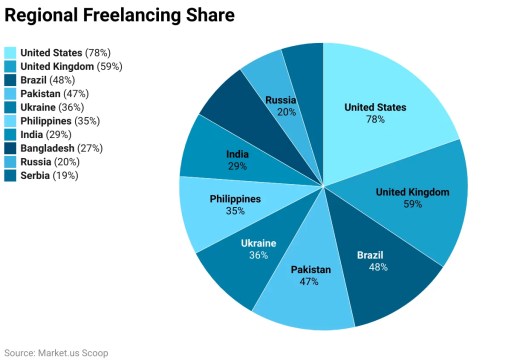
The influence of Freelance labor is demonstrated by its strong year-over-year growth in bellwether markets such as Britain, South Africa, India and the U.S. In 2026, the population of independent workers is predicted to reach 1.57 billion worldwide, with 83 million Freelancers engaged in the U.S.Freelancers make a substantial economic impact, contributing an estimated $1.27 trillion to the U.S. economy in 2024.

Most Freelance professionals work in the knowledge economy and perform services that require specialized expertise, education and training that’s obtained by earning undergraduate or advanced post-secondary school degrees and/or specialized certifications. From bookkeepers and accountants who ensure that clients’ financial statements are accurate and able to inform business decisions to special events photographers who memorialize the proceedings of Fortune 500 corporate meetings and other important events, the skills and ambition of independent workers have pushed the Freelance economy to unprecedented growth,

fundamentally reshaping the worldwide labor market and positioning the global business processing sector—finance and accounting, customer service, human resources, marketing and other B2B services– to generate revenue of $407.1 Billion (USD) in 2026.

The U.S. has the fastest-growing Freelance economy, with revenue increasing by 78% year-over-year 2023-2024 and a compound annual growth rate (CAGR) of 17% in 2025-2029. The global data-as-a-service giant Statista predicts that by 2027, 86.5 million U.S. workers will Freelance, accounting for 50.9% of the country’s total workforce.


Your inner optimist may interpret this forecast as an opportunity to grow your billable hours; your inner pessimist may see disturbing visions of increased competition in the Freelance hiring landscape. Why not be realistic and take a look at your organization to find where you would be wise to raise the level of your game and enable yourself to be more responsive to clients and prospects in ways that grow your client roster? Make lemonade out of the lemons.

In fact, Freelance professionals are optimistic about the future of Freelance work. Your confidence is fueled by increasing demand for specialized skills and a global pivot toward more flexible work arrangements. According to the Upwork Future of Work Index in April 2025, 82% of Freelancers say their work opportunities have grown since last year, versus just 63% of full-time employees. In that same report, 84% of Freelancers reported that they are excited by how the prospect of Artificial Intelligence tools will reshape their services, offerings and workflows.

Research indicates that Freelance work will continue in growth mode and the data has a high confidence level amongst the experts. You should be able to claim your share of the pie. If the intentions of corporate decision-makers can be taken to the bank (ha!) they support Freelance expertise. A January 2025 Upwork report found that 29% of executives believe that Freelance workers are essential to their business and 48% of CEOs plan to increase their hiring of Freelance workers over the next 12 months.

Still, there are worries that keep you awake at night. A November 2025 survey found that 66% of Freelancers feel that securing enough work is their primary challenge. Other major concerns included managing an irregular income, unpredictable work availability and non-paying clients.

Research also shows that Freelancing in 2026 won’t be all about finding projects; 2026 is shaping up to be about adapting to new skills, technologies and ways of working. Staying informed will help you to prepare and position yourself to keep up as the independent economy continues to grow. The Upwork Future of Work Index found that the most relevant Freelancing strategies to follow in 2026 will be to stay informed about global developments as you remain apprised of relevant shifts that occur in the U.S. B2B Freelance economy.

These are the signals every Freelance consulting specialist should pay attention to. For example, as automation becomes more common, skills that are uniquely human become more valuable. Negotiation, communication, empathy, storytelling, decision-making and leadership will help Freelancers stand out and facilitate building long-term client relationships. These soft skills are now seen as core strengths that technology cannot replace. The Future of Work Index shows that 87% of Freelancers prefer work that helps them improve their current skills or learn new skills, versus work that only allows them to use the skills and proficiency they already have.

 Let’s finish up with some 2025 statistics that examine billable hours and revenue. I’m sure you know that Freelance earnings differ according to the services provided. Generally, the more technical the service, the higher the billable hour. High-demand services such as programming allow Freelancers in the field to bill at $70/hour. Artificial Intelligence and Machine Learning engineering are currently the highest-paid sectors among all Freelancing roles and expertise in one or the other niche allows you to command a billable of $50-$200 per hour. The number of computer and information research scientists is expected to grow by 26% by 2033. (Upwork)

  • Full-time B2B Freelancers on average work approximately 43 hours per week
  • Approximately 54% of Freelancers work five days a week
  • On average, Freelancers earn $99,230 annually; however, the top earners have annual earnings of $200,000. Meanwhile, 25% of Freelancers earn $50,500 annually.
  • The average hourly billable earned by U.S. Freelancers is $47.71, with a range of $132.21 to $14.90 per billable hour. 
  • The average Freelance programmer bills at $60-70/hour and generates annual revenue of about $120,000 
  • The average Freelance writer bills at $30-40/hour and generates annual revenue of about $42,000
  • Online marketers typically earn $50/hour and generate $100,000 annual revenue
  • Freelance graphic artists bill at $40-$45/hour but are known to receive enough billable hours to generate $90,000 in annual revenue

Thanks for reading,

Kim

Image: market.us

New Regulations Will Impact SMBs in 2024

As if figuring out how to make a decent profit in 2024 won’t be enough to tie your stomach in knots, the federal government has arranged for the New Year to bring a passel of new regulations for Freelancers and small business owners to grapple with. While it’s true that business and labor regulations are created to promote fair, ethical and legal conduct and working conditions, what it takes to comply can sometimes place a burden on Freelancers and small business owners, who may struggle with the required paperwork, the costs of implementation and, always, the threat of penalties for missing a deadline or failing to comply. But cheer up, my friend, because one of the new rules will give you a spoonful of sugar (thank goodness!). Here’s the who, what, when and why of it all, coming your way.

Corporate transparency

As of January 1, 2024, most small businesses will be required to file a Beneficial Ownership Information (BOI) report with the federal government under the Corporate Transparency Act. The act is intended to increase transparency regarding business ownership and help law enforcement officials discourage the use of shell companies for money laundering, terrorism, fraud, or other illegal activities.

Under the CTA, new and existing businesses that meet the definition of a reporting company must file a BOI Report with the U.S. Treasury’s Financial Crimes Enforcement Network (FinCEN). The report provides information about the identities of the beneficial owners of the business, that is, those who directly or indirectly exercise significant control over the business or own 25% or more of the business. Entities formed on or after January 1, 2024, must also provide “company applicant information” about individuals who file business formation or registration paperwork and will have until January 1, 2025 to file the initial beneficial ownership.

Unless your entity is exempt, all corporations, limited liability companies and other reporting companies must provide the Treasury Department (FinCEN) with info about the beneficial owners, meaning, a list of those who either own or control the company. New businesses are also required to provide info about who prepared and filed the business formation documents. Reporting companies could face civil and criminal penalties if they don’t file the report. While the CTA may seem as if it applies to big corporations, the rule primarily impacts small businesses, including LLCs and S Corps with just one or two owners.

Domestic reporting companies are corporations, LLCs, limited partnerships and other business entities created by filing documents with the secretary of state or similar office, or with a Native American tribe. Foreign reporting companies are businesses formed in a foreign country that have registered to do business in any U.S. state or Native American tribe. A sole proprietorship or informal business partnership is not considered a reporting company and will not have any reporting requirements under the CTA. LLCs, corporations and limited partnerships must file beneficial owner information unless they fall within one of the 23 exemptions listed in the act. Most exemptions apply to larger companies and specific regulated industries, so small businesses and Freelancers who operate as a C Corp, S Corp, LLC, or limited partnership will likely need to file a BOI Report.

Small business loans

The Consumer Financial Protection Bureau’s Small Business Lending Rule would require affiliated financial institutions to collect and report data on small business loan applications, including applications from minority-owned and women-owned small businesses. The rule would also create the first comprehensive database of small business credit applications in the United States.

The goal is to create a database similar to what the mortgage industry has. Per the Home Mortgage Disclosure Act of 1975, banks collect data from residential mortgage applicants that includes geography, race, whether or not the loan was approved and at what interest rate. HMDA data is used by regulators and the public to look for possible signs of mortgage lenders discriminating against borrowers (redlining).

It’s often difficult for small businesses to obtain a loan because there may be scant profit made or an insufficient track record to assure banks of the owner’s ability to repay the loan on schedule. Women and minority-owned businesses especially find it difficult to obtain loans to grow their ventures. To encourage more transparency and equity around business loans, the CFPB in 2023 said it would require banks to begin reporting the demographics and income of small business loan applicants in 2024.

In rebuttal, some small business advocacy organizations claim that CFPB requirements will slow down the loan process and make it still more difficult for small businesses to obtain loans, not easier. Karen Kerrigan, Small Business & Entrepreneurship Council President and CEO, says the proposed regulations will “bury small businesses and financial institutions with costly and time-consuming paperwork, expose small-business borrowers and lenders to increased litigation and privacy risks, drive more small banks out of business and limit competition in the financial lending space”.

On October 26, 2023, the U.S. District Court for the Southern District of Texas issued a nationwide injunction prohibiting the CFPB from implementing or enforcing its Small Business Lending Rule, the CFPB has stayed deadlines for compliance with the small business lending rule for the moment. The U.S. Supreme Court may take up the matter, so those of you in search of a business loan may want to follow this issue.

National Labor Relations Board joint-employer rule

Also in October 2023, the National Labor Relations Board issued a revised joint employer rule, expanding the definition of “joint employer.” This means that two companies that are both responsible for some decisions about employees—such as a franchisor (entity that holds the trademark and grants license to use the corporate name) and franchisee (owner/operator of one or more individual franchise locations)—can both be held liable for unfair labor practices and the rule goes beyond franchises.

Backstory: in 2019, a group of 1,400 McDonald’s workers filed a lawsuit alleging that their employers had violated California Labor Code wage-and-hour regulations by denying them overtime pay and meal and rest breaks and also forced them to work off the clock. Furthermore, the suit alleged that as “joint employers,” both the Haynes Corporation, the franchisee that owned eight locations in Oakland and San Leandro, and the franchisor, McDonald’s, were responsible. Although the employees and Haynes reached a class-wide settlement, the court ruled that McDonald’s was not responsible, since it isn’t involved in “day-to-day operations” of the restaurants, despite them carrying the McDonald’s name. But on October 26, 2023, the NLRB issued a clarification of the joint employer rule, deciding that both franchisors and franchisees can be held liable for unfair labor practices and labor law can no longer insulate corporate franchisors from liability for what goes on at individual franchise locations.

Unions and workers’ groups say the new rule will benefit and help protect workers, but restaurant associations and other small business advocacy groups say it’s unfairly burdensome to owners. The rule was scheduled to go into effect on December 26, 2023 but pending Congressional and legal challenges, the NLRB extended the effective date of the new joint-employer rule to February 26, 2024.

Wages and overtime

Maybe you own a seasonal business and hire minimum wage employees to keep things going during the busy season? If so, you already know that hourly wages are rising and in fact, more than 20 states will have minimum wage increases in 2024, including Nebraska’s minimum wage increase of $1.50 to $12/hour on January 1, 2024, and Rhode Island’s increase of $1 to $14/hour.

There could be still more action on wages coming soon—in August 2023, the Department of Labor proposed a rule that would allow 3.6 million more workers to become eligible to receive overtime pay. The proposed regulation would require employers to pay overtime to salaried workers who are in executive, administrative and professional roles and earn less than $1,059 a week, $55,068 /year, as full-time employees. That annual salary threshold was increased from $35,568.

Karen Kerrigan, President and CEO of the SBE Council (and who also opposed collecting demographic info on small business loan applicants, as discussed above) said she expects that when the final rule is handed down it will face legal challenges, since raising the minimum wage would have a big impact on many businesses. The Labor Department may issue the final rule sometime in 2024. Kerrigan said, “That’s going to have a lot of disruption for small businesses in terms of cost, but also the models they may use in their workplace in terms of career growth models, compensation models, etc.”

$600 online payments reprieve

I’ve saved the best for last! In November 2023, the Internal Revenue Service for the second time delayed activating the requirement that payments of $600 or more for goods and/or services provided by you and sent to you via Third-Party Settlement Organizations, e.g. payment apps like Venmo and Zelle or online marketplaces like Amazon or Etsy, must be reported on IRS Form 1099-K as taxable income. The requirement was scheduled to go live in tax year 2023.

Instead, the IRS has instituted a threshold of $5,000 for tax year 2024 that will introduce a phase-in of what will eventually include the Form 1099-K $600 reporting trigger for TPSO payments received. The IRS in November 2023 said that in tax year 2023, 1099-K reporting will continue to be required only of Freelancers and others who received $20,000 or more in annual gross TPSO payments for 200 or more sales transactions in that year. Beginning in tax year 2024, the TPSO annual gross payments threshold for Form 1099-K reporting will be lowered to $5,000. 

Thanks for reading,

Kim

Update: In response to a suit brought by the National Small Business Association against the Treasury Department, the U.S. Federal District Court for the District of Alabama ruled on March 1, 2024 that the Corporate Transparency Act is unconstitutional. Presiding Judge Liles Burke granted the plaintiffs’ motion for summary judgment and issued a permanent injunction after finding that the CTA “exceed[ed] the Constitution’s limits on the legislative branch and lacks a sufficient nexus to any enumerated power to be a necessary or proper means of achieving Congress’ policy goals.” The ruling was handed down only two months after the CTA went into effect on January 1, 2024 and an appeal by the Biden administration is expected.

Image: © (Getty Images) James Stewart (R), as a caring community activist, points at Lionel Barrymore (L), a “greed is good” style real estate baron and banker, in a scene from It’s a Wonderful Life (1946, produced and directed by Frank Capra).