8 Hacks to Make 2024 Your Best Year!

At the top of the year many of you—working or retired, seniors or teens, traditionally employed or self-employed— will develop a list of goals you’d like to pursue and achieve over the next 12 months. You know that identifying a purpose that inspires, motivates and gives direction to your professional or personal life makes you feel confident and is a cornerstone of how you define success.

To get started on your annual plans, dedicate a block of time and use it to make an objective assessment of where you are now and where you’d like to be at this time next year. Commit to writing the rough draft of your emerging goals and begin to flesh out the proposed actions and time lines to carry them out, whether you scribble on the back of an envelope or record your ideas on a white board at a company meeting. You’ll find it useful to include monthly or quarterly milestones as a way to document your progress and perhaps make adjustments as you observe the impact of your action plans on the strategies you’ve developed.

Below are a list of hacks (the good kind!) that I hope will nudge you in the right direction and serve as a general road map for your 2024 annual plans.

1. 5:00 AM wake-up

In the cold, dark winter even those who love early morning can struggle to greet the day before sunrise but you’ll soon learn that the sacrifice will be quickly immediately rewarded with a noticeable spike in productivity that will encourage you to maintain the habit. Here’s the earlier riser secret—as the days gradually get longer and brighter throughout late February and early March, set your alarm to wake up 30 minutes earlier than usual. Every week or two, change the wake-up call to half an hour earlier until you’re waking up at 5:00 AM. Whether you prefer to start the day with a mug of hot tea and a review of email or with exercise, you’ll be off to the races and you’ll win every time.

2. Define your success

Goals help you focus your time and energy and it’s wise to spend adequate time determining the business results you’d like to achieve, followed by creating strategies, action plans and a timetable that serve as the engine to move your plans forward. It’s useful to revisit the previous year’s goals and objectives as you define what success could look like in 2024—you can perhaps build on previous successes or modify that which remains relevant but could benefit from a re-calibration. Your challenge will be to identify reasonable, ambitious, achievable goals for your company and to understand the purpose, impact and ROI of each goal. Finally, you’ll need objective measures for determining success and experts agree that SMART goals are still the best—Specific, Measurable, Attainable, Relevant and Timely.

3. Follow the money

To properly manage your business you must understand its financial metrics and heed what those metrics indicate. You don’t have to be an accountant to understand the numbers, but I’ve found that my best and most profitable clients know their numbers. They monitor sales revenue weekly or monthly; they analyze cash-flow reports weekly or monthly; they calculate costs associated with client acquisition; they determine profit margins for their products and/or services and price accordingly. Furthermore, those who operate a service business will calculate the hours devoted to billable and non-billable work that’s performed each week or month. It will also be a good time to reconfirm or reconfigure the metrics, i.e. the KPIs, that will most accurately reflect the performance of any new goals or other initiatives you’ll put into place this year.

4. Nurture client relationships

Clients are the lifeblood of your business and it is obvious that cultivating and nurturing client relationships is of utmost importance. Video meetings, telephone calls and emails are the easiest contact methods available and each has a place in a comprehensive client outreach strategy; however, the most impactful relationship-building activity is a face2face visit. There is nothing like the warm and friendly rush of a big smile and a handshake. You may have had innumerable phone conversations with a client or prospect, and a video call or two as well, but can you say you’ve met him/her until you’ve met and talked in real time? You may find that you develop deeper and longer-term relationships when you meet people face to face.

Online meetings absolutely serve a purpose, but humans (and animals) respond most intensely to physical contact. That psychological fact should give you the motivation needed to attend business and professional association meetings, drop into networking events, or simply invite a client or serious prospect to meet for lunch or coffee.

5. Skills development

Ensure that you have the wherewithal to evaluate and, where appropriate, utilize resources offered by emerging technologies and leadership practices that will benefit your business. You can pay to take professional development courses and/or attend conferences but if keeping costs low is a priority, you have other means to keep your skills current.

For starters, make it a ritual to peruse at least weekly the business section of your local newspaper, so that you’ll obtain information that pertains to your local marketplace. Read also at least one national business-themed publication to keep yourself apprised of national trends and happenings that might eventually impact how you do business or influence how your clients might respond to your products and services.

In addition, promise yourself to read at least two business books in 2024. Improve your understanding of financial management and how that knowledge can be applied to grow your business when you read Financial Intelligence (Karen Berman, Joe Knight & John Case, 2006) https://www.barnesandnoble.com/w/financial-intelligence-revised-edition-karen-berman/1110913346 . You’ll thank yourself for reading Good Charts: The Harvard Business Review Guide to Data Visualization (Scott Berinato, 2016) https://www.barnesandnoble.com/w/good-charts-scott-berinato/1122655992 when you learn how to design and present charts and graphs that enhance your next client meeting or speaking engagement. Last, here’s an international list of 25 top-rated consulting themed podcasts for your edification https://podcasts.feedspot.com/consulting_business_podcasts/.

6. Exercise

Numerous studies demonstrate that regular vigorous exercise contributes to a healthy body, greater energy and stamina and sharper cognitive skills. You might play a sport and make a date to play once or twice a week and visit the gym on other days. Or, you might swim, bike or run twice a week and lift weights once or twice each week. If the weather interferes with outdoor workouts, you can always find an online class. The point is to exercise regularly. Early morning workouts are an unbeatable way to wake up and get your energy and creativity flowing. Since you’ll wake up at 5:00 AM, why not start your workout of choice at 6:00 AM?

7. Embrace AI

Exploring how to most efficiently use Artificial Intelligence will probably dominate the technology strategy of most of you this year. You may get some insight from the marketing automation and bookkeeping/ accounting software that you use. Expect a continued rollout of AI tools that will save you time and help business productivity. You will be wise to devote a significant amount of time researching and staying up to speed on these very fast-moving developments. Keep an eye on Microsoft, they are in the lead.

8. Strategize growth with your accountant

Your accountant is uniquely qualified to counsel you on ways to promote the stability and profitability of your business entity. All you have to do is ask. Moreover, if you’re percolating an idea of making any major capital investments, or if you envision growth and expansion as goals you’d like to kick-off in the next 12-18 months, a face2face talk with your accountant is your first step. Make it a tradition to meet twice a year with your financial guiding light; May and September seem like good months for a money talk.

Thanks for reading,

Kim

Image: ©️ Getty Images. Jennifer Capriati won the women’s singles title at Roland Garros/ French Open in 2001

Survey: Freelancing in America 2023

Upwork, the global marketplace that connects businesses in need of capable and reliable Freelance professionals and talented independent workers who are looking to generate billable hours, has just released the results of “Freelance Forward: 2023,” the 10th annual comprehensive study of the U.S. independent workforce. The study found that 64 million Americans participated in Freelance work during the past year, adding 4 million more self-employed workers over 2022. Freelance workers now comprise 38% of the nation’s workforce and contributed nearly $1.27 trillion to the U.S. economy in 2023.

Highly skilled professionals

Most Freelancers perform highly skilled professional work. Nearly half (47%) work in the knowledge economy and provide B2B services such as computer programming, marketing, IT, graphic arts and business consulting. Another 23% of Freelancers create influencer and other marketing content that fuels livestreams, social media videos and images, blogs and newsletters. 

Freelancers are also at the forefront of embracing new technologies. When asked about generative Artificial Intelligence use in the past three months, Freelancers were 2.2 times more than traditionally employed workers to say that they frequently use generative AI tools. In total, 20%, approximately 12.8 million Freelancers, use generative AI tools regularly (multiple times per week), compared to just 9% of traditionally employed professionals. When asked the functions for which Freelancers use generative AI, research (46%), brainstorming and ideation (35%), translation (33%), proposal writing (32%) and coding (28%) ranked at the top. 

Why we Freelance

Results of Freelance Forward studies produced over the the study’s 10 year history show that respondents enter Freelancing for various reasons, but flexibility and control consistently emerge as prime motivators. Beyond earning a living, when asked about reasons for Freelancing, “to have flexibility in my schedule,” “to be in control of my own financial future” and “to work from the location of my choosing” top the list. This is mainly because unlike traditional employees, whose work schedules are largely imposed by the company, Freelancers are our own bosses. We determine when, where and for whom we will work and therefore, we are able to control our schedules and lives.

The evidence of this freedom is apparent in where Freelancers perform our work. Although return-to-office mandates have brought many professionals back to their cubicle, the majority of Freelancers work from home, at a co-working space, or in another location of their choosing. In fact, 60% of Freelancers work remotely, as compared to just 32% of traditionally employed professionals who work remotely. Furthermore, Freelancers also choose the hours and amount of work they’ll do at a given time. While 77% of Freelancers say they work consistently, they do so based on a schedule that best suits their lifestyles.

The future is Freelance

Freelancing continues to grow as a viable career choice for professionals and according to survey participants, the future of Freelancing remains bright. To understand the future of Freelancing, survey respondents were asked to assess their feelings of optimism, or pessimism, ahead of 2024. Overwhelmingly, Freelancers are optimistic about prospects for their professional growth (80%), personal income and revenue increases (76%), opportunities to earn billable hours (74%) and personal development (84%). When asked about the future, 85% of Freelancers say the best days for Freelancing are ahead. Key findings of Freelance Forward 2023 include:

  • Freelancing remains a significant part of the U.S. labor market and economy: Freelancers contributed $1.27 trillion in annual earnings to the U.S. economy in 2023. This was a 78% increase from the estimated $715 billion contributed to the economy in 2014, the first year of Freelance Forward.
  • Freelancing hits a new all-time high: The number of professionals Freelancing increased to 64 million Americans, or 38% of the U.S workforce, an increase of 4 million from 2022.
  • Freelancers are 2.2 times more likely to regularly use generative AI frequently in their work: 20% of Freelancers use generative AI tools on a regular basis (multiple times per week), which compares to just 9% of traditionally employed professionals.
  • Nearly half of Freelancers provide skilled knowledge services: 47% of all Freelancers, or nearly 30 million professionals, provided knowledge services such as computer programming, marketing, IT, and business consulting in 2023.
  • A quarter of Freelancers are creating influencer-style content: 23% of all Freelancers, or 14.7 million professionals, created influencer content including livestream services, social media videos, images or blogs in 2023.
  • Generation Z and Millennials are the most likely to explore Freelancing: In 2023, 52% of all Gen Z professionals and 44% of all Millennial professionals performed Freelance work.
  • Older Americans continue to be part of the Freelance market: In 2023, nearly 8.3 million professionals, or 13% of all U.S. Freelancers, were aged 59 or above.
  • The future is bright, according to Freelancers: Over 85% of Freelancers say the best days are ahead for Freelancing.

Happy New Year and thanks for reading,

Kim

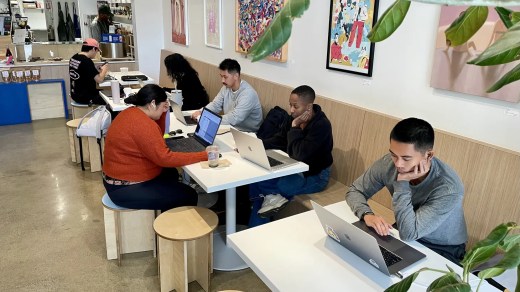
Image: Frontal Lobe Coworking, located in the Nationally Registered historic downtown of Howell, MI, opened in 2013 with the intention of attracting workers to a shared office space while also utilizing empty downtown buildings.

6 Digital Trends to Make Doing Business Faster and Easier

Maybe you and I are alike when it comes to technology—-neither in love with tech-based products and services, nor afraid of them. I’ve never played a video game in my life but when fax machines were still a new thing, I bought a (Panasonic) combination phone and fax. You may remember that first wave fax machines required special paper that was sold in rolls. When plain paper fax machines became available, it was a big thing.

When a new product or service brings a significant improvement to my life or business, I’m happy to be an Early Majority Adaptor, in marketing parlance. I do not rush forward with my arms wide open when a big media rollout announces that a flashy new product or service has come to market but before too long, I’ll investigate. Might this new arrival be useful for my life and business? Will it help me to make money, save money, save time, or enable me to do business more efficiently or amplify my impact somehow? Can I afford to buy it? Can I afford not to?

Presented below are six relatively recent technological inventions or developments that are reshaping how we work and live. Nearly everyone on Earth is almost guaranteed to utilize at least four of these six tech- based services, whether or not you realize it. The presence of these resources—-and that is what they are—-will only become more entrenched over time. It’s up to you to be proactive and figure out how to harness the power and tap into benefits that these resources can deliver to you.

  1. Artificial Intelligence

I’ll bet you’ve used a chat bot —-an AI-powered service— when you visited a website and wanted your basic questions answered quickly. No? We’ll, does the keypad on your tablet, desktop, or smartphone have autocorrect typing? I thought so! AI has seeped into so many routine functions that we take for granted.

A common use of artificial intelligence is for what’s called machine learning, algorithms that through repetition appear to “learn” over time. Artificial intelligence is also making inroads into Customer Relations Management (CRM) systems. With the introduction of AI, CRM systems transform into self-updating functions that allow business owners, marketers and accounts payable specialists, for example, to set up AI generated order confirmations, customer birthday greetings, or subscription renewal notices.

Artificial intelligence is also a mechanism for detecting gaps in computer network hacking defenses. AI systems can recognize a cyberattack, as well as other cyberthreats, by monitoring patterns from data input. If a threat is detected, it can backtrack through your data to find the source and help to prevent a future cybersecurity threat.

2. Automation

Routine administrative tasks are unavoidable in most jobs and getting it done is often time-consuming. The practical benefits of intelligent automation companies increasingly enable the automating of many repetitive tasks so they do not require manual input from you or other team members. Today, payroll, invoicing, event registrations and numerous data entry functions are handled by automated services.

Expect more business solutions to be powered by AI for analytics, data protection, security and search algorithms. As a result, many businesses will run leaner as business owners find ways to employ automation.

3. Hybrid workplace

We turned on a dime and responded most efficiently to the reconfigured workplace (and classroom) environment brought about by the coronavirus shutdown. The pandemic proved a virtual workplace is possible.

But also, it has shown that a work-from-home setup is not ideal for everyone. The solution is to design your hybrid workplace to fit the needs of your workers, as directed by their functions and deliverables they produce.

Workflow development specialists will be especially useful for helping hybrid teams, some that may even work across national boundaries, decide how to approach decisions about how the work can be efficiently executed, how to promote good communication and camaraderie and even who should work from home and who should work in the office.

4. Cybersecurity and privacy

As of July 1, 2022, 4.95 billion of the 7.95 billion global population are internet users (source: United Nations). That about 62% of the world is online has all sorts of implications, for better—-more opportunities for communication and exchanging information!—and worse—an urgent need for user data protection, to protect privacy and promote security.

Online business owners should already have encryption security measures in place, to safeguard financial transactions and customer information. Online customers are becoming more concerned about the security of their personal data that by necessity is in the hands of many organizations, including banks, employers, insurance companies, retailers and social media platforms. Freelancers and small business owners are expected to guarantee security measures to protect their customer data just like global enterprise companies.

Data breaches are embarrassing and expensive. They’re bad for business, especially for smaller companies, that don’t have the budget to engineer a reputation rescue executed by a crisis communication marketing team. To ensure the data integrity at your organization enact all of the standard data protection protocols. Verify the security of your cloud-based software systems, cloud data storage service and your online and mobile payment providers. Protect all company internet devices, as well as personal devices, by using two-factor sign-in and strong passwords.

5. 5G

In 2021, I took my sweet time to trade in my 3G smartphone for a 5G smartphone and my cellphone provider was unhappy with me for a while. We’ve been hearing about the 5G revolution for, what, 5 years now? More networks and devices have moved—-more like been pushed—-to 5G in response to increased demand for faster connectivity, but 5G is more than just faster downloads.

Speed of data transmission on all of your mobile devices is a huge plus. Online meetings, streaming movies, listening to music and watching live TV are so much more seamless and satisfying with 5G bandwidth. You may not have noticed, but your phone and tablet are already faster now and they’ll soon become faster still with successive 5G upgrades and rollouts. Expect to see very soon expansions of fast, powerful and more reliable wireless internet service at home and at the office.

5G will also impact your car. Automobiles coming to the market this year will offer 5G capabilities. In the not-too-distant future, expect high-speed cloud connectivity to bring AI powered smart mirrors, super premium audio systems and self-driving trucks and other delivery vehicles—-yikes!

6. Digital payments

We’ve witnessed an expansion of digital payments and related banking options courtesy of the of pandemic shutdown. But the need for secure and fast mobile and online payment systems was already in a slow boil. The steady rise of e-commerce demanded secure online payments. Outdoor festivals, flea markets, farmers markets, art festivals and every imaginable business conference found someone. with a self-published book to sell or motivational videos to buy, enabled by remote payments.

Banks and other consumer financial institutions such as Venmo, Square, Wallet and PayPal, continue to invest more in online solutions for their customers.

  • Online payment channels.
  • Online loan applications and approvals.
  • Cashless payment transactions.
  • Online personal identification.
  • Faster and user-friendly online banking apps

Thanks for reading,

Kim

Image: “Digital rain” computer code in The Matrix (1999)

Machine Learning: Coming To A Freelancer Near You

Machine learning is a ground breaking technology that uses Artificial Intelligence to allow computer systems to automatically “learn” from the patterns of the user’s online browsing choices, without the need to program the system to do so.  Many of us became familiar with AI and machine learning through movie choices offered to us on Netflix or music on iHeartRadio.  Think also of the Digital Personal Assistants Siri and Amazon Alexa, other applications of AI and machine learning that many have embraced.  Machine learning focuses on developing computer programs that can access data, analyze that data (to find patterns) and then use that information to “learn.”

Machine learning and AI are slowly filtering down the food chain from global and national corporations to regional operations.  Start-up entrepreneurs are launching enterprises that employ machine learning and early adopter Freelance consultants will soon be able to incorporate machine learning beyond what we may already be doing with Siri and Netflix.  In particular, marketing is poised to become a primary utilization of the technology, in businesses of every size.

About a year or two ago, you noticed that when you visited a particular website and then returned to Facebook, LinkedIn, or your chosen online homepage, an ad from the site you visited would soon pop up and tempt you with an offer.  The phenomenon is called “real-time” by marketing specialists and it’s driven by the data that your browsing history generates via machine learning and AI.  It’s a manifestation of being responsive to a potential customers’ interests as a way to fill the sales funnel and facilitate a sale.

To take AI and machine learning a few steps closer to ordinary mortals on planet Earth, these tools are uniquely suited to B2B marketing, because they limit the (costly) trial-and-error activities that haunt every online or off-line marketing campaign.  Now, your marketing activities, whether presented in an online display ad, social media posts, or content marketing outreach, will be seen by those whose online searches indicate that they are likely to be interested in exploring your products and services.

Machine learning, augmented by AI, will allow marketing specialists to greatly reduce the wasteful expenditures inherent in every marketing budget and direct those valuable dollars toward self-qualified leads who have a much greater potential to become paying customers.  Your marketing campaigns cannot help but become more cost-effective whether online or offline, print ads in traditional publications, banner ads on individually targeted websites, social media posts, or email marketing.

Speaking of social media posts, machine learning allows marketing specialists to monitor trending topics on various platforms, i.e., topics that currently resonate with particular market segments.  Certain of those memes can become the basis of content for blogs, newsletters, email marketing and other promotional activities.

Finally, let’s circle back to what machine learning has been doing for Netflix and iHeartRadio, which in marketing speak is called demand forecasting.  When movie and music choices are offered to you, the goal is to give you what you want before you know you want it.  Current algorithms are doing a pretty good job of doing that now, but more sophisticated algorithms are in development, with predicting accuracy refined by machine learning and AI.  What is offered will still be a guess and just a suggestion, but for many of us, at least once in a while, we’ll receive an offer that we cannot refuse.

Thanks for reading,

Kim

display.png   Happy Valentine’s Day!

Photograph: Jean Jennings (l) and Frances Bilas programming ENIAC (Electronic Numerical Integrator and Computer), the first large-scale computer to run at electronic speed   Courtesy of the University of Pennsylvania (1946)

AI and U: Bye, Bye Billables

The trouble hasn’t trickled down to us middle grade Freelance consultants or small boutique consulting companies yet,  mostly because we are not servicing Fortune 500 C-Suite clients, but apparently, the Artificial Intelligence phenomenon is being positioned to impact in particular the high-end management consultants and not for the better.  Eventually, our comparatively modest stratum will be touched as well, depending on the services that your consultancy provides.  I’ve got no love for the consulting giants Bain and McKinsey, but I’m worried by this trend.

AI is already at work, automating routine tasks such as maintaining calendars, but it is now poised to support decision-making functions in HR, marketing, finance (budgeting) and resource allocation.  It seems safe to say that AI will in the near future be used as a strategic planning tool.

According to The Wall Street Journal, U.S. businesses spent $58.7 billion on management consulting services in 2016, a 7.1% increase over 2015, and the bulk of the business was generated by the financial services industry.  The primary expertise of high-end management consultants is data analysis and presentation and facilitating long-range strategic planning.  It is becoming obvious that AI can execute many functions as well as an elite consultant, and can perform more accurately, faster and at a fraction of the cost of a consultant’s billable rate.

Do you have an iPad or iPhone? Then you are part of the AI revolution yourself whenever you ask voice-activated Siri to give you directions or show you the lunch menu at a new restaurant.  Alexa, the AI voice-activated digital personal assistant app for your tablet or smart phone developed by Amazon, will already allow you to control your smart home features such as lighting, heating/ air conditioning and keyless entry for your doors.  Presently, Alexa has the capability to answer economic questions for clients of the Swiss global financial services giant UBS Group AG.  The Wall Street Journal reported that Alexa will answer UBS client queries by using information provided by its chief investment office.  Alexa is expected to soon begin analyzing markets and may also be used to buy and sell stocks.

Meanwhile Boston-based Blackrock, the financial planning and investment management outfit, which happens to be the world’s largest asset management firm, used by institutions and individuals, is rolling out computer-driven algorithms and models in a move toward management by smart machines, that is, employing passive management rather than active management of their funds.  In other words, a machine will become the asset manager of Blackrock’s funds and not human, salary, bonus and benefits receiving employees.

Like the 1992 candidate for president Ross Perot predicted, that sucking sound you hear is your job going out the window.  The middle class is about to shrink some more.  Happy Labor Day.

Thanks for reading,

Kim

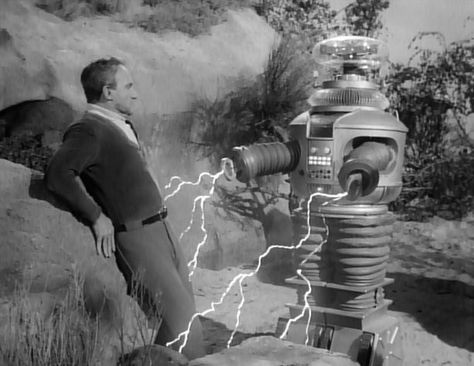
Photograph of Lost in Space, the CBS-TV series 1965 – 1968               Jonathan Harris (as Dr. Smith) and the robot