Client Acquisition Tips

According to client acquisition coach and best-selling author Brian Hilliard (Networking Like A Pro [2017] with David Alexander and Ivan Misner), the most vital task for B2B service providers is to organize and articulate your company’s services in a way that makes it easy for prospective clients to understand what you do.  As the in-house marketing and sales expert, the Freelancer must create marketing messages and sales pitches that enable prospects to figure out how and when to work with you.

Yet the unfortunate tendency is for Freelancers to present their services as all things to all people, preventing prospects from getting a handle on what you can do for them (and I’ve done this, BTW).  Casting a wide net may seem like a winning strategy, but in reality it often results in a bewildered and frustrated prospect who doesn’t know how to use your expertise—so they don’t. It’s essential to help prospects see solutions in your services if you expect to make sales and build a client list.  Getting specific is the way to do it, Hilliard says:

  • Promote your services to prospects with the motive and money to do business
  • Define your services using terminology and selling points that the prospect will understand
  • Demonstrate that you can deliver requested services and ensure desired outcomes
  • Price at a level that clients accept and also generates a good profit for you

In your next prospect meeting, when you’re asked “Tell me more about what you do?” give an example of how you’d implement the basic option and the premium option of a service that fits with what s/he might need.  Since you will have become specific, you can expect that your prospect will then become comfortable enough to reveal specifics about his/her reason for speaking with you.  When you hear the details, you can then provide  more precisely tailored versions of your basic and premium options.

Next, although it will take both courage and discipline, stop talking and let the prospect ask questions or provide feedback on your proposed solutions. Expect to be asked if you’re able to further customize a solution and of course you’ll gladly do so.  Whatever you can do to add value will increase your chance of getting the sale.

Finally, there will be the price negotiation.  Ask for the amount of the project budget, to increase the chance that you’ll present an acceptable (verbal) estimate for your services.  If it seems to you that in order to provide the requested services your estimate might somewhat exceed the client’s budget, be willing to negotiate.  When you’ve shown the prospect that you can speak to and address what s/he needs, you’ll probably sign a contract and a new client will join your roster.

Thanks for reading,

Kim

Image: Isidor Kaufmann (1853-1921, Austro-Hungarian) A Business Secret, 1917      private collection

Want More PR? Show Them You’re an Expert!

Recently, I gave myself another try with what is probably the most effective PR service for business owners and Freelancers,  Help A Reporter Out . I originally signed up with HARO about five years ago, but quickly discontinued when I felt overwhelmed by the thrice-daily emails that arrived Monday – Friday to inform subscribers of 20 or so potential opportunities to be interviewed. The drill is, as soon as a topic that you can speak to with authority appears, you click the link to the reporter’s HARO request for an expert and attempt to sell him/her on your ability to provide quotable information.

You will compete with numerous contenders.  But if you keep at it, the odds are that you’ll eventually speak with a reporter and get your quote.  Mentions and appearances in newspapers, magazines, widely read blogs, podcasts, or television shows is effective marketing and branding.  Include the link to your quote or interview on all of your social media platforms and download the full text (not just the link, which can be taken down) in your press kit. 

A press kit is your brand’s portfolio of verbal, audio and visual demonstrations of your credibility.  A well-stocked press kit provides third-party verification of your stature and expertise.  Whenever you reach out to the press, send a link to your press kit (remember to include your bio and photo).  If you take a booth at a trade show, bring along hard copies of your press kit.  When courting an especially desirable client, send a link to your press kit for his/her review, as a confidence builder.

When approaching journalists at HARO as they seek insights from trustworthy experts to add credibility to an article they have in development, or if you send out press releases to inform your local media of some newsworthy achievement in your business or professional life (perhaps you’ve just signed an especially prestigious client?), it’s essential that you present yourself as an authority in your industry whose story will interest the readers of the publications that you pursue.  Review your PR-worthy attributes and make sure that they’re up to snuff:

Experience and track record

Longevity in business is considered a sign of success, experience and credibility.  If your client list includes one or more high-profile clients, that enhances your presumed expertise.  If you author a blog or newsletter that has 5000 or more subscribers, that is another strong selling point that often persuades reporters to interview or quote you.

In fact, reporters will hope to attract many of those followers to his/her article when you provide the link to the item in which you are quoted.  Freelancers who’ve built up big online followings are always attractive media sources.

If you can produce links to articles in which you’ve previously been quoted or interviewed, that evidences the approval of fellow journalists and you will be well-positioned to receive more media mentions.

Enviable sales revenues

Are you a million dollar consultant (or close to it)? That’s an attention-getting descriptive  and it ensures journalists of your business acumen and therefore, credibility.  Journalists will be delighted to interview you.

Impressive credentials

If you’ve earned the scholarly degree of Ph.D, M.D., Pharm.D or Esq. in your chosen field, you will quite readily be able to present yourself as an expert.  Alternatively,  if you’ve earned one or more respected certifications in your field, you may advertise yourself as an expert in that field.

If you own (or share) a patent for a product or process that you’ve invented or co-invented, you may as well claim that you are an expert in your industry and you can do the same if you teach a subject related to your industry at the university level, especially if you teach at an Ivy League or other large institution.

Your book

If you’ve authored a book, whether an industry “how-to” or the story of how you overcame business or personal struggles to launch and sustain a successful enterprise, that will be a brilliant marketing tactic that will convince reporters of your authority.  Additionally, you can use your book to obtain speaking engagements and even teaching appointments.  Plan to self-publish and expect to pay about $5000 for editing, proofing, book text lay-out, cover design, printing and professional photography.

Awards received

If you’ve received a business award from a chamber of commerce, that is a noteworthy honor.  A service award from a Rotary Club, while it is an organization composed of business executives who perform volunteer service, is nevertheless highly regarded in the business world.  Awards and prizes that you’ve earned from national or local organizations will stand you in good stead as well.  Note all official recognition that you’ve received in your bio and curriculum vitae.

Judge awards

Five or six years ago, I was invited to become a judge in the Women in Business category for the Stevie Awards, an organization that recognizes achievement in the entrepreneurial, corporate and not-for-profit sectors in organizations around the world.  I hope to be invited to judge this year’s competition as well.  If you are a member of a business or professional group that presents awards, ask to join the awards committee.

Thanks for reading,

Kim

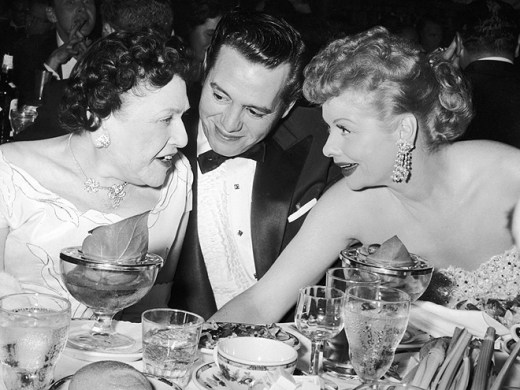
Photograph: Powerful gossip columnist Louella Parsons (l) with bandleader – actor – producer Desi Arnaz and his wife, actress Lucille Ball at the 1956 Golden Globe Awards in Los Angeles

Corporate Social Responsibility and Freelance Consultants

“We live in the era of the conscious consumer,” says Marco Scognamilio, global CEO of RAPP, the advertising agency based in New York City. “No longer content to separate their politics from their wallets, buyers want to know that the brands they’re supporting also stand for something.”

Freelance consultants and business leaders for the past decade or so have been encouraged by our customers and communities to disclose our organizations’ guiding principles and adherence to best practices and demonstrate our philanthropic priorities.  By the early 2000s, the term corporate social responsibility came to encompass not only standard business ethics, but also actions that promote some form of social good, as interpreted by the organization leaders.  It’s now common for businesses, in particular national and global enterprises, to take a public stand on social justice issues such as environmentalism and sustainability, public health promotion, civil rights and individual liberties.

Organizations large and small that operate in certain industries, most notably entertainment and fashion, are now well aware that publicly supporting individual liberties (that in some demographic segments are promoted as civil rights) is a must-do.  Activists are ready to quickly call out all who do not fall in line.

So it may be useful to evaluate how your organization can demonstrate some measure of your personal values as a way to show current and prospective customers that your purpose is not solely to make a profit, or even to do work at which you excel and enjoy, but also show your concern for the well-being of fellow citizens, wildlife, or the environment.

Kara Alaimo, Assistant Professor of Public Relations at Hofstra University in Hempstead, NY points out, “There’s huge demand right now for professionals who can teach businesses how to navigate these new consumer expectations and how corporations can  take stances on political issues and practice good corporate social responsibility.”

Hildy Kuryk, founder of Artemis Strategies, a New York City consulting firm that creates marketing messages for socially aware customers, so that consumer-facing companies can deepen their civic engagement and communicate their value story more persuasively, cautions, “What’s astonishing is that we’re consistently seeing major brands that can’t seem to apply basic principles to how to make decisions when they’re taking stances on political issues.”

I concur that wise organization leaders are advised to be circumspect when evaluating which social or political causes to publicly support.  Ms. Kuryk goes on to say, “In an unpredictable political landscape, brands need to be acutely aware and cautious (about) whom they align with.” No kidding.

But I trust her instincts.  If your company can afford the Artemis Strategies consulting fee, I recommend that you call her and commence the building of your organization’s social responsibility based marketing campaign strategy and messages.  Those who are not so flush are invited to spend another 5 minutes reading this post, at no charge, and make note of my respectfully offered observations and suggestions.

Declaring the values that guide your business practices will humanize you, differentiate you from competitors and make you less likely to be perceived as a commodity.  It’s smart marketing and effective branding.  So choose the causes that you’ll publicly associate with your organization very carefully and avoid the possible disapproval of current and prospective customers.  Keep what might be considered controversial in your private life.

Widely approved causes include libraries, Boy Scouts and Girl Scouts, working against hunger or homelessness, remedial education and raising money for research used to discover therapies that would eradicate or more effectively treat serious diseases.  I’m a board member at my local branch library and serve on the committee that selects local authors for our guest author series.  Previously, I’ve conducted “Dress for Success” and networking workshops for low-income women who were in a 20 week job training program and for several years I was a board member at an organization that transfers donated original art to sparsely funded social service agencies.

Find a cause that resonates with you and your leadership team and decide what your organization’s budget will allow you to donate.  Alternatively, it’s sometimes also possible to provide volunteer labor, where your employees spend a day assisting a not-for-profit agency to deliver certain services.

Publicize your organization’s involvement in social and philanthropic causes on your website, on social media, in the local business press and in your bio.  BTW, philanthropy can bring networking opportunities and it’s possible that you might meet your next client through volunteering.  You could do well by doing good.

Thanks for reading,

Kim

Photograph: Mohandas K. Gandhi (the Mahatma), leader of the campaign for independence in India, meets with Jawaharlal Nehru (l), who would become the first Prime Minister of India after independence from Great Britain, at the All-India Conference in Bombay (Mumbai), July 6, 1946.  © Associated Press

Competitive Intelligence: The Role of Social Media

To those who think you know all the ins and outs of using social media, fasten your seat belts.  If you created a LinkedIn profile at the turn of the century, started out with MySpace and later jumped to Facebook, became an early adopter of Vine and now work Snapchat, I have news for you.  Social media platforms are not just one-way PR broadcast channels that let you tell the world how brilliant and popular you are.  You can (and should) do some of that, but there is more.

Maybe you already do more?  You regularly use social media to encourage comments from customers about their experiences when doing business with your company.  You understand that social media is a two-way street.  But, still, there is so much more.

Social media can be effectively used not only for inbound and outbound marketing, but also for keeping tabs on competitors.  Social media is ideal for gathering competitive intelligence that can make you a smarter marketer, salesperson and business owner.  Here’s how.

First, determine who your competitors are, something that’s not always easy and obvious for B2B service providers.  Discover who your competitors are by meeting them.  The most efficient method to meet your competition is to join a professional society, where you’ll meet fellow accountants, life science marketers, event planners, etc., or join one or more chambers of commerce.  In four or five visits, you’ll meet a good cross-section of peers who do what you do, or something very similar.

Make it a point to talk to these people. Get to know them somewhat and exchange business cards, for they are not your enemy.  In fact, they can probably give you some valuable advice.  You should be willing to share a pearl or two of wisdom with them in return, as long as you don’t give away any proprietary information.

Once their business cards are in your possession, the second thing you’ll do is set up Google Alerts, so you’ll receive notice of their company’s print or online mentions, at no charge.  Whatever your competitors choose to publicly announce, you’ll quickly know.  It will be so enlightening to have the PR of competitors delivered directly to your inbox.

You’ll learn who will keynote at a conference, who will moderate or serve on a panel, who’s released a new product or service, who gets quoted in local or national press, or who will teach as an adjunct professor this semester.  Discover who’s quoted you, or if there are sites linking to your website or blog.  Monitor the content marketing of competitors (e.g., blogs and newsletters) and assess the perspectives and even the expertise of those whom you’re working against.

You can also receive alerts for your own company, to reveal what others are saying about your enterprise.  You’ll learn whether you have supporters who give you compliments in newsletters or blogs, or if someone is undermining you on social media.  Use competitive intelligence to shape your response and support your reputation management.

Regarding the successes of competitors, there’s no mandate to imitate what they do and that’s all to the good.  Be yourself.  But what you learn may inspire you to take, or not take, certain actions based on information you’ve gleaned from the three or four competitors you select to follow.  Set up a Google Alerts account to track key words and phrases and you’ll be happy that you did.

You might also try Hootsuite, a paid service, and use it to search podcasts and webinars by topic and engage in social media listening, for less than $20/month.  The primary role of Hootsuite is to allow users to write posts and manage all of their social media accounts from one site.  Those who are active on multiple platforms find Hootsuite very convenient.  Plus, the analytics reports included with the service reveal which of your social media tactics and strategies are worthwhile and which need rethinking.

Finally, if you can budget $80/month, then take a deep dive into your competitors’ content marketing activities with BuzzSumo.  Examine which content is getting traction for competitors, the shares competitors’ content receives and how your company’s content stacks up in comparison.  It’s possible to receive an update each time selected competitors publish content and you’ll also be able to compare the overall performance of your company’s content with that of competitors.

Thanks for reading,

Kim

Image: His Master’s Voice (1898), starring Nipper the dog, by British painter Francis Barraud. In 1901, the painting became the logo of what would eventually become RCA Victor.  EMI, JVC and HMV (His Master’s Voice) have also owned the logo rights.


Exit Loyalty, Enter Relevance: The New 5 P’s of Marketing

Which quality best supports and encourages B2B buying decisions? In the 21st century, that quality is relevance.  According to a recent survey by Kantar Retail Consulting, whose North American division is based in Boston, MA, 71% of B2B and B2C customers feel that loyalty-incentive marketing promotional programs do not cause them to feel more loyal toward a company.  It has become evident that regardless of your industry, customers are doing business with you based on the perceived relevance of your products and services to their needs and priorities.  Attempting to buy loyalty with discounts, rebates, rewards, or swag bags is not as effective as it used to be.

A 2017 study by the global consulting firm Accenture found that U.S. businesses lose $1 Trillion a year in annual revenue to competitors because their (former) customers no longer consider them to be relevant.  The study results appear to indicate that to succeed, businesses must be perceived as fulfilling customers’ immediate needs as they occur. Personalization is helpful, but it is best applied in support of relevance.  The authors recommend that companies structure the customer experience  to deliver as does a butler or concierge.

So how do business leaders navigate the paradigm shift? Joshua Bellin, Robert Wollan and John Zeally of Accenture recommend that organization leaders move on from the former gold standard of marketing, the 4 Ps—Product, Place, Price, Promotion.  No disrespect to the 4 Ps, they served companies well for decades, but customer behavior and expectations have changed over the past 10 years or so.  The 4 Ps are unfortunately rather narrow and product-focused for our times.  Today, it’s about delivering customized solutions, especially for B2B customers.

Furthermore, a close reading of purchasing data indicates that the usual product-focused market segment labels, e.g., discount, luxury, or environmentally conscious consumers can no longer consistently predict purchasing choices.  The needs of all consumers, regardless of socioeconomic status and sociopolitical ideology, vary according to their immediate priorities and context.  In response, Zeally et al. suggest that companies expand their marketing guideposts to include these updated 5 Ps:

Purpose:           Customers feel that the company shares and advances their values.

Partnership:    Customers feel the company relates to them and works well with them.

Pride:                 Customers feel good about using the company’s products and  services.

Protection:        Doing business with the company makes customers feel confident.

Personalized:  Customers feel that their experiences with the company are always  tailored to their goals, priorities and needs.

The “what have you done for me lately?” mindset has replaced loyalty, to a large degree. Perhaps it’s a sign of the entitled and narcissistic culture in which we in the U.S. live.  Customer preferences are in constant flux. Short-term strategies and goals are often the norm.

Some companies are able to thrive in this environment, perhaps most notably the global retailer Zara, founded in Galicia, Spain. “Fast Fashion” is the guiding force.  In the 1980s, the company invested heavily in design, manufacturing and distribution systems capable of reacting to market trends very quickly.  As a result, Zara is on top of nearly every trend in women’s, children’s and men’s fashion and customers eat it up.  As of March 2018, there are 2,251 Zara boutiques in 96 countries.

Smaller companies and Freelancers cannot come close to being able to match the power of Zara, but it is possible to leverage relationships and personalization to encourage your current and prospective customers to share what is important to them and discuss how you can meet their needs today and in the future.  You probably already know that all too many of your customers will move on and do business with another company that seems to offer a better mousetrap without even discussing their needs with you first.  It is discouraging, I know.

The best defense is to be found in the 5 Ps.  Start with Personalization and move to Purpose, so that you can make it known that your company can advance the customer’s goals.  Segue next to Protection and use the trust that you develop to encourage prospects to feel confident about doing business with you.

Thanks for reading,

Kim

Photograph: Lurch (Ted Cassidy), the Addams family butler, in an episode of The Addams Family  (1964 – 1966, ABC-TV)

The Smart, the Talented and the Lucky

The fickle randomness of the phenomenon called luck fascinates me.  I wonder why luck seems to so often reward people who don’t seem to deserve its favor and punish those who are good and hardworking people.  Luck is maddeningly capricious.  Who among us has not worked and planned and calculated the possibility for the success of a certain project, only to have it fall through and at another time, be amazed at the success of another project that has been given only casual thought and little effort?

I know quite a few people who’ve been very, very lucky in life.  Some have made the most of their good luck and others have squandered it (but they still do sort of OK, because they are lucky).  I’ve noticed that other than a man with whom I worked for a number of years, who was often very lucky and acknowledged his good fortune, people who are lucky do not believe in luck.  They actually believe that they can make all sorts of wonderful things happen all by their lonesome.  Some tell me that they pray and their chosen Deity answers their prayers.  Some tell me that they visualize what they want to happen and so it is given to them.  Still others claim that they always plan carefully and their plans yield the expected results, nearly always.  Riiiiight!

What my fortunate friends do not realize is that the answer to a prayer can be “No,” that plans can fall apart because they often depend upon certain critical factors falling into place, that is, good luck is an unacknowledged ingredient of the plan; and that one can visualize a future that seems fully attainable, not at all grandiose and yet the process can yield nothing but daydreams and disappointment.

My lucky pals are as clueless as The Fool pictured above, because they can afford to be.  I have seen certain of them (metaphorically) ready to step off a cliff when the ground somehow rises up to meet them so they do not stumble.  In my life, when in a similar circumstance, I’ve been thrilled to see a nice bridge appear to rescue me, only to be horrified when it turns out to have been built by the folks who engineered the amazing bridge at Florida International University.  Sigh.

In a 2017 study conducted at the University of Catania in Sicily (Sicilians absolutely believe in luck and if you are Sicilian or Italian—yes, they are different!— you will know this to be true).  Alessio Biondo, Alessandro Pluchino and Andrea Rapisarda created a computer model of 1000 virtual people.  Some of the virtual subjects were given more intelligence, talent, or money and others less, in an attempt to simulate real life.  During a 40-year “career,” certain virtual subjects received “lucky events,” i.e., opportunities to boost their careers that their intelligence or talent could help them exploit.  But some were made to suffer “unlucky events” that took away some of their career advancement and money.  At the end of the 40-year “career,” the scientists examined the characteristics of the wealthiest virtual people.

The results showed that while intelligence, talent and wealth play a role in the achievement of success, those who rose to the top were almost always the recipients of “lucky events.” Lead researcher Alessandro Pluchino wrote, ” It is evident that the most successful individuals are also the luckiest ones and the less successful individuals are also the unluckiest ones.” The study also reinforced the validity of the Pareto Principle, known as the 80/20 Rule, meaning that 80% of the wealth in the virtual society wound up in the hands of 20% of the population, as it does in real-world societies.

That 80/20 distribution does not correspond with the distribution of intelligence and talent. “The maximum success never coincides with the maximum talent and vice versa,” noted the researchers. “Our simulation clearly shows that such a factor is just pure luck.”  Pluchino and his team showed this by ranking the virtual subjects by the number of lucky and unlucky events each experienced in their simulated careers.  The most successful individuals had the most good luck and the least successful had the most bad luck.

So now what? Do those who are short-changed by good luck just roll with the punches? I mean, these findings, although most likely accurate, run counter to the American can-do, Horatio Alger spirit.  One must take charge of life and never knuckle under to unfortunate events or unsavory people.

I suggest that the best way to bring good luck, or at least minimize bad luck, is to introduce Feng Shui, the ancient Chinese system, into your home and office.  Eight years ago, I wrote about exploring Feng Shui.  You can play catch-up here.

In short, start by cleaning and organizing your home and office.  De-clutter and organize because qi, good energy, likes order.  Give yourself a harmonious environment and you are almost guaranteed to feel more relaxed, less frazzled and more confident.  Because you will become more calm and centered, you’ll function more effectively in your professional and personal lives.  I think it could be successfully argued that you’ll be positioned to more easily recognize both potentially good and bad events along your path.  You can then gravitate to the former and avoid, or at least mitigate, the latter.

Feng Shui will probably not replace an overabundance of bad luck with good fortune, but you’ll most likely be able to grab whatever good luck crumbs come your way and that’ll be about as good as it’s going to get.

Thanks for reading,

Kim

Image: The Fool, from the ancient tarot card deck. In a tarot card reading, The Fool represents one’s potential and abilities and also new beginnings.  He is young, lucky, light-hearted and blissfully unaware of potential limitations and danger.

Save the Sale You Might Lose


  1. No urgency to get the deal done

SYMPTOM:  The prospect will not engage in a serious discussion about buying your product or moving forward with the alleged project you hope to work on. Probing questions about the product, or about the solutions your service would provide, are deflected.

TACTIC:  Look for a way to take an advisory role.  Surely you’ve been given some information about the client’s reason for speaking with you? Build on it.

If the prospect has no questions, then you propose them.  Start by asking if the project/ need, or something similar, was previously addressed in-house or by another vendor?  Find out what was done in that instance and the outcome—could that solution be implemented in this circumstance ? Are there certain refinements and customization of product specifications or services that the prospect  would find potentially useful this time around? Point out how you can fulfill those expectations.

Your goal is to spark some interest and get the prospect’s wheels turning to envision how you can deliver what is needed and concluding that you should be awarded the sale.

2.   No firm project deadline

Early in conversation with a prospect, it is advisable to inquire about the timeline.  It’s often safe to assume that conversation is taking place because the need is immediately urgent, but that is not always the case.

SYMPTOM: Sometimes, clients will contact a Freelancer merely to learn what types of services are available from an outside expert and how much these services cost.  Next year’s budget may be on the drawing board and the client is in no rush to fund a sale at this time.

TACTIC: Find out as much about the project specs as possible and offer the client a discount that is good for 8 – 12 weeks.  Give a 25% discount (or make it appear that you have done so!) for a project that is started within three months.

But if it becomes obvious that the prospect is not going to kick things off anytime soon, leave your card and walk away.  Stop wasting time.

3.   You’re not speaking with the decision-maker

SYMPTOM: You know or suspect that the person with whom you are speaking may not have the authority to green-light the project or sale.  It’s not uncommon to have an early conversation or two with a lieutenant in the company, but important deals are basically never negotiated by anyone but the C-Suite, Directors or VPs.

TACTIC: Show respect for the person you’re speaking with and ask if s/he is the decision-maker (you may be able to guess by the job title).  If the decision-maker is your contact’s boss, ask when the boss will join your meetings.  Suggest bringing the boss in by Skype or conference call, so s/he can directly ask questions of you and you can sell the person who  needs to be sold.  The boss will also be able to confirm the budget and any deadlines.

4.   Your price is too high

SYMPTOM: The prospect feels that your price is too high.  This complaint is often a smokescreen, or a bullying tactic.  Some clients make a sport of squeezing a small vendor on price because they enjoy exploiting others.  Other times, the client really does have a limited budget and can only afford to pay so much.  If the company is small, you can perhaps assume the latter and if your prospect is with a large organization, it’s probably safe to assume the former.

TACTIC: Ask what the budget is, then ask what the must-haves are re: the product or service that you would provide and then customize according to what you can afford to provide as regards your service or the product features.  Under no circumstances should you lower your price and offer the same level of service or the same product features.  Other options are to throw in value-addeds to sweeten the deal, or to offer an extended payment plan.

Thanks for reading,

Kim

Photograph: Street vendor, courtesy of Sofia Cristina Cordova Valladares (Mexico) on Pixabay

6 Conversation Starters for Your Next Networking Event

At last! You’ve been thinking about going to a chamber of commerce meeting for three years and you’re finally doing it.  The speaker will address a relevant topic.  The weather forecast is good.  You know where to park.  The only downside is that you probably won’t know anyone in the room.

You’re not shy, but neither are you keen on ping-ponging around a roomful of strangers, in search of your next client, or at least someone to talk to.  You have no fear of meet and greets, but wouldn’t it be great if you knew some conversation starters that can steer folks away from the usual sports talk and “how’s business?” Let’s learn how to sidestep mindless small-talk and get into conversations that can launch a relationship.

  1. What subject has your attention right now?

When you’re meeting someone and searching for ways to connect, this question can open the door to a discussion about business, family, extracurricular activities, a much-anticipated vacation, even home renovations.  The person to whom you put this question will light up and be happy to talk and you’ll be on your way to building a relationship.

2.   What are you looking forward to?

This question opens the door to the person’s hopes and plans for the future.  Again, this makes it possible to start a real connection as the conversation progresses.  You communicate your genuine interest in that person and what s/he feels is important.

3.  What’s the best thing you’ve done this year?

Or what’s the smartest thing, or the luckiest?  Here, the person gets to distinguish him/herself and has the pleasure of boasting a little bit.  You’ll get to know what s/he values and what makes him/her proud.  You’ll gain some insight into the person’s past in this question.  You’ll get to know what makes him/her happy and also one of the sources of his/her self-esteem.

4.  What’s your story?

I’m careful with how I pose this question, to avoid appearing as if I’m looking to invade boundaries.  Maybe showing a bit of humor when you ask will make it go over well? Now you’ll give the person you’ve just met a chance to do what most of us adore—talking about ourselves! Here, you allow your new acquaintance to take center stage and discuss his/her past successes or challenges, reveal how s/he has overcome obstacles or taken advantage of opportunities and share his/her aspirations by shedding light on the road ahead.

5.  What are you currently reading?

Jane Austen, Shakespeare, Edith Wharton, or Stephen King? Getting to know someone through his/her choice of books is wonderful.  You’ll learn something important about your new acquaintance.  It’s possible that s/he seldom read books and instead prefers business journals and blogs and watching a lot of movies. Whatever.

While in conversation, you may be pleased to learn that you both enjoy certain authors (and actors) and that opens the door to an engaging conversation and the perfect opportunity to build a relationship, business and/or personal.

6.  How can I be most helpful to you right now?

An offer to help your new acquaintance to take a step closer to achieving a goal or objective is the highest compliment that you can extend and demonstrates that you trust him/her enough to put your reputation on the line on his/her behalf.  The building blocks for a relationship are about to be put into place.

Thanks for reading,

Kim

Photograph: Rosalind Russell as party hostess extraordinaire Auntie Mame (1958). The film won Best Picture and Best Actress (Rosalind Russell) Academy Awards.


Become A Media Darling

Positioning oneself as a trustworthy expert is paramount and ongoing for B2B professional service providers.  Everything we can do to establish credibility and stand out in a crowded marketplace can add to billable hours, our reason for being. “The media,” meaning television, radio, magazines, newspapers, industry journals, podcasts and blogs, help us spread the word about our expertise to a wide audience.

Persuading media gatekeepers—editors and producers—to invite you to give a quote or become a featured player in a magazine or newspaper article, become a guest on a podcast, television, or radio broadcast, or write an article for a journal is not easy.  Many of your peers are vying to do the same.

Therefore, you must find ways to separate yourself from the pack and showcase your potential appeal and relevance to audiences.  Below are a few ways to make that happen. When reaching out to journalists, editors or producers, I suggest that you call first. Learn the name of the appropriate editor for your business category before contacting a magazine or newspaper.  Read a half dozen or so of his/her items and find out what s/he has written before you try to pitch your story.  If the response is positive, only then will you send your one-sheet bio and photo.

HARO

Help A Reporter Out will send to your inbox a boatload of emails every week, but you could obtain a few requests for quotes in exchange for the inconvenience.  HARO gives Freelancers and other independent business owners real opportunities to build  credibility through media exposure.  One will also learn how to build relationships with print and online media gatekeepers. You can eventually claim the title of expert and have the article clippings to prove it.

Social media and content marketing

If you’ve got 5,000 or more social media followers on at least one platform, or an impressive number of newsletter followers or blog subscribers, media outlets will pay attention.  Present your stats to the media gatekeeper when you get him/her on the phone and remember to include that info on the one-sheet bio that you’ll send, along with your photo, to media outlets.  Those with large social media and online followings know that your big following can boost their viewers/readers/listeners and that translates into additional advertising dollars.  It is a pathway to the short list of potential interview candidates.

Write a book

The barrier to enter the realm of book authors has dropped precipitously with the rise of self-publishing and cheaper printing costs.  Investigate self-publishing houses both local and national.  Find a topic and title that will grab your business’s target market and you’re on your way to becoming an author.

No matter what anyone tells you, hire an independent content editor to ensure the continuity and flow of your story and also hire a copy editor or proofreader to eliminate grammatical and spelling errors.  Your book is part of your brand, so it must represent you well.  You will be judged. A ball park budget for a 150 page book could be about $5000.  Write it off as a business expense, since your book is marketing collateral.

Make lots of money

If at least once in the past five years your business has grossed $1,000,000 (or close to it), then go ahead a lay claim to the fact that you’ve built a million-dollar business.  OK, so maybe you’ve grossed only half of that and it’s too much of a stretch to put yourself into the million dollar category.  But if indisputably you’ve created a very lucrative business, then speak up.  Media outlets will want you to tell their readers/viewers/listeners how you did it and how they can do it, too.

And the winner is…

Formal recognition of your success as an independent business professional is very powerful.  Nominate yourself for a chamber of commerce award, neighborhood business association, professional association, or any other business award that is presented somewhere.  If you win even third prize, then spread the word by adding the photo of you accepting the award to your preferred social media platforms and send a press release and photo to the business editor of local newspapers.  Add this information also to your one-sheet.

Judge a business award

About five or six years ago, I was invited to judge The Stevie Awards/ Women in Business category.  That I’m qualified to judge the expertise of my peers has impressed a couple of decision-makers.  There are many business awards being doled out.  Join a professional association and get yourself on the awards committee.  Add the judging duty to your LinkedIn page and media one-sheet.

Thanks for reading,

Kim

Photograph: In 1955 Dr. Joyce Brothers, pictured with Boxing Commissioner Eddie Egan (her big question was about boxing), became the only female grand prize winner on “The $64,000 Question” (1955-1958). Brothers parlayed the win into a long and lucrative television career, which began in 1958 with a show on which she dispensed advice. She went on to take guest roles in dozens of TV shows and appearances on talk shows.

Coaching Guide

Have you ever worked with a business or life coach? I worked with a business coach as I built the foundation of my consulting practice and the experience was useful.  When a significant life goal is on your agenda and you’re unsure how to achieve it, or you recognize that you’ll need some expert assistance to help you make a plan, consider checking in with a business coach.  Also, if you find yourself thwarted as you attempt to move forward in life and achieve goals that you find meaningful or essential, but now you’re stuck and at a loss for a remedy, seeing a skilled business or life coach may be beneficial.

If you’re not the type of person who feels comfortable sharing intimate information in a counseling situation, or if the necessary time or money are restricted, it’s possible to coach yourself.  The ability to coach (yourself or others) to success is a powerful professional development skill.  We’re all capable of giving ourselves and others a pep talk.  We’re all capable of creating a list of goals, with timetables for completion.  We are also capable of asking ourselves eight insightful questions that when we answer them truthfully can help propel us out of a rut and put us on the path to achieving our most treasured goals.

The Difficult and Troubling Situation Exercise questions below were developed by Jack Canfield, corporate trainer, motivational speaker and author of The 25 Principles of Success  (2007).  You can use the questions to either self-coach or partner with one or more friends or supportive colleagues and conduct a group coaching session.  When a question is asked, answer thoughtfully and honestly, but without elaborate explanations or equivocations.  Let the questions do their work.  What is the difficulty or troubling situation in your life?  How and when will you overcome it?

  1. What is the problem or troubling situation?
  2. How are you contributing to the problem, or allowing it to continue?
  3. What are you pretending not to know?
  4. What is the pay-off for maintaining the status quo, for keeping things as they are?
  5. What is the cost of not changing the situation or your behavior?
  6. What would you rather be experiencing in your life?
  7. What actions will you take and what requests will you make to bring the conditions or experiences that you want into your life?
  8. When will you take those actions and requests for guidance or support?

Question 1 asks you to state the problem, or if working alone, to write it down.  Admit the problem or obstacle out loud or in writing.  Acknowledge that you have a troubling situation on your hands—a roadblock or obstacle, a significant disappointment, or a run of bad luck that is thwarting your desire to attain certain goals and live a life that would make you happy and proud.

Question 2 asks you to accept responsibility for the existence of the problem, or  ignoring it, perhaps enabling it and at the very least, prolonging it, or allowing it to continue.  This question helps you pull the plug on playing the victim, poor pitiful me.  If the roadblock or bad luck in your life remains there for a while, it’s likely that you’ve played some role in bringing it there or keeping it there.  Here is your mindset switch.  Let yourself know that just like you’ve allowed this obstacle to appear or linger, you can remove out.  You have know-how and power.  You are not incompetent and helpless.

Question 3 shakes loose the denial that surrounds your difficult situation.  In every seemingly intractable problem, it’s likely that s/he who is mired in the mess is pretending not to know why the matter exists.  So if your daughter hasn’t spoken to you in 5 years, don’t pretend that you don’t know why she’s cut you out of her life.  It’s just that you find it inconvenient to admit to yourself that you know.  You find it easier to hide your head in the sand and deny what you know because if you admit to yourself that you know, then you’ll have to do something about it—and you’re probably afraid to do that.  There is some seemingly greater difficult situation that you’ll need to confront and resolve.  Oh, no!

Question 4 requires that you recognize and catalogue the benefits you receive from allowing the roadblock to remain in place, for the problem to fester.  Maybe you run from responsibility?  Do difficult conversations make your skin crawl? Might the probable solution to your obstacle cost more money and/or time and commitment than you think you can muster, or cause you to stand up and take charge of your life in a way you fear you cannot?

Returning to school to earn an advanced degree or certification is daunting.  There are classes to attend, exams to take, papers to write and all are uniquely costly, in some way.  Ugh, why do that when you can go shopping when you feel frustrated about not advancing in your career? Shopping is fun and so is going out drinking with your friends.  Many of us prefer to just settle in and become “comfortably uncomfortable,” as my late friend Chris Nieves used to say.

Question 5 compels you to calculate the losses that have piled up as you allow the problem to continue,  through your lack of action— a stunted career, diminished income, an apartment that’s not in the part of town that you’d rather live,  the inability to provide certain extras for your children, an estranged relationship?  Refusing to act has  consequences.

Question 6 urges you to love and respect yourself enough to envision the things in life that would satisfy you—a fulfilling relationship with a worthy significant other, a home that makes you feel comfortable, a healthy body, a business or employment that showcases your skills and pays you at a rate you find acceptable, the ability to travel.  What conditions or experiences do you want in your life? Verbally paint the picture.

Question 7 reminds you that the resolution to any problem or obstacle demands that you get out of your comfort zone and take action.  The action might require you to reach out and request physical help or advice.  It’s OK if you cannot take on the problem alone.

So if someone is violating your boundaries by doing any number of things that make you feel uncomfortable, then you must speak up and put a stop to that behavior and apply impactful consequences to those who disrespect you.

Question 8 requires you to establish reasonable target dates to move forward with your actions.  Develop a timetable, add milestones and chart your progress.  Success is waiting for you!

Thanks for reading,

Kim

Image: Telemachus (l) and Mentor (who in the coaching of Telemachus was actually the goddess Athena, who disguised herself as the wise old man). Illustration by Pablo E. Fabisch from Les Adventures de Telemaque (1699) a book based on Homer’s Odyssey by Francois de Salignac de La Mothe-Fenelon (France)