Create Your Crowdfunding Campaign

Crowdfunding has caught on among entrepreneurs in need of funding for their start-up ventures and numerous business incubators across the country now offer information on crowdfunding sources. Crowdfunding veterans know that the fundraising campaign is won or lost before the campaign goes live and that the most important decision a campaigner will make is to choose the most suitable platform for the business or project that will be funded. Please see my March 3rd post for a sampling of crowdfunding platforms.

To get an insider’s understanding of how a smart crowdfunding campaign is created and managed I spoke with Alice, a neighbor who is a documentary filmmaker. Alice said that she spent about 8 – 10 weeks, working about 4 -5 hours each day, to prepare for her campaign kick-off and another 4 weeks or so running and managing the campaign while it was live on Indiegogo. The post-launch phase was easier, focused on follow-up and updates.

To create her campaign, Alice asked a friend to build a 6 page campaign website, she filmed a pitch video (she is a filmmaker, after all) and developed a synopsis to further explain and “sell” her film concept. She even planned a small campaign kick-off party to encourage friends and family to participate on day one and create momentum and good results that often make the difference between reaching the fundraising goal or falling short.

Once the campaign was in motion, Alice estimated that she spent about 10 hours/ week on upkeep during the second, post-launch, month. This phase involved follow-up, consisting mostly of engaging updates and donor outreach on social media and in emails.

Keep at top-of-mind that your campaign is unlikely to succeed without a total commitment on your part. Think of crowdfunding as a full-time job while you’re driving your campaign goals. Leverage every relationship and marketing channel available to you. Crowdfunding campaigns are a lot of work but if you build it right, you can possibly meet and or even exceed your funding target. 

Storytelling

Help potential funders understand how backing your product or business idea can benefit them. Tell them who you are, what you’re planning to do, where the project idea came from, what your budget is and why you’re passionate about it. Show that you’ve thought through your idea, which helps prove the legitimacy and credibility of your project. Communicating your story through visual imagery is particularly effective and many successful fundraisers create a 5 (or so) minute video.

Make sure to create an eye-catching campaign landing page image as well as a persuasive video pitch. The video quality must be good, your story must be clear and compelling and your product must shine. Show that you are knowledgeable and articulate as you clearly outline your concept and the benefits and demonstrate exactly how it works.

Connect emotionally by expressing your story in a way that helps potential backers to relate. Show and tell why your product is desirable and unique. People need to know what problem you can solve and why the solution will appeal to target customers. Be advised that your backers are of primary importance. When you show them that you care, they’ll be more willing to trust you and may even reach out to friends to share your campaign with them.

Funding goal

Research your business start-up or expansion costs. Prepare 12 month P & L and Cash Flow Statements, plus a Break-even Analysis, to confirm with confidence both your expenses and when you expect that sales will equal and then surpass expenses. Furthermore, be realistic about your fundraising potential as you estimate how many of your friends and family might be willing to donate. Based on that information, set your fundraising target. Alice predicted that while your campaign might attract the attention of new people, most of your support will come from those who know you. BTW, your fundraising goal cannot be changed once you’ve started the campaign.

The rewards

People will support your project if they think it’s worthwhile, but it’s always good to have interesting donor perks, since people expect a little swag. You might check out the Kickstarter Creator Handbook to figure out what you can and cannot offer, as there are some common restrictions that you’ll need to know. Also, be mindful as you structure your rewards in terms of price points. It’s fine to promise big rewards, but remember that delivery can take considerable time and effort.

Promoting and updating

Your Crowdfunding platform may have built-in tools that allows campaigners to update project backers and send messages to them and you should take advantage of these tools. Email marketing, your blog or newsletter (you might create either or both for the campaign) and social media can be effectively employed to spread the message about your campaign and its progress. Continually keep your project backers in the loop as you move forward with the campaign. Fail to share regular updates and you risk losing donor interest and that can result in a smaller donor pool. Be positive, yet transparent, in your updates. If things aren’t going quite as anticipated, let folks know.

Encourage product feedback

One of the most important things to do before starting a crowdfunding campaign is to run a beta-test and obtain some product reviews. Feedback is essential to making helpful product or process improvements before launching the campaign. You may have an amazing product or service, but that doesn’t mean it can’t become even better with a little extra work.

Deliver on rewards and promises

Your crowdfunding campaign isn’t over if and when you reach your funding goals. It’s over when you’ve fulfilled your promises. This means completing your project, delivering your perks or rewards and continually communicating with your supporters. Only when fulfillment is complete can you truly say you had a successful crowdfunding campaign.

Thanks for reading,

Kim

Photograph: ©Lai Afong, Hong Kong photographer and founder of Afong Studio, one of the first in China. Afong was considered the most influential Chinese photographer of 19th century China. His photograph shows men betting on and playing a game of Fan-Tan in Canton (Guangdong), China circa 1890s.

Crowdfunding for a Business

What do you do when you need money to either launch or expand your business venture and the bank won’t give you enough money? For many entrepreneurs, crowdfunding is the answer. Originally used to fund charity drives or creative projects like recording music or film making, crowdfunding is now recommended as a business financing strategy by organizations that support aspiring entrepreneurs.

That said, I remain skeptical. I understand the allure of crowdfunding—people will give someone money to finance a creative project or business venture and that person will, ideally, achieve the goal without taking on debt. In exchange for the financial support, the entrepreneur, in many cases, will promise to give backers a reward, or even a small equity stake (ownership) for certain investors.

But ask yourself—why would a total stranger contribute to a crowdfunding campaign for a start-up, unless it’s a not-for-profit venture and I believe in the cause and would like to support it? Well, some folks are just of a mind to be a part of someone’s success and that’s the best reward. However, campaigners are advised to align the reward offered with the project.

If the campaign will fund the production of a big special event, for instance, the campaigner might offer free admission, backstage passes, or even a chance to hop up onstage and jam with the band. For consumer products, the most obvious reward would be to provide backers with a digital or physical copy of the item in advance, or offer a purchase price that is far less than the typical retail value. Bear in mind that creativity pays: among the most consistently popular rewards are those that offer personal or unique touches, or provide singular opportunities, e.g, lunch with the founders or the inclusion of donors’ names in the new software product’s credits.

Since there is growing interest in the entrepreneurial community about this nontraditional funding source, I decided to research. Here’s the first half of what I learned. Next week, I’ll follow-up and examine how one might create a successful crowdfunding campaign for a business.

WHICH PLATFORM IS FOR YOU?

CircleUp—Best for fitness, food & beverage, technology

  • Campaign types: Equity, credit
  • Industry focus: Early-stage consumer brands
  • Funds you can keep: All or nothing
  • Funding fees: N/A
  • Payment fees (US): N/A
  • Startup locations allowed: Worldwide

If you’re an entrepreneur working to get your consumer product on the market, CircleUp offers an excellent array of services, including a platform for connecting with accredited investors, insights from machine-learning technology and access to special lines of credit for start-ups. Accredited investors must have a net worth of at least $1 million and earnings of $200,000 a year or more, per SEC regulations. In other words, the investors are quite affluent and capable of writing big checks.

While the focus is on early-stage companies, the platform is nevertheless best suited for more established start-ups looking to scale, rather than companies in their infancy.  CircleUp doesn’t charge any fees for friend and family investments and provides special access to funding through partnerships with Procter & Gamble and General Mills. 

Fundable

  • Campaign types: Equity, rewards
  • Industry focus: Healthy startups ready to expand
  • Funds you can keep: Whatever you raise for equity; all or nothing for rewards
  • Funding fees: $179 monthly subscription
  • Payment fees (US): 3.5% + $0.30 per transaction for reward campaigns
  • Start-up locations allowed: Must be headquartered in the US

Most crowdfunding platforms, whether equity or reward, take a percentage of funds raised. However, this platform just charges a flat monthly subscription fee. As long as you’re subscribed, you can create campaigns to raise money.

The flat fee makes it a great deal for many successful crowdfunding campaigns. The only problem is that campaigners must pay the fee whether or not one is successful. A failed campaign will lose you money, so Fundable is best for start-ups that have a high-potential business model.

But if you’d like a little extra help with your campaign, Fundable offers consulting services and will do everything from design assets to market your campaign. These consulting services do cost more than Fundable’s monthly fee; contact Fundable to obtain pricing.

GoFundMe—Best for not-for-profits and charitable causes

  • Campaign types: Reward, donation
  • Industry focus: People and causes
  • Funds you can keep: Whatever you raise
  • Funding fees: 0% for personal campaigns in the US; 5% for charities and countries outside the US
  • Payment fees: 2.9% + $0.30 per transaction
  • Start-up locations allowed: 19 countries

GoFundMe campaigns are donation-based and focus on not-for-profit start-ups and charities. If you operate a not-for-profit, or are trying to raise money for a cause, this is the preferred platform.

IFundWomen—Best for women entrepreneurs

  • Campaign type: Reward
  • Industry focus: Women-led businesses
  • Funds you can keep: Whatever you raise
  • Funding fees: 5% of all funds raised
  • Payment fees (US): 2.9% + $0.30 per transaction
  • Start-up locations allowed: 23 countries

Women entrepreneurs, who own a growing share of new startups, still face significant challenges in securing investment capital to get their businesses off the ground. iFundWomen offers a a solution to some of those challenges. The founders created the platform as a “fundraising ecosystem for women-led startups and small businesses.” It also provides coaching, marketing and other services for start-up owners.

Unlike some reward-based crowdfunding sites, iFundWomen lets campaigners keep whatever funds they raise. Of the money the site earns from funding fees, 20% goes back into supporting campaigns and services that benefit women business owners.

Indiegogo

  • Campaign types: Reward, equity
  • Industry focus: Tech and innovation
  • Funds you can keep: All or nothing; whatever you raise
  • Funding fees: 5%
  • Payment fees (US): 2.9% + $0.30 per transaction
  • Start-up locations allowed: Worldwide

A big plus is that Indiegogo allows campaigners to choose to structure either a fixed or flexible funding arrangement for your campaign. If you choose flexible funding, you still get the money even if you don’t fully reach your goal. Fixed funding is the same as all campaigns on Kickstarter. Reach your funding goal or the funds are returned to prospective backers (see below). Either way, campaigners must deliver the equity and/or rewards that you promised to supporters.

The site has millions of visitors and the traffic can, in theory, be great for your campaign. If you get featured in your category, your project will be exposed to a ton of people and possibly bringing in many backers. The problem with the mega-sites is that it’s difficult to get featured and your campaign can easily get lost in a sea of other aspirants.

Kickstarter

  • Campaign type: Reward
  • Industry focus: Creative arts
  • Funds you can keep: All or nothing
  • Funding fees: 5% of successful campaigns
  • Payment fees (US): 3% + $0.20 per pledge $10 and over; 5% + $0.05 per pledge under $10
  • Start-up locations allowed: US, UK, Canada, Australia, New Zealand, the Netherlands

Red alert people! Kickstarter campaigns are all or nothing. Meaning, if you can’t meet or exceed your funding goal, all the money is returned to your prospective backers. You had better know that you have enough check-writing friends to get your campaign to the first milestone and that the strength of your project, supported by a very compelling marketing outreach, will carry you across the finish line.

On top of that, the platform is highly competitive and carefully selects the projects allowed on the site. You cannot fund just any business on Kickstarter—you must “create something to share with others.” Your project also needs to fall under one of site’s curated categories, such as arts and crafts, fashion and design, film and photography, games, and technology.

Moreover, investors will expect some type of reward, so you’ll need something of value for the swag bag you must distribute to investors (and you must categorize rewards by their value, to correspond with the amount of donations). So if you’re trying to scale your Public Relations business, what might your reward be—3 years of free press releases? I dunno.

Kiva—Best for micro-loans

  • Campaign type: Debt
  • Industry focus: Startups interested in microloans
  • Funds you can keep: All or nothing
  • Funding fees: N/A
  • Payment fees (US): N/A
  • Start-up locations allowed: United States

If you will accept taking on debt, this not-for-profit style platform could be your most affordable option. Successfully funded Kiva campaigns give your start-up a 0% interest loan, the best of all borrowing options.

The loan must be repaid, but there are no funding or payment fees for you to worry about. Since Kiva requires that you prove your social capital by kicking off your campaign with donations from family and friends, that means convincing people you know to fund your business—but were’t you going to do that anyway?

Note that Kiva loans top out at $10,000; this is micro loan territory. But if you want affordable debt crowdfunding for your small fundraising goals, Kiva’s worth a look.

Publishizer

  • Campaign type: Equity
  • Industry focus: Book publishing
  • Funds you can keep: Whatever you raise
  • Funding fees: 30% of money raised
  • Payment fees (US): 2% – 4% per PayPal transaction
  • Start-up locations allowed: United States

Not all crowdfunding sites are giants, as are GoFundMe, Indiegogo and Kickstarter. In fact, most are smaller, niche-specific platforms, such as Publishizer, which was designed specifically to help authors crowdfund their books. Authors can certainly still use Kickstarter or Indiegogo, but this platform gives the benefit of having a specialized audience that supports authors and books.

Republic

  • Campaign types: Equity, reward
  • Industry focus: Start-ups with a focus on diversity
  • Funds you can keep: All or nothing
  • Funding fees: 6% for the startup + 2% Crowd SAFE fee
  • Payment fees (US): 3.5% per transaction
  • Start-up locations allowed: United States

As an equity-focused crowdinvesting platform, Republic is the new kid on the block and with it’s highly selective curated selection of companies, it’s not for everyone. But for growing U.S. companies with large revenue potential, Republic’s 95% success rate for selected campaigns make it one of the most enticing platforms for connecting with willing investors. Furthermore, Republic also looks for organizations with diverse founder teams.

SeedInvest

  • Campaign type: Equity
  • Industry focus: Technology startups
  • Funds you can keep: All or nothing
  • Funding fees: 7.5% of successful campaigns + 5% equity fee
  • Payment fees (US): $0 paid by the startup; 2% paid by the investor
  • Start-up locations allowed: United States

Founded by MBA graduates and experienced investors, SeedInvest started as a way to give technology startups access to capital from people willing to make sizeable equity investments.

To start, you need at least a minimum viable product or prototype, proof of concept and two or more team members. If you make the cut, you’ll get access to both accredited and non-accredited investors for campaigns starting at $100,000.

SeedInvest’s biggest drawback is its expensive 7.5% placement fee on all successfully funded campaigns. Still, the site has a growing base of investors and successful companies, as well as a positive reputation in the entrepreneur community.

I’ll be back next week with information on how to set up your campaign. Thanks for reading,

Kim

Photograph: ©David Cairns/ Getty Images. Roulette at the Playboy Club in London, England early 1960s

Press Release: To Send or Not to Send?

I’m impressed! You have news that you’d like to share with the world, with a particular emphasis on those who are potential clients and referral sources for your business venture, and you are sophisticated enough to think outside the box in an old-school way and consider sending—-ah ha!!—a press release. Yes, a press release remains a relevant tool, the standard route to media outreach.

While most everyone else chooses to make big announcements by way of social media you, sophisticated Freelancer friend, understand the reach and power of traditional media outlets, be it radio, neighborhood newspapers, or digital-format regional business magazines. Social media is great outreach but there are times when you want to get beyond your followers and obtain third-party support that implies objectivity and real world legitimacy.

Be aware that a press release is a marketing and sales tool. The idea is to communicate a message to customers and prospects through the vehicle of a print or online article, adding the authority and credibility of the publication to the message.

Before you go online and remind yourself how to write a press release—Who, What, When, Where, Why and How—first ask yourself these two questions and follow a couple of pointers. These may sound stringent but they’ll help you make a rational decision regarding media outreach for your organization.

  1. Am I newsworthy? Do you or your company that regularly receive media attention? If so, then you are newsworthy. Press releases by larger, established, household-name companies receive more attention than smaller companies and startups. Have you or your enterprise received any media attention at all? If so, that puts you at an advantage. Or, have you served on the board of your local chamber of commerce, library, or neighborhood business association? Are you a long-term and active member of a neighborhood group, school, Rotary Club, or place of worship? In other words, are you well-known in your community and can you leverage your renown to persuade an editor or reporter that you have sufficient name recognition among the media outlet’s readers or listeners that would motivate them to learn more about you?
  2. Is my story/announcement news? To get your message communicated through the publication, you’ll need to convince a reporter or editor that your message (or the story surrounding it) is newsworthy. Your story must have the potential to appeal to the readership of the publication, or listening audience if podcast or radio. So if your goal is to fill seats at a conference, don’t send a press release. The most important element of a press release is that it’s helpful to reporters, by offering them news of interest to their audience. Journalists don’t care to help fill seats at your conference.                                                                                                3. Write like a reporter   If your press release looks and feels like a real article, reporters will often just file it as a story with minimal editing. Therefore, it’s up to you to make sure that your press release looks and feels like a real news item. Avoid using business jargon.                                                     4. Call media outlets to confirm interest in your story Before sending a press release, call all media outlets on your wish list and ask to speak to the (business) appropriate editor or reporter. Do yourself a favor and read 3 – 4 issues to familiarize yourself with the types of stories that are carried and the names of reporters who cover your topic. Then, contact the reporters that you really want to cover the story. Mention that you’ve read their stories and name at least two. If you reach an editor, still make it known that you are familiar with other stories in your category.

Thanks for reading,

Kim

Photograph: (circa 1988) Phil Donahue (L) and candidate for president George H.W. Bush on The Phil Donahue Show.

How B2Bs Use Social Media

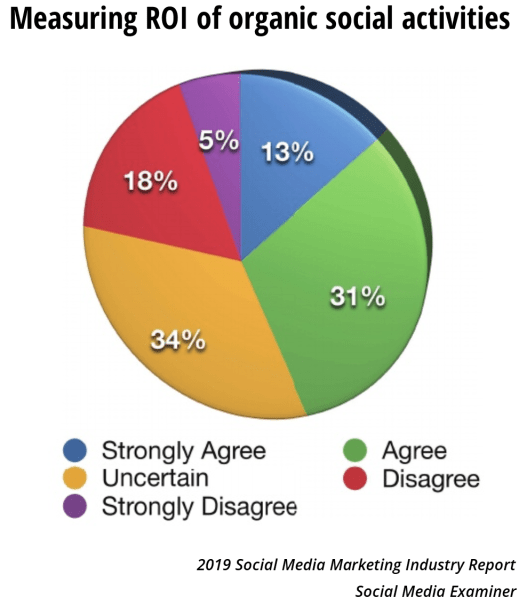
Take a look at the pie chart above. In response to the question, “I am able to measure the return on investment (ROI) for my organic social media activities,” only 44% of marketers in a recent survey that examined the use of social media in the B2B and B2C sectors agreed they were able to measure the performance of their organic social activities. This challenge has plagued marketers since the format appeared. Social media marketing is now included in most marketing strategies, yet a demonstrable ROI still eludes many. In my experience as a Freelance marketing professional, business owners and leaders still haven’t figured out how to effectively use the medium, measure its success or, for that matter, establish reasonable expectations for its benefits.

The wrong platforms are used. Content doesn’t fit platform. Investments are made in platforms that customers do not follow. Postings, after an initial burst of energy, appear only erratically after four or five months. Most of all, in an effort to both save money and simplify, social media all-too-often becomes  the company’s marketing strategy, rather than one component of the strategy.

The 2019 Social Media Marketing Industry Report, released by Social Media Examiner, surveyed more than 4,800 marketers with the goal of understanding how they use social media to grow and promote their organizations. for the past five years, the top benefits derived from social media are increased exposure in the marketplace and increased website traffic. Company exposure grew to 93% (from 87% in 2018) and website traffic improved to 87% ( up from 78% in 2018). Lead generation increased to 74% from 64% in 2018 and, most importantly, sales rose to 72% from 2018’s 53%, solidly demonstrating that B2B and B2C marketers see positive results derived from investment in social media. https://www.socialmediaexaminer.com/social-media-marketing-industry-report-2019/

Facebook remains the number one social media platform for both B2C and B2B marketers, who together account for 94% of business use on the platform. When B2C and B2B are examined separately, however, LinkedIn takes the number two spot for B2B, at 80%, while the number two B2C pick is Instagram, at 78%. Facebook and Instagram were the top two favorites of marketers overall in 2018.  

YouTube is still the number one video channel for marketers (57%) and Facebook’s native videos hold second place (50%). When the survey separated B2C and B2B responses, B2B marketers were found to choose LinkedIn native videos, while B2C marketers preferred Instagram stories and Facebook native videos. 

Of the platforms marketers regularly use for social media ads, Facebook is far and away the number one choice but once again, when separating B2B and B2C, the results show that B2B marketers use more LinkedIn ads while B2C marketers favor Facebook and Instagram ads.

Now, let’s look more deeply into 2020. A serious contender, at least in the B2C space, will be TikTok, an already massive platform beloved by Generation Z and Millennials. Launched in 2016, the site has more 500 million + active users worldwide; over one million of its 15 second videos are viewed every day. In January 2020, Statista reported that 37.2 % of TikTok users are age 10 -19, 26.3 % are age 20-29 and 16.7 % are age 30-39.

TikTok now has a shopping feature called “Hashtag Challenge Plus” that allows users to browse products that are associated with a sponsored Hashtag Challenge, all without leaving TikTok’s platform. Customers have now spent $50 million on TikTok purchases and 42% of all TikTok revenue now comes from the USA.

Did someone say influencer marketing? In 2020 and beyond, it’s safe to say that global brands whose customers skew to tweens and young adults will seize upon TikTok to spread their brand voice, engage with audiences and attract younger consumers, the golden key to future sales.

Thanks for reading,

Kim

A 360 Degree View of Your Brand

I recently gave a talk on branding, a term that we know gets used quite a bit, but I wonder if Freelance consultants and business owners fully understand what a brand means and how the brand can be put to work in service of the business? It is vitally important to first, recognize certain identifying characteristics of the business, which need not be complex or unique, and then spin those characteristics into a mythology or a story, a brand narrative or creation story, that is then packaged and marketed as a brand, destined to become a powerful selling tool.

Depending on your business, you might even build a brand around your location. Maybe you own a restaurant, or a hardware store, in Idaho. Common impressions that Idaho natives and Americans in general have about Idaho—rugged, outdoorsy, resilient, folksy, friendly, mountainous, beautiful—can be used to build a distinctive and compelling brand narrative. The essence of Idaho can become a defining characteristic of the brand.

Other branding possibilities are grandmas recipes (restaurants), the size of the establishment (large and comprehensive or small and curated), the longevity of the business, the number of generations that the same family has owned and operated the business, prestige clientele, expertise in a niche market, or superb customer service.

The function of a brand is to communicate. The brand is the reputation of the business. What a business leader must decide is the primary message that should be communicated and how to articulate that message.

What can the brand tell current and prospective customers? The brand tells them what to expect when doing business with you and your company—the available products and services, that the business can be trusted to deliver what they expect it to deliver, for starters. Branding is about reassuring. Branding is about consistency, predictability, trust, dependability, familiarity, the customer experience and comfort.

If the business owner or leader does it right, the brand will become habit-forming and the list of repeat customers will grow. Customers will be motivated to refer their friends, family and colleagues to the business. They will endorse the business on rating sites like Angie’s List, Yelp and Trip Advisor.

When examining and/or refreshing the brand, remember that the brand is two-sided. There is the internal brand and the (better-known) external brand. The internal brand represents what the business owner and leaders feel describes the brand. The external brand is how the business is perceived by the public, i.e., customers. The internal brand is self-image and the external brand is reputation.

It’s easier to start the brand examination internally—what do you, business owner or leader, want your organization to be known for? What do you interpret as its competitive advantages? What do you see as the value proposition or distinguishing characteristics?

The external view can be assessed by talking to customers, whether the best customers or occasional users of the products or services. In both cases, it’s important to ascertain what has persuaded them to do business with you. What brought them to your establishment, how do they feel about the experience and was the problem solved or objective achieved? Who is motivated to do business with you again and why? Who will not do business again with you and why?

In this way, business owners and leaders can determine what customers and prospects consider to be the defining competitive advantages and selling points. Conversations, face-2-face or by social media, and customer surveys are among the useful ways to learn what makes a difference and keeps customers coming back—or drives them away. If something can be summed up in a clever tagline, so much the better. Most of all, the business must promote what customers value most and express that message in language and symbols that will resonate.

When the value proposition, i.e., the value that the products or services will deliver to customers, perceived competitive advantages and selling points have been recognized and articulated, the business owner and leaders can confidently spread the word by way of promotional channels that customers and prospects trust and put the brand to work for the business.

Thanks for reading,

Kim

Photograph: Dwayne Johnson, aka “The Rock,” whose approach to branding has both a physical and professional dimension.

The Hidden Codes of Body Language

On Monday February 10 at 6:00 PM I’ll give a 1-hour presentation on the basics of branding your business — or yourself! Find me at Staples/Government Center in Boston. Learn how to sharpen your image and tell your story in 2020. Please click the link and RSVP to attend. Free. (and I will work on my body language!) https://www.eventbrite.com/e/your-brandknow-it-own-it-work-it-tickets-92254605007

Kasia Wezowski, co-Founder (with husband Patryk Wezowski) of the Center for Body Language, a firm based in Antwerp, Belgium that teaches body language training and decoding to business executives and co-author (with her husband) of The Micro Expressions Book for Business (2012) says that non-verbal communication is powerful behavior that can accurately predict one’s success or failure. Wezowski claims her research has proven that decoding someone’s body language can predict the outcome of everything from presidential elections or one’s inborn potential to have an advantage when in negotiations.

The Wezowskis have studied successful leaders across a range of fields and they’ve identified several positions which their data indicates are effective and persuasive body language that will help you bring listeners around to your way of thinking. In 2013, they delivered a popular TEDx Talk How Microexpressions Predict Success.

The box—trustworthy and truthful

Early in the political career of former President Bill Clinton, he would often punctuate his speeches with big, wide arm gestures that had the boomerang effect of leading audiences to perceive him as untrustworthy. To help Clinton keep his body language under control, his public speaking coach taught him to imagine a box in front of his chest and mid-section that would contain his hand movements within it. Since then, “the Clinton box” has become a popular term in the public speaking field.

Hold the ball—commanding, dominant and in-charge

Gesturing as if one held a basketball between the hands helps the body signal confidence and control. Do this and the audience will feel that you, learned presenter, literally have the facts at your fingertips. The Apple Computers co-Founder Steve Jobs frequently used this hand position while delivering one of his legendary speeches.

Pyramid hands—calm and self-assured

When people are nervous, their hands often flit about and fidget. When one feels confident and in control, one is usually also calm and still. Help yourself to communicate this state of being by clasping both hands together in a relaxed pyramid. Many business executives employ this gesture, so beware of overuse or pairing this technique with facial expressions that may telegraph anger or contempt. The idea is to show that one is relaxed, not smug.

Wide stance—confident and in control

How people stand is a strong indicator of their mindset. When facing an audience, one does not want to slouch! Instead, stand in this strong and steady position. The feet are about shoulder width apart; knees are relaxed and not locked. The spine will be erect and the neck and shoulders will also be relaxed. Now the speaker signals that s/he has important information to share and that s/he feels confident. In a 2012 TEDGlobal talk Your Body Language Shapes Who Your Are, social psychologist Amy Cuddy sparked a sensation when she modeled this and other so-called “power poses.”

Palms up—honest and accepting

This gesture indicates openness and honesty.  Media impresario Oprah Winfrey makes frequent use of this tactic during her speeches. She is a powerful, influential figure who also appears willing to connect sincerely with audiences, be it one person or a crowd of thousands.

Palms down—strong and assertive, yet calming

The opposite movement can be viewed positively too—as a sign of strength, authority and assertiveness. Former President Barack Obama has often used this technique to calm a crowd right after moments of rousing applause in response to his speech.

Thanks for reading,

Kim

Photograph: © Christopher Simon Sykes/Hulton Archive. Ronnie Wood (L) and Mick Jagger of The Rolling Stones strike Gods of Rock n’ Roll power poses at Madison Square Garden in New York City (1975 on the Tour of the Americas)

Your Business Advisor

As I go about my life, I will sometimes meet the owner of a small to mid-size business who, when I say that I’m a Freelance business strategy and marketing consultant who works with companies that need a professional to solve problems and get the company on track to grow and become profitable, or achieve other important objectives, they tell me about a business goal or obstacle they’re wrestling with. They ask if we can grab a coffee and talk sometime soon?

The stories that the business owners share are familiar—marketing problems, especially social media and content marketing questions; cash-flow bottlenecks; how to best launch a new product or develop a niche market; branding; pricing; and how can we scale and grow the company? Maybe a consultant can help?

Hiring a Freelance consulting expert can be helpful. The right specialist will give business owners and leaders an unbiased “view from 30,000 feet” of the business, making it possible to pinpoint problem areas and recommend strategies that will guide the organization to growth and profit. A consulting specialist can be brought in to address nearly any business need, from accounting, management and marketing to selling skills, IT, operations and even telephone etiquette.

If you hire the right person, the consulting fee will more than pay for itself, and save or make money for the organization. Consulting specialists work only on specific, predetermined business needs and do not add to the company payroll.

“Consultant” is a generic term; there are at least four types. Business consultants have a specific area of expertise based on their work experience and educational background—strategy, marketing, branding, sales training and financial management are common specialties. Process consultants develop practical solutions to improve a company’s day-to-day operations and overall functioning. IT consultants solve problems for those who need help with technology, Artificial Intelligence, Blockchain, cloud, cyber security and the Internet of Things. Executive coaches are counselors who guide clients through a wide variety of business or personal challenges. Increasingly, executive coaches do not have business expertise; many are psychologists (PhDs). Here’s a seven-point strategy to ensure you get the most from the consultant you’d like to hire.

Ask questions

Interview a prospective consultant before you hire. Questions to ask include: “What is your experience in my industry or field? Can you describe problems similar to mine that you’ve handled? Can you offer me full confidentiality and represent me without conflict of interest with your other clients?”

Also, confirm that the consultant will regularly communicate with the company contact person and prepare periodic progress reports. Request a written proposal that spells out how s/he plans to approach the organization’s problem, the approximate time needed and the fee you’ll be charged. If the business owner approves, that will serve as the contract.

As you evaluate a consultant’s experience and skills, consider your working relationship. Do you like and trust the person? Do you have a good rapport with him/her?

Expectations

A consultant is an advisor, not a miracle worker. If your marketing campaign hasn’t increased sales for the past six months, don’t expect a consultant to turn business around overnight. If someone promises to do so, be skeptical. You want a consultant who is knowledgeable in your industry or field and can recommend a workable solution, which is often not a quick fix.

Job specs

The business owner must decide what tasks to pursue and commit that to writing. The more specific, the better. There can be no confusion about the assignment. Asking for a strategy to increase sales by 10 % within 12 months, or increase social media followers by 25 % in a similar time frame, will ensure that the consultant understands the expectations.

On your end

The business owner should anticipate the information and resources that the consultant will likely need to do the job. Consider what documents, metrics, history are essential, along with any office equipment, office space, supplies, or team members that can make the job progress at a smooth and efficient clip.

The money talk

Some consultants charge flat rates or bill by the hour, the day, or the project. Others charge a contingency fee, in which the amount paid is based on the results. For instance, if a consultant reduces business operating expenses by $10,000, s/he might receive 10 % of the savings as the total fee or as a bonus in addition to the flat rate. I estimate that the average full-time consultant charges $75 to $150 per hour.

References

Ask the prospective hire for three recent references—and call them. You want to know if the consultant accomplished what was promised within the agreed-upon deadline, if s/he communicated regularly and if the company would hire the consultant again. Ideally, the consultant will have worked for at least one client who operates a businesses similar to yours.

Contract

Prepare a written agreement (the project proposal referenced above will usually suffice) that clearly spells out the terms of the arrangement. Define the services to be performed, the starting and ending dates, the fee schedule and how it will be paid, milestones, expenses that the business owner agrees to pa, and services the consultant will provide. For contracts $10,000 or more, the business owner is recommended to ask a business attorney to review and edit/ approve the agreement.

Thanks for reading,

Kim

Photograph: © Paramount Pictures. Robert Duvall ([L]as attorney and advisor Tom Hagen) shares information with his only client, Marlon Brando (as family business CEO Vito Corleone) in the multi-Academy Award winning film The Godfather, Part I (1972).

7 Kinds of Business Financing

Is 2020 your year to launch a business, or is growth and expansion of your existing venture on this year’s must-do list? If so, congratulations and best of luck to you! I’m sure you’ve thought of the most advantageous way to obtain the required financing for your plans and we’ll look at some good options right now.

A study conducted by the National Small Business Association found that 19% of small business owners cite a lack of available capital as the biggest challenge to plans for future growth and 82% of businesses outright fail because of cash flow management issues. In preparation for borrowing, I remind you that financial institutions will evaluate your credit score, so make paying off bills and boosting your savings immediate priorities.

According to the 2018 Small Business Lending Index, big (national) banks approve 25% of loan applications made by small business owners and smaller (community and regional) banks approve nearly 50% of loan applications made by small business owners. So whether it’s your food supply or your money supply, keeping it local is a good thing, am I right? https://www.biz2credit.com/small-business-lending-index/january-2018

Line of credit

A business line of credit functions like a credit card and it’s available to borrowers with either good or less than perfect credit. Borrowers can be approved for a potentially generous amount of funding that can be accessed immediately. The application process to obtain a line of credit is usually quick, and many businesses receive approval in a day or two. Interest rates range from 7% – 25% and repayment terms are usually between six months and one year, (meaning that one cannot run a balance ad infinitum) depending on the business’ revenue and credit score.

Short-term loan

Pursue this type of loan to, for example, bridge cash flow gaps, stock up on inventory that is available at an attractive price, or take advantage of a lucrative business opportunity. Surprisingly, borrowers often don’t need a great credit score to be approved for a short-term loan and that can be an advantage. In fact, the borrower could use the loan to pay off higher-interest debt and improve the credit score. Furthermore, short-term loans tend to involve less paperwork and processing is usually fast, making funds available quickly.

Short-term loans must be repaid in rather a short amount of time, often in just one year, and payments are usually due weekly, not monthly. They also generally come with a relatively high interest rate when compared to other types of loans and loan amounts are usually capped.

Secured loan

Secured business loans require a specific piece of collateral, such as a business vehicle or commercial property, that the lender can claim if the borrower fails to repay the loan. Unsecured loans, on the other hand, are not attached to collateral. Personal loans, student loans and credit cards are common examples of unsecured loans. Unsecured loans have higher interest rates and stringent approval requirements, to ensure that lenders gets their money back. Secured loans are often easier to obtain and may also have a lower interest rate, because the lender has a guaranteed way to recoup money lost to default by selling the borrower’s collateral.

Because of the increased risk an unsecured loan represents to the lender, borrowers may be asked to sign a personal guarantee in order to receive approval. If the borrower defaults on the loan, s/he will then be personally liable for repaying it. While a creditor can’t seize business property under a personal guarantee they can legally claim the borrower’s personal assets, including bank accounts, cars and real estate, until the loan is repaid.

Another common method used by institutions to mitigate the risk associated with secured loans is by reserving the right to file a blanket lien against the borrower’s business assets. Most business loan terms include a blanket lien clause that allows the lender to claim and resell business assets to collect the debt.

Term loan

Term loans, also known as long-term loans, are best for business owners with great credit and who are requesting a big loan. They may not be a good option for those who are launching a new business, however, since lenders usually want to see a track record of success (evidenced by 3- 5 years of business financials) before taking on the risk. 

The term loan application process is lengthy. If the application is accepted, borrowers must pay a principal amount plus interest each month until the debt is paid in full. Term loans are most often used to buy real estate, acquire another business, remodel or renovate a commercial space, or support long-term business expansion.

Equipment loan

Owners of businesses large and small often need to purchase, replace, repair, or upgrade various kinds of equipment to process, manufacture, or produce their products and equipment loans are essential to this process. These loans can be a great option for start-ups as well as established businesses, and they can be used to finance nearly every type of business equipment, including company vehicles. Owners of new businesses can take advantage of an equipment loan because the equipment secures the loan, regardless of the success or failure of the company. Interest rates are often reasonable and will reflect the individual’s or business’ credit rating and financial picture.

Be aware that excellent credit is required for most equipment loans. In general, borrowers will be able to finance 80% of the total purchase price of the equipment. A down payment of about 20% is typically required for most small business equipment loans.

Borrowers with less than stellar credit should investigate the terms of leasing the desired equipment. Leasing typically does not require a down payment and that especially benefits businesses that have little or no available working capital. When a down payment is required, it is typically relatively small compared to what a traditional loan down payment would be.

Purchase order financing

To qualify for purchase order financing, the company must sell finished goods (not raw materials or product components) to B2B or B2G customers with profit margins of at least 15%. Start-ups can qualify for PO financing because approval is based primarily on the creditworthiness of, and borrower history with, those customers and suppliers. The chances of being approved are even greater if customers and suppliers are well-established, reputable companies.

PO financing can present a great opportunity for start-ups that receive lots of orders but don’t have the cash to fulfill them. In these cases, similar to invoice financing, the purchase order secures the loan. Once the business receives a purchase order from a customer, the lender directly pays the supplier to manufacture and deliver the product to the customer. Once delivery is accepted, the customer pays the lender. The lender then deducts their fees from this amount and pays the remainder to the borrower, which can be counted as profits. 

PO financing is a great way to help your business grow without taking on bank debt or selling equity in your company. If sales outpace your incoming cash flow, then purchase order financing might be a good strategy to fulfill big orders.

Invoice financing

Also known as accounts receivable financing or factoring, this loan allows Freelance consultants to survive slow-paying clients. Small and medium- sized businesses will be able to manage the increasingly common practice of “net 90” receivables payment that large companies impose on smaller organizations, in exchange for big orders.

With invoice financing, lenders advance to borrowers the value of accounts receivable, less a fee of perhaps 15%. The borrower will pay a weekly fee while waiting for the customer to pay up. Invoice financing helps businesses improve cash flow, meet the employee payroll, pay vendors and suppliers and reinvest in operations and growth earlier than they could if they had to wait for clients and customers to pay their balances in full.

Thanks for reading,

Kim

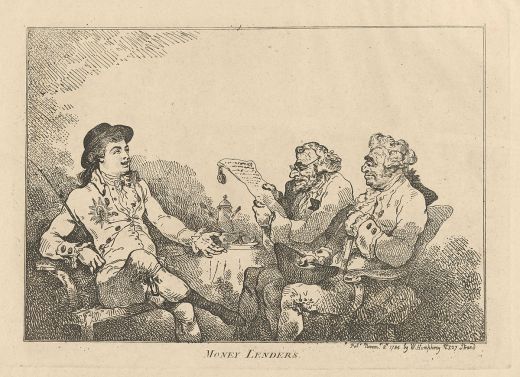
Image: Money Lenders (1784) an etching by Thomas Rowland. The aspiring borrower (L) is George, Prince of Wales (George IV 1820 -1830).

Paying You: How to Pay Yourself When You’re the Business Owner

Freelance consultants and business owners dedicate a considerable chunk of mental bandwidth to thinking about how to generate business, because the top line matters. We think a lot about making money, but we may not devote much time to thinking through the mechanics of paying ourselves once the money arrives.

Sole Proprietors and single person LLC owners may consider the self-payment process a no-brainer—as invoices are paid, one simply deposits the money into the business bank account. But like so may actions that seem easy at first glance there is usually a right way, a smart way, to pay oneself as a self-employed person.

So—are you on your business’ payroll or do you take payments from your business in the form of owner draws? Do you and your business partners take guaranteed payments (salary)?  Are you paying yourself too much or not enough? How can you tell? Also, where in your business financials are the payments recorded?

Business type Payment Tax return Payroll Tax

Sole Proprietor Owner’s draw         1040/ Sched. C     Yes                                

Single LLC Member draw 1040/ Sched. C Yes

Multi LLC Member share 1040/ Sched. K-1 Yes

S Corporation Dividend/ wage 1040/ Sched. K-1 Yes

C Corporation Dividends 1040 dividends not on dividends

Sole Proprietor

Business owners and Freelancers who adopt this, the default business structure, pay themselves through an owner’s draw, i.e., the amount of money taken from business earnings, after expenses and taxes, by the owner for his/her personal use. The payment is called a draw because money is drawn out of the business.

Sole Proprietors usually take draws by writing a check to themselves from their business bank accounts. Smart Sole Proprietors will then deposit that check into a personal bank account and avoid co-mingling business and personal funds, a practice that inevitably leads to accounting and tax complications. The owner’s draw doesn’t affect business taxes because the net income has already been taxed. The draw is also not a business expense. From an accounting and tax perspective, the owner’s draw is income distribution. Owner draws are recorded on the Balance Sheet.

Limited Liability Company (LLC)

LLC owners, who are known as members, are not (always) considered employees of the entity and therefore they do not (always) take a salary as would an employee. LLC members, especially single member entities, usually pay themselves with a member’s draw, which is taken from the member’s capital account (business bank account). Multiple owner LLCs are considered to be partners in the business and pay themselves with a member’s share distribution, also taken from the member’s capital account. 

While members may periodically draw from their capital account, a draw is in reality an early withdrawal of anticipated year-end profits, a goal that is perhaps at top-of-mind at multi-member LLCs. Whenever a member receives a draw during the year, his/her capital account decreases, but if the business shows a profit at the end of the year, the member’s capital account will increase in accordance with the percentage of ownership. If a member owns 25 % of the LLC, then s/he can expect to receive 25 % of year-end profits. Single member LLCs own 100 % of the entity and are entitled to 100 % of the profits. Member draws are recorded on the Balance Sheet.

A working member in a multi-member LLC has the option of either receiving a guaranteed salary amount as an LLC employee, or paying oneself with a member’s share distribution, as will a single member LLC owner. Members who are strictly silent partner investors and do not work in the business are not entitled to period draws, but will receive their member’s distribution of profits in accordance with their ownership percentage at the end of the tax year. 

The member salary, known as a guaranteed payment, is not based on the percentage split agreed upon in the LLC operating agreement but based on the work the member performs in the business. Unlike member distributions, guaranteed payments are recorded on the Profit & Loss (Income) Statement and are taken from business profits.

The LLC must be diligent about filing the correct tax forms on behalf of members and maintain accurate accounting histories for everyone throughout the year, to reflect member payment choices. Members paid as LLC employees must file IRS Form W-4 to calculate the amount of payroll tax withholding taken from from each paycheck. The member is then treated as a W-2 employee of the LLC. If the member is paid as an Independent Contractor, then s/he must file IRS Form W-9 with the LLC and the LLC must file IRS Form 1099-MISC by the end of the year. All member draws or distributions are deducted from the amount of profits assigned to the capital accounts, based on ownership percentages.

Corporations

An S Corporation is in reality either an LLC or C Corporation that has elected for special tax treatment with the IRS. S Corp income, losses, deductions and credits pass through to its shareholders’ personal IRS Form 1040. Shareholders then report the business’s income and losses on form 1040 and are taxed at their individual income tax rates. C Corps are subject to double taxation—a separate corporation tax and when dividends are paid to shareholders, that amount is recorded on IRS 1040 (but there is no payroll tax).

S and C Corporation owners who work in the business pay themselves a regular “salary” and also distribution payments. S Corp owners are usually employees of the business. Owners who work as employees must be paid a “reasonable salary” before profits (dividend distributions) are paid and the salary is subject to payroll taxes. The IRS has guidelines that define a reasonable salary, based on job responsibilities. Salaries are generally taken from business profits.

Owners of C Corps can elect to pay its shareholders a cash dividend, which is a distribution of company profits. However, the C Corp board may choose to retain either the entirety or some portion of business net profits and decline to pay a dividend in a given quarter or year. If a dividend is paid, that amount is added to income reported on the shareholder’s personal IRS Form 1040. The company records dividend payments on the Balance Sheet.

S corporation owners have been known to request that their corporations pay them little or no salary, since salaries are taxed, and instead take payments as dividend distributions, which are not taxed. The IRS has stepped up enforcement on this issue and in 2000 audited thousands of S Corps whose owner the IRS concluded had received a suspiciously low salary and very generous dividend distribution, in an apparent attempt to evade payroll taxes by disguising their salary as corporate distributions.

Thanks for reading,

Kim

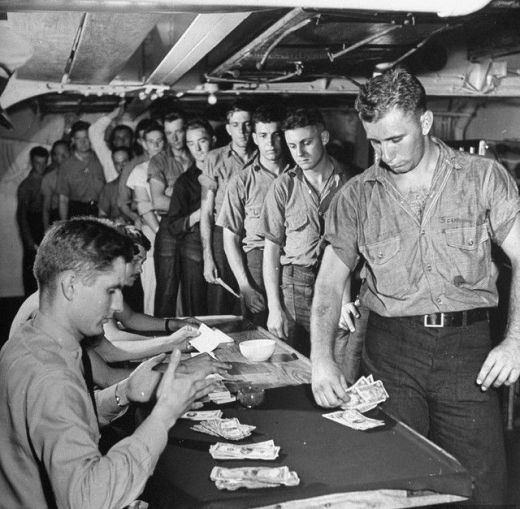
Photograph: Pay day on a U.S. Navy cruiser (1942)

Elevator Pitch: Master Class

Every Freelancer has an elevator pitch, but few of those pitches are as effective as they could be. My own could use some work, to be honest. Freelancers are hunters and we thrive only when we bring in clients who trust us with lucrative and/or long-term projects. Arguably, the most important facet of a Freelancer’s skill set is the ability to quickly assess whether that interesting someone we’ve just met might have the potential to green light our next payday.

Street smart Freelancers anticipate the opportunity inherent in every meeting by using our hunter’s instinct to take aim and expertly deliver an elevator pitch that gets bells ringing in the head of a listener. In the conversation that’s sure to follow, these Freelancers ask a handful of smart questions designed to quickly weed out window shoppers, tire kickers and those whose needs do not align with our skill set.

The hunt starts with the pitch and Freelancers must build it with precision and deliver it in 30 seconds. The biggest mistakes Freelancers make in elevator pitch content are: (1) merely stating their skill set or job title, rather than giving a brief description of the problems they solve for clients and (2) failing to communicate the value they provide, the practical application of their expertise, that makes a persuasive case for working with them.

Skills or functions?

“I’m Bob Rossi, a business lawyer who also edits a digital business management magazine.” The information is accurate but Freelancer Bob has not expressed what is uniquely worthwhile about his business, he has not presented a story or any information that might persuade a listener to take notice. Expecting his job title to interest the listener is unrealistic because that alone doesn’t necessarily help anyone understand why s/he should care who Freelancer Bob is and envision how his products or services might be useful.

Whatever your job title and skill set, there are most likely dozens, if not hundreds, of highly skilled professionals who do some version of the same thing. There are many types of lawyers and business writers in the world. The successful hunter-Freelancer knows how to present a tidy little narrative of an elevator pitch that puts the listener at its center. In this much more compelling version, the Freelancer succinctly (1) names his/her specialty— the kind of work that you do best or most often (or your most popular product)— and how you add value; (2) identifies the types of clients you usually work with; and (3) gives three or four examples of article topics that regularly appear in the magazine (marketing, sales, finance and tech, perhaps).

“Hello, I’m Bob Rossi. I help business start-ups solve their management and legal issues, including LLC, incorporation and partnership set-ups. I also edit a nationally known monthly digital business management magazine that addresses topics that are important to business owners, entrepreneurs and self-employed professionals, primarily finance, marketing, sales and tech.”

It’s critical to wordsmith an elevator pitch that will convince the listener to pay attention and, if your timing is right, think of how s/he can use your know-how and imagine bringing you into a project that needs to get done in the near term. A money-making elevator pitch can convert a listener into a prospect who wants follow-up, who will say “take my card and shoot me an email, or call me at around 5:00 PM on a Tuesday.”

Finally, like the old joke says, “How do you get to Carnegie Hall? Practice!” Nothing sounds worse than clumsy delivery of an elevator pitch. You will be dead in the water and the VIP will never give you a second chance. Like an actor or an athlete, Freelancers must constantly rehearse and refine the elevator pitch, working it so that it slides off the tongue effortlessly. Because we never knows when a fortunate encounter with a VIP will occur, practice your elevator pitch often. Edit and edit again, until the wording is perfect and the cadence natural. Learn to step up to the plate on a moment’s notice with confidence, energy and enthusiasm and hit a home run every time.

Thanks for reading,

Kim

Photograph: ©TV Guide. Deluca (Giacomo Gianniotti) delivers his elevator pitch to Meredith (Ellen Pompeo) in Season 15, Episode 9 of Grey’s Anatomy.