Trending: Remote Work

A recent survey of 500 + venture capital backed tech company founders conducted by the Kung Group, a San Francisco Bay Area organizational development consulting firm, revealed that the most prominent response employers have had to the coronavirus pandemic has been the launch of the work from home culture.

70% of Kung Group survey responders said they planned to allow some or all of their employees to continue to work from home when their office reopens.

76% of responders reported that their employees had either maintained or increased business productivity while working from home.

66% of responders plan to reassess their company’s future use of and need for office space, as a result of their company’s success with the work from home strategy.

The predictive value of the survey results has been confirmed by prominent technology companies, including Google, Facebook, Square and Twitter, indicating that a significant portion of employees will continue to work from home when the shutdown ends. Facebook projects that in 5 – 10 years, 50% of its employees will work from home.

Remote work is poised to become a defining feature of the early 21st century work place—-work from home, work from anywhere. The new normal for millions of Americans will not include returning to the office. Some employees are already considering a change in their living arrangements, as they contemplate trading cramped and expensive city apartments for houses in the suburbs, or even rural locales, where a home office (single or his & hers) can easily coexist with their personal lives.

Amid the enthusiasm for the shrinking of the corporate office, business owners and leaders would be wise to give serious thought to the practical functionality of the company. In particular, how to build cohesive and productive teams that theoretically might stretch from Ghana to Georgia to Goa?

Needless to say, exceptional communication and collaboration proficiency will be needed. For certain projects, companies may learn that face2face interaction produces the best results.

In support of that approach Apple has decided to continue the company culture of in-house collaboration and is in the process of moving 12,000 employees back into the Apple Park headquarters in Cupertino, CA. Even Facebook is hedging its bets on remote work; it’s been reported that the company plans to create hub offices in the (moderately priced) cites of Atlanta, Dallas and Denver.

But the question for readers of this column is, what will happen to Freelancers in the office space shake-up? It remains to be seen, of course, but there may be reasons for cautious optimism.

If so many team members are working remotely, we Freelancers may have a better chance of inspiring the trust and confidence of decision-makers because to a certain extent, a significant percentage of the workforce will operate in a similar fashion to Freelancers, with the exception of submitting a monthly invoice. Freelancers can much more easily position ourselves as another remote team member.

Furthermore, the shutdown encouraged businesses to re-evaluate many jobs and discover that an unexpectedly wide range of tasks can be performed remotely. The consensus is that most tasks relegated to employees working remotely have yielded satisfactory results. The expectations of their customers have been met.

So the outcomes of remote work have been demonstrated and it bodes well for Freelancers. As businesses recover from the shutdown and need more hands on deck to get things done, decision-makers will feel more comfortable about bringing us on board. Ka-ching.

Harshvendra Soin, Chief People Officer at Tech Mahindra, a multinational technology company headquartered in Pune, India, recently said, “We hire gig workers for niche or scarce legacy skills which are not immediately available internally.” Tech Mahindra has an AI based talent marketplace called Talex that identifies gig workers internally. Soin elaborated, “ We have built an external marketplace called Flex.ai, that allows employers to seamlessly tap into the Freelance workplace.”

Top Freelance skills in demand include business planning, brand strategy, cloud computing, data analytics, digital marketing and SAP implementation. Now you’re smiling.

Thanks for reading,

Kim

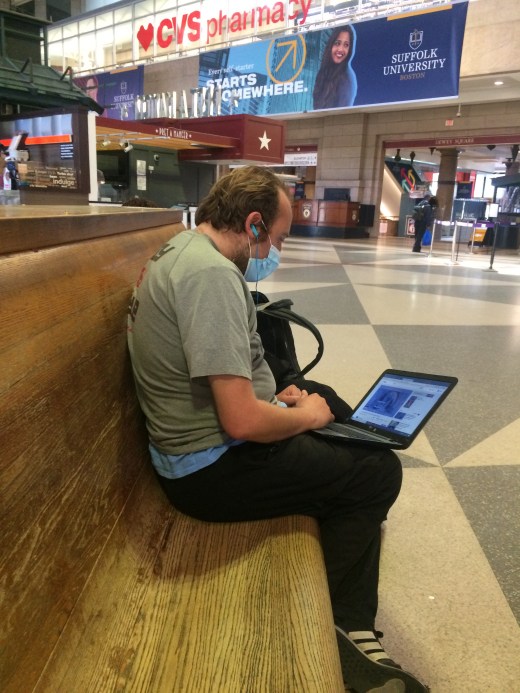
Photograph: A traveler passing through South Station in Boston, MA gets some work done remotely.

Moving Past Panic

Slowly, tentatively, businesses around the country are being allowed to reopen and at least partially end the COVID-19 shutdown that began in the U.S. in mid-March. Last week, houses of worship were allowed to hold services in some localities, with plenty of social distancing mandated by state legislatures. Restaurants in many cities and towns are now able to seat patrons for outside dining only, with tables spaced wide.

A theater company in the Berkshire Mountains of western MA, an area that for 100 years has featured high quality plays, music and dance performances during the summer months, is negotiating with Actor’s Equity, the powerful union, to get permission to hire actors and stage a production or two in July and August.

So we can finally shift gears from park to drive and the forward motion is a relief after 10 weeks of a mandated standstill. But do we know where we’re going now and how to get the show back on the road?

Businesses large and small are in agreement on at least one thing and that is, we cannot go back and pick up where we left off. It has been said that one never steps into the same river twice because it keeps flowing and changing before our eyes. In the post- shutdown world, those who lead a business must make some adjustments.

Reframe capabilities

Quite simply, business owners and leaders are now tasked with discovering and responding to how customers and prospects feel about and are inclined to use products or services in the reopening. How might your organization address the now reframed experiences and expectations of customers and prospects as they, too, emerge from the shutdown? How can you repackage what you sell? What should your marketing message be now? How can content marketing and social media tell your story in a way that resonates with today’s redefined customer experiences?

Reframe operations

It’s almost a given that you’ll have to retool. Must you change how you deliver services because so many of your clients’ employees now work from home? Are client meetings now videoconferences? Have you been invited to deliver a workshop virtually?

Communication with clients will be key as you learn how your organization can most effectively deliver the value of your products and services to the end user.

Reimagining how to deliver your services online is an operational paradigm shift that your company must make immediately. You must also make the delivery of your services frictionless and engaging, for maximum perceived effectiveness.

Reframe relationships

Relationships may be the most important segment of your organizational response to the new and evolving business environment. Without appearing to violate boundaries, position yourself to clients as a partner. Encourage honest communication and share information that could be helpful to clients. Be generous in your pricing and payment structures when necessary and possible for your cash-flow and revenue needs. Make referrals.

Thanks for reading,

Kim

Photograph: Kim Clark. The former Algonquin Club on Commonwealth Avenue in Boston has been reframed as The Quin, a private club set to open in Spring 2021.

Defensive Marketing

In sports and in business, well-planned and executed strategies and tactics are necessary to win the day. Some sports or business plays or strategies come from the Offensive side. Those strategies are proactive—-the opening salvo, aggressive and attacking, putting out a direct challenge to the competition.

Introducing a new product and all the activities related to the launch are an example of Offensive Marketing. One might also think of push marketing tactics, e.g., email marketing that announces a new product or service.

Your company is in expansion mode, perhaps entering a new market or geography and battling for the attention and support of new customers.

In contrast, Defensive Marketing strategies and tactics, on the playing field or in the board room, are designed and utilized to protect your turf. Tactics and strategies are reactive. When responding to an attack, whether it’s the other team positioning itself to chip away at your lead or a competitor cutting into your market share, assume a Defensive stance and take steps to protect what has been achieved. Position your entity to maintain or reestablish dominance.

When a Defensive Marketing strategy is required, the company objective is to retain clients and market share, to refine product positioning messages, strengthen customer relationships, or enact other reparative therapy. Crisis communications, i.e., the response to a public set-back or scandal, is a classic Defensive Marketing move.

Depending on what a business needs to achieve, marketing strategies that work from an Offensive or Defensive stance can be employed separately or simultaneously. In the coronavirus business climate, that our politicians seem inclined to prolong, Defensive Marketing rules the day.

Everyone is hunkered down, if not outright shut down. Nevertheless, those businesses allowed to operate are doing just that, even if employees are working from home. The companies have budgets. Some are hiring Freelancers.

Just because many companies have curbed their spending doesn’t mean that they don’t have a modest budget available for certain types of high-value projects, as owners and leaders define it.

Put on your thinking cap—-What might motivate your clients to spend money these days? Chances are they’re working hard to protect what they’ve built up over the months that preceded the shutdown. It’s likely that your clients are shoring up systems and resources and reaffirming relationships with their customers. Your clients are probably positioning their organization for long-term success.

The question is, how can we Freelancers package, describe and promote our organization to effectively communicate to current and prospective clients that we can assist their Defensive Marketing campaigns?

To predict how your services might fit into the picture, take time to think objectively about the client’s business and what could be considered logical long-term objectives that could reap benefits over the next 5 or so years.

Nurturing and promoting their most important, biggest selling products or services is a safe bet, as is protecting and/ or upgrading business continuity processes and also insurance, disaster recovery systems in nearly every stripe, from hardware and software to the physical plant. However, some organizations might go on the Offensive and begin making some surprisingly aggressive moves as they pursue customer acquisition.

Keep in mind that scaling back on what is considered spending on nonessentials should not be mistaken for the cessation of spending. The organizations could be merely reflecting the economic or political climate and allowing their expenditures to reflect the new normal.

Good customer knowledge and relationships, along with agility and adaptability, will support proprietors of Freelance consultancies as we respond to yet another set of difficult business conditions. Our clients are either thinking of what must be done today to get their business back in motion, or looking at how the distant future might look and how they can engineer safe passage. Defensive Marketing strategies will predominate.

Thanks for reading,

Kim

Photograph: Kim Clark. The Boston Common tennis court.

Rethink the Customer Experience

Well now this seems obvious, doesn’t it? Like the divide between BC and AD, the au courant paradigm shift is Before Coronavirus and After Coronavirus. Navigating life and business will change in ways that we cannot necessarily anticipate.

It is safe to assume that our clients are anxious to get back to the office and into the driver’s seat, to work on generating profits. But it’s probably also safe to assume that clients are uncertain about how to make things happen again.

In the After Coronavirus world, their reliable golden touch business model may no longer make the cash register ring. What were once considered business best practices may no longer apply. There may be new public health regulations to follow, such as the number of employees who can work on site at a given time, or the number of customers who can enter the premises, all in observance of social distancing.

Many businesses have lost a great deal of money as they simultaneously paid employees, rent, insurance, utilities, software licensing fees and other fixed expenses. The owners/ leaders are relieved that the doors are open again but there can be confusion about what “open for business” will look like now, at least in the short term. Added to the list of worries may be the possibility that certain employees might continue to work from home until further notice and the impact that will have on productivity, work flow and team communication.

In the After Coronavirus business environment, nearly every operation will undergo a shakeout and no one can predict the length of that period or the needs of the business as the new normal unfolds. As a result, the client experience that your organization has dependably provided will have to shift in response. The usual benefits linked to the usual client touch points have already lost their relevance and luster.

As noted in previous posts, trust, dependability and communication will be among your most valuable intangible competencies and may I also suggest that you add good listening skills to your toolkit? Listening, empathy, trust, dependability, flexibility, agility and big-picture thinking are the qualities and skills that will help you to help your clients rebuild. Listen actively and figure out your strategy.

Face2face meetings I think will be most useful as you refresh client relationships, but there are also ways to make virtual meetings both fun and profitable.

Surprise and delight your client by adding a personal touch to a virtual meeting with a take out order that arrives 10 minutes before the meeting start time. Send over something tasty, be it afternoon tea complete with scones or gourmet pizza and Italian sodas. Deliver the same menu to yourself and your team. When the videoconference goes live, tah- dah! everyone will share a meal and a memorable experience, whether simple or elaborate.

Your services may also need to adapt to the new universe that your clients now inhabit, so do your best to customize your offerings. Furthermore, your usual payment payment schedule, if not the pricing itself, may need to be adjusted. While keeping an eye on one’s own revenue and cash-flow needs, do what is possible to encourage sales and make pricing attractive.

As your clients rebuild, they bring you with them. None of us will get through these trying times alone. Collaboration and cooperation are the way.

Thanks for reading,

Kim

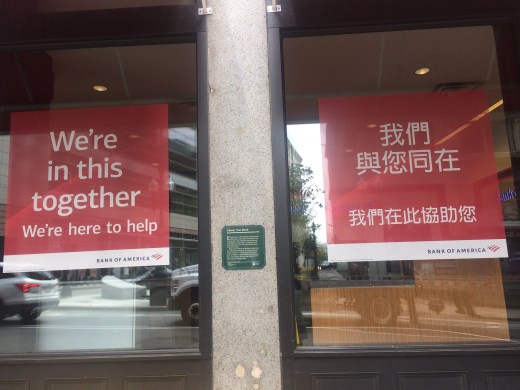
Photograph: Kim Clark. Bank of America office on Washington Street in Boston, MA 02111.

Your Technology Recovery Plan

We’ve been tethered to our tech devices over the past few weeks and they enabled our productivity in many ways. However, now that several states are in the process of cautiously discontinuing quarantine protocols, I think it’s time for us to rethink our heavy tech dependency. Too much of a good thing can lead to unfortunate consequences.

Unzip Zoom

I suspect that those who shifted from going to the office to working from home were particularly entangled in videoconference technology, which can eventually send team members into diminished productivity (or maybe just annoyance) if overdone. Well meaning managers inexperienced in the mechanics of leading an entirely remote team are known to hold many meetings and because videoconferencing technology exists, some managers will hold a (probably Zoom hosted) meeting every morning at 9:00 AM, for example, so everyone will be in the loop and, especially, the big bosses will know that your boss is getting the work done (or doing a good job at making it look that way!).

Despite the technology’s surging popularity, there is no need for every meeting to be a videoconference call. Audio only conference calls remain useful, especially when they are of less than 30 minutes duration. Furthermore, the matter at hand might be resolved in a two paragraph email. Resist the temptation to use video calls as your default communication tool because that’s not what it was designed to be.

Moreover, no one who is working from home should on a regular basis feel the need to assess the Home & Garden Magazine readiness of their home/ office space whenever they need to talk business. Not only that but your home may not have the best WiFi service. Your neighbors are also working from home, participating in videoconference meetings while their children are home schooling lessons on Skype or Google Hangout. Your internet signal could slow down or freeze up. Videoconferences are pressure and one does not always need to take it on to get the job done.

Physical over digital

As was discussed in the last post, suggest a face2face meeting with your VIP and arrange to have at least a beverage on the table when you meet. Oh, it’s been so long since we’ve been able to grab a coffee or whatever and sit down at a table and talk. Oh, how powerful that simple ritual is and how we took it for granted until it was gone!

Now that it is, or soon will be, within our grasp again, why not pay homage and invite a client you’re reconnecting with to meet you for ice cream now that warmer days are here? Surprise and delight!

Daily tech break

Rest your eyes and hunched shoulders and schedule two 30 minute tech tool breaks every day (unless you’re on project deadline). Believe it or not, taking a couple of short breaks during your work day is a time management technique that boosts energy, concentration power, creativity and productivity. We all need to periodically unplug and refresh ourselves physically, psychologically and emotionally because resting is necessary.

Pencil and paper

It’s also possible to walk one’s use of technology all the way back and periodically remind yourself of the charms of paper and pencil. The next time you (and your team or client, for that matter) need to brainstorm ideas or make a list, pull out a sheet of paper and a pen and write in longhand. Whether you’re in a face2face or videoconference meeting, don’t be afraid to go low tech old school every once in a while. You can use the white board in your office and plot a timeline in longhand. When you’ve completed it, take a picture with your phone and send it around. The raw, in the moment look of your notes will be the soul of creativity and authenticity.

Finally, you can cut back your screen time and reclaim the lost art of reading a physical book or newspaper. Every Sunday I buy the paper and read it in sections throughout the week. My eyes and brain appreciate the break; I enjoy it and find it relaxing.

Whenever I grab something to eat, I almost always also grab something to read as well. If I want to share an article with someone, I go online to find the link and copy/ paste, reminding myself that technology maintains its advantages.

Thanks for reading,

Kim

Photograph: Kim Clark May 19, 2020. Office at Chase Bank 800 Boylston Street Boston, MA.

Bouncing Back

Can we at last peek out from under the covers and think about ending the shutdown and getting on with life and business? I certainly hope so! A few businesses are beginning to reopen, depending on local regulations, Apple, Microsoft and Panera Restaurants among them. The definition of reopening may be limited but a few small steps are being taken and more will join in soon.

In reality, Freelance consultants did not so much close down but either ceased or continued operations according to what clients were doing. Some of my clients temporarily closed because they could no longer function, as was the case with a well-known arts organization. Their twice-a-month live events abruptly ended and were last held in February.

Might local officials allow the group to reopen in September? When will their audience feel comfortable to return? Might the organization regain full capacity by Spring 2021?

Most of us intuitively know that a “new normal” is ahead of us and we don’t yet know what it will mean for business, whether our clients’ or our own. Resilience will be among the most valuable resources we Freelancers can bring to bear and we must call it up from within ourselves and learn how to apply it.

Honor your feelings

Are you frightened by the potential outcome of the shutdown, which is unprecedented in the history of the U.S. if not the world? Do you wonder if your Freelance entity will survive and how you’ll be able to support yourself if it collapses?

Being deeply concerned about the future viability of what you’ve built and its ability to sustain you in even the near term is only natural in light of what the national economy has been through. Whatever you’re feeling is normal for you. Acknowledge and own your emotions.

The only thing we cannot do is become paralyzed by fear. We are compelled to move forward because life demands it and our clients expect it. Constructive action is required and to fulfill expectations—-remember that meeting or exceeding expectations is the core of consulting—-Freelancers must tap into and magnify our ability to recover from setbacks.

Share your feelings with peers and mentors

Selectively share your worries and doubts, questions and potential answers, with those whom you trust and respect. Fear is a widely experienced emotion these days and you will find yourself in good company. Talking with others will make you feel supported and will give you the confidence to recognize and act on solutions and opportunities that will help you get back on your feet.

Get perspective

I grew up hearing my parents, aunts and uncles tell moving stories about the 50 year long polio epidemic which took a devastating toll on many countries. I heard about children being confined to the iron lung. I saw polio survivors, and be aware that the fatality rate far exceeded that of COVID-19 no matter how much the media plays it up, and the outcome was not pretty.

Polio nearly always severely crippled those that it did not kill. BTW, everyone went to work or school and the only social distancing that occurred was when my grandparents every so often would not allow my (eventual) parents and their siblings go to the movies or otherwise be in crowds.

I was myself in business during the 2009 Great Recession and I suffered. But failure was not an option. I found an under the radar, low wage part time job to help cash-flow and stayed on a rebuilding course.

I continued to post these columns weekly and found another site to post them on as well. In two years, my posts were featured on a national (and now international) digital publication whose target readers are female entrepreneurs and that gave me a nice title and a little money. I was resilient and you can do the same.

Prioritize

As I think about it, the most important thing that Freelancers can do to rebuild is to reestablish the trust, dependability and empathy that our clients need to know are present before they’re comfortable doing business with us again.

When a client who has recently reopened reaches out to you, rather than just trading emails why not suggest a meeting over lunch or morning coffee to set the stage for a real connection? Offer to meet them at a convenient restaurant, or arrange to bring in some food and drink (you’ll pick up the tab, of course).

Now you can discuss what it appears the new normal could mean for your client and his/ her relationship with their clients and how recalibrated expectations will impact what will be needed from you. Articulate your awareness of the fact that so much has changed thanks to the shutdown and your willingness to be creative, flexible and resourceful in formulating solutions that will position your client to regain, if not improve, market position.

Model resiliency in your thoughts and actions

Yesterday evening, I received an email from a woman who was born to a prosperous family, has a part-time grant sponsored job at an influential global not-for-profit organization and a good and talented husband. Yet, she sought me out for some apparently much-needed encouragement. What is so funny is that I’m just a Freelancer, unmarried and not well-connected, who’s trying to maintain middle class solvency in America. Still, this very affluent woman, who I love talking to BTW, calls me when she needs a little hand-holding.

In other words, I do what I can to bring resilience into my life and I’m willing to share the resource with friends and colleagues to help them sort things out when they need. On a regular basis I also practice self- replenishing rituals to keep my physical strength and positive mental energy flowing because burnout will make it all come crashing down. I encourage you to think about your own resilience, how you can strengthen and expand it and share it when necessary.

Thanks for reading,

Kim

Photograph: Panera restaurants are reopening for takeout only. This one is on Huntington Avenue near Symphony Hall.

Pandemic Home Office

There is an art to working from home and not everyone can master the craft. Before COVID-19 dominated our lives, working from home was not a government mandate, but a privilege for the traditionally employed and a practical adaptation for Freelancers. The traditionally employed considered the ability to work from home a valuable perk that became a point of negotiation in employment contracts and employee annual reviews.

Those who work from home save time and money associated with commuting. One can avoid at least some aspects of office politics and those impromptu meetings that might ruin one’s work schedule. As long as water, electricity, Wi-Fi and heat or AC are working, you’re good.

The coronavirus pandemic has taken away some of the work from home luster, I’m sorry to say. Working from home still eliminates the time and money associated with commuting but it now also means that you might share your workspace with roommates who are also working from home; roommates who are home but not working; an intimate partner who now works from home, or does not; and children who must be alternately home-schooled, entertained and refereed because school and all after-school activities are cancelled, which effectively means that your kids are at the office with you.

The work from home life has become a radically changed landscape, filled with potential landmines that threaten to upend your carefully cultivated office environment. The internet is slow and Skype is freezing up because too many people are streaming data. The noise level is distracting. Your once de facto private workspace is now crowded and people are barging in and asking where the peanut butter went. Working from home is starting to feel like an out-of-control co-working space and you hate it.

Guy Winch, Ph.D., a New York City psychologist and author of Emotional First Aid (2014) told the New York Times in April 2020 to “…establish office rules and get granular.”

‘What are our work hours?

Where do we go in the house when one of us needs to take a call?

Where will our individual work stations be?

Who keeps an eye on the kids and when?’

At the end of each day during the first week of following a work from home plan that you and household members create, Winch recommends that you all “Check in with each other and say something like, ‘Just in terms of being work colleagues, what worked for us today? What would we like to change? Was it useful for us to take a lunch break at the same time?’ “

Most of all, be mindful of the emotions involved as those at home work, or don’t work, study, or put on a brave face as they wonder what will happen to their job when it’s time to return to work. Below are a few tactics that will keep you in a good work from home groove.

1. Create an office space

If you are able to have a room in your home to use as an office space, you are fortunate. City dwellers might place a small desk or writing table in the corner of their bedroom. Keep your work space clean and organized, as recommended by feng shui experts and also the neatness guru Marie Kondo. Orderly and attractive environments put us in a good mood and that state of mind boosts energy, creativity, confidence and productivity.

2. Establish boundaries

Teach household members to understand that when you step into your office space, you are at work. You cannot referee spats; you cannot chat with your mother-in-law; you cannot drive anyone to the post office. Shut the door and work. Noise canceling headphones may be helpful. Encourage yourself to take regular coffee and lunch breaks. When possible, take your breaks off-site to give yourself a battery-charging change of venue.

3. Dress for success

The popular image of those who work from home is of someone who is in sweats or even a bathrobe all day. Remind yourself and those with whom you live that you are a professional who takes your work seriously. Shower daily, brush your teeth, comb your hair and dress for work, whether in business casual attire or jeans and T-shirt.

4. Keep regular work hours

Go to work every morning, Monday to Friday. You may have the luxury of starting your work day in mid-morning, after a 5 mile run or a bike ride that gives you a burst of energy or ending work in late afternoon to do your workout after close of business.

Of course if you’re tied to an office – based team, you must align your work hours accordingly and that includes the time zone. At least some will be able to allow either their biorhythms or projects on their desk guide the work schedule. Resist the temptation to be either a workaholic or a slacker.

5. Stay connected

Working from home is by its very nature isolating, although some thrive on the independence. Still, maintaining and creating your professional ties is important.

At least every two weeks, schedule a video chat with a colleague so that you’ll stay in the loop with what’s happening at the office if you happen to be a remote team member. Furthermore, participate in your team’s group conference calls that allow you to check in and stay abreast of front burner projects as well as get advance word about what’s on the horizon. Write reports that document your contributions to reaching project milestones and goals achieved.yo

Enhance your professional skills and listen to a (sometimes free!) webinar. Promote your thought leader status, showcase your expertise and expand your network when you present a webinar or become a podcast guest.

Thanks for reading,

Kim

Photograph: Co-working office spaces are available at WeWork in the (adjacent) neighborhoods of Fort Point and the Financial District in Boston, MA.

COVID-19 Cash-Flow Update

The nationwide economic shutdown that went into effect in mid-March has done the vast majority of U.S. businesses no favors. In fact, the shutdown has been devastating for business owners and Freelance consultants alike.

According to an April 18, 2020 survey of 16, 620 business owners conducted by Alignable, an online referral and business development organization for business owners and self-employed individuals that claims 4 million members, 43% of businesses in America have had to temporarily close. Of those that remain open, 28% report that business is down by 75%; 15% said that business is down by 50%; 11% found that business is down by 25%; and a lucky 2% report that the shutdown has been good for business (maybe grocery and liquor stores?). The enormous impact of COVID-19 on the economy has compelled the federal and state governments to offer financial assistance to U.S. citizens.

The Payroll Protection Program, which is designed to help businesses that employ fewer than 500 workers to retain those workers on the company payroll in the face of often drastic revenue reductions brought on by the coronavirus business shutdown, ran through the original $349 billion appropriation approved by Congress in less than two weeks. Happily, Congress has just pushed through another bill that will not only add $320+ billion to PPP but also earmark $60 billion of the funding for small banks, credit unions and community based lenders.

Furthermore, business owners and Freelance consultants can apply for a loan that’s up to 2.5 times the average monthly payroll of the business, not to exceed $10 million per entity.

Remember, the PPP loan can flip to a grant if the recipient Freelancer or business owner applies 75% of funds received to payroll expenses (I including the owner’s draw) and 25% of the funds to business operating expenses. Otherwise the loan, which must be repaid within 2 years, is payable at 1% interest.

The Small Business Administration has also played its customary role in assisting business organizations large and small through the Economic Injury Disaster Loan program. EIDL provides loans and also a maximum $10,000 immediate cash advance to businesses financially harmed by the shutdown. The SBA reported that as of April 20, nearly $3.3 billion in EIDL grants and $5.5 billion in EIDL loans had been awarded. Congress is expected to approve an additional $60 billion in EIDL funding, bundled with the $320+ billion initiative to replenish PPP.

Still more help will be made available to Freelancers by way of the new Pandemic Unemployment Assistance program , a variation of Unemployment Benefits and therefore administered by the states, is set to provide up to 39 weeks (maximum) of unemployment benefits to those who have historically been excluded , i.e., us—- independent contractors, the self-employed Professionals, or gig workers.

To be eligible, applicants must provide self-certification to demonstrate that they are available to work but are prevented from doing so as a result of COVID-19 or actions related to it, including one’s own illness due to the virus or a close family member who contracts the virus. Even workers who are collecting sick pay or other benefits that amount to less than one’s weekly pay, or those who are working fewer hours, resulting in diminished income, might nevertheless be eligible to collect PUA benefits. For more information, search Pandemic Unemployment Assistance in your state.

Thanks for reading,

Kim

Photograph: Kim Clark 4/23/2020. The Doc Martens store on Newbury Street in the Back Bay.

The Beat Goes On : Visit the Job Boards

As the coronavirus continues to stalk the land and our political leaders and many citizens continue to see a business shutdown as the only response, making a living has become very difficult for the 57 million Freelance Professionals in the U.S. (Statista). If our clients don’t work, neither do we.

Federal government relief was rumored to be on the way, but I don’t see any evidence of it. It’s probably going to be smarter to put one’s energy into finding projects from a mix of new and current clients (same as it ever was!).

Still, maintaining the discipline and enthusiasm required for a job hunt is difficult and discouraging when the prospects for success appear bleak. But if you can make yourself surf through job board listings three times per week, you might come up with a project, however small.

I am most grateful that my largest client came through and asked me to provide a one hour marketing consultation with one of their clients, an RN/ Nurse Practitioner and midwife who recently launched a Freelance business that focuses on hormone management in women, from post-partum to menopausal. BTW, I sent Easter/ Passover cards to a select group of clients, including this one, and thank heaven my outreach paid off!

Among the marketing strategies the RN will pursue as she builds her Freelance consultancy is a new website, which will function as a lead generator. I was so excited to be able to refer to the RN a Freelance web developer with whom I had worked a few years ago. I’ve reached out to him and as soon as his schedule allows, I’ll conduct an email introduction and hope that the relationship will be fruitful.

That is how we’ll make it through this never-before-experienced crisis, my Freelancer friends. We must rally forward and do some job hunting at least two or three times each week for at least an hour at a time and as well we ought to remember to refer our colleagues along the way.

Now about the job boards—-I found a few possibilities, some familiar and others unexpected, to help you jump-start the client building work,

Aquent

Specialties covered include Management, Marketing, IT Design, Managed Services and Professional Development. Some workers can qualify to receive benefits. Free online training courses for workers are also available. http://acquent.com

This company is strictly top- drawer and seeks only cream of the crop gig workers. Extended Workforce Services is what the company provides and the work assignments may not be remote; there are 35+ offices around the world, primarily in the U.S.

Guru

The site boasts that prospective employers will work with among the most talented professionals in the field, regardless of the assignment. Among the services provided are translation/ writing, legal services, architecture & engineering, marketing & sales, business & finance, software development & programming and administrative services. https://www.guru.com/d/jobs/

LinkedIn ProFinder

The ProFinder algorithm sends jobs to your inbox, thus eliminating the need to continually search for employment possibilities. Only five proposals are accepted for each assignment, so time matters for assignments that appear very attractive .

Proposals are short, which allows bidders to quickly put themselves into consideration but limits one’s ability to sell oneself in some instances.

I’ve submitted 8 -10 proposals over the past 12 – 18 months, and I came close to being hired only once. The project was interesting and the rate of pay offered was very decent. The lady who interviewed me over the telephone was very nice and also honest.

That said, I still recommend that you sign up for ProFinder, create a profile and compete for assignments. The first 10 submitted proposals are accepted at no charge but to submit additional proposals the job seeker must join LinkedIn Premium at $60/ month and that is steep. Depending on your luck, you may decide to pay up and roll the dice on being hired. Or you’ll pull the plug on this service.

However, none of my other proposals was ever acknowledged, including one submitted by a man who had once written for the New York Times. What was his motive for the job posting? Maybe he thought he just felt my writing isn’t good enough? http://LinkedIn.com

The Creative Group

Freelancers looking to earn money and work on interesting projects may be very happy with this site. It’s the place for advertising whiz kids, marketing rock stars, genius art directors, amazing website designers and super organized account managers, too. Full time and project work is available, both on-site and remote.

The company is a division of the global giant Robert Half Staffing Agency. https://www.roberthalf.com/submit-resumeglobal

TopTal

TopTal announces to both job seekers and prospective employers that the site features the top 3% of Freelancers from around the world. software developers, finance experts, product managers, marketers, graphic designers and project managers are the principal hires. ://www.toptal.com/careers#positions

Upwork

I’ve gotten a couple of small jobs on the site but I abandoned ship when it was announced that it would cost money to submit a proposal. On top of that payment, there will be a 20% fee attached to each invoice submitted. Furthermore, Upwork clients like to low-ball on fees, so there is not a lot of revenue to be generated, unless one specializes in software development and other IT functions.

I was lucky enough to start work on a sales training manual but then the client pulled the plug and regards was the end. She claimed to really like my work. The fee charged was less than half of what it should have been. I suspect that the client suddenly got spooked by the business start-up costs Oh. well. I sometimes think about reaching out to say hello to the client. She was great to work with. http://Upwork.com

Thanks for reading,

Kim

Photograph: Runner on Commonwealth Avenue in the Back Bay neighborhood (Boston, MA) on Monday April 20, 2020, what would have been the Boston Marathon.

Coronavirus Cash Flow

Because federal and state governments chose to require most businesses to cease operations as a way to decrease public exposure to COVID-19, those entities have recently decided to throw a few dollars back at the citizens, to help us manage our financial obligations as the shutdown grinds on. As you may have predicted, the response may be inadequate and imperfectly distributed, but it will help a little bit.

CARES Act Economic Impact Payment

Every citizen and legal resident not claimed as a dependent on someone else’s tax return is eligible to receive an EIP, that is, a Stimulus payment of up to $1200 per person, or $2400 per couple, plus an additional $500 for each child.

Eligibility for financial assistance will be calculated from one’s 2018 (or 2019, if filed) tax filing, so make sure that one or both are completed and in the hands of the Internal Revenue Service and your state Department of Revenue. The new tax filing deadline date is July 15, 2020 for 2019 federal taxes and most states have assigned that date as a deadline as well, but I suggest you verify that ASAP.

Filing for extensions on the federal or state level remains April 15, 2020. To keep abreast of this fast-changing situation on the federal level, check in at http://irs.gov/coronavirus.

Single filers whose Adjusted Gross Income was $75,000, joint filers whose AGI was $150,000 and marrieds filing separately (head of household) whose AGI was $112,500 in 2018 (or 2019) will receive the full amount of the award (see above).

Single filers whose 2018 AGI was between $75,001 – $99,000 and marrieds whose AGI was $150,000 – $198,000 will lose $5.00 for every $100 that their AGI exceeds the $75 K and $150 K single or married filers thresholds. Regarding those whose AGIs are below the thresholds, there doesn’t appear to be a plan in place.

Children who qualify for the Child Tax Credit can help their family receive an extra $500 each. Dependent students aged 17 – 24 years will not bring the Stimulus benefit to the family but working students aged 18 – 24 years who file their own taxes and are not listed as a dependent on the tax return of another are eligible to receive a Stimulus payment for themselves.

The Department of the Treasury prefers to send Stimulus payments electronically so if you’d like to receive payment more quickly, make sure that your bank or debit card info is on file. If the IRS does not have direct deposit information for you as a result of previous tax refunds, there will soon be a website to allow filers to add that information.

CARES Act Paycheck Protection Program

This program was originally created to help business owners who employ fewer than 500 workers to retain their employees in those essential operations that are sanctioned to remain open during the shutdown. The PPP is technically a loan program that has the potential to become a grant. Those who apply need not prove any lost income or financial hardship. It’s recommended to apply for the loan through your business banker.

If 75% of the loan money is applied to payroll expenses and 25% is used to pay operating expenses such as rent and utilities, the loan will then be forgiven and essentially become a grant. If that formula is not followed, the business owner will pay a 1% interest rate, payable over two years, with the first payment not due for six months.

Freelance consultants benefit when the payroll portion of the loan calculation is instead applied to our revenues as determined by one’s “net earnings, wage, commissions and/or income from the self- employment venture.” If the Freelancer employed any full or part- time workers, they must remain on the Freelance entity’s payroll for a minimum of 8 weeks, at the original rate of pay, in order to qualify for the loan, as is the case with typical business owners. If the Freelancer hired other Freelancer contract workers to help out on a project, those contract Freelancers are not covered in the PPP calculation; they may apply on their own for the benefit and include that income.

FYI, PPP loans may be administered only by a pre-approved list of banks and the word is that for the most part, only existing business banking customers will be approved for the loan.

There are now millions of Freelance workers in the U.S. and the demand for PPP loans, which if handled as described above can become a grant, is high. It’s rumored that Congress is weighing the possibility of adding $250 million to the original $500 million appropriated for PPP, so that the Small Business Administration can expand the list of approved lender banks. To be continued.

Thanks for reading,

Kim

Photograph: Kim Clark. Shopping at the South End Whole Foods Market in Boston, MA.