Marketing and the B2B Buyer’s Journey

A few years ago numerous authorities who research and report on the habits of those who purchase B2B products or services for their organizations noted that B2B buyers do a significant amount of online research to improve their understanding about the products or services they intend to buy before speaking with potential vendors. As prospective buyers move through the journey there are a series of touch points, that is, encounters with B2B product and service providers (you).

Opportunities to influence and shape the perceptions that prospective buyers form while they investigate your company and its offerings are strewn along the Buyer’s Journey path like Hansel and Gretel breadcrumbs. The point of this exercise is to remind Freelance consultants where and how in the journey your marketing tactics have the power to persuade (or discourage) a few to do business with your organization. The steps that B2B buyers take can be broadly categorized as follows:

I. Identify a need

The initial stage opens the opportunity for B2B companies to introduce themselves to potential buyers and position their organization as a credible provider of B2B solutions. Cultivating a positive impression and trust in their products, services and brand is the goal of the Freelancer (the seller).

  • Recognizing that a problem or pain must be resolved, or an objective achieved

Creating awareness of your company’s product and/or service-based solutions is your objective during the first stage of the Buyer’s Journey. Providing examples of the challenges or problems that your products and services might solve, or examples of goals or objectives that can be advanced, can be effectively discussed in your website, newsletter, email marketing campaigns, blog, webinar and podcast appearances and social media posts, serving to help prospects understand what your company is all about and whether your organization has the right stuff to deliver what is needed.

  • Research

Your potential buyer now investigate solutions that appear capable of providing a remedy for the problem, or could advance the objective or goal. Most will conduct online searches and 70% will use Google, according to Salesforce. The B2B Freelance consultant is advised to provide the potential buyer with information that is typically expected and appreciated, is considered relevant—yet another reason to know your customer. User reviews from a site like Yelp, statistics, facts and other hard numbers could be in order.

Focus your content around the buyer’s most likely goal, challenge, or pain. A white paper to inform and persuade potential buyers that your company’s products or services, expertise or technology, for example, is superior for solving a particular business problem or addressing a certain goal. A free 30-minute consultation with your prospective buyer will also be helpful as you’ll be able to propose customized solutions and discuss how they might be implemented and delivered in a way that the buyer prefers.

II. Evaluate and compare available options

Be advised that the potential buyer will also investigate at least a couple of your competitors—and who could blame them? The decision-maker or his/her appointed representative will at this point start talking to colleagues about what is “out there” in terms of services, products, pricing, add-ons, upgrades, delivery date, free trials and anything else that will matter in the comparison. Case studies tell a story that illustrate precisely how, in real time, your organization is able to expertly deliver a customized solution and create an experience that meets or exceeds customer expectations.

  • Prioritizing

At this point in the buyer’s journey, the term prospective customer can be used with confidence, as s/he has clearly defined the problem or goal, has confirmed who will be the end user for the product or service and is fully committed to choosing and paying for what is perceived to be the most appropriate solution. An opportunity to develop a relationship with prospective buyers who are interested in your company at this stage of the journey may present itself because you could receive a call or email.

III. Decision and contract

Are you still in the game? Hope so! Prospective customers at this juncture have consulted with the project stakeholders at his/her company and are looking to get a deal that pleases as many as possible. This could be the time to tempt your prospect with deal clinching sweeteners—options, pricing, add-ons or (apparently) gratis upgrades that s/he and the influencers and end-users will appreciate and that cost you next to nothing. You want wrap this thing up and motivate your prospect to sign with your team. Surprise and delight.

Thanks for reading,

Kim

Image: The kids are alright. Goat farmers in Champaign, IL supply artisanal cheese to Chicago restaurants and gourmet shops


Freelancer Health Insurance DEADLINE: August 15,2021

Heads-up Freelancer friends—-the Health Insurance Marketplace (Healthcare.gov) special enrollment period will end on Sunday August 15, 2021. If you find yourself without health insurance, or you’d like to modify or renew the plan you have, now is the time to buy what you need.

According to data from a survey of independently employed American workers released in July 2021 by Stride Health, a provider of health and other types of insurance marketed to Freelancers, 31% of respondents were uninsured—a rate that is more than twice that of traditionally employed Americans (12%). Cost was the top reason that caused Freelancers in the survey to decline health insurance, with 64% of uninsured respondents reporting that they didn’t think health insurance was affordable. The seventh annual survey of American workers, conducted by Upwork and The Freelancer’s Union in 2020, reported that 59 million workers freelanced part-time or full-time, representing 36% of the American workforce.

Managing cash-flow while depending on a sometimes unpredictable amount of billable hours or payment of accounts receivable, as is the case with many Freelancers, can be a struggle. We are often loathe to commit to fixed expenses that might be perceived as “optional,” especially those who are single.

That said, acquiring health insurance is a prudent investment. Consider it risk management and therefore, good for business. One never knows when a health crisis will occur. Unexpectedly large medical expenses have been known to cause financial havoc and that scary possibility makes health insurance worth the expense. Fortunately, health insurance on the Marketplace became more accessible when Congress approved the American Rescue Plan on March 11.

The new law expands eligibility for Affordable Care Act benefits and provides subsidies to ensure that no Marketplace buyer pays more than 8.5% of annual income on their health insurance premium. The American Rescue Plan also increases the subsidy for lower-income Americans who already qualified for that benefit. Furthermore, those currently receiving health insurance through the Marketplace can expect to save an average $50 a month and some may save more.

According to President Biden, “For millions who are out of work and have no coverage, thanks to this law there’s an Obamacare (ACA) plan that most folks can get with zero-dollar premiums. Four out of five Americans shopping on the Obamacare Marketplace can get quality healthcare with a premium of $10 dollars a month or less (after tax credits).”

Better still for Freelancers, the Stride Health survey showed that 93% of us who enrolled for health insurance via the Healthcare.gov Marketplace qualified for a subsidy that will offset the cost of health insurance, up from 87% who qualified for a subsidy in March 2021. As a result, health insurance enrollment increased sixfold between April 2020 and April 2021. Year to date, nearly as many people have signed up for health insurance as did during the annual open enrollment period at the end of 2020, the Stride Health reported.

Over the next few days, those who need health insurance will want to visit Healthcare.gov or call the national hotline at 800-318-2596. Some states have their own health insurance platforms and if you live in one of those jurisdictions, you’ll be routed to the appropriate registration platform.

Thanks for reading,

Kim

Image: Luis Jimenez Aranda The Visit of the Doctor (1897), courtesy of El Cason del Buen Retiro/ Museo del Prado in Madrid, Spain

How Would an Investor Judge Your Company?

Recently, I was invited to judge a pitch contest for start-up entrepreneurs that will be hosted by the business incubator where I teach courses and workshops—-business plan writing, branding, selling skills and marketing. As I reviewed the list of questions that pitch contestants will address, I realized that those same questions mostly apply to those who already operate a business.

Every Freelance consultant and business owner should be able to answer pitch contest questions because when you think about it, selling products and services to clients isn’t altogether different from pitching a start-up to investors. So why don’t we flip the script and imagine that you’re an investor who’ll hear a pitch about your own business, delivered by your alter ego self?

An investor pitch outline is a useful guide to metrics and other critical elements that have a big impact. When business owners and leaders address these key performance indicators, a powerful enterprise will result.

Introduction–Who are you?

Introduce yourself with a 30-60 second elevator pitch. Give a brief overview of the type of solutions—products and/ or services—that the business provides and the primary benefits derived. Identify also one or two major client groups.

Purpose–What is the company’s reason for being?

Name the pain that the solution provided by your company’s products and services will eliminate. Paint a verbal picture to make the problem your products or services solve understandable to prospective clients. Give a succinct yet compelling description of the detrimental impact of not having your solution available, which could include loss of market share or dominance, diminished revenue, or even legal penalties.

Solutions–The value proposition that motivates clients to pay

What is the “fix” that resolves the pain or problem and therefore brings value that clients are willing to pay for? Describe or demonstrate how your solution resolves the pain and solves problem—how will the product or service directly address the problem and deliver the solution?

Detail two or three noteworthy benefits that your clients, or the client’s customers, will derive when your company’s solution is used. Benefits speak to most clients, whereas features appeal to technophiles. Overall, benefits are a more powerful sell, especially those that directly address the pain points you described. Be careful to limit industry-specific jargon so that your prospect will not feel intimidated.

Function–Prove that your product or service works

If you sell a technical solution, for example software as a service, explain in layman’s terms a brief summary of how the product works and why it’s useful. Include, as appropriate and helpful, product photos, screen shots, diagrams, drawings, etc.

Market reach–How much demand for your solutions?

Purely an FYI question and the answers you discover will benefit your business tremendously. Conduct some basic market research and reconfirm the size of your target market. Post-pandemic data could be available in some cases and that’s the data you want to examine. In order to make an intelligent plan for the future of your organization, you need to know, as confirmed by objective data, where your market is going and what’s trending.

If you’ve been thinking that a pivot might make sense, you’d be wise to know in advance what you can successfully pivot into—ideally, a sector that’s growing and that you have the expertise and contacts to enter.

Credible sources of business data include Forrester Research, Gartner Global Research, local trade journals, professional association research, the business section of The Wall Street Journal, The New York Times and other newspapers that address business issues in depth and also business data published by the U.S. Census/ Business and Economy data. Show your potential investor that there is a growing and sustainable group of potential buyers for your products or services.

Business (revenue) model—How will you find customers and make money?

Here’s another FYI question that you should periodically revisit, especially in the post-COVID era. The shutdown caused massive turmoil for the independently employed, fueled by the hollowing out of major industries. The work from home culture (which is waning) has made accessing potential clients tremendously difficult.

Now seems like an ideal time to re-examine how you expect to make money over the next 12-24 months. Determining what clients are willing to pay to do business with you is another question you need to address. Price to profit.

Focus on how the company generates its primary revenue stream(s). Review and clarify the usual steps of the buying process, including how long that process usually takes. Think about the job title of the decision-maker on the client’s team, as well as the usual job titles of the end user of the product or service. Furthermore, consider who the key influencers might be in the buying decision process, the steps are needed to achieve a sale and the usual length of time involved in the sales cycle.

Go-to-market—What’s the sales strategy?

Update the strategy you’ll follow for lead generation, inbound and outbound marketing outreach tactics. Discuss how product and service sales are executed—at your company office or retail location, at the client’s office (because you work from home), e-commerce via your website or other platform.

Identify whatever strategic partnerships or consignment arrangements that are in place (or are being negotiated). Identify who is responsible for selling—is it you, Freelancer friend, or do you split the sales function with a co-founder, or has the company hired sales reps?

The team—Who’s running the show?

If your company has co-founders or a management team, name them and describe everyone’s role. Describe also the job titles and functions of any part-time or full-time employees. If certain functions are outsourced, e.g., accounting, legal, payroll, or bookkeeping, document and describe their roles.

The purpose here is to reassure the prospective investor that your company is well-managed, that your solutions will be delivered as promised and that the company is capable of routinely meeting or exceeding client expectations.

Financial projections—Show me the money

Absolutely, your potential investor will take a keen interest in the state of your venture’s finances. You, the owner, must clearly demonstrate that you are reasonably adept at managing the company’s finances (even if your real talent is marketing and sales). At the very least, learn to get comfortable with interpreting the Profit & Loss (Income) statement, the Balance Sheet and the Cash-flow Statement.

Hiring an accountant, as well as a bookkeeper who is more than a record keeper and has a feel for financial management, will be tremendously helpful regardless of your talent for handling finances.

Thanks for reading,

Kim

Image: A resident of the New England Aquarium shark tank in Boston, MA.

Networking in the Next Normal

We are on the cusp of a new era (but you know that). Can we agree to name the period before COVID-19 normal, the business-as-usual drill with which we’re all familiar? Where we are now, the present, is commonly referred to as the new normal and maybe for you the term is already getting old. But time moves forward and we will soon enter the true post-COVID-19 era, the next normal. If you expect your business venture to survive and thrive in the fast-approaching future, the time to prepare for the next normal client is now.

Preparation begins with devising strategies to recover revenue lost to the 2020-2021 shutdown. Your plan to encourage and support client acquisition and increased revenue may include upgrades to the company’s digital presence, more sophisticated and targeted content marketing, greater use of marketing automation, greater attention devoted to financial management and post-pandemic next normal networking activities.

Networking is one of the most important business development activities that a Freelance consultant can perform. Networking can have a significant impact on your ability to meet potential prospects and build your client list. In the post-COVID environment, you would be wise to put your networking energy into building relationships and not blatantly hunting for a sale.

In your travels, where networking can organically happen anywhere and need not be limited to formal meetings or conferences, set your sights on meeting people who you find interesting and enjoy getting to know. Should the subject of business comes up, listen for ways that you can be helpful.

While conversing with a new colleague in person or online, you may eventually find an opening to talk turkey and slip into LeadGen. Whether you meet your new colleague in real time or by digital means, the smart networking strategy is to use finesse as you steer the conversation to the next level. Don’t risk undoing the effort you’ve invested with a clumsy approach.

  • Ask the right questions: Be politely curious and actively listen as you encourage your new colleague to talk about him/herself and their business. Focus on getting to know those whom you meet.
  • Be a resource: Marketing is the new sales. Offer insights based on your experiences and/or offer to send a link to additional info that spotlights your expertise and grasp of the goal or problem that a would-be prospect needs to address.
  • Don’t be afraid to play the long game: You’re not going to marry someone on the first date and you’re probably not going to reach your LeadGen goal in the first encounter. Start networking conversations by asking questions and actively listening, to learn more about the potential prospects. Build trust as you invite him/her to do what they like best—-talk about themselves! It can also be an excellent strategy for building relationships and finding clients.

Thanks for reading,

Kim

Image: The the networking is in full swing in a scene from an unidentified circa 1930s Hollywood movie.

Make Email Subject Lines Pop

Email marketing is an all-star player in your outbound marketing lineup. During the 15 month pandemic shutdown email marketing which, BTW, includes your blog posts and newsletters, became even more important as business leaders struggled to maintain communication with clients and prospects.

Think about it—-before you can schedule a video call to launch a full-on sales presentation, you need to establish contact with would-be prospects and open the door to the buyer’s journey. LeadGen is how to keep your sales pipeline filled and the process deserves a comprehensive inbound and outbound approach.

The challenge with email marketing is getting your message opened and read, even when the recipient knows your company. The powerful decision-makers you need to reach are pummeled with dozens of emails every day, Monday to Friday (and sometimes on the weekend). To manage the inflow, your decision-maker prospects are constantly prioritizing their inbox, often setting up filters and other gateways to organize messages that help them respond to important and urgent notes as efficiently as possible.

If you expect to persuade your intended prospect to click on your email in the midst of a typical deluge, it’s imperative that your email stand out in the best way. The way to do that is to create a stop-and-read subject line, an irresistible headline, that acts like a magnet. The subject line is the single most important part of an email because the opportunity to tell your story is lost if your email is sent to trash. The success of your marketing strategy is tied to the open rate of your sales/ marketing emails.

So, how does one create an intriguing, arresting, read-me email subject line? While every subject line is unique, there are guidelines to keep in mind as you write. In short, your subject line must tell recipients that your email contains information they’ll consider valuable, or somehow interesting, maybe a tad controversial or unexpected.

Eye-catching

Words such as free, limited offer and new are among those that can potentially make your subject line grab the reader. Providing a contrarian or surprising fact or statistic that challenges a common belief can likewise be compelling. Info that concerns a recent change in the industry is an update that many clients and prospects will appreciate.

Call-to-action

A call-to-action asks the reader to do something — learn, win, sign up, give feedback, for example. Many emails that drop into the average inbox lack an interesting, appealing subject line. It’s so easy for the eye to slide over much that is sent.

Devise an amusing, novel, or practical call-to-action that will both grab attention and either inspire or dare your intended reader to read on.

What’s in it for the reader?

Do you sell a product or service that can help your email recipients make money, save money, or save time? Can you help the reader’s organization achieve a mission-critical goal faster, more easily and maybe at a lower than expected cost? All of these scenarios offer value to your recipient and are enticing benefits to include in your subject line.

Be concise

Your subject line must do a lot of work in a small space. It must grab attention with a call to action, tempt the recipient with what could be in it for him/her and concisely getting to the point.The ideal length of an email subject line varies between mobile, desktop, and tablet devices, so keep this in mind as you craft the perfect one-liner for your sales email. On average, the maximum subject line is about 40 characters so that it can be seen in its entirety on phone, tablet, laptop, or desk model devices.

Thanks for reading,

Kim

Image: Attention grabbing front page headline in the Roswell (NM) Daily Record July 8, 1947 issue

8 Great Business Reads for Summer 2021

This summer seems tailor-made for staying close to home. International travel remains a difficult proposition as COVID-19 rages on, causing the Tokyo Summer Olympics to ban the presence of a live audience. Weather across the U.S. has been a problem, with the East Coast repeatedly doused with heavy rain while western states suffer through dangerously dry conditions and temperatures ranging from the 90s to beyond 100F.

We cannot control the weather, but we can control our response to it. Whether summer finds you in your back yard or a park in the city, vacationing in the mountains or near the water, why not crack open a business book or two and pick up some pointers on how to grow your business skills? Please take a look at the recommendations below.

Rise and Grind (Daymond John with Daniel Paisner, 2018)

Shark Tank investor Daymond John reminds readers that anything worth having is worth working for. He tells the outrageous truth—if you want to create real success in business, then be prepared to out-think, out-hustle and out-perform the competition. In 1992, John and three friends in his hometown of Queens, NY founded FUBU, a casual apparel line that become must-have street style fashion.

In this New York Times and Wall Street Journal best-selling book, John shares behind-the-scenes stories of how he overcame adversity and went on to co-found and become CEO of a company that now generates nearly $6 billion in annual sales worldwide. https://www.goodreads.com/pl/book/show/35083562-rise-and-grind

The Art of the Start 2.0 (Guy Kawasaki, 2015)

Kawasaki made a name for himself in the 1980s, when he helped launch the Apple Macintosh computer. He’s an entertaining writer and presenter and his book is filled with practical advice, particularly for those who’ll need venture capital. Whether you’re leading an existing business or planning to launch a new venture, you’ll find Kawasaki’s cut-to-the-chase business building blueprint useful and inspiring.

https://www.barnesandnoble.com/w/the-art-of-the-start-20-guy-kawasaki/1120058655

Marketing Made Simple (Donald Miller, with Dr. J.J. Peterson, 2021)

New York Times best-selling author Donald Miller details how to create and implement a marketing plan that will bring qualified prospects to your door. Readers learn the fundamentals of lead generation, how to build a sales funnel, how to recognize and optimize key customer touch points and how to develop and communicate an authentic brand story that builds trust and loyalty.

https://www.barnesandnoble.com/w/marketing-made-simple-donald-miller/1132751806

Uplevel Your Business, Uplevel Your Life (Kristen S. David, 2020)

Discover the four pillars of successful business management. Ms. David gives Freelancers and small business owners a roadmap for scaling or growing your venture. Learn to recognize growth opportunities and push them forward with smart action plans. Learn to accurately monitor progress with relevant quarterly goals. Understand the types of operational support systems and processes that will enable you and your team to build and sustain a thriving, profitable venture.

https://www.goodreads.com/book/show/50390493-uplevel-your-business-uplevel-your-life

Eat What You Kill (Donald Williams, 2020)

In 2005, Williams launched the eponymous Williams Accounting and Consulting in New Orleans, LA and in 2006, he opened a second location in Atlanta, GA. Small business owners are the principal customer group served. Guiding clients as they grow their ventures is Williams’ mission and he provides for readers valuable money-saving and money-making strategies that will enhance your financial management and future.

Donald Williams’s “Eat What You Kill” Promotes Financial Empowerment

The E-Myth Revisited: Why Most Small Businesses Don’t Work (Michael E. Gerber, 2004)

The author is credited with revealing the distinct differences between working in and working on your business. Gerber has more revealing insights to share in this influential book, including the common fantasy that just because you enjoy and may even excel at doing something—cooking, for instance—does not mean you are prepared to operate even a modestly successful restaurant. Just because you are good at something doesn’t make you qualified to turn your hobby into a business.

https://www.goodreads.com/book/show/81948.The_E_Myth_Revisited

Your Next 5 Moves: Master the Art of Business Strategy (Patrick Bet-David, 2020)

At age 10, Bet-David and his parents escaped war in Iran. The family traveled to the U.S., earned citizenship and Bet-David eventually joined the Army and served in the 101st Airborne Division. After his tour of duty, he worked in the financial services industry. Before his 30th birthday, Bet-David successfully launched PHP Agency, Inc., an insurance sales, marketing and distribution company, which has become one of the fastest-growing ventures in the financial services sector.

But when Bet-David created the video The Life of an Entrepreneur in 90 Seconds, it went viral. The 30 million viewers his educational video received inspired Bet-David to found Valuetainment, which quickly became the #1 YouTube channel for entrepreneurs.

https://www.goodreads.com/book/show/50542735-your-next-five-moves

The Lean Startup (Eric Ries, 2011) Ries has a long history with start-up ventures, variously serving as a start-up employee, adviser and founder and this book is a long-time best seller. While a college student, he founded Catalyst Recruiting, a platform on which students could create and share their professional profiles that could bring them to the obtaining a job after graduation. The venture failed, because he didn’t understand the needs of his customers. Ries eventually learned that in order to build a great company, one must begin with addressing the needs of target customers.

Over time, Ries connected the dots on what he’d learned about launching a new company. The lean start-up methodology favors experimentation over writing the traditional, elaborate business plan, direct customer feedback and iterative design over traditional “big design up-front” development. Although the lean startup strategy is just a few years old, its concepts—such as “minimum viable product” and “pivoting”—have quickly taken root in the start-up world, and business schools have already begun adapting their courses to teach them.

https://www.barnesandnoble.com/w/lean-startup-eric-ries/1100642052

Thanks for reading,

Kim

Image: Books that beckon at The Last Bookstore, the largest independent bookstore in Los Angeles, CA https://www.lastbookstorela.com/about

Kick-off FY 2022

Hello July! Fiscal Year 2022 has arrived and happy new year. Calendar year people are greeting the second half of 2021. As businesses throughout the U.S. shake off the shutdown, we can be confident that nearly every business owner and leader is working to decipher what the post-COVID landscape looks like for their enterprise and how to make it profitable. It’s time to double down and make up for revenue losses.

In-person encounters are on the rise. Work from home policies are receding and employees are being asked to return to the office, if only for two or three days a week. To position your organization for a fourth quarter recovery, July and August are the time to put pedal to the metal and revitalize your company.

First thing, if you haven’t done so already, is to determine how much revenue was lost during the shutdown. It’s a bitter pill to swallow, but that information will greatly support your recovery plans. When you know about how much revenue was lost, you’ll know how much revenue you’ll need to generate to get back on your feet and you can start to think realistically about how you might be able to do that. Use your 2019 year- end P & L figures as the 2Q 2020 – 2Q 2021 benchmark.

Focusing on the marketing and operations functions of your company will be useful as you develop rebooting strategies. The typical Freelance consultant is familiar with marketing and may even dabble in it, at least in the social media realm. However, operations is often outside of our B2B knowledge economy comfort zone. It shouldn’t be.

Operations encompasses whatever it takes to acquire or produce your product or service, get it into the clientshands and do so efficiently, with a goal of maximizing productivity and minimizing costs. If your clients have made adjustments in how they do business, how they serve their clients, you may have to change along with them. Changes in how you provide your products and services is an operational issue.

Pivoting to videoconferencing from in-person meetings when clients opted to work from home was an operational change for all involved. The response to that change entailed not only a change in communication but also technology and skill set upgrades (or the meeting tech was outsourced, at a price).

You’ll continue to work the operations angle as you consider the financial, technical, educational and even networking resources and activities you may need to launch your recovery, as well as the timeline. You may need to confront the reality that while some clients were able to adjust to the pandemic restrictions and bounce forward, with some having resumed working with you at some level, others may be gone forever. In other words, assess the size and likely revenue potential of your client list.

Operations will look different in every business but in your B2B service venture, be aware of operational processes, which also include invoicing and getting paid. Use the post-pandemic reopening process to rethink what you do, how you do it and for whom you can do it now that maybe a couple of big clients aren’t working with you anymore. Do you need to revamp your business model and reevaluate your value proposition? How will you you reach out to clients now?

Ramp up marketing with content and PR. Increase the name recognition and visibility, credibility, trust and perceived expertise of your business venture (and you) with text, audio, or video content that reaches out to current and prospective clients to educate, inform and engage with them. Content is still king but distribution is now queen. You must create content that persuades prospective clients to follow-up with your organization in some way—-listen to your webinar or podcast appearance, read a case study, request a free 30 minute consultation.

Include distribution in your your PR/content strategy. Not every prospect will find your content through your website or social media and that is why sending a press release to print or digital publications that are trusted by those who could potentially buy from you is important.

Work on finding good speaking engagements and use them to create a compelling PR roll-out. In-person events are being restarted. Let that inspire you to pick up the thread and reach out to organizations where you’ve appeared before, or contact those on your wish list. You could be a keynote speaker or moderate a panel. Podcasts and webinars are still a thing. Just get yourself in front of a good audience, so you’ll generate buzz in the right circles.

Your PR strategy might consist of first, confirming that the host organization will do a PR campaign to publicize your appearance. On your end, you’ll post the notice for your talk on Alignable, Facebook, LinkedIn and Twitter accounts. Post your event in the local Patch if the location where you’ll speak is part of that community and also send a press release to local community newspaper. Be advised that if the editor chooses to include your story, many community newspapers will simply publish your press release so make sure that your story is concise and compelling.

As your name and your company’s appear in various online media, there will be positive impact on search engines. Google favors companies that EAT—expertise, authoritativeness and trustworthiness—and that’s who gets the highest page rankings.

An online presence makes your company more prominent and brings those looking for your category of products or services to your website and social media pages. That is precisely what you want, whether or not you’re rebuilding your business, because leadgen is always a priority. As you attract new potential clients, your updated operations will greet them with a seamless and pleasant experience, that may result in referrals.

Thanks for reading,

Kim

Photograph: © Associated Press 1996 created by Lynne Sladky. Carl Lewis qualifies for the long jump finals at the 1996 Summer Olympic Games in Atlanta, GA (USA).

Why, When and How to Delegate

WHY? Because you have a boatload of things to do and there aren’t enough hours in the day to complete them all. Because you may not have the expertise or inclination to do everything that needs to get done. Because removing certain tasks from your plate will improve your productivity and also lower your stress level.

The best leaders know how to delegate. There is an art to delegating, though, and to do it well takes practice. Some leaders resist delegating because they assume it will take as much time to explain to someone how to do what needs to be done as it would to do it themselves. Others are so buried in work that they’re unable to recognize what only they, the leader, can do and what someone else can do.

Those who have employees should also realize that delegating certain tasks to the team represents skills-building opportunities for them. Delegate selected tasks and you acknowledge the expertise within your team and demonstrate your trust in their professionalism. Employee job satisfaction will increase, as will the quality of work they do, because your employees will feel valued and respected.

Delegating can be a win-win for all, but upfront planning and maybe also a tutorial will be necessary. Furthermore, you’ll need to decide who you’ll delegate to and why.

WHEN? First, take an honest look at your to-do list and the timetables involved. Do you have the time and bandwidth to do it all? Then, determine which tasks can be called executive functions that only you can do, like meeting with clients or writing proposals and contracts. Next, acknowledge your primary skill set and own up to those tasks that you simply hate doing.

Now you’re ready to figure what you might delegate. Rather than muddling through and forcing yourself to take on what you either don’t do well or hate doing, do the smart thing and delegate to employees or to a Freelancer who has the expertise needed.

Bookkeeping, graphics, payroll and video meeting tech help are often outsourced. Do you have an important client proposal to prepare? If you’ve been invited to submit a proposal that may win you a new client, ask a team member who has a talent for creating data presentation graphics to turn the numbers you’ll include in the financial section into easily understood and visually interesting charts and graphs. Train a team member who has an affinity for technology to run and manage the tech requirements for videoconference meetings and webinar.

HOW?

Communicate expectations

Be specific about what you would like to be done. If there is a deadline attached, make it known. Create project milestones to help guide and pace the project and ensure that the final deadline is achieved. Commit directions to writing, so that everyone understands and you remember what you asked for. Verify that the person(s) to whom you delegate understands what to do, the process you would like him/her to follow and the deadline for completion. If you delegate to a team, appoint a project leader.

Provide resources

Empower the person or team to whom you delegate and give them full access to all necessary information, budget, authority and all necessary support to come through for you. Provide the context of why their work is integral to the overall success of the larger project, if that is what is delegated, or explain why the routine task you have now passed along may seem mundane but is nevertheless vital to operating or managing the company.

Verify and give feedback

Ask questions about the progress of the work and examine what has been done. If a mid-course correction is needed, show patience as you point out what must be redone and why. Were your directions not understood, or were the required tools or resources not made available? If everything is going well, be generous with your praise.

Thanks for reading,

Kim

Image: Chefs training in the culinary arts program at the University of Hawaii

Storytelling Basics

We all know that bringing to market a desirable product or service is the foundation of every successful business. It would seem that alone would guarantee the ongoing presence of loyal paying customers but we also know that other factors can influence business viability. Business location and pricing may immediately come to mind, but there are less obvious factors involved as well and those factors can potentially play a significant role in creating a successful enterprise. Their absence or mishandling can tank it.

One factor that can convert an occasional customer into a repeat customer is the right brand identity that is articulated by a brand story that resonates. When a business develops an appealing brand identity and delivers a brand story that seeds an emotional connection with target customers, brand loyalty will be the likely result. Feelings of empathy and belonging drive the process.

According to Gerald Zaltman, emeritus professor of business administration at the Harvard Business School, 95% of customer buying decisions emanate from the subconscious and are fueled by emotions, not logic. In 1997, he received a U.S. patent for the Zaltman Metaphor Elicitation Technique, which is used to explore the unconscious thinking that drives behavior. Based on Zaltman’s research-backed theories about what motivates customers to buy, or not, we might infer that an effective and accessible way to create an emotional connection that draws current and prospective customers to a company and its products and services is a good brand story.

Now like every other marketing strategy, a powerful and effective brand story requires research and planning. You have to figure out what to say and how to say it. Mostly, a compelling brand story will focus on the customer, s/he who makes the purchase. We’re talking B2B products and services here, something meant to benefit an organization, even if used by just one department. Still, it’s important to remember that the buyer is an individual (representing the company) and s/he is often (but not always) one of the users of your product or service.

Think P2P, person-to-person, and incorporate personal, individual benefits and user experiences as part of your storytelling—-brand narrative, buyer’s journey, or selling points—-that make the story relevant and memorable to potential buyers. Logic-based reasoning and key statistics are helpful but they’re not the story. Bullet points and numbers quickly fade from memory.

Remember as well that buyers today have a finely-tuned sense for authentic and inauthentic storytelling and authentic means that the brand story will validate what the listener already believes and also reflects your own values. Wrap your products and services in the context of a story and your narrative instantly becomes far more memorable and trustworthy than a digital banner listing your current sale prices and website address.

The emotional connection that leads prospective customers to identify with the hero of the story and root for his/her victory is a big part of why case studies and testimonials are such effective tools. Presenting a story that shows the personal benefits someone enjoyed through your brand helps potential customers to visualize how your products and services could help them, too. Real-life stories that are presented in a compelling manner will make your brand far more memorable and valuable in the minds of your customers.

Thanks for reading,

Kim

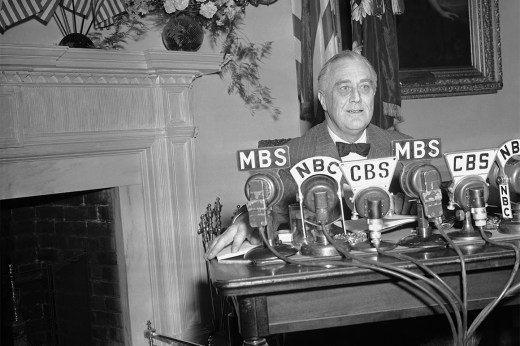
Image: Franklin Delano Roosevelt (January 1882 – April 1945) was elected President of the United Stares four times—1932, 1936, 1940 and 1944. His pioneering “ Fireside Chats,” broadcast on coast-to-coast radio, set a new standard in how political leaders communicate with the citizens.

Trendspotting: 5 Sales and Marketing Benchmarks

Your prospects are continuing to increase their control over the buyer’s journey, enabled by the internet and the work from home culture. That said, it makes sense for marketers to confirm our understanding of how buyers respond to your marketing activities. A few key data points, culled from a large and well-selected cohort, can provide to Freelancers and others who oversee marketing or sales functions valid insights into how buyers are responding to commonly used inbound and outbound marketing tactics in the post-COVID marketplace.

The content marketing company HubSpot, based near Boston, MA, began collecting marketing and sales outcomes data from its 100,000 + customers in January 2020 which was, as it turned out, a most interesting time to begin. Barely three months later the world would change radically. Billion dollar industries, most notably travel, hotel, restaurant and fitness, would crater. Those enterprises lucky enough to have survived, or thrived, have entered a changed business environment.

Benchmark data can provide guide posts that help you to get your bearings in the new business environment. The post-shutdown business climate demands a recalibrated understanding of customer expectations. How do prospects and customers want to experience the buyer’s journey now? How do they want to be sold? Find answers here in May 2021 data.

  • Sales meetings. The number of sales meetings in May 2021 (overwhelmingly made by videoconference call) was 21% higher than what was done last May and have risen 18% since March of this year. Knees were buckling in March 2020 and nearly every company was reeling, including those that were emerging as winners, such as grocery and liquor stores. Small business owners and leaders tended to reach out to customers sooner than larger companies. It is theorized that small business owners immediately realized that if they wanted their venture to survive, it was imperative that a plan to generate revenue had to be put into action, which usually meant figuring out a polite way to contact customers (I did the same). May 2020 was not the time to pursue new business, but rather to offer empathy and reinforce relationships that one hoped could be leveraged at some point, including relationships with those who cancelled contracts just 60 days previously.
  • Prospecting. Small business (1-25 employees) got busy prospecting at a frequency that was 31% higher in May 2021 compared to May 2020 and up 26% as compared to March 2021. Companies with 26-200 employees also saw an increase in prospecting activity of 18% as compared to May 2020, with a 17% increase as compared to March 2021.
  • Website traffic. Perfect your landing page! Website traffic was 34% higher in May 2021 than it was in May 2020. Further, website traffic increased by 25% between March and May 2021. Online shopping of various kinds, from home decor at Wayfair to the take-out dinner you’ll pick up in 20 minutes at a favorite local restaurant seems to have accounted for a big chunk of the increase. Software companies accounted for 51% of website traffic seen by HubSpot customers.
  • Chat bot. Speaking of your website’s landing page, a useful tool to add there would be a chat bot. Business moved online in a big way in March 2020, but the trend has been building for 20 years. Business owners and marketers are stepping up the functionality of company websites and adding a chat bot is a leading upgrade. Customers appreciate them because through chat, they’re able to get basic questions answered quickly and without paging through the website, which can be time-consuming. The volume of chat conversations rose 16% year-over-year May 2021 compared to May 2020.
  • Marketing emails. Reports of the death of email marketing have been greatly exaggerated and marketers are reinvesting in the genre (again!). Since the start of the pandemic shutdown in mid-March 2020, marketing email volume has increased 49% through May 2021 and is 52% higher pre-COVID volume. The open rate hovers at around 15% and that is 10% – 20% higher than April 2021.
  • Sales outcomes. U.S. Businesses adapted extremely well to the numerous protocols required by the shutdown, most dramatically demonstrated by the quick and often well- executed pivot to working from home. America means business! However, unreliable cash-flow prevented many customers from buying and that resulted in sluggish sales revenue in many organizations. In April 2020, sales outcomes bottomed out at 36% lower than 1Q20 benchmarks. Positive sales outcomes rose gradually throughout 2020 and May 2021 finished with a 10% increase in deals done (national or international companies). Deal creation (proposals) climbed 35% above benchmark.

So how do these statistics apply to you? They definitively show that the shutdown has ended, that money is being made agin and that you can make money again, too. Reboot your operation by using what have become standard marketing and sales strategies and actions.

Develop a powerful digital presence for your company. Employ Inbound and Outbound marketing and sales tactics. Optimize your website to help prospects easily find information about your products and services. Post and distribute relevant marketing content to confirm your expertise. Send emails to promote engagement with customers and prospects. Work hard, work smart.

Thanks for reading,

Kim

Image: A young lady gets serious about researching benchmark data.