What Kind of Consultant Are You?

According to Winford E. Holland, co-founder and partner of the Houston, TX consulting firm Holland & Davis, Inc. (now Endeavor Management) and author of Change Is the Rule (2000),  there are four types of consultants—Expert, Process, Coach and Temporary.  When deciding whether to enter the realm of Freelance consulting, or when you reassess the business model and branding strategies for your existing  consulting practice, think objectively about the type of services that you are qualified to offer, the type you like to perform and what you have the skills and relationships to sustain.

Your consulting category should be reflected in the elevator pitch you use to meet and greet colleagues and potential clients, in your marketing strategy and talking points/messages and your sales strategy, even if you don’t necessarily use the words “expert” or “process” or “temporary” (if you’re a coach, you’ll describe yourself as such).   Communicate to prospective clients what you’re best at doing and succinctly articulate what they’ll gain or solve when they bring you in.  Make your value proposition known straight away.

Your consulting category will become the core of your branding strategy.  There are so many consultants hunting for projects—you must differentiate.  Furthermore, when you communicate your brand, you will attract your ideal buyers, your target market.

Expert: These consultants have advanced knowledge and a deep skill-set in a certain industry or discipline, based on the individual’s education, training and work experience.  Their unique value proposition resides in content.

Process: These consultants excel in methods of process improvement.  For example, they don’t contribute content to the strategic plan, but they can facilitate the meeting at which company goals, objectives and strategies are discussed and prioritized and they may also guide clients through the plan’s implementation.  Their unique value proposition resides in methodology.

Coach: Helping clients recognize, manage and resolve their business (and sometimes also personal) challenges, decision-making questions, or professional development plan is the specialty of Executive Coaches.  Their unique value proposition resides in process, i.e., methods.

Temporary: These consultants might serve as short-term helpers on project teams.  Others may evaluate and install IT solutions such as computers, or smart home or office systems.  Their unique value proposition resides in content, in know-how.

“Successful consultants are problem solvers,” Holland says, “They’re passionate about what they’re doing and able to market their skills—and the latter is often their biggest challenge.”

The most successful Freelance consultants are invariably those who once worked for a consulting firm (I know one such person ant she is very successful).  Experience in the corporate world is almost as helpful, particularly if one reached the level of Chief, Vice President, or Director.  Veterans of senior positions are at an advantage when it comes to building a client list, because they’ve had opportunities to create relationships with their employers’ customers, who may be positioned to green-light projects and become their first clients.

The value that consultants bring to businesses is either content (Experts and Temporary) or process (Process and Coaches) and the most successful consultants are of the Process category.  Why? Because Process consultants aren’t limited by their highly specific training, education, or experience to a particular discipline or industry.  They don’t supply content (advanced knowledge), but they can apply their expertise in certain processes and methods to many industries.

Process consulting expertise is more flexible and valuable to a consultant’s money-making potential because it can be applied to many environments.  That flexibility can make up for the lack of content expertise.  That’s something to remember as you consider the type of consulting you should practice.

Thanks for reading,

Kim

Image: Portrait of Benjamin Franklin, founding father of the American Republic, statesman, inventor and polymath, conducting his kite experiment in Drawing Electricity from the Sky by Benjamin West (circa 1816) courtesy of the Philadelphia Museum of Art
Recipe For Success

Solopreneurs and owners of small businesses can benefit from what can be called a basic recipe consisting of time-tested business practices that will put you on the path to building a profitable enterprise that will make you proud.

Business strategy

Every business needs a strategy and a business plan is a very helpful tool that supports you as you implement your strategy to develop and launch your venture.  A complex strategy or business plan aren’t necessary to achieve success.  A one-page business strategy and a five-page business plan may do the job, as long as both are well thought out and executed.

A good business strategy (and plan) defines and drives the activities and behaviors of the entire organization. Without it, the business becomes a rudderless ship, lost at sea.  A well-conceived business strategy and properly written business plan reflect and support the business model and always address marketing, operations, finance, staffing and customer service, at a minimum.

Business model

The business model is the plan for how your company will generate revenues and make a profit.  The business model answers the question “Who is the customer and what does that customer value?” As a result, your business model must also spell out the company’s value proposition and what differentiates your products and services from those of competitors.

The business model will keep company leaders focused on the core markets and measuring success as defined by the business strategy.  Here you’ll detail a step-by-step action plan to operate profitably within your marketplace.

Marketing

In order to develop a realistic and potentially effective marketing strategy, it is essential to thoroughly research the most likely target customers for the venture.  What problem or goal will be solved with your products or services—what is the customer’s motive for doing business with you? How much will potential customers pay to obtain the solutions that your venture will offer?

Finding out which competitive products target customers now use to get their needs met is another essential marketing research function.  As well, you must learn the type of marketing and information gathering outreach that potential customers will find and trust.  An effective marketing strategy addresses how you will:

  • Identify target customers
  • Identify the products or services now used  (competitive products)
  • Describe how you will promote your products and services to those customers
  • Explain the positioning strategy for products and services
  • Discuss the branding strategy
  • Describe the sales strategy—how will you sell to customers
  • Address the pricing strategy
  • Identify advertising and social media marketing activities

Sales

The sales strategy that you adopt will depend on your target customers, your access to those customers and the competitive landscape.  You may be able to build referral arrangements and strategic alliances that allow you to generate enough sales to be profitable.  On the other hand, cold calling may be the most effective way to generate sales for your organization.  Will you sell in a physical location, or online? Will customers pay immediately, or will they be billed? The preferred selling approach a company uses is defined in the marketing plan.

Operations

Predictable, practical and streamlined business operations processes are a must.  The customer experience is closely linked to what happens in the behind-the-scenes delivery systems of products and services.  Think of it this way—when you go to your favorite breakfast place to get a muffin and coffee, you expect to receive what you’ve ordered with a minimum of fuss. That is how you start your day because it’s convenient and it makes you feel good.  You, business owner and leader, must create a similar experience for your customers if you intend to retain them.  Smooth business operations also play a role in building good word-of-mouth for your business.  Fail to develop a good operations plan and things could blow up in your face as disappointed customers spread the word about your shortcomings.

Unfortunately, many businesses give short shrift to the operations section of their business plan.  The purpose of thinking through operations processes is to increase business productivity and reduce costs as you offer the same (or better) outcomes to each customer, time and again.  There may be some trial and error along the way, but most of all it takes thought and planning.

Successful business leaders understand the need to continually improve business processes, to become more efficient and productive and able to respond to market changes faster, all the while providing excellent service to customers.

Technology

While technology is important, it needn’t be complex or costly to be effective.  Up-to-date technology products enable upgrades within any number of company functions: product manufacture, delivery of services, inventory management, payment systems, sales and distribution, marketing campaigns, quality control and customer service.

Finance

A realistic financial plan is the cornerstone of building a profitable enterprise.  Every business requires a financial roadmap and budget, along with the discipline to follow it.  You must anticipate and plan for business start-up or expansion costs,  projected sales and assisted by a break-even analysis, project that point in the future when the business will be positioned to make a profit.

The financial plan ensures that the business owner recognizes the most likely sources of business launch or expansion capital (will a bank loan or a partner be necessary?). A financial plan reminds owners where and how to spend money and it provides ways to measure progress, promote healthy cash-flow and warn of impending shortfalls.

Customer service

Smart business leaders treat customers well, because they are aware that there can be no business without customers who make purchases that create revenue and lead to profits.  Integrate customer service into your business practices and review those practices frequently to ensure that they are having the intended effect of facilitating customer satisfaction, repeat business and referrals.

Thanks for reading,

Kim

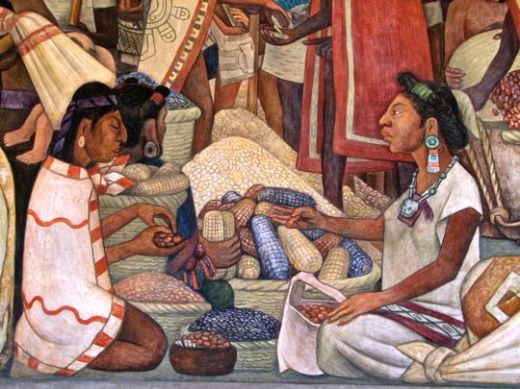
Image: One scene in a mural displayed in the Templo Mayor Museum in Mexico City, where thousands of artifacts were excavated from the ruins of Tenochtitlan, the former capital of the Aztec Empire (now called Mexico City).


The Art of the Sale: How Marketing, Branding and Advertising Help Revenues

Today, I respectfully offer you a tutorial. Our inquiry will focus on the essence of doing business: selling. The purpose of starting a business is to generate sales, produce revenues and earn a profit.  If a business cannot generate a certain threshold of sales, business expenses cannot be paid and the owner’s investment will be negatively impacted. To curtail mounting debts, the business must close.

Over the past 10 years or so I’ve noticed, sometimes with amusement and other times with dismay,  that the word selling seems to make people feel uncomfortable.  I noticed that frequently, aspiring business owners and Freelance solopreneurs, who must find customers and earn money that is derived from the exchange of money for the products or services that their ventures would produce and provide, avoided the word sell. Instead, the word market was substituted.

Many self-employed professionals are uncomfortable with the process of selling, so they’ve decided to banish the very word. It’s as if selling is now perceived as crass or pushy. That is a shame.  The sales profession is one of the oldest on earth and honorable. Selling is one of the foundations of civilization and selling skills are among the most useful anyone can have; it is the ultimate transferable skill.  Selling makes the world go round, because we wouldn’t have much of a world without it. The ability to sell is far more valuable than the ability to code (yes, really!).

So we can agree that the success of a business is dependent upon sales?  Now, let’s go back to the process of marketing.  The American Marketing Association defines marketing as:

The activities and processes for creating, communicating and delivering information about products and services that have value for customers. Marketing is a set of processes that are interconnected and interdependent with other business functions aimed at achieving the interest of (prospective) customers.

Marketing consists of using information, in words or pictures, to promote products and services and persuade potential customers to make purchases.  Customers have an array of motives that drive their purchases.  Marketing campaigns are designed to appeal to the motives of selected customer groups (e.g., parents, young professionals, adolescent males) that research has shown are potential customers for the product or service in question.  The purpose of marketing is to communicate with and appeal to targeted customer groups and persuade them that (your) products and services will satisfy one or more of their needs or desires.

So we can agree that generating sales is dependent upon marketing campaign promotion that is directed at the most promising customers for your products and services? I hope we can also agree that marketing and sales, while on the same continuum, are not one and the same.  Let’s move forward on the path and consider branding.

Branding campaigns are designed to enhance and expand marketing messages by differentiating and distinguishing the reputation of products and services available in the marketplace.  Products, services and individuals can, through an effective branding campaign, acquire a powerful reputation, recognition and loyalty among customers, fans and the general public.  That reputation is known as the brand.

A company logo is usually associated with products that have acquired sufficient popularity and sales to be considered a brand. That logo is instantly recognized and conveys the essence of the brand to its loyal fans, as well as those who may not use the product.  The product name itself will come to symbolize a powerful brand, as does Coca-Cola.

Now let’s take your marketing and branding messages to the public and that brings us to the next stop along the marketing continuum, advertising.  There are more ways to advertise than ever before, thanks to the digital age,  but do not underestimate the value of traditional methods.  The century-old medium that is radio remains a highly effective advertising tool, as do billboards.  Taxi cabs and city buses (and bus stops) announce local events, such as the circus coming to town.  Newspapers and magazines continue to be packed with eye-catching ads.

Content marketing, which many call the new advertising, continues to grow in influence.  It’s approach is indirect and it is presented as relevant information.  Content marketing is stealth advertising that uses primarily written information conveyed in blogs and newsletters to provide information about topics that would be of interest to prospective users of the products or services sold by the company.  The purpose of content marketing is to build an audience of regular readers who trust the source (you) and would feel confident enough to do business with you.

Then there are the social media platforms that are now in the mix. Regardless of the name social media marketing, when used for business purposes it is advertising: the Instagram photos of your wedding venue, the video clip of you accepting an award at the Rotary Club, the webinar posted to your website and LinkedIn profile.

If your marketing strategy and campaigns have been effective and enabled the development of a trustworthy brand and memorable advertising campaigns, your business will attract paying customers. Your business venture will generate sales and you can declare yourself a winner.  Let’s sum up our tutorial:

MARKETING:  How you envision and describe your company. The verbal, voice and visual messages used to promote your products or services. The business owner identifies the market positioning strategy for the company, based on populations predicted to  become customers: mid-market, luxury, or bargain, hipsters, seniors, adventure travelers.  Product positioning impacts all marketing campaigns and messages, the branding strategy and advertising choices.

BRAND:  The company reputation, what it is known for. How others perceive your company.

ADVERTISING:  How and where you portray and describe your company to the public: in print or digital, visual or audio formats placed in Popular Mechanics, Harper’s Bazaar, subway stations, flyers tucked onto car windshields, or Twitter.  Advertising usually costs money.

SALE:  The ultimate goal and final step of the marketing process.  The exchange of money (or another valuable item or service) for the purchase of a product or service.

Thanks for reading,

Kim

Photograph of Cher by Richard Avedon (1986)                                                                 Courtesy of the Ogden Museum of Southern Art in New Orleans, LA

Every Freelancer Is Agile

New, presumably more innovative, effective, market-responsive and profitable business practices are like the tides—they arrive with a big splash and quietly recede after a while.  Who remembers Management By Objectives? Are any of you Six Sigma certified? Has anyone worked for or with a company that launched a successful disruptive technology or service? The Next Big Thing is Agile, which arrived in the early 2000s, born in the software development sector.

What is agile? Agile is the ability of an organization to successfully respond to change:

  • Smart and quick when adapting to shifting business conditions
  • Timely response to evolving customer preferences
  • Create and maintain competitive advanges

Experience shows me that agile business practices are a natural for Freelance consultants and small business owners because that is how we can thrive and grow our client lists and revenues. We must adapt to the continually changing priorities and concerns of our clients, as well as local and national business conditions.  Should our revenues dip for three or more quarters, for example, we must be willing to re-think and possibly re-calibrate the products and services that we provide and how we package and sell them, that is, once we’ve figured out what those adjustments should be.  We need to create or identify as many competitive advantages as possible and use them to build customer loyalty, revenues and profits.

Business experts claim that agile is best suited to innovation—the development of products, services, business processes and business models.  IT departments were the original home of the agile philosophy, but the practice is expanding into marketing, product development and even project management.  Agile organizations support achieving the best outcomes and they agree that innovation happens from the ground up.  Agile is the opposite of top-down management.

Agile practices are carried out by teams that are typically small and multidisciplinary, to enable creativity and efficiency.  Teams approach large or complex problems or projects by breaking the task down into manageable components.  Team members study the case at hand, next develop and test solutions for each component and finally integrate the solutions into the project as a whole.  Agile teams are accountable for outcomes: profitability, growth and market share, for example.

Organizations that promote agile teams put them into motion when a project or challenge is complex, solutions seem unclear and the team is able to collaborate with the client or end-user of the product or service.  Does that describe the situation of every Freelance consultant and small business owner, or what?  We were born to be agile.  We can now think about where and how to use our already agile skills and learn how to consciously incorporate the practice into our business.

The agile philosophy directs us to survey and assess our business goals and choose what will best respond—product/ service development (or tweaking what is currently offered), marketing, the business model and technology can be considered for your entrée into agile.  Next, develop your goals and list of desired outcomes.  For example, are you looking to attract certain clients to the business (big-ticket, for example)? Are you wondering if you should adjust your business model to better respond to shifting client preferences? Or has a new technology impacted the way your clients can engage with or do business with you but you wonder if the investment will likely deliver a good ROI?

Whatever you decide to pursue, once you choose a challenge to tackle, break it down into components and study each segment.  If it’s your business model that’s going under the microscope, agile will guide you as you examine the aspects of what makes a successful business model and help you avoid becoming overwhelmed with the size of the project or frightened by what is at stake.

With agile, you can look at the moving parts, basically turn them upside down and shake them and rationally hypothesize about what, if anything, you can do to tweak the money-making engine of your venture.  What can you do about your products and services? Is your sales strategy helping or hindering sales? Should you take on the expense of accepting credit cards to stimulate big-ticket sales? Small business owners who have employees can perhaps involve certain of their staff to weigh in on these matters, whether they have front-line customer involvement or back office operations experience.

With agile, you and your team can propose incremental improvements, test them in combat and incorporate what is successful.  The small successes will encourage you to move forward in your problem-solving and eventually you will achieve larger and more impactful outcomes and goals.

Agile practices  lead to greater efficiency and productivity and allow your organization to be more responsive to client needs. Agile will show you the way, step by step. It has great potential to deliver measurable improvements to your business, especially when you’re not sure what will work.

Thanks for reading,

Kim

Photograph: Guru B.K.S. Iyengar, who founded the Iyengar yoga technique in the 1970s (photo date unknown)

Win Every Negotiation With These Tactics

Chris Voss is a former FBI lead negotiator for international kidnapping cases, founder and CEO of The Black Swan Group, a firm that provides negotiation services to law enforcement, businesses and governments and author of Never Split the Difference (with Tahl Raz, 2016).  When you are faced with a very important negotiation that you’ve decided is a must-win, Voss offers these field-tested tactics:

  1. Mirror words selectively

Validate your negotiating counterpart’s perspective by repeating back four or five of his/her words when s/he expresses something that is apparently important to him/her.  Do this and without realizing it, your counterpart will become more trusting and candid because you will have shown that at least somewhat, you hear and understand his/her viewpoint.

Furthermore, it will be to your advantage to slow down the pace of the conversation, to give yourself more time to think and ideally, gain more control over the process. While negotiating, speak in a calm and comforting tone of voice and a measured pace. Chris Voss suggests that you take on the vocal tone and pace of a late night radio disc jockey.

2.  Practice tactical empathy

Show strategic empathy for your negotiating counterpart by helping him/her to own and label fears or reservations. “It sounds as if you’re afraid that…” and “You seem to be concerned about…” will be phrases that you’ll employ.  Everyone wants their feelings to be recognized and understood.  Communicate empathy to neutralize distrust and emotionally disarm your counterpart.

3.  Get to “no”

Being pushed to say yes can make some people feel trapped and they’re liable to become defensive.  Make your counterpart feel in control by creating opportunities for him/her to say no.  We feel safer when in control and the ability to refuse a request will support that.  The smart negotiator will selectively present questions that will likely cause your counterpart to say “no.”

Start by confirming the negotiation meeting, once you’re both in the room: “Is this a bad time to talk?” S/he is likely to say “No, this is a good time to talk,” since the meeting date and time were mutually agreed upon.  If the negotiation becomes tense, ask “Have you given up on reaching an agreement?” Again, the reply will likely be “no.” Your counterpart sees benefits in reaching an agreement because if s/he didn’t, there would be nothing to discuss and no meeting.

4.  “That’s right”

The beginning of a negotiation breakthrough is signaled when your counterpart feels that you respect his/her position, priorities, concerns, fears, or feelings.  Lead your counterpart to say “that’s right” by confirming his/her feelings and must-haves, remembering to underscore your appreciation of his/her point of view by repeating back four or five of his/her words.

5.  Resist compromise

Prepare exceptionally well for the negotiation by researching and anticipating the expected motivations, priorities, strengths, weaknesses, biases and company culture of your negotiation counterpart.  Develop a list of your competitive advantages and use them to prevail.

Pay attention to your counterparts facial expressions, tone of voice and body language and use that feedback to assess whether or not s/he is telling the truth.  Use a deal-making deadline to create a sense of urgency that will encourage your counterpart to accept your terms and get what seems to be the most s/he can get out of you by reaching an agreement.  Make your counterpart feel that if s/he declines to accept your offer, it will feel like a loss to him/her.  Play to win.

6.  Create the illusion of your adversary’s control

Use what Chris Voss calls “calibrated questions” that are designed to allow your counterpart to bring his/her must-haves, concerns and goals and perhaps also biases or world view, out into the open and make him/her feel good about having the opportunity.  Voss suggests that you pose questions that start with “what” or “how,” which will open the door to a candid conversation and not be perceived as demanding. The answers to these questions typically reveal lots of valuable information that you can use to your advantage later in the negotiation.

“What’s the biggest challenge you face?”; “What are you up against here?”; “What are we trying to accomplish?”; and “How is that worthwhile?” are phrases to remember.  Should your counterpart throw you a curve ball question, throw one back with “How am I supposed to answer that?”  Then shut up and listen to the answer, which will probably be some incoherent sputtering, or blurted information that gives you an unexpected advantage.

When your counterpart pushes back on something that you’ve proposed, ask “What about that doesn’t work for you?” or “What would you need to make this work?” When you need to throw off a refusal of your terms but still continue to move the ball down the court, rebound with “Let’s put price aside for now and talk about what would make this become a good deal?”

Finally, let your counterpart make the first offer, because that will reinforce his/her feeling of control and it might possibly exceed your expectations.

7.  Confirm the agreement

Validate that your counterpart’s “yes” is real by leading him/her to reconfirm what’s been agreed to at least three times.  To reveal behind-the-scenes deal killers, ask “How does this affect the rest of your team?” Get your negotiated agreement in writing ASAP.

Thanks for reading,

Kim

Photograph: The Basic Training of Pavlo Hummel by David Rabe, presented in New York City (l-r) Tisa Chang, Al Pacino, Anne Miyamato and Don Blakely (1976)                               © Afro Newspaper/Gado