Overcoming Income Inequality

Happy Halloween! Today, we’ll take a look at one of the ultimate Trick or Treat scenarios, the business model known as the Global Economy (the most recent version, that is—trade has been global at least since the glory days of Timbuktu) as well as other factors that will impact your income.  The Global Economy as we know it began about 20 years ago, midwifed by the internet.  There is plenty of evidence to show that the vast majority of the world’s 7.6  billion souls have received only a global Trick, while a fortunate “1% of the 1%” has received a nearly endless supply of economic Treats.  Most of the candy is in the goody bags of the 2,043 billionaires in the world, 233 more than there were in 2016.  In aggregate, they are worth $7.7 trillion USD. (Forbes Magazine, October 2017)

Earning a living isn’t getting any easier for the 99.99%.  In the October 8 and 15, 2017 issues of The New York Times, lengthy articles appeared and told sad tales about blue-collar workers.

From Indiana came the story of skilled factory workers who until recently earned $25/hour.  Those workers have now joined the growing ranks of low-wage and  underemployed workers, in the aftermath of the ball bearing factory’s move to Monterrey, Mexico.

Factory leaders appealed to the Indiana workers to train their Mexican replacements.  Despite significant peer pressure from most of their colleagues a few agreed to do so, primarily to receive the $5000 bonus that was promised to those who cooperated with the transition.  But once the replacements were trained,  factory leaders reneged on the $5000 bonuses.

Workers south of the border are paid less than $6/hour for their skilled labor.  Most of the former ball bearing factory workers in Indiana have secured other employment, but nearly all have seen their wages cut in half.  Financing their housing costs is an issue for many.

From Oslo, Norway, came the story of construction workers whose labor has remade the skyline of that city, capital of a nation that has become wealthy on profits from North Sea oil that was discovered in the 1960s.  Pay for construction workers remains generous, thanks to a strong union, but workers haven’t seen a pay raise in five years or more.  Further, workers from eastern and southern Europe are now being hired by local construction companies and factories at considerably lower wages than Norwegian citizens receive, so that the companies can compete successfully for projects that are put out to bid by national or global firms.

The global economy has caused workers everywhere to get low-balled on wages and benefits, whether we are blue-collar skilled labor or white-collar professionals.  Most companies fear losing a contract to a competitor; their strategy has become to keep internal expenses low, so that project proposals can include not only lower prices for the prospective customer, but also more in-house profit.  To minimize the heft of payroll, which is usually the biggest expense on the P & L statement, companies send jobs off-shore, recruit and hire foreign-born workers who desire a residency visa and are willing to accept a lower salary to obtain one , or clandestinely hire illegal aliens at bargain-basement pay.

Meanwhile, citizens who are employed at well-paying, full-time, benefits paying jobs are loath to complain or quit, because what are the chances of doing better financially at another company? For most, it’s smarter to grin and bear it.  Maybe you can rent out a spare bedroom on Airbnb or drive for Lyft or Uber to make extra money?

Another factor that depresses wages and impedes hiring is what appears to be lingering discrimination against 50% of the population.  Honeybook, a company that provides administrative support to the various specialties that service the special events and conference planning industry, in a 2017 report on the gender pay gap reported that on average, women earn 24% less than men and in the finance and insurance industries, women earn 29% less than their male counterparts.

Female Freelancers in the events and conference planning industry fare even worse. Honeybook analyzed 200,000 of the client invoices they prepare for affiliates from October 2016 – October 2017 and found that women who Freelance earn 32% less than men in the industry.  Female photographers make 40% less than their male counterparts and female event planners make 24% less than their male peers earn.  Regarding annual earnings, 42% of men earn more than $50,000 per year, while only 20% of women are paid at that rate; 20% of men earn at least $80,000 annually, while only 8% of women are able to do so.

Things are even more dismal for women at the top of the self-employment food chain, the venture capital funded start-ups.  The start-up database Crunchbase confirmed that globally, 43,008 venture capital-backed start-up enterprises were founded from 2009 – 1Q2017 and 6,791 (15.8%) of those companies had one or more female founders.

Crunchbase reports that in 2016, start-ups founded by men received a total of $94 billion in seed (angel) investment fundraising, while start-ups that had even one female founder received a total of only $10 billion.  Start-ups with one or more female founders raised 19% of all seed investment rounds, 14% of early-stage venture rounds, 8% of late-stage venture rounds.

Yeah, OK, so do we continue to cry into the champagne, or maybe do something substantive? The Honeybook crew strongly suggests that women (and men) who are Freelancing to negotiate rates and in fact, to come in with a project fee or hourly rate that reflects the quality and value of your work in the marketplace.  This is not exactly easy, however, and requires some courage. No one wants to lose a contract to a competitor, or to be challenged by a prospect.

Regarding negotiation, Freelancers have an advantage over the traditionally employed because fee negotiation is not unusual.  To succeed in a negotiation, it’s necessary to do a bit of research in advance to learn more about the project.  The process is quite simple—talk to your prospect and ask a few basic questions.  If you learn that your work will bring the client a significant ROI, or if a deadline looms, let that be reflected in your project fee or hourly rate.

If the client balks at your pricing, do not lower your fee.  Instead, adjust the scope of the work you’ll do.  If at all possible, avoid allowing a prospect to dictate your pricing terms.  Ask how much has been budgeted for the project and then decide how much work you can afford to perform for the money available.  Address the client’s most urgent needs and make him/her feel good about the value s/he will receive when your superior expertise and work ethic are applied.

Regarding female entrepreneurs, Crunchbase notes that there are now several angel investor networks funded by female investors who welcome women who lead venture capital backed enterprises.  Access to capital when it’s needed is crucial to a start-up venture’s success.  Women helping women is how we can climb the mountain.

Thanks for reading,

Kim

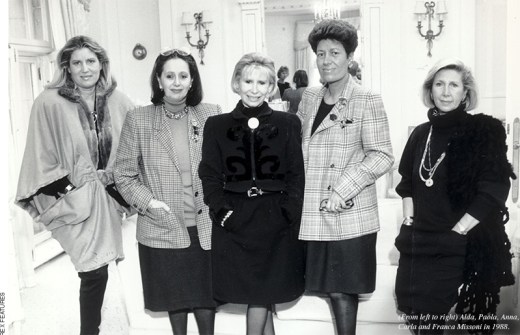
The Fendi sisters (l-r) Alda, Paola, Anna, Carla (who passed in June 2017) and Franca took over the business founded in Rome by their parents Adele and Edoardo in 1925.  Led by Carla, they transformed Fendi into an international brand that is now owned by LVMH.   Photograph: REX (1988)

Leverage Your Brand and Make Money

Hello Freelancer friend and thank you for coming back to continue our examination of how Freelancers who are just regular folks can leverage our know-how to generate a sufficient income in the 21st century knowledge economy.  For most, it is an uphill battle.

One very ambitious (and possibly overwhelming) monetization strategy is to write a business book that will either:

  1. tell your business creation story— how you overcame adversity and persevered until you prevailed, or breezed through every door and stumbled into lucrative assignments
  2.  function as a how-to guide that details how the reader can become a more proficient and successful public speaker, financial manager, business strategist, Freelance consultant, or the like

A business book is an evergreen PR tool and door opener.  Authors are often asked to give quotes to journalists and content producers, are more often invited to speak at business or professional association meetings, receive more adjunct teaching opportunities and are considered more qualified than non-authors by potential clients.

Podcasts are another promotional strategy, one that is more accessible than writing a book.  Ideally, podcasts will position a Freelancer to monetize his/her knowledge or skills and it’s not necessary to create a series that will attract thousands of listener downloads and a gaggle of advertisers.  For at least a handful of podcasters, several of their strategically selected guests have become clients.  However, in order to make that transition, one must be the host of the show and not merely a guest.

Yet, if one appears as a guest on enough podcast shows and moves up the food chain to appear on popular shows, it will be reasonable to apply that achievement to the pursuit of paid speaking engagements.  Preferably, speaker circuit bookers will find you, but it would nevertheless be worth your while to initiate contact.  You could possibly receive offers in the $250 – $750  per talk sector.  You won’t get rich, but you might create a modest revenue stream and enhance your ability to attract big-budget clients to your core business.  Along with your podcast appearances, become a panelist or moderator at conferences sponsored by neighborhood business associations, chambers of commerce, or professional associations, to hone your pubic speaking skills and enhance your presence and brand.

Finally, there is the growing popularity of creating and presenting online courses.  If you are an experienced teacher and comfortable in front of the video camera, you may want to brainstorm a course or two to create and present.  Essentially, this means you must identify a problem and then design a course to solve it.  Click the link and get information on how to  create your online course

In closing, I don’t see much of a solid business model in the new economy brand and knowledge monetization game, I’m sorry to say, and maybe that’s why so many Freelancers are struggling.  As I see it, a business model is similar to the template for a franchise.  The template is not as precise as a mathematic formula, but given similar business conditions and customer demographics,  one can produce the desired outcome.  In other words, if you buy a CVS or Dunkin’ Donuts franchise, you will make money if the store has the right location and management.  Unfortunately, our fortunes in the 21st century knowledge economy are not so predictable.

Dorie Clark (no relation), author of Entrepreneurial You (2017) and frequent contributor to the Harvard Business Review, advises Freelance consultants to follow these steps to monetize our knowledge and brand:

  1. Cultivate an inner circle.  From this group, one receives feedback and  encouragement.  If some in your circle are well-connected, they may provide important client referrals and open other doors for you as well.
  2. Build an audience.  This is how you launch your monetization strategy.  Announce the roll-out in your blog or newsletter, on your website and on social media and YouTube.  The goal is to become visible.
  3. Build your community.  As your audience grows, you must encourage them to talk to each other and connect around your concept. The community will initially be nurtured online, probably through Facebook and Twitter. Eventually, you will solidify your community support with ticketed face-to-face gatherings where you are the featured speaker.
  4. Build trust.  Your community has to trust and respect you.  Continue to create content that they find relevant and be careful in what and how often you attempt to sell to them.

Thanks for reading,

Kim

Image: Screenshot of Paul Masson Wines advertising campaign. Academy Award winning writer (Best Original Screenplay 1941, Citizen Kane), producer, director and actor Orson Welles was the Paul Masson Wines (of California) brand ambassador from 1978-1981.

How to Monetize Your Brand

In the internet age, there are numerous Freelancers who gain significant notoriety through social media platforms, mainly Instagram, Facebook, YouTube, Twitter or their blogs.  Their accounts have thousands of subscribers and followers.  Paid advertising deals have come to about all of them and provide a revenue stream.  However, advertising deals are not all equal and advertising rates received can be too low to substantively impact one’s financial status.  Often, the achievement of notoriety earns these Freelancers little money.

Among the primary differences in earning a living in the 20th and 21st centuries is that in the former, one made money by doing a particular activity, such as law, medicine, secretarial, writing, or being a musical entertainer.  In this century, there are proportionately far fewer traditionally employed full-time workers and many more of the self-employed.

A 2017 study by Intuit (maker of QuickBooks) reports that 34% of U.S. workers are self-employed, swelled by Lyft and Uber drivers who join the usual plumbers, electricians, website developers and event planners.  The path to money for Freelancers is to skillfully parlay the achievement of notoriety into a series of revenue streams that create a sustainable income.

For example, Freelance writers of magazine articles were formerly paid $1.00 per word or more and many publications would regularly hire writers to produce 500 – 1500 word articles. The writing life was good.  Even those who wrote for a mid-level daily newspaper and occasionally submitted a story to a middle-brow magazine could be financially comfortable.

Then the internet age arrived and turned the world on its head, in more ways than one.   Online ads may sometimes be clever but they are apparently perceived as less compelling than the full-page ads that once fattened your Sunday newspaper and as a result, online ads command a lower price.  Advertising revenue is tanking and has caused publishers to cut back on editors’ salaries and perks.  Compensation for writers at online magazines is a mere pittance.  In the literary world, advances to writers have become smaller and less frequent.  Book tours are for big-name authors only.  Publishers and editors-in-chief have much smaller budgets and the chauffeured town car to take them to the office is about to disappear.  The Vanity Fair and Rolling Stone editors-in-chief recently announced their retirements.

Musical entertainers of every level made money from record sales, singles and albums, plus touring.  But in the late 1990s that began to change when Napster brought about peer-to-peer sharing of music files. Today, music is downloaded and performers from Nicki Minaj, who is the face of MAC cosmetics, to Lady Gaga for Tiffany & Company, use their famous brands to generate millions of dollars for the corporation and themselves by appearing in ads.  Touring remains relevant but music sales, for decades the very reason for being for a musical entertainer, are greatly diminished.

In the 21st century, one must learn to generate a livable and sustainable income as a result of one’s writing, or other expertise.  This is an unprecedented shift in the way an economy works.  The big challenge for those of us who are self-employed and following the playbook as regards developing a strong online presence, teaching at the university level, speaking at business and professional associations will not appear in an auto advertisement any time soon monetize their comparatively modest brand and perhaps superior expertise?  For those who no longer find an open door to full-time, benefits paying employment, making a living only becomes more difficult as time goes on.

So what does one do? Suggestions on how to make money by building on your brand will be featured in next week’s post.

Thanks for reading,

Kim

Academy Award winning actress Joan Crawford (Best Actress 1945, Mildred Pierce), who was the Pepsi Cola brand ambassador, in Frankfurt, Germany (1963).  Photograph: Tony Evanoski/Stars and Stripes (publication that has served military personnel since 1936)

Freelancers Hiring Freelancers

Are you preparing to submit a proposal for a big assignment you hope to win and know that the project specifications will cause you to subcontract some of the work? Congratulations! You will have the pleasure of hiring one or more of your Freelancer peers. Together, you will become a team whose mission will be to produce the client’s deliverables by achieving outcomes of the highest quality, on or in advance of the project deadline and on budget.

You, the external team leader, must understand the skills that the project requires, know how much it will cost to secure the services of your Freelancer team and write a winning proposal.  Project management is an everyday reality for Freelance consultants and the bigger the project, the more planning is involved. Your reputation is forever on the line and when subcontracted work is involved, you must be diligent in your search to identify the best talent to bring on board.  Read on and get some helpful advice on how to assemble a winning team that will enhance your brand and your billable hours, current and future.

Get budget estimate

Get a reliable project budget estimate from your client, if possible.  If the client prefers playing possum with that amount, then make sure you are able to accurately estimate both the quantity and quality of work the project requires so that you can first, calculate your own labor cost and target profit margin and next, understand what you must budget to pay your subcontractors.

Hire specialists

Directly ask candidates you interview and confirm that the skill you need is a competency in which that candidate excels and that s/he has performed often enough to claim deep experience.  You are in no position to train someone on the job.  You must guarantee superior results.

Pay well

Why not ask candidates what they want to make as a subcontractor on the project? Start by researching the going rate range for that specialty, so that you’ll know what to expect to pay and you can rule out those who attempt to take advantage of you.  People will do their best work when they feel valued. They’ll be happy to give extra to make you look good and make themselves shine along with you.  They’ll go above and beyond because they’ll want to be hired to work with you again since you value their capabilities.

If you encounter someone who seems a perfect fit for the project but his/her subcontracting fee is somewhat beyond what you planned to offer, then ask what perks might make that person happy, in addition to money.  You may be able to get who you want for a little less money if you give a little more in another area that demonstrates how you value the skill set.

Set clear expectations

If the project is on a tight time frame and in order to meet the deadline long hours and a seven-days-a-week schedule will be needed then you, the external team leader, must present this schedule information to your candidates in the interview.  You need team members who are able to block out the necessary time and are willing to work hard.  If time is an issue, expect to pay a premium to your subcontractors and add a premium to your own fee as well. Develop a contract for your subcontractors, so that all responsibilities, relevant milestones, the project deadline and the rate of pay are in writing.

Communicate often

Request weekly or bi-weekly written progress reports from your subcontractors and send similar updates to your client.  Announce to the client and your subcontractors whenever a project milestone has been met.  Interim victories will give you an opportunity to thank and congratulate your subcontractors and inspire them as you do.  Learning that you and your team have reached a milestone gives your client confidence in you.

View work samples

In the subcontractor interviews, be sure that work samples provided correspond with the project specs, to confirm that you are evaluating what is relevant.

Check references

Ask to speak with two of your candidate’s clients.  Confirm the type of work that the candidate has done for each reference.  Inquire about the quality of that work and the candidate’s willingness to do what was needed to get the job done.  Ask what it’s like to work with the candidate—is s/he positive and upbeat, or a constant complainer? Finally, ask if there’s anything else you should know about the experience of working with the candidate.

Paperwork

Once you understand the project specs, the role that your subcontractors will play and what you will pay for their services, you can then write a draft contract.  Also, download from the IRS website tax form W-9 for your subcontractors to complete and return to you. You’ll retain the W-9 and use it to prepare and mail to subcontractors IRS form 1099 before January 31 of the following year if payments to any subcontractor reach $600.

Finally, set up an accounting method that will allow you to easily and accurately calculate hours worked and dollars earned for each subcontractor.  If you’ve seldom worked with subcontractors, then speak with a bookkeeper or accountant for more information.

Thanks for reading,

Kim

Photograph: Seven Samurai (Japan, 1954) Directed by Akira Kurosawa and starring Toshiro Mifune (foreground)


When Negotiating A Project Fee

There are ways to strong-arm a highly competent Freelance professional who is ready to give a client his/her best work into accepting less than that Freelancer’s proposed project fee.  So many desperadoes are willing to work for pennies and that can make it difficult for those whose work quite simply is more valuable because s/he brings expertise and work ethic that ensure the project work will be flawless and client expectations will be met.  Those qualities should justify almost any project fee.  But sometimes, clients like to low-ball.

What do you do when s/he who would be your client tells you that you charge rather more than others for the same work? Remember that the best defense is a good offense and start justifying your pricing strategy from your initial contact with the prospect. Continuously model professionalism and expertise that separate you from the hoi polloi.

Remember also that Rule Number One in the consultant’s bible is to never cut your price. Not-for-profit organizations can receive a 10%- 25% discounted rate, but under no circumstances do you lower your hourly or project fee for any client.

Instead, add in a modest service upgrade at no charge, to make the price more palatable.  You can also scale back the work and that would be associated with a fee reduction, but one does not do the originally requested work for less money.  If the client becomes adamant about receiving the original project specs at less than your proposed fee, then find the courage to walk away.

I know that billable hours may not be falling out of trees, but you cannot participate in a race to the bottom.  Do not get sucked into competing with online Freelance service mills.  Read on and learn to create your rebuttal.

Exhibit your expertise

Clients get what they pay for and pay for what they get! Let prospective clients know that when you are hired, a task can be completely handed over to you and you will own it. Furthermore, you are willing to use your expertise to make suggestions that might improve the quality of the project deliverables.  You are a first-rate service provider who is dependable, responsive, talented and trustworthy.  Your work is done correctly the first time and there will be no need for either micromanaging or do-overs.  The client’s role in completing the project will be much lighter and that adds up to value.  These practices and competencies are reflected in your project fee and hourly rate.

Reveal your responsiveness

Especially when an important deadline looms, reassure your prospect that you are prepared to work hard and ensure that project milestones and the deadline are met.  You understand that sometimes, late nights, weekends and holidays must be at least partly devoted to work.  Your admirable work ethic is reflected in your project fee and clients who are in a hurry find your fee structure reasonable.  Your project fee includes timely communications, responding to feedback, generating ideas and more.

Demonstrate your dependability

Clients can be confident and relax when you are on the job because they know and trust your work, attention to detail and diligence.  You make life easier and allow the client to attend to other duties while you manage the project.  Project work is reliably completed as requested and within budget.  Your clients look good to their superiors, peers and direct reports.  No one winds up with egg on their face when they hire you.

Trot out your testimonials

In addition to your LinkedIn recommendations and endorsements, you no doubt will be able to supply client testimonials from one or two satisfied customers who will speak on the record with a prospective client.  If you have one or two client success stories on your web site so muh the better, as these are case studies that detail the client journey and spell out the wonderful work you can do.

Thanks for reading,

Kim

Photograph: Mike Tyson (left) by Milo threeoneseven for ESPN (date unknown)