I’ve often recommended that Freelancers seek out speaking opportunities as a way to meet potential clients or referral sources, enhance your brand, add names to your mailing list to support leadgen activities and to generally build name recognition and expand your influence. Speaking before an audience, in-person or virtual, is a golden opportunity and, as noted, confers many tangible and intangible benefits. But the cold fact is, speaking engagements often do not pay, or pay only a modest amount.
As a seasoned professional with wisdom to share, you deserve to be paid for speaking engagements but unfortunately, that is not always the case. While occasional pro bono speaking engagements might be building blocks for your brand, it nevertheless makes sense to get some quid pro quo. Use some creativity and moxie to first, think about acceptable substitutes for money and then ask the organizer what can be done for you. In other words, redefine what it means to get paid and negotiate for an alternative form of payment that will compensate you for the value you’ll deliver. The alternative payment might be tangible or intangible. The idea is to not walk away empty-handed and create a win for yourself and the organizer.
As you consider what you may be willing to accept in place of monetary compensation, remember what is required to prepare a talk. Typically, a one hour program consists of about 45 minutes for the presentation plus 10-15 minutes allotted for your introduction and Q & A. Presentations require numerous hours to prepare—slides must be designed and created and maybe handouts, too. Practicing your delivery and figuring out how to best integrate the visuals can take three hours or more. You’ll want to negotiate for a fee alternative that for you will be a high-value commodity, even if it’s not money. Here are seven possibilities to consider:
Networking opportunities
There is value in relationship-building conversations with leaders. Request an introduction and 30 meeting with a leader or decision-maker within the organization to build broader deeper networks. This creates long lasting connections after your talk. Research the organization to help you prepare a list of questions you can ask and to also help you understand how you can be a resource to the organization and vice versa.
Testimonials
Ask an organizer in a leadership role to provide a flattering quote or endorsement that can be uploaded to your website or LinkedIn profile. If there is a heavy-hitter in the audience, ask the organizer to introduce you and ask if the VIP would be willing to supply a quote that you can record as a video.
Referrals
Request that if your talk receives positive feedback from the audience, you’ll be invited to speak again in 24-36 months. Or, if the organizing body happens to be the local chapter of a regional or national organization, ask your local contact to recommend you as a speaker at the regional or even national level. You can also ask to be referred and recommended to speak at a related organization or conference. The goal is to use this first opportunity as a stepping stone for upward mobility.
Discounted memberships and dues
Many speaker series programs are hosted by organizations whose members and programs can provide networking and professional development opportunities for you. Consider asking to receive a waived or discounted one-year membership, to help expand your network, upgrade your skills and save money as you do. Or you might request comped admission to certain upcoming programs that you’d like to attend.
A public speaking coach to build your skills
Ask your con if the organization has affiliations with professional storytellers or public speaking coaches. If so, request that the coach meet with you for an hour or two, to give feedback in advance of your talk. Or, ask for the coach to attend your presentation to evaluate you and provide verbal or written feedback. Using your talks as opportunities to improve your speaking skills is always a good strategy.
High-resolution event photos
Some speaking engagements are still virtual, but if your talk will be in-person , request that a photographer, if available, takes action shots of you at work, speaking at the podium and interacting with the audience. You might also request that the photographer take a headshot of you. High-quality photos are an important resource and images of you in action are especially valuable, but may be difficult to obtain. High quality, recent photos are guaranteed to be excellent additions to your print or online promotional materials, from website to media kit.
Social media boost
Ask the organizer to record the presentation, whether virtual or IRT, and send three of four five-minute highlight video clips for you to upload to social media. Teaser videos can also be used to promote your content and speaking style. Use the material as a demo reel to help solicit further speaking opportunities.
Thanks for reading,
Kim
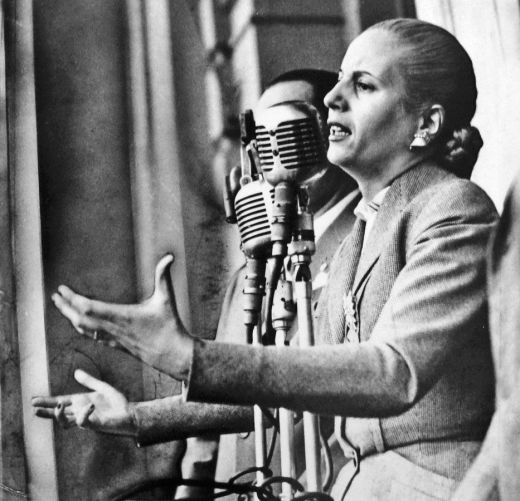
Image: Former first lady of Argentina (June 1946 – July 1952), Eva Peron electrifies a crowd




 Freelancetheconsultantsdiary's Blog