Give Me A Break!

Ambitious people work hard. Their to-do list is too long—and they wouldn’t have it any other way. They are achievers and they have mountains to climb. They are always flat-out crazy busy and cannot afford to waste a single moment. Working hard, working smart (hopefully) and working nonstop defines being productive, as they see it. Productivity is the engine of ambition. To the hard-working ambitious, this is a no-brainer, right?

It seems that many, if not most, ambitious people buy into this mind-set. To show the world (and themselves) that they are not slackers, they may brag about sleeping just four or five hours at night, because they have so much work to do. Others brag about waking up at 5:00 AM, so that they can wring as much productivity as possible from the day. Working 10 or 12-hour days and maybe skipping lunch, too, is standard behavior for members of the Hard Working Club; even vacations can include a Dropbox file filled with documents to review and a list of emails destined to populate their send file.

If the above scenario describes you, please know that I admire your ambition, work ethic and determination to succeed. To keep you on your path, I respectfully offer an observation—in order to sustain your ability to work hard and smart and maximize your productivity so that you can take aim at the ambitious goals you want to achieve, you must effectively manage your energy, concentration (i.e., focus) and endurance, mental and physical. Proper management of energy has nearly as much impact on productivity as the time spent working on your task.

Recall an instance when you finally had time to work on a task that was hanging over your head, but you put it off because you were too unmotivated or exhausted to do it. What your brain and body were telling you was that every once in a while, it is beneficial to stop working and rest. Rest periods—breaks—during your working day are more powerful than you might realize. In fact, rest breaks can improve productivity because they allow you to replenish your physical and mental energy.

A period of at least 10 minutes, during which you stop working and engage in a restorative activity (or inactivity) helps your body and mind to relax and refresh. Fatigue undermines concentration, creativity and endurance. Ignore that reality and you can find yourself unable to focus or perform well. Habitually pushing yourself to work through fatigue is not a sign of discipline or determination. Ignoring your human needs is counterproductive and can lead to burnout, a condition associated with unfortunate physical and psychological consequences.

By contrast, taking short breaks throughout the workday will restore your energy and help you maintain the physical and mental endurance needed to maximize your productivity. Taking breaks also supports the healthy self-regulation of your emotional state and behavior—that is, your mood—to promote positive interactions with others. When over-tired, we are vulnerable to responding to others in ways that are reactive—brusque or irritable—and we’re prone to taking frustrations out on others.

So, to stay at the top of your game, take a few micro-breaks throughout the day. Those respites can be as brief as 10 minutes in duration, but they matter. Just as micro-stresses might accumulate at work, micro-breaks can help you counter the negative effects. Below are examples of how and when you can incorporate restorative, productivity-enhancing breaks into your crazy busy workday.

1. Give yourself permission to take breaks.

Challenge the assumption that you’re too busy to take a break—you can’t afford to not take a break! Instead of leaving it to chance that you’ll find a few random minutes to squeeze in the rest you need, be as intentional about restoring your energy as you are about working hard and being productive. When you get into your car to begin a journey, you must have fuel in the tank. Taking a break during your workday is like going to a filling station to get the fuel needed to reach your destination.

2. Schedule breaks and set reminders.

Schedule blocks of time during the day when you’ll step away from work-related activity and do something that allows your mind and body to relax, so that you can replenish your physical and cognitive energy. You can let your biorhythms guide your break time and schedule a rest period when science predicts that your energy is at its lowest — in mid-to-late afternoon.  Research shows that our energy is typically lowest at around 3:00 P.M. You might try giving yourself 15-minute breaks at mid-morning and mid-afternoon, plus a 30-60 minute lunch break. Adjust the timing as you see fit.

If you’re inclined to get lost in your work and ignore the physical or cognitive hints that signal it’s time to rest a few minutes, install a pop-up alert on your desktop or phone to encourage you to stop working for a few minutes. Having a visual cue on your workspace screen, maybe a coffee mug, or an image of someone walking a dog or in a yoga pose, is a practical and entertaining reminder that break time has arrived. There are several apps designed to do this and some are free.

3. Build on bio breaks.

The breaks we must all take are the bathroom breaks. You can build an add-on to one or more of your bio breaks by “stacking,” that is, developing a new habit by attaching it to an existing habit or behavior. So, after your bio break, add your preferred relaxation or exercise activity. In this way, you pair something you want to do (or should do), with something you must do, such as visiting the bathroom. After your bio break, it will feel easier to transition to a 10–15-minute break that you devote to practicing deep breathing, meditating, climbing a stairwell or, for a longer break, taking a walk or run.

4. Batch email and other communications.

It can be tempting to use a few spare minutes when you have them to quickly respond to email or Slack messages, to make what could be an avalanche of mail more manageable. Yet, blocking out specific times in your workday for responding to emails is not only an efficient use of time, the practice also makes it easier to develop the habit of scheduling time exclusively devoted to breaks that do not include some form of work. It is in your interest to enable yourself to periodically relax and refresh, to sustain your energy and work at peak productivity.

5. Maintain meeting boundaries.

If possible, do not allow yourself to be trapped in meetings that exceed their allotted time frame (admittedly, this is easier to enforce when you preside at the meeting). If you are not the convener or meeting leader, be proactive about defending your boundaries by communicating in advance that you have another commitment that follows the meeting and therefore, you must observe the adjournment time indicated on the agenda and make your exit. Setting the expectation from the start that you will leave a meeting on time subtly encourages other attendees to be sensitive to the need to adjourn promptly.

It’s imperative to exert control over your time. When meetings exceed their projected adjournment time it can cause you to join your next meeting late, which is disrespectful and possibly disruptive to those attendees. Moreover, being late adds stress to your day. Most people will appreciate your stated intention to leave the meeting when the expected conclusion time arrives because respecting time often benefits them as well. In the event that you arrive late to your next meeting, spending just 15 seconds to take three deep breaths can help you focus, feel more prepared and be fully present.

6. Your go-to routine for unexpected breaks.

When possible, take advantage of unexpected breaks that occur when a meeting adjourns early or, conversely, starts late. Whether you listen to music, stretch your neck and roll your shoulders, or engage in a breathing exercise, creating in advance an easy to do and remember relaxation routine will allow you to use unanticipated breaks to your advantage. When it happens, embrace the serendipitous gift of time and use it to reduce stress and replenish your energy.

Thanks for reading,

Kim

Image: © Bettmann Archive, Lunch Atop a Skyscraper photographer unknown, September 1932. Iron workers take a lunch break 800 feet above West 49th Street during the construction of NBC Studios at 30 Rockefeller Plaza.

One Sentence Team Building

The ability to harness the energy, creativity and productivity derived from group collaboration—-teamwork—-is a defining characteristic of good leadership. The best leaders have learned how to guide and inspire their teams, learned how to both challenge and support them. They know how to rally the team to deliver exceptional results and achieve mission critical goals that move organizations to greatness.

Effective leaders know that becoming a trusted and supportive resource for their teams is fundamental to achieving excellence. The best leaders demonstrate their commitment to the team by enabling the group to deliver results that meet or exceed expectations.. In their interactions with team members, the best leaders may make a simple but profound appeal to their team members with the question , “What can I do to help?”

This innocuous and disarming question is surprisingly powerful. When a leader asks this question, s/he opens the door to a teamwork culture that introduces a mentoring aspect to team building. With this question, the leader offers opportunities for confidence, trust and relationship-building that are often overlooked benefits of team building and often unacknowledged ingredients of a team’s success.

Unfortunately, the trite statements typically made by team leaders to express a willingness to advise team members who may be, at some point during the project assignment, uncertain about how best to proceed, often do not motivate team members to step forward with questions. How many times have you heard leaders insist that their “door is always open?” While no doubt spoken with good intentions, this statement often fails to encourage requests for help. Neither does it invite team member suggestions that may increase productivity or enhance results. Leaders who understand and fully inhabit their responsibility to the team know to be more emphatic in their outreach. They ask how they can help.

Communicate value, drive results

Ask the question during one2one meetings or project update check-ins. You’ll soon realize that knowing they are supported and valued greatly reassures your team members. You’ll be pleased to discover that members of your team will not only be comfortable discussing their questions, but might also share their thoughts on how to improve the results of project deliverables.

“Just ask” statements don’t feel real. A more direct and specific offer of assistance breaks down barriers and creates a safe space where team members can drop their guard. Team leaders may eventually realize that the silence that resulted when a general “just ask” offer didn’t mean that team members would not have welcomed opportunities to talk; it’s more likely that they weren’t sure how to ask for it, or worried that they might look less than smart if they did.

Asking “What can I do to help?” not only benefits team members lucky enough to be asked the question; leaders who are insightful enough to ask also benefit. Choose to extend yourself to your team and you’ll be rewarded with the recognition of the value you bring to your team and, by extension, your client. How powerfully affirming it is when the members of the client teams you expertly lead spread the word about how rewarding it was to work with you. Exceeding expectations and creating a satisfying project experience is everything you aspire to achieve.

Reward initiative

Be aware that more frequently than some realize, there may also be team member or two looking to receive support for contributing an outside-the-box idea to the project. Smart leaders are always willing to hear the ideas that team members would like to share. Some novel ideas may be feasible and others may not, but it’s important to welcome initiative and creativity.

Leaders who habitually refuse to consider unexpected methods or perspectives, who don’t reward a team member’s passion for giving the best of him/herself to the work, will eventually see that suggestions of useful ideas, along with the commitment and focus that created them, will cease. Team members who have no incentive to bring the best of themselves eventually pull back. They resign themselves to operate as mere functionaries, a waste of precious human capital.

By welcoming creativity, curiosity, diligence, attention to detail and basic pride in one’s work, high-functioning team leaders nurture an environment where useful ideas, perhaps unexpected, are allowed to surface and impact productivity and performance for the good.

Thanks for reading,

Kim

Image: The Bad News Bears (1976) starring Walter Matthau (center left) and Tatum O’Neal (#11)

When Your Client Goes Hybrid

You’re a Freelance consultant and well aware that continually demonstrating your value to clients, prospects and potential referral sources is an ongoing must-do. You may agree this is especially true when you recently arrive at an assignment. Your new client may throw a curve ball, maybe as a test or maybe because s/he is crazy busy. Whatever the motive, you’d better not fumble.

Increasingly, the ability to function effectively in a hybrid work environment is a competency that Freelancers and company leaders and their teams must acquire. Those of you who specialize in process improvement might even be hired to help a client institute systems and protocols designed to enable a hybrid team to operate well. Others may discover—-surprise!—-that you’ve arrived at a gig where the team is in the midst of going hybrid. Don’t be surprised to see that it will be up to you to figure out how to interact with both at-home and office-based staff and still hit your milestones and meet the deadline.

So in your back pocket it’s a good idea to have a road map to guide you through the hybrid landscape, a blueprint designed to minimize any awkwardness or missteps between the at-home and in-office crews and you. The objectives are to demonstrate your project management and political skills, produce the deliverable you’ve been hired to produce (on time and on budget) and, most of all, increase the odds of getting called back for another project. You can do it.

Martine Haas, Ph.D., professor of management and organizational behavior at the University of Pennsylvania Wharton Business School, notes that the most common challenges resulting from hybrid teams originate from what she named 5C Challenges: communication, coordination, connection, creativity and culture. You can study her 5C guideposts as you prepare to encourage hybrid team members you’ll work with to bridge the divide between working from home and working in the office. Do that and you’ll support efficiency and productivity, enhance the success of your project and lower your stress level, too.

Communication

Sometimes, a team member who should be included in an email is accidentally omitted. That little error can result in that person being unintentionally dropped from an important conversation. The error might also result in that person being excluded from an important decision. This type of unfortunate consequence is disproportionately borne by those on the WFH shift.

Freelancers might consider developing a list of primary and secondary contacts and stakeholders and making note of who is present or absent from communications and also when decisions will be made. Politically savvy and practical Freelancers take steps to ensure that all who can contribute valuable work and perspectives will participate when you need them most.

More often than in-office teams like to admit, WFH team members are also prone to be omitted from informal discussions and minor decisions made by those who are working together in the office. The problem lies somewhere between out of sight, out of mind and the logistics of bringing WFH folks into the conversation.

Connection

In addition to technological and logistical coordination, the importance of the team’s social interactions should not be minimized. It’s vital to also encourage social connections between in-office and WFH crews, although composition of each may vary depending on the day of the week. Life and work are about building and nurturing relationships. Our networks contribute quite a bit to the success and happiness we achieve. There’s a reason that most people consider networking to meet peers or potential mentors, partners, investors, or sponsors so important.

Because a WFH schedule physically separates coworkers and has the potential to isolate and cause relationships to wither, occasional informal videoconference meetings could provide a helpful balance. Freelancers should be able to schedule an informal video meeting or two without appearing to over-reach. Nurturing relationships within your working team will make the experience better for all. Speak with your primary contact and propose an ice-breaker introduction video call designed to bring your project team together and set the stage for positive 5C experiences.

Coordination

Hybrid teams bring a greater risk of snafus than working face2face. The most common downside is the gradual onset of a rift between the in-office and WFH crews. Freelancers would be wise to apply extra effort to coordinate and follow-up with team members who work remotely. Without diligence, WFH team members could slip out of the loop.

That could result in the WFH crew not being completely on board with certain assumptions or adjustments that the in-office crew has agreed upon, for example. Freelancers working in a hybrid environment would be wise to take whatever necessary steps that bring in-office and WFH crews into agreement and on the same page. Freelancers usually depend on certain information, access, approvals, or actions to reach project milestones. Agreement and coordination are essential to success and must be enabled.

Creativity

It was probably discovered a few centuries ago that conversations spark creativity. It’s becoming apparent that teams working together in the same physical space experience a sort of collective creativity that arises organically when co-workers spontaneously begin to discuss a problem or opportunity. Scheduling a videoconference to conduct a brainstorming session is just not the same. It’s so much better to bounce ideas around with others or work intensively on solving a problem together. If it’s possible to bring WFH team members into the office once or twice during the project timeline do so. All 5C metrics will get a boost.

Culture

The phenomenon known as The Great Resignation, which was discussed in the September 7, 2021 post, has had a profound effect on working in America. The Bureau of Labor Statistics recently reported that in February 2022, U.S. businesses had nearly 12 million unfilled jobs.

That means once cohesive teams are in danger of weakening as people exit. When experienced employees leave and new ones arrive, another challenge of the WFH era is how to onboard newcomers and integrate them into the company’s culture, the expression of its brand and respect for its values. If a fluid but essentially constant percentage of a company’s workforce will remain in WFH mode, rarely or never working side-by-side with colleagues or spending time together to talk shop, how can a company’s unique “personality” be maintained or communicated? Back-channel, off-the-record. tellings are powerful. Institutional memory is a precious resource.

One fact is clear about the future of work, at least in the near term and that is, the hybrid workforce will be the norm for many organizations large and small and we’d better learn to navigate them.

Thanks for reading,

Kim

8 Skills Everybody Needs

Whatever work one does, from start -up founder to pastry chef, automotive mechanic to chief financial officer, it is interesting that we all need the same short list of skills to become successful.

Consultants are often advised to hone and promote fluency in the skills listed here but everyone who works—-business owner, Freelancer, or employee—-taps into these skills on a regular basis. Your hair stylist and the guys who do your yard work use the same skills as your bookkeeper and your periodontist and if they didn’t, you wouldn’t have hired them. Let’s remind ourselves of what we really need to know in life.

Adaptability

Because when we wake up in the morning, we never know what the day will bring. One may learn, for example, that a potentially lethal and highly contagious virus, for which there is no reliable antidote, has entered our country by way of a meeting of executives employed by a prestigious biotechnology company.

When those who attended the meeting returned home and went about their daily lives, some of them infected people with whom they interacted. Very quickly first hundreds, then thousands, of citizens contracted the virus and many died. In an attempt to block the spread of the virus, governors in all 50 states ordered nearly half of commercial enterprises, plus all schools, government offices, libraries, museums and other public spaces, closed. So what did we citizens do?

We adapted as much as possible, that’s what. Grocery stores, the post office and other entities deemed essential were allowed to remain open. Many business owners and leaders found ways to keep their ventures functioning, with revisions.

Millions of knowledge economy workers used their personal computers to work from home, as department heads kept their teams united with videoconference meetings. Schools quickly switched from classroom to online learning (many colleges long ago added online courses).

Retail stores sold merchandise through their already robust e-commerce websites. Personal trainers and fitness instructors contacted their clients and followers and invited them to participate in outdoor workouts. We did what we had to do and we got by.

Creative thinking

Whether or not an out-of- the-box solution is needed, every once in a while it’s fun to bring innovative flair to a plain vanilla task. Whatever the motivation, resourcefulness and creative thinking are appreciated, because the need for an end run or a work-around can be part of daily life. Sometimes, one needs all of that just to get through the morning commute!

Creative thinking is often associated with the arts or architectural design. But during the COVID shutdown wedding planners, who were watching the ground give way beneath their feet, flexed their creative genius to reimagine weddings for panicked brides and grooms. That often meant broadcasting the ceremony virtually and rescheduling the reception for the following year.

Creative thinking can also reach back into the past for an innovative solution. This year, the New York Film Festival, barred from using shuttered movie theaters, will debut its contenders at drive-in theaters in the Brooklyn and Queens boroughs.

Credibility

Dependability, judgment and expertise are the three pillars of professional credibility. These attributes add up to trust and trust is what gets one hired and motivates customers to give referrals. People do business with people they like. They do more business with people they trust.

Communication

As it is often said, it’s not necessarily what you say, but how you say it. You’ve got to know how to talk to people.

One of the best ways to communicate with someone is to not talk (much), but tlisten. Use nonverbal cues to demonstrate that you are following the narrative. Ask questions to clarify or confirm what you think you’ve heard. Pay attention and let others know that you value them and their opinions (even when you see things differently).

Decision-making

Here’s the reality—-when a big decision is on the table, we seldom have access to as much information as we feel would be helpful as we weigh the possibilities. It is frustrating, to be sure, and we’ve all been there. The thought of taking the wrong path makes the stomach queasy.

But at some point, one must make a move and travel to the left or right, say yes or no, or leave well enough alone. Or, one can elect to put the matter aside and revisit it within a certain period of time.

If a decision carries impact, it cannot be ignored. The fear inspired tactic known as analysis- paralysis, where information is considered and reconsidered ad nauseum, is counterproductive. The best way to improve the quality of information to use as a guide for wise decision-making is to ask the right questions.

Problem-solving

Nearly every purchase one makes is intended to solve a problem, from a bottle of juice (thirst) to calling Lyft (door2door, on-time transportation). Whether the items your company sells are products or services, you’ll make more money when you 1.) understand the business you are really in, by thinking through the underlying motive for the purchase, beyond the obvious, and 2.) design your marketing strategies and sales pitch to reflect item #1.

Teamwork

Many hands make for light work. Too many cooks spoil the broth. Teamwork and collaboration lie between those warring poles and a real professional will persuade others to join him/her in the sweet spot.

Someone must step up and take the lead on a project of any magnitude. Those responsible can draw up an action plan, complete with due dates. Milestones or a mid-point check-in will help to keep everyone on schedule and ensure that mistakes have not been made.

If everyone holds up their end and the project is completed on time, you’ve got a team. If a mistake is discovered and corrected in a timely fashion with the help of your colleagues then congratulations, you’ve got a high-functioning team.

Time management

The ability to prioritize and organize, enabled by an action plan that includes target completion dates, are the three pillars of time management. Understand and get agreement from stakeholders and decision-makers regarding mission- critical tasks. Confirm that team members and other collaborators have the time to produce what has been asked of them within the desired time frame.

Thanks for reading,

Kim

Photograph: Kim Clark, February 2019. Choreographic Objects, installation at the Institute of Contemporary Art/ Boston by William Forsythe (a choreographer who works with world- class ballet companies)

Your Technology Recovery Plan

We’ve been tethered to our tech devices over the past few weeks and they enabled our productivity in many ways. However, now that several states are in the process of cautiously discontinuing quarantine protocols, I think it’s time for us to rethink our heavy tech dependency. Too much of a good thing can lead to unfortunate consequences.

Unzip Zoom

I suspect that those who shifted from going to the office to working from home were particularly entangled in videoconference technology, which can eventually send team members into diminished productivity (or maybe just annoyance) if overdone. Well meaning managers inexperienced in the mechanics of leading an entirely remote team are known to hold many meetings and because videoconferencing technology exists, some managers will hold a (probably Zoom hosted) meeting every morning at 9:00 AM, for example, so everyone will be in the loop and, especially, the big bosses will know that your boss is getting the work done (or doing a good job at making it look that way!).

Despite the technology’s surging popularity, there is no need for every meeting to be a videoconference call. Audio only conference calls remain useful, especially when they are of less than 30 minutes duration. Furthermore, the matter at hand might be resolved in a two paragraph email. Resist the temptation to use video calls as your default communication tool because that’s not what it was designed to be.

Moreover, no one who is working from home should on a regular basis feel the need to assess the Home & Garden Magazine readiness of their home/ office space whenever they need to talk business. Not only that but your home may not have the best WiFi service. Your neighbors are also working from home, participating in videoconference meetings while their children are home schooling lessons on Skype or Google Hangout. Your internet signal could slow down or freeze up. Videoconferences are pressure and one does not always need to take it on to get the job done.

Physical over digital

As was discussed in the last post, suggest a face2face meeting with your VIP and arrange to have at least a beverage on the table when you meet. Oh, it’s been so long since we’ve been able to grab a coffee or whatever and sit down at a table and talk. Oh, how powerful that simple ritual is and how we took it for granted until it was gone!

Now that it is, or soon will be, within our grasp again, why not pay homage and invite a client you’re reconnecting with to meet you for ice cream now that warmer days are here? Surprise and delight!

Daily tech break

Rest your eyes and hunched shoulders and schedule two 30 minute tech tool breaks every day (unless you’re on project deadline). Believe it or not, taking a couple of short breaks during your work day is a time management technique that boosts energy, concentration power, creativity and productivity. We all need to periodically unplug and refresh ourselves physically, psychologically and emotionally because resting is necessary.

Pencil and paper

It’s also possible to walk one’s use of technology all the way back and periodically remind yourself of the charms of paper and pencil. The next time you (and your team or client, for that matter) need to brainstorm ideas or make a list, pull out a sheet of paper and a pen and write in longhand. Whether you’re in a face2face or videoconference meeting, don’t be afraid to go low tech old school every once in a while. You can use the white board in your office and plot a timeline in longhand. When you’ve completed it, take a picture with your phone and send it around. The raw, in the moment look of your notes will be the soul of creativity and authenticity.

Finally, you can cut back your screen time and reclaim the lost art of reading a physical book or newspaper. Every Sunday I buy the paper and read it in sections throughout the week. My eyes and brain appreciate the break; I enjoy it and find it relaxing.

Whenever I grab something to eat, I almost always also grab something to read as well. If I want to share an article with someone, I go online to find the link and copy/ paste, reminding myself that technology maintains its advantages.

Thanks for reading,

Kim

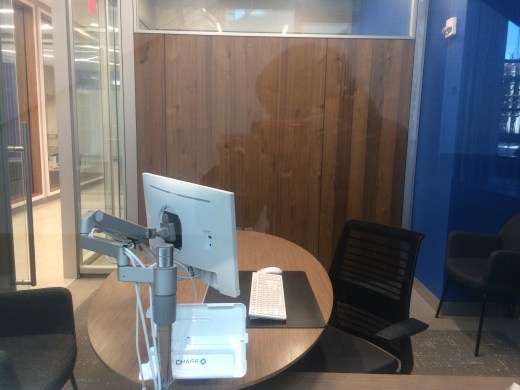
Photograph: Kim Clark May 19, 2020. Office at Chase Bank 800 Boylston Street Boston, MA.

Bouncing Back

Can we at last peek out from under the covers and think about ending the shutdown and getting on with life and business? I certainly hope so! A few businesses are beginning to reopen, depending on local regulations, Apple, Microsoft and Panera Restaurants among them. The definition of reopening may be limited but a few small steps are being taken and more will join in soon.

In reality, Freelance consultants did not so much close down but either ceased or continued operations according to what clients were doing. Some of my clients temporarily closed because they could no longer function, as was the case with a well-known arts organization. Their twice-a-month live events abruptly ended and were last held in February.

Might local officials allow the group to reopen in September? When will their audience feel comfortable to return? Might the organization regain full capacity by Spring 2021?

Most of us intuitively know that a “new normal” is ahead of us and we don’t yet know what it will mean for business, whether our clients’ or our own. Resilience will be among the most valuable resources we Freelancers can bring to bear and we must call it up from within ourselves and learn how to apply it.

Honor your feelings

Are you frightened by the potential outcome of the shutdown, which is unprecedented in the history of the U.S. if not the world? Do you wonder if your Freelance entity will survive and how you’ll be able to support yourself if it collapses?

Being deeply concerned about the future viability of what you’ve built and its ability to sustain you in even the near term is only natural in light of what the national economy has been through. Whatever you’re feeling is normal for you. Acknowledge and own your emotions.

The only thing we cannot do is become paralyzed by fear. We are compelled to move forward because life demands it and our clients expect it. Constructive action is required and to fulfill expectations—-remember that meeting or exceeding expectations is the core of consulting—-Freelancers must tap into and magnify our ability to recover from setbacks.

Share your feelings with peers and mentors

Selectively share your worries and doubts, questions and potential answers, with those whom you trust and respect. Fear is a widely experienced emotion these days and you will find yourself in good company. Talking with others will make you feel supported and will give you the confidence to recognize and act on solutions and opportunities that will help you get back on your feet.

Get perspective

I grew up hearing my parents, aunts and uncles tell moving stories about the 50 year long polio epidemic which took a devastating toll on many countries. I heard about children being confined to the iron lung. I saw polio survivors, and be aware that the fatality rate far exceeded that of COVID-19 no matter how much the media plays it up, and the outcome was not pretty.

Polio nearly always severely crippled those that it did not kill. BTW, everyone went to work or school and the only social distancing that occurred was when my grandparents every so often would not allow my (eventual) parents and their siblings go to the movies or otherwise be in crowds.

I was myself in business during the 2009 Great Recession and I suffered. But failure was not an option. I found an under the radar, low wage part time job to help cash-flow and stayed on a rebuilding course.

I continued to post these columns weekly and found another site to post them on as well. In two years, my posts were featured on a national (and now international) digital publication whose target readers are female entrepreneurs and that gave me a nice title and a little money. I was resilient and you can do the same.

Prioritize

As I think about it, the most important thing that Freelancers can do to rebuild is to reestablish the trust, dependability and empathy that our clients need to know are present before they’re comfortable doing business with us again.

When a client who has recently reopened reaches out to you, rather than just trading emails why not suggest a meeting over lunch or morning coffee to set the stage for a real connection? Offer to meet them at a convenient restaurant, or arrange to bring in some food and drink (you’ll pick up the tab, of course).

Now you can discuss what it appears the new normal could mean for your client and his/ her relationship with their clients and how recalibrated expectations will impact what will be needed from you. Articulate your awareness of the fact that so much has changed thanks to the shutdown and your willingness to be creative, flexible and resourceful in formulating solutions that will position your client to regain, if not improve, market position.

Model resiliency in your thoughts and actions

Yesterday evening, I received an email from a woman who was born to a prosperous family, has a part-time grant sponsored job at an influential global not-for-profit organization and a good and talented husband. Yet, she sought me out for some apparently much-needed encouragement. What is so funny is that I’m just a Freelancer, unmarried and not well-connected, who’s trying to maintain middle class solvency in America. Still, this very affluent woman, who I love talking to BTW, calls me when she needs a little hand-holding.

In other words, I do what I can to bring resilience into my life and I’m willing to share the resource with friends and colleagues to help them sort things out when they need. On a regular basis I also practice self- replenishing rituals to keep my physical strength and positive mental energy flowing because burnout will make it all come crashing down. I encourage you to think about your own resilience, how you can strengthen and expand it and share it when necessary.

Thanks for reading,

Kim

Photograph: Panera restaurants are reopening for takeout only. This one is on Huntington Avenue near Symphony Hall.

Exercise Leadership in the New Year

Physically fit people are in general healthier, smarter,  physically and psychologically stronger,  younger looking, less stressed,  more disciplined and more focused than their sedentary peers,  according to medical researchers and exercise physiologists. These attributes benefit all of us and they in particular serve Freelance consultants and business owners very well.

The tangible and intangible benefits of exercise are directly transferrable to our business lives,  for what a successful Freelance consultant must be is calm,  disciplined, focused, resourceful and prepared to overcome challenges, seize opportunities and deliver excellent results every time.

Because the self-employed typically have more control over our schedules that should make it easier to begin and maintain a regular exercise regimen.  Researchers recommend that to achieve the  best results of an exercise regimen,  we should aim to get at least 45 minutes of weight lifting, cardio, core training and/or yoga at least four times per week.

Surfer and CEO of Manhead Merch, Chris Cornell, shared a few reasons for making the sport  (that is, physical fitness regimen) of surfing part of his life and business strategy.

Better perspective

As we go through life, we are eventually able to view challenges in a more balanced way.  What appeared to be a life-altering crisis at age 21 is all in a day’s work by the time we turn 35.  Because working out regularly makes us physically and psychologically stronger,  it prepares its practitioners to fight stress and fatigue.  “Working out serves as a life balance and centering point for me,” according to Cornell.

More creative

In Cornell’s experience he has observed that “Working out while being alone with your thoughts enhances creative awareness. You are more mentally sharp and physically settled at the same time”, he notes.

I’m not the most creative person that you’ll meet,  yet most of my clients , colleagues and friends I believe would consider me to be resourceful.  As a matter of fact,  during my work outs (and especially, in the post-work out shower) solutions to vexing problems have come to me.

Improved decision-making

Those who work out regularly learn to listen to their bodies and their intuition and they are able to figure out what is and is not good for them. They eventually  learn when to work through a problem, or when to walk away, for that is what is encountered in the gym.

Am I too tired to continue this workout? Am I injured and should I do a light work out, or take a few days off and make an appointment to see a chiropractor or an orthopedic surgeon? Decision fatigue and general indecision is diminished.

Perseverance

Formidable challenges await in the gym and in the business arena. In the gym,  one learns to dig deep and push through the challenges.  As you train to do this physically,  you also train to do it psychologically. Working out makes us stronger and more resilient. It is a confidence booster, as studies have shown. One develops the mental strength to face down onerous tasks and take them on with everything you’ve got.

If you regularly visit your local gym and/or participate in a sport,  you have experienced and appreciate the numerous benefits of exercise.  If you are among the 80% of Americans who is sedentary,  why not rethink your strategy and view your exercise regimen as an activity that confers competitive advantages?

Merry Christmas and thanks for reading,

Kim