Whenever You Call

If half of what we do to find success is about showing up, the other half is surely about follow-up. Money is regularly left on the table because the person who was awarded the golden key couldn’t make him/herself go to the post office to pick it up.

A handful of hustle and a drop of two of discipline are required for this recipe. When your marketing tactics actually work—-you meet a potential prospect while networking and s/he hands you a card and asks to continue the conversation—-you must respond. Or maybe you want to drum up some business and feel that making a few cold calls will be worth the effort. The operative word is call.

Despite the technological advances that have been made over the years the telephone, patented in the U.S. by Alexander Graham Bell in 1876, has demonstrated staying power. Videoconferencing makes electronic communication more personal but it must be scheduled. Also, WiFi access is needed. The telephone’s audio-only format nevertheless enables good communication and it’s easier to use than Zoom. Plus, it never crashes.

According to a 2021 survey by Indeed, the best time to call a prospect, especially when you’re cold calling, that is, attempting to make your first contact, is between 4:00 – 5:00 PM. At the. end of the day, the prospect is often more inclined to not just take the call and more likely to your pitch. At the end of the day, the prospect is more likely to be at his/her desk, is unlikely to start a new task and is perhaps wrapping something up and is perhaps also more inclined to listen to your offer.

If you’d like to try a morning call, late morning is preferable. Calling during the approach to lunch time, 11:00 – 11:45 AM, is the best time for morning calls to prospects, whether cold calls or warm (meaning the prospect has requested a call).

The best days to call prospects are, you guessed it, Wednesday and Thursday. Monday and Friday are likely to yield less than stellar results for obvious reasons. Tuesday isn’t so bad, but apparently there can be spillover from the Monday rush that takes away some of its appeal.

Script your pitch

It will be very helpful to create a cold call and a warm call script. You want your delivery to be smooth, your language concise, your tone upbeat and, of course, your pitch airtight. You do not want to forget to say something important and you don’t want to be at a loss for words. Neither do you want to sound like a robot who’s memorized the words. Write a script to ensure that you’ll sound confident, conversions, knowledgeable and in control.

Helpful hints

  • Should the prospect take your call, ask if you’ve called at a good time and next, ask if s/he has five minutes to talk.
  • Present your call-to-action not as an urgent push to make an immediate decision but rather to persuade the prospect to commit to follow-up action, as a way to continue the conversation. S/he will likely want to discuss your offer with the team.
  • If a prospect contacts your company by phone or email for any reason, respond within an hour.
  • If you meet a prospect while networking and s/he has questions about your products or services, call or email the next day.

Thanks for reading,

Kim

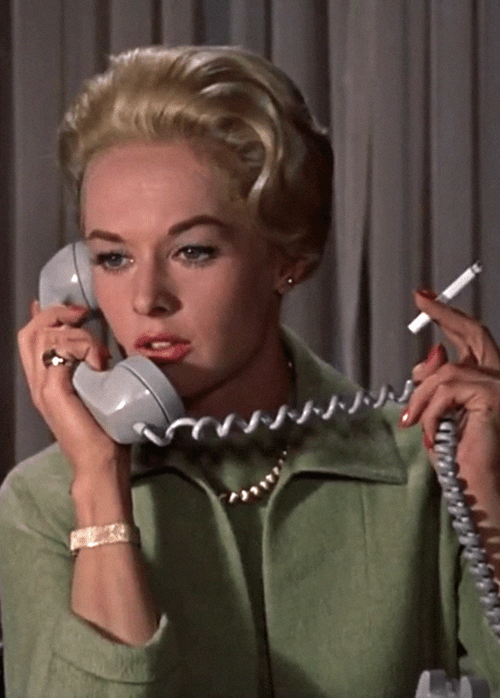
Image: Tippi Hedren, the original Cool Blonde, in The Birds (1963), directed by Alfred Hitchcock

Post From the Trenches: Cold Calling

Even experienced sales professionals wince a little at the thought of dialing up an unknown person and attempting to persuade him/her to entertain the idea of doing business.  Those who perceive themselves as busy often never answer their phone.  Those who are reached usually decline the offer.  Yet if by some stroke of luck you reach a VIP,   prepare yourself to both deliver a pitch that will keep the prospect on the phone and hit a single to keep the inning alive.

Cold calling is prospecting and it is not the time for selling,  but rather for determining whether there can be an opportunity to sell.  Hitting a home run is not on the agenda.   During the call,   confirm whether the prospect perceives a need for your product or services and ask for a meeting.  In advance,   you will have researched the company and will be able to anticipate basic information that may be requested.

But first,  one must reach the prospect.   We all know this is increasingly difficult,  but 8:00 AM and 5:30 PM are good times to call: there are usually fewer distractions at those times.   If you have the prospect’s mobile phone number,  text a concise and tantalizing sentence about how your offerings might help the decision-maker to achieve an important goal and request a time to talk,  in person or by telephone.   If you do reach a warm body,  here are some hints that will help you execute a successful cold call:

Write a script

Identify yourself and your company.  State your product or service.   Confirm that you’ve called at a convenient time.   If told that your timing is not good,  as for a better time to call.   If told that you’ll be given a minute,  thank the prospect and say that you will be brief.  State an outcome achieved  (or problem avoided)  when using your product or service that is relelvant enough to intrigue your prospect and entice him/her to keep listening and ask for a couple of details.  Concisely fill in with a couple of pieces of information.   Ask how the need in question is being fulfilled now,  so that you can position your product/service.   Ask the prospect what  specific information would be appreciated and if he/she can see how what you are selling might be useful.   Ask permission to extend the time limit on the call and also offer to schedule a time to speak in person.

Speak with the decision-maker

In general,  there is no reason to speak with a gatekeeper,  unless that individual is able to facilitate access to the decision-maker or provide accurate information about competitive products and services that the decision-maker is now using.  Ideally,  you want to speak only with the person who has the authority and budget to green-light your presence.

Pursue prospects with big-money potential

Active pursuit of small budget clients is a waste of time.   Because they have little money,  small clients agonize over budgets and will do whatever possible to limit your billable hours.  Unless your goal is to gain experience,  let the small clients come to you.

Name drop

People usually trust those with whom they share a common relationship.  In other words,  if you are trying to get in the door somewhere,   obtain permission to use the name of a person whom the prospect trusts and respects.  Also, ask the referral source to speak on your behalf should the prospect want to check you out.

Make your cold call a dialogue,  a two-way conversation.  Listen to your prospect and respond to questions and objections.  Be pleasant and professional.  Even if you don’t do any business,  that prospect might refer you to a colleague.

Thanks for reading,

Kim

Cold Call Clinic

Recently,  I suggested to my friend Regina that she cold call a local venture capital firm. I’d read about the company and, thinking of Regina, visited the website.  It looked like a good fit,  so I forwarded the link for her review.

Regina is a Freelancer who specializes in evaluating the market potential for incubator stage life sciences products.  Small companies and start-ups often seek out venture capital or angel investors to obtain financing for further research and development or a  product launch.  Both the VC/angels and the company must be certain of the financial potential of the new product.  Regina is hired to make that assessment and issue her findings.

She and I worked together in sales for several years and she is well versed in the art of cold calling.  Although several tactics can be instituted to  “warm up”  a cold call via referrals/introductions,  networking,  or speaking/teaching,  sometimes it is necessary to plunge in,  pick up the phone and try to wrangle an appointment with someone who could become a client—if you can convince them!

Here are steps you can take that will improve your cold calling skills and give you another way to expand your client base:

Do your homework
First,  verify that your services are likely to be of value to your prospect.  Visit the company website.  Conduct an internet search and learn what has been written about the company recently and which execs have been quoted in the media.  Read up on the industry to find out what hot issues are getting press coverage.  If possible,  deduce which competitor could be doing business with your prospect and what unique benefits are offered.  Can you sell against that?

Ask around to your colleagues and inquire as to who may know this prospect,  or have a contact at the company.  Can an introduction be arranged? You may discover that your prospect belongs to a certain organization that you can visit.  Maybe you’ll cross paths?

Write a script
If you must call or email the prospect,  assemble your talking points in advance. Brainstorm the most appealing benefits and other selling points,  where you see alignment between your services and the prospects’  apparent needs and smooth answers to anticipated objections.

Devise  2–3  questions to ask that will show you’ve done your homework and will clarify prospect needs.  Remember to identify who makes the decision to hire.  Smart questions put the finishing touches on the pre-qualifying process.

Open with benefits
“What’s in it for me?”  is the question on everyone’s mind.  Whether your initial contact is a serendipitous face to face or by email or telephone,  you’ll have to sell your prospect and maybe the gatekeeper, too with compelling benefits if you want to get invited to the office.

After you briefly introduce yourself,  your company and services,  ask if  it is a convenient time to talk.  Your respect for their time will earn you points.  If granted a minute to talk,  paint a quick picture of how benefits you bring will provide  valuable solutions.

Listen well
Allow your prospect to talk about their business needs.  The information given will help you to position your services and verify—or rule out—your theory of alignment between the two of you.  Ask questions when necessary.  Remember that selling is a conversation and not a monologue.

Confirm agreement
If your prospect has been amenable to your sales pitch,  ask to continue the discussion at the office or over coffee or lunch—whatever is most convenient for the prospect.  There may not be an offer of immediate work,  but consider it relationship building and getting a foot inside the door.

Objections
If your prospect balks,  acknowledge the hesitation and ask for clarification.   Have you misunderstood something? Is there no budget available for the project? Is there a relationship with a competitor? Is there no perceived need for your services?

If the prospect works with a competitor,  ask about the types of projects that are outsourced.  Diplomatically mention your expertise in handling such projects.  If the prospect sees no need for your services,  ask how solutions are achieved or problems resolved? Again, diplomatically soft-sell and plant the seed.  However, do not start a wrestling match. You want to leave a positive impression,  even if you do not get the chance to have a meeting.

Referral
If the call has gone well (and it will!) but you still don’t get an appointment,  ask your erstwhile prospect if he/she can point you in the right direction and refer you to someone they know who might benefit from your services.  Be certain to ask whether or not you can use their name.   Even if you don’t get a client,  you might get a referral.  Equally important,  you will have interacted with an important person who will remember you favorably should your paths cross again.

Thanks for reading,

Kim