Freelancers and all business owners and leaders are well aware that promoting and enhancing their entity’s products, services and the company brand is a prime and ongoing responsibility. To accomplish that important objective, you’re always on the lookout for marketing opportunities and channels that are a good fit for your brand and also allow you to effectively broadcast your marketing message and/or brand story. As you consider which marketing channels are most appropriate, it would be no surprise that in addition to your company’s website social media, whose active users number in the billions, likely take precedence in your hierarchy of preferred marketing options.
But think for a minute. Facebook et al. do not completely dominate all influential marketing channels; your hometown newspapers and magazines still wield influence in the communities where you operate. Although their number and reach have probably diminished over the years and have never attained audience numbers that rival social media, you may nevertheless find it beneficial to periodically reach out to certain local media to share a newsworthy update about you and your business. Local media outlets and the stories they feature continue to get noticed and command respect. Their readers and listeners could easily include your customers and prospects. Getting yourself and your company featured (positively!) in traditional media outlets, however modest the audience reach, is a marketing win. Consider outreach to local media as part of your personalized marketing strategy.
Getting started
The various social media platforms, as you know, have made it possible for nearly anyone to build an audience if the topic is attractive to readers or viewers and they’re willing to create and post content. There’s no need for today’s aspiring Influencers to work toward a degree in journalism or media communications as a steppingstone to earning credibility and acceptance as a thought leader or style setter.
In stark contrast, traditional media outlets—print, radio, television—have gatekeepers, that is, publishers, editors, or reporters, who control all content that is featured. So, just because you call yourself an expert in your professional field, it will take some convincing to persuade the gatekeepers to quote or feature you in their publication, especially if you lack examples of previous media coverage to validate the expert status you claim. However, if you create an effective pitch in your press release https://freelancetheconsultantsdiary.wordpress.com/2020/02/25/press-release-to-send-or-not-to-send/ that concisely and enticingly explains how your topic (story) is relevant to the outlet’s audience and describe your professional experience and educational background in language that supports your position as an expert on the subject, you could receive a positive response to your media outreach and be on your way to being quoted as an expert source, if not a spotlighted subject of a feature article.
Build your media list
Before you can send a press release, you’ll need a current list of media contacts. Sending a well-crafted pitch that’s tailored to a small but select group of gatekeepers who may be interested in your story and have the power to green light it will always yield better results than sending a pitch to every email address you can find.
Begin building your media list with a visit to the mastheads or websites of media outlets you feel will be appropriate for your story; in many cases, the name and contact info of the editor who manages your story’s category, and/or reporters who cover your topic, will be listed there. You might also search back issues of your preferred publications to find and skim articles by reporters who cover topics relevant to your story and/or your business.
If there is insufficient info listed on the outlet’s website or masthead, search for reporters on X (Twitter), Facebook, or LinkedIn. You can direct message on those platforms, but it may be better to make your media pitch via email; it can be more effective to first telephone the reporter or editor and verify potential interest in your story before blindly sending a press release. Initiating a conversation with an editor or reporter is a better way to build a relationship. Be sure to mention that you’ve read one or two of that reporter’s articles if you get him/her on the phone.
Eye-catching subject line
Regardless of how you make initial contact, if you receive an invitation to provide some details in writing, the quality of your email subject line is the starting point of your media pitch. Whether you DM or chat on the phone, the email subject line will be the first (official) info the reporter or editor sees and even if interest in your story was expressed while on the phone, a riveting subject line will remind the journalist of your story’s relevance. Your subject line may determine whether or not your email gets opened. The viability of your story is at stake.
Devise an eye-catching subject line that contains maximum seven to nine words, if possible. Incorporating relevant current events, using an unexpected statistic or statement, or promising a unique solution to a common problem have been known to capture a journalist’s attention.
Surprisingly, it may be easier to create a good subject line after you’ve written the body of your pitch email. Reversing the usual custom will allow you to see your entire message and the big picture perspective may lead you to create a more powerful subject line. Finally, create a draft version of your pitch and open it on your mobile devices, to confirm that your subject line will always display fully.
An intriguing intro
Because you more than likely have had no previous contact with the journalist, there is no need for friendly overtures. Politely get down to business. If your subject line has held your journalist’s attention, you have just a second or two to keep that attention and a compelling intro is how you do it. You might repeat your subject line and add two or three additional sentences or bullet points to strengthen your case. The examples below may be helpful:
- The Chief Information Officer at workwear manufacturer Carhartt reported that the company currently utilizes 121 software-as-a-service subscriptions, up from 59 subscriptions five years ago. The number of SaaS subscriptions now exceeds the number of IT employees at the company. “We don’t have enough resources to manage the administrative aspects of the platforms,” says company Chief Information Officer Katrina Agusti.
- In response to a suit brought by the National Small Business Association against the Treasury Department, the U.S. Federal District Court for the District of Alabama ruled on March 1, 2024 that the Corporate Transparency Act is unconstitutional. More than 32 million U.S. business entities are estimated to be affected by CTA and were required to comply and submit company documentation. While it is likely that litigation will continue to play out in the federal court system, the initial victory has gone to small business and that means compliance with this now unconstitutional regulatory regime can be set aside for the time being.
Identify the problem and its impact on their audience
If the journalist is still reading at this point, congratulations, you’ve captured his/her interest in what you have to say, so it’s up to you to keep them interested with the pitch itself. Most stories in the media are based on some type of conflict—a problem that affects their audience in some significant way.
Succinctly describe the event or challenge and concisely explain how it impacts the media outlet’s audience. Avoid using technical jargon unless you’re pitching to an industry publication and you’re in the field. Your pitch will resonate with the journalist only if s/he feels it will resonate with the audience, so keep readers and/or viewers in mind as you craft your pitch. Keep it simple and clear, expressed in a few brief sentences or better yet, a few bullet points. Statistics and quantifiable data are especially powerful.
What makes you an expert
Compose a simple one or two sentence statement that establishes your expertise and authority to understand and address the topic, for example CPA, CFA, MD, or PhD. Trust and credibility are important to your clients and prospects and also important to journalists and editors. Even if the media outlets you approach are small and local, they must be confident that anyone interviewed is reputable and knowledgeable.
- (you) are a serial entrepreneur turned investor in start-ups launched by retired professionals
- (you) own the largest bridal shop in your state and have operated the business for 30 years
- (you) are a Freelance cybersecurity expert who’s received extensive training in private industry and at government agencies including the U.S. Air Force
What makes you and your story of special interest?
Arbiters of the media are perpetually in search of what will stand out and grab the attention of their audience. Audiences are sometimes interested in what they feel is “better”, but they more often give their attention to what is different. Keep that truism in mind as you create your media pitch because you must possess one or more attributes that make you stand out and capture the interest of a media gatekeeper. Otherwise, journalists will just cite the already well-recognized experts instead of you. You may have a unique perspective on, or solution for, a particular challenge but what is it about you that gives you a special authority to present yourself as a thought leader or expert?
Sell you story by highlighting how you do things differently and why your approach is better for their audience. If you and your 11-year-old daughter have figured out how to sell 5,000 boxes a week of Girl Scout cookies, by all means send a press release to your local newspaper!
Close with a call-to-action
A well-worded call-to-action will serve as a bridge or a well-lit path that encourages the recipient of your media pitch to take action and contact you to learn more about you and your story. For that reason, it is in your interest to conclude your media pitch email by telling its recipient what you’d like him/her to do next—contact you by phone or email as soon as possible to discuss how your quote or story might be featured in his/her media outlet.
A polite, yet unambiguous call-to-action works best. A statement as simple as, “If this sounds like a story you may be interested in covering, please email or contact me directly at (your preferred phone number and email address). It’s been said that failing to request follow-up action on a press release decreases the likelihood of the story being featured.
Thanks for reading,
Kim
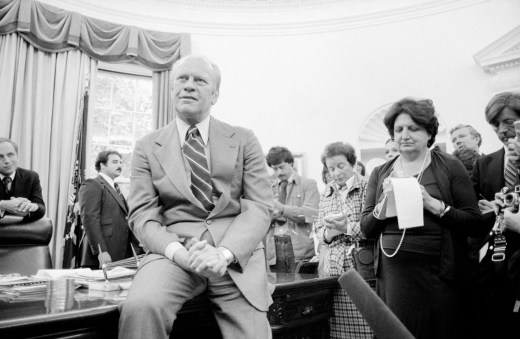
Image: Photo by Marion S. Trikosko (public domain). White House correspondent Helen Thomas (R) with President Gerald Ford and White House Chief of Staff Dick Cheney (far left) during a 1976 White House press conference.
 Freelancetheconsultantsdiary's Blog