Email marketing remains an effective and valuable practice that deserves a place in the marketing strategy of Freelancers and other small business owners. If you haven’t explored email marketing as a way to promote your venture, read on and learn why you will reap benefits from developing email marketing campaigns and how to maximize their success.
Data supplied by Statista, the Germany-based marketing info giant, reports that an estimated 4.3+ billion citizens of planet Earth use email. Maybe that’s why email marketing continues to be central to our business and personal lives? Email marketing campaigns will help you to promote your products and services, acquire new customers or retain current customers, increase your venture’s annual revenue and position yourself as a thought leader and expert in your field.
Email marketing remains one of the most effective forms of outbound marketing, whether you send email appeals and announcements to prospects and current customers or publish a company blog or newsletter. According to data from the e-commerce company Oberlo, 81% of small business owners use email marketing as their primary method of customer acquisition and 80% use email marketing outreach to support customer retention. Marketing researchers have calculated that email marketing campaigns generate an average ROI of $43 for every $1.00 spent. In 2022, B2B and B2C email marketing campaigns combined generated $9.62B in sales revenues.
- Update your list. Review your address list each month and follow-up on all emails that “bounce,” that is, are returned. Verify and update the address or delete the name.
- Personalize greeting. Your readers likely have little use for a emails that are addressed to no one in particular and reek of spam. Impersonal mailings are not endearing and are usually deleted. Your email marketing distribution service has the capability to personally address the communications you send.
- Opt-in, opt-out, sign-up. To grow your database, make it easy for those who’d like to follow you and/or subscribe to your emails by making your sign-up/ opt-in link visible. On the other hand, those who’d rather not receive your mailings should be able to easily decline them. The unsubscribe/ opt-out link is usually placed at the end of the email.
- Customize templates. Represent and promote the value of your brand by having a custom template designed for your marketing communications. The cost is modest and will give your campaigns a professional look that is immediately recognizable to your audience. Choose a template design that is uncluttered and visually cohesive. Also, since more than half of the audience will view your emails on a mobile device, confirm that your marketing service uses responsive design.
- Relevant content. Know the topics that will interest your readers. Stay current in your knowledge of national and local developments by regularly reading nationally focused business publications and the business section of your local newspaper. Furthermore, it’s helpful to create a marketing calendar, because some topics are seasonal and your information should be timely so that it will be useful. In other words, if your email will discuss taxes, keep in mind the filing dates for quarterly and annual taxes. As well, keep in mind the Pareto principle, best known as the 80/20 rule, to keep audience engagement high. Make about 80% of your content educational and no more than 20% self-promotional. In time, your audience will come to trust you as a source of helpful information, which will keep them opening your emails. Your emails are about the reading audience and not about you.
- Tempting subject line. Give readers an incentive to open your emails by creating subject lines that command attention. The subject line is the most important element of a marketing email. If it’s not compelling, your email will be swiftly deleted. A good subject line often arouses curiosity or surprise. It may even shock recipients, or make them laugh. A well-crafted subject line makes recipients want to go further and find out what you have to say.
- Interactive extras. Every so often, give readers something unexpected and interesting to see or do as they skim through your content. Devise a one or two question survey to let them tell you how they feel about an issue. Not only will you get to know them better, they’ll appreciate that you value their opinions. A 60-90 second audio and/ or video clip that showcases something they’ll find useful is another good tactic. Including an image that ties into the message and purpose of the email is yet another good idea. Limiting extras to a maximum of two is suggested, to avoid clutter or sensory overload.
- Social media teasers. Before emails are sent, post a line or two of content on social media as a way to cross promote and expand the audience for your mailings. Let social media visitors know that the content is exclusive to your email list and use this incentive to increase sign-ups.
- One irresistible call-to-action. The purpose of your emails is to convince readers to do something—-hire you, watch your webinar, read your case study, come out to meet you and hear you speak. If email recipients don’t know what you want them to do within 20 seconds of opening your email, whether that’s visiting a page, calling a phone number, or completing a form, they will most likely click and delete.
- Consistent schedule. Whether you send a newsletter, blog post, or marketing letters once a quarter, once a month, or once a week—-every Tuesday at 11:00 AM Eastern or the 15th of every month—-be consistent. Predictability breeds trust.
FYI, as of March 5, 2023, data supplied by the email marketing company Constant Contact reported on email open rates in various industries and a sampling is below. As of January 2023, the combined B2B and B2C sales conversion rate of email marketing campaigns was 8.17%.
- Administrative support—billing, phone answering—29.1%
- Business consulting—marketing, advertising, management–28.3%
- Financial services—accounting, bookkeeping, insurance–27.1%
- Technology services–19.3%
- Health & wellness–home care, nutrition, dental, medical–35.3%
- Cleaning, contractors, landscaping–38.6%
Thanks for reading,
Kim
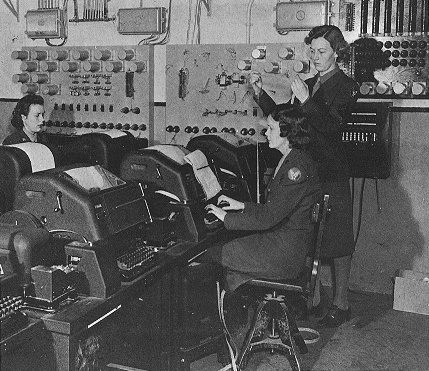
Image: Invented by Edward E. Kleinschmidt in 1914, the high speed teletype machine allowed users to both send and receive typed messages and was a major breakthrough in telecommunications technology. The picture shows teletype machines being used in England during WWII.
 Freelancetheconsultantsdiary's Blog