Getting out in front of an audience is one of the best and most efficient ways to network. Approach the podium and the spotlight will shine on you! Everyone in the room will want to meet you and exchange a few words. Inevitably, some will ask to exchange cards and request follow-up conversation.
Taking on a keynote speaking role instantly lends credibility, showcasing you as a an expert in your field and a trusted source of information. Freelancers, owners of business ventures of every size and corporate and not-for-profit organizaton leaders understand that speaking engagements introduce them and their organization to colleagues, potential clients or donors, influencers, referral sources, potential investors, or strategic partners.
Some are intimidated by the thought of speaking before a group of people, no matter how well-versed they are in the subject matter. Public speaking is not a natural activity for everyone. Nevertheless, for those who hold or aspire to a leadership role of some sort, public speaking comes with the territory.
The good news is that public speaking is skill that can be learned. Those who make the effort to develop the skill will be happy to realize that the more you do it, the more proficient and comfortable you’ll become. Consider it professional development. Also encouraging to know is that like learning any skill, breaking the components down into manageable “chunks” and tackling them one by one prevents you from feeling overwhelmed and helps you to learn.
Keep it simple
Be considerate to your audience by making your talk both informative and relatable. Let the audience govern the content of your talk. In particular, unless you’ll address an industry group, avoid technical jargon—it’s not the best way to show off what you know. Not only does high-falutin’ tech speak bore most listeners, it doesn’t convince anyone of your expertise or insights into the topic.
To make your subject engaging for an audience, using easily understood language is the most effective way to demonstrate your grasp of the subject . The most important thing about your talk is that the audience “gets it.” Keeping your things simple allows you to control the flow, no matter which way it goes,” says Maria Thimothy of Forbes Magazine Young Entrepreneur Council.
Shape the story
Rather than composing your entire speech ahead of time, write out key concepts you want to emphasize and then rehearse, using those key points as a focus. You’ll find that by allowing room for flexibility, it will be easier to adjust your talk to the mood of the room and your talk will be better received. For example, if you sense that you’ve lost the attention of some in the audience, you might pose a question or slip in a joke or reference to some happening in the news as a way to re-engage them.
Own the stage
A presentation is more than words. Audience members expect the speaker to be an expert in his/her field who possesses knowledge and experience that will inform and enlighten those who’ve come to listen. Additionally, the speaker’s intention may be to rally audience members with a compelling Call-to-Action that inspires them to demonstrate their support of a cause. To achieve these objectives, public speakers must be both highly competent and also confident.
The successful speaker makes it known that s/he is worthy of the audiences’ trust and respect not only by way of the content of the talk but also in body language and demeanor. It is important for a public speaker to develop stage presence.
- Power stance
How one stands is a strong indicator of that person’s confidence and mindset. When facing an audience, the speaker should hold a strong and steady position. The feet will be shoulder width apart, with knees relaxed and not locked. The spine will be comfortably erect and the neck and shoulders will also be relaxed.
With this posture the speaker signals that s/he has important information to share and that s/he feels confident. In a 2012 TEDGlobal talk Your Body Language Shapes Who Your Are, social psychologist Amy Cuddy sparked a sensation when she modeled this and other so-called “power poses.”
In a 2013 Harvard Business Review article, TED Curator Chris Anderson seconded Cuddy when he noted that the most common mistake made by inexperienced or nervous speakers is the inability to maintain a solid, stationary posture. Swaying or fidgeting works against the ability to communicate confidence. Anderson noted that “Simply getting a person to keep his or her lower body motionless can dramatically improve stage presence.”
- Eye contact
Making eye contact is important for maintaining dynamic interaction with the audience. It’s another reason to avoid memorizing your speech and instead focusing on the key points you want to emphasize
To incorporate good eye contact, Chris Anderson recommends finding five or six friendly-looking faces in different parts of an audience, then making eye contact with them as you speak. “Even if you don’t have time to prepare fully and have to read from a script, looking up and making eye contact will make a huge difference,” he advised.
- Vocal power
When you think about it, the human voice is like a musical intrument. What is singing? You can learn to use your voice as if you are playing a musical instrument, to increase your vocal power and persuasiveness, whether you’re giving a speech or having a conversation. You can learn to adjust your vocal pitch, volume and speed in a way that allows audience members to follow your talk and want to hear more.
The primary lessons are to keep your tone of voice conversational, enunciate your words clearly and speak somewhat more slowly. When you slow down your speech somewhat, your voice will take on more power and you’ll sound more authoritative. Another benefit of slowing down your speech is that it gives your listeners the opportunity to absorb and reflect on what you’re saying.
Another useful public speaking vocal technique is to include strategically placed pauses when you’ve made an especially salient point to let the information sink in and resonate. Tape your rehearsals and play back to assess your vocal delivery and make adjustments where necessary.
- Dynamic opening
Attention spans and patience seem to get shorter every month. In the Twitter, TikTok, jump-cut to the chase media hyped world we inhabit, engaging an audience has become more challenging than it was even a few years ago. Those is search of an audience have had to become more inventive.
So try this tactic—rather than opening your talk with the usual trite and predictable ritual of thanking the person who introduced you and then greeting the audience and asking everyone how they’re doing, dare to do the unexpected. Why not simply take the stage and look at audience, as you pause for a beat to create a frisson of tension. Then, launch your talk with a fact or a story that is surprising, if not shocking. You might begin with a tale in which you or someone else is in a moment of crisis. Make a confession. Say something in that very first line that both demands attention and is entirely relevant to the rest of your speech.
Thanks for reading,
Kim
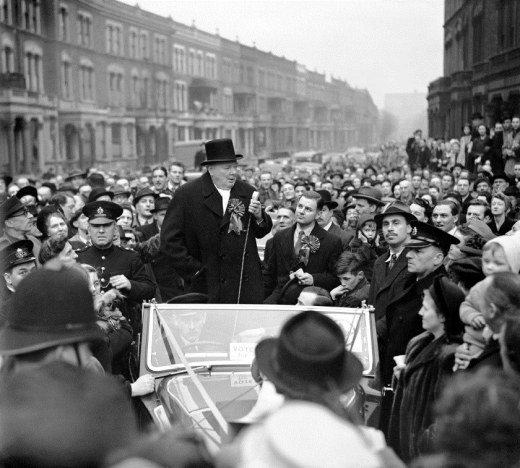
Image: © PA Archive/Press Association Images. Sir Winston Churchill (1874-1965) speaking at Blythe Road, Hammersmith, London February1949. Churchill served twice as UK Prime Minister, 1940-1945 and 1951-1955.
 Freelancetheconsultantsdiary's Blog