Economists and other thought leaders predict that 2023 will be a recession year and if the prediction holds, many Freelancers will see a decrease in sales revenues. Diminished revenue has the potential to bring on many unpleasant outcomes, among them the imperative to reconfigure how you can best allocate your shrinking funds. Belt-tightening isn’t fun, but do it right and you might survive or even, eventually, thrive. Take these three actions:
- Defend cash reserves
- Identify most profitable business activities
- Guarantee the optimal delivery of products and services
Conserve cash
You may not have a large amount of cash on hand in your business, but make a point to locate where you might find revenue that hasn’t been tapped. The first place Freelancers should investigate is the Accounts Receivable file. Rethink your strategy to collect unpaid AR and better still, start planning for AR when discussing the agreement with clients you’re about to work with. Request up-front money before you start project work on jobs that bill for less than $100—10% – 20% in advance is reasonable. Second, tie interim payments to project milestones where possible. Institute policies to avoid leaving more than 50% of the fee payable when project deliverables are handed over. The best defense is a good offense.
In the present tense, identify outstanding invoices and tactfully, persistently, pursue payment. Follow-up with clients who might be struggling to pay invoices and negotiate a payment plan if possible. Do whatever you can to ensure that all money owed to you will be paid as soon as possible (FYI, I’m negotiating right now with a client who should have no problem paying, but is 60 days late). Bring in the money and hold on to it—spend only on activities with demonstrated potential to increase revenue.
Double down on money makers
Going into a recession is a great time to do an audit and verify the most profitable parts of your business. When the economy becomes favorable again, you’ll be even better set up for success. Once you’re sure of the money-makers, do what you can to expand billable hours of those assignments. If you can scrape together a marketing budget, here is where you spend.
Marketing sometimes seems counterintuitive when you have less available revenue but in most cases, you can’t make money unless you spend money. What you must do is limit spending to activities that positively impact revenue generation. It could be that you buy a software program that makes it faster to generate and send client invoices. You might also invest in making credit card payments available and thereby make it easier for clients who can’t afford to write you a check can nevertheless use credit to pay your outstanding invoice.
There are also the more immediately recognizable marketing activities, among them selectively attending meetings and conferences where you might encounter prospects who may become clients and advertising, print or on-line, in publications that are read and respected by your target audience for your rainmaking projects.
All about deliverables, client retention, referrals
Happy customers create more business. Repeat and referral business is extremely important in a recession. Ensuring that your clients are happy is vital in any economy but especially in a recession. Creating glowing online reviews, testimonials and good word-of-mouth are essential to growing your revenue when times are tough (and even when there’s lots of money rolling around).
Sometimes when the economy changes, so do your client’s needs. Extract this opportunity, hidden in adversity, to learn more about your clients and what they feel they need now to ensure the survival of their organizations. Now is the time to talk to your clients and discover any changes in what they consider the pain points and priorities. Once again, it will be demonstrated that when you are attuned to the needs of your clients that knowledge can lead to more more active clients, more referrals and more revenue and profit.
Thanks for reading,
Kim
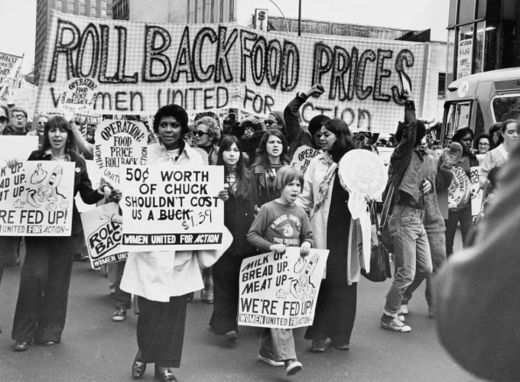
Image: © Keystone/Hulton Archive/Getty Images. Protesting the rise of food prices in 1973.
 Freelancetheconsultantsdiary's Blog