By analyzing your customers’ behavior, Freelancers and other business owners and marketers come to understand their needs, priorities and concerns, a point that’s often noted in these posts, as regular readers know. When those responsible for marketing understand those factors, you are then able to create marketing and sales messages that speak with authority to your intended audience and also broadcast those messages through marketing channels that your typical buyers trust and follow.
Plus, an accurate understanding of customer behavior helps you to anticipate and deliver customer service and other post-sale needs more effectively, giving you a third benefit to take to the bank. The more familiar you become with the behaviors of your typical customers as they engage with your organization, the more business you will do with them.
Several metrics can give reliable insights into customer behavior and it’s a smart idea to examine all aspects that your data tracks. Today, we’ll examine what you’ll learn when you analyze how visitors to your website or social media accounts react to the customer journey you present to them. The point of this exercise is to figure out how to persuade more prospects to become customers.
From the first encounter with your organization, to digging in to research and compare your product or service to the competition and finally to making a decision to give you the sale, or not—-are you answering prospects’ questions or do they lose interest and abandon you? Where in the customer journey are the biggest drop-offs? How might you coax prospective customers to return to your site to research and evaluate your company’s products and services, so that they’ll realize your organization is capable, trustworthy and prepared to deliver solutions that solve problems and achieve goals?
The function we’ll study today is known as mapping the customer journey and it will be instructive. First, break down the steps that customers in decision-making mode will take, the through-line that begins with their first encounter with your organization and all the way to the sale. Every touch-point, or interaction, that happens along the way makes up the customer journey. There is a beginning, middle and end and interesting tidbits of information will be available for prospective customers at every stage.
Next, evaluate the persuasiveness of the information offered. Information at each stage must be chosen strategically, to help prospects trust and recognize the value of what they read, hear and see. You want them to buy, to become customers. Mapping your customer journey reveals how customers engage—or not—-with the content you’ve made available to them, as documented by your website analytics.
BTW, you’ll probably notice that the customer journey closely resembles a sales (or marketing) funnel. First encounters with your company correspond with the top of the funnel (TOFU). Visitors who are increasingly curious about your products or services will stick around to enter the middle stage, the mid-funnel (MOFU), as they venture beyond landing page info. Maybe they’ll read your blog or newsletter, or accept your offer of a free e-book? The most serious prospects, those who are finalizing their choice, are with you until the final stage of the customer journey, which is comparable to the bottom of the funnel (BOFU).
Early stage
As you’d guess, initial encounters with your organization are mostly filled with non-committal window-shoppers. Early stage potential prospects often cast a wide net. They may be in the process of confirming and defining the challenge or problem that must be resolved and they’re usually compiling a list of companies that offer what appears to be the most effective product or service at the best price. Maybe they’ll check you out on social media, too, and read the About Us page on your website.
Early Stage prospects may have discovered your organization through one of your marketing channels, by referral, or maybe in a personal encounter with you when you taught a class or participated in a webinar. Most early stage encounters do not lead to a sale. Some potential customers may not be certain that they’ll commit to a solution in the near term.
Middle stage
Expect window-shoppers to abandon here. This stage is a natural turning point in the customer journey because it’s moving toward commitment. Those who seriously research and evaluate your product or service advance to the Middle Stage of the customer journey because they have a goal or problem in front of them and they have to do something.
These folks are real prospects. They have a good idea of what they want and how they want it. They demonstrate their resolve by remaining on the customer journey, in search of detailed specifics that will rule you in, or out.
That means you have an excellent opportunity to demonstrate the unique, defining attributes of your product or service and communicate where using your offering is especially well-suited. Here is where you can really shine and build credibility and trust and convince prospects that you are The One. Your e-book, podcast or webinar appearance link, and/ or customer reviews can demonstrate your expertise, convey the respect that industry colleagues and customers have for you and build a strong case for your organization.
Final stage
Ideally, the customer journey you present will get you on the short list of companies that might effectively address your prospects’ needs and goals. You either inch closer to the sale and eventually win, or the prospect steps away to pursue another solution. Prospects in the Final Stage of the customer journey will either fish or cut bait, commit to a purchase and become your customer or tell you goodbye (or go silent).
Your task here is to make a very compelling and appealing last ditch pitch to win the sale. A powerful case study could be an effective deal-closer, as could a free upgrade (that costs little to provide) or, perhaps most of all, a personal appeal from you, in a telephone or videoconference call or a face2face meeting. Do whatever seems reasonable to cross the finish line and win your sale.
The moral of this story is, the more you know about the typical challenges and goals of your most frequent customers, the more adept you will become in developing content to communicate that your solutions are effective and your organization is dependable.
Your customer journey doesn’t end once you’ve welcomed and onboarded your new customer! After-sale and other types of customer service are, collectively, the communication that is essential to building and nurturing the best customer relationships. You will be wise to design an experience that encourages still more purchases, plus referrals, positive reviews and good word of mouth advertising.
Thanks for reading,
Kim
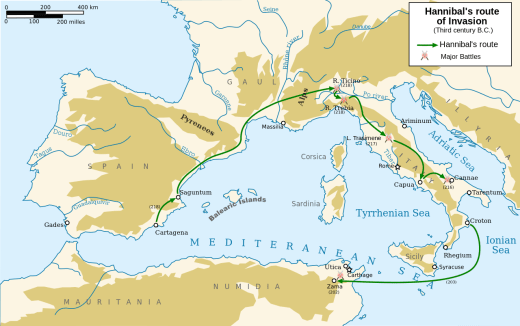
Image: Hannibal’s map to victory in the 2nd Punic War. Hannibal’s crossing of the Alps in 218 BC was one of the major events of the war and one of the most celebrated achievements of any military force in ancient warfare.
 Freelancetheconsultantsdiary's Blog