Strategies to Manage Stress

The American Psychological Association defines stress as “any uncomfortable emotional experience accompanied by predictable biochemical, physiological and behavioral reactions.” Stress is part of daily life, as we know. Not all stress is bad and in fact, stress that induces the “fight or flight” response to a potentially dangerous situation is necessary for survival.

But chronic stress that results from an inability to eliminate or control an overwhelming or upsetting set of circumstances may precipitate serious health and behavioral complications, including hypertension, obesity, drug or alcohol abuse and depression.

Self Care

Busy people, whether highly stressed or not, are wise to set aside special time several days each week to devote to self-care. The activities can take the form of cross-training—-kick-off Monday with a run, swim, bike ride, or power walk, Tuesday for yoga or tai chi, Wednesday weightlifting at the gym, Thursday at home for prayer or meditation and Friday can belong to boxing or ballet.

Exercise, meditation and prayer have been confirmed through scientific research to deliver more benefits than I can remember, but among them are improved energy/ stamina, improved self-esteem, lower blood pressure, improved joint mobility, enhanced mood, improved cardiac functioning and a decreased incidence of stress. In other words, everything we need in the physical, cognitive and psychological realms gets better when we move our body and nurture our soul.

Eat well

Good nutrition supports one’s physical health. Maintaining a balanced diet enhances energy, stamina, cognitive functioning, the immune system response and helps the body defend itself against toxic stress. There will be times when deadlines or other intense situations might derail healthy eating habits and fried food bingeing rules.

Refuse to succumb to that temptation over the long- term. Get back on track ASAP and eat simply prepared fresh food, homemade or takeout, to feel, work and even sleep better. When faced with high-level physical, cognitive, or psychological demands, overdosing on sugar, salt and fat could leave one vulnerable to a crash of some sort, because unhealthy food does not adequately nourish.

Caffeine and alcohol are also not your friends when their intake surpasses a certain threshold. Listen to your body. A 20 ounce coffee or tea may get you going in the morning and a glass or two of wine, or a couple of cocktails, may help you to relax in the evening. Jittery feelings, heart palpitations and inebriation are warning signs and if they appear, dial back.

Sleep well

When starting or leading a business, there will be times when burning the midnight oil, if not burning the candle at both ends, will be the story of life. The opportunity and ability to sleep could easily be diminished. Yet it is advisable to guard against long-term sleep deprivation.

Arm yourself to take on difficult challenges by keeping your diet healthy and continuing with exercise and other forms of self-care (e.g., massage or energy work) that provide the stamina, cognitive functioning and decision-making ability that enable peak performance. Getting the work done makes it a lot easier to sleep and maintain a defense against the harmful effects of stress on the body and the psyche.

Medical and psychological researchers have published dozens, if not hundreds, of studies that document the relationship between inadequate sleep and stress. Sleep, like food and drink, is a biological need and we cannot survive without it (but the precise reason is unknown). The National Sleep Foundation has confirmed the long-held consensus that the average adult requires about eight hours of sleep/day. Teens may need 10 hours/ day. Some adults can perform well on just six hours/ day.

If sleep difficulties are the result of the stress related to getting things done, an executive coach may be able to identify ways to resolve workflow and time management issues that will make the to-do list more manageable, improve productivity and make falling asleep and sleeping through the night possible.

While you’re working on rectifying conditions that may be causing toxic amounts of stress, I recommend what I call The 90 Minute Rule, that pulls together a few NSF recommendations: 1) Evening workouts should conclude at least 90 minutes before bedtime, to allow the body to relax. 2). Dinner should be consumed at least 90 minutes before bedtime, to allow the body to digest. 3). Take a bath or shower 90 minutes before bedtime to promote the release of melatonin, a hormone that encourages sleep.

Delegate/ outsource

The struggle to get the work done is sometimes stress-producing, as noted in the preceding paragraphs. Learning to prioritize is integral to time management. An examination of projects and tasks that only the business founder/ leader is equipped to do is Step 1 of time management. The founder/ leader can then delegate other tasks to team members, if employees have been hired, or outsource to Freelancers or other business specialists, in the absence of staff.

Just say no

Saying no is occasionally necessary, even when it disappoints someone. Saying no may enable you to better manage time, energy, or other resources and become more productive.

Say no to enforce your boundaries. Say no to what you feel is unacceptable. Say no to honor your values, self-respect, or priorities. Say no to stress.

Thanks for reading,

Kim

Photograph: Kim Clark. Practitioners of Falun Gong, a spiritual philosophy with roots in China and derived from Buddhism, meditate on Boston Common.

Collaborating in the Digital Realm and IRT

Collaboration is a soft skill that in the COVID era rapidly acquired big implications. Even more than in the recent past, the ability to achieve efficient and effective collaboration within work teams, and in fact within organizations, is recognized as a fundamental leadership skill. Collaboration today plays a defining role in driving successful business outcomes.

Because it is now common practice for team members to work from either home or office and to be scattered across city, state, national or even international borders, in addition to occupying various time zones, it is critical to ensure that all players are on the same page. Freelance consultants would do well to diplomatically encourage a collaborative environment on every project in which they participate. A project that yields less than stellar results will weigh most heavily on the Freelancers’, and not the employees’, reputation. The opportunity to receive referrals and repeat business sometimes rests on making one or politically savvy suggestions.

Collaboration is born of trust, respect, communication and, ultimately, sharing information and responsibility. These attributes and actions promote both camaraderie and good decision-making. Teamwork begins when team members understand their project mission; understand how their project supports organizational objectives; have the data, tools and authority to carry out their work; and know whom to consult when questions arise. Think about how you can advance those ideals on your next project.

Digital workflow systems such as Asana, Slack, Trello, or Microsoft Teams are excellent tools that provide access to all relevant documents, support continuity, allow all team members to view and contribute information as work progresses and document progress. Study the project specs. Visit the websites of the digital workflow systems mentioned here or recall your experience with other systems. In the kick-off team meeting, raise your hand (virtually or In Real Time) and suggest a workflow system that will both expedite the work and promote transparency and collaboration.

Virtual check-in meetings may find some team members in a makeshift home office, on a park bench surrounded by greenery, or in their familiar workplace office but nevertheless, if trust and respect have been properly seeded and nurtured, open communication that also allows for differing perspectives, will support candid assessments of project progress, about what may not be working and enable the wisdom of the team to devise solutions that all will support.

Follow-up is where the team pulls together to implement whatever useful suggestions for improvement that surfaces at check-in progress meetings. It is often said that half of life is about showing up. Surely, the other half is follow-up.

Follow-up moves the team and the outcome they produce from good to great. Top teams never assume that someone else took care of an important detail— they make sure it’s been done, the right way. Dot the i’s, cross the t’s and deliver excellence.

Thanks for reading,

Kim

Photograph: Kim Clark. Nursery school students collaborate on their project (the morning walk).

SnapChat and the Power of Ephemeral Content

SnapChat, still a rising star among social media platforms, burst onto the scene in 2011 with an innovative feature that was catnip to the under 35 age cohort. Skillfully catering to the fickle attention span of its target audience, SnapChat allowed uploaded photos and videos just a 24 hour lifespan before disappearing them, bringing the Fear of Missing Out to a fever pitch.

Rumors of the platform’s death have been greatly exaggerated. The market research firm Statista predicted that in 2020, SnapChat will be used by 101.4 million visitors in the U.S. alone, a 20.5 % increase over 2019 (55 % of users live outside the U.S.).

The marketing analytics firm Hootsuite data revealed that the concept pioneered by SnapChat, allowing access to content for a limited time only and known as Ephemeral Content, continues to be a growing phenomenon among the target audience. 62 % of SnapChat Stories viewers reported that their interest in a product or service is intensified by the Ephemeral Content tactic.

The prevalence of mobile devices also plays a role in popularizing Ephemeral Content. First, mobile capability stokes the appetite for online everything, from ordering groceries to reading news articles to sending texts to keeping up with social media.

Second, FOMO mixed with mobile devices adds up to an audience that is often online and searching for something that will entertain or inform. Holders of mobile devices will anticipate Ephemeral Content if it’s known to be posted on a regular basis. When it comes to posting, people want predictability. When it comes to content, they want to be surprised.

So now you know what younger audiences (24% of SnapChat users are young adults) and mobile device owners respond to and your current and prospective clients are members of one or both of those cohorts, whoever they are. Now—-what 4 or 5 photo spread or 2-3 minute video can you and your team conjure up to tell a little story, or give a back stage look, into you company, its products, or services?

It will probably take a healthy dose of creativity to pull off in the B2B sector, but maybe you can put something interesting together once a quarter to include on your favorite social media platforms for a week—or SnapChat for just one day? When the second or third round of Ephemeral Content is posted and creates a little champagne fizz for your company, you’ll be on your way to cultivating followers who will be positioned to become paying customers. This is about LeadGen.

To get going on SnapChat, set up a business account. Encourage followers with your unique Add Me URL, that is accessed through the Settings icon, which brings users to the Username tab and then to the URL that’s already been created. Also at Settings and waiting for you to access will be your unique SnapCode badge that functions like a QR code to carry users directly to your content when the SnapCode is scanned with a mobile device. From Settings, click SnapCodes, then My SnapCodes. Finally, make use of SnapChat Insights, the free analytic tool that breaks down who your visitors are and the type of content that brings in good leads.

But—-but—-what if your clients and prospects are older than 40? What about maintaining content for a week? Then post your Ephemeral Content to Instagram, Twitter and/or your Facebook Fan (business) page. Just remember to delete your little teaser before a week goes by and keep your followers hungry for more.

Thanks for reading,

Kim

Photograph: Kim Clark, February 2019. Your diarist gets ephemeral in Nowhere and Everywhere at the Same Time, installation at the Institute of Contemporary Art/ Boston by William Forsythe (choreographer who works with world-class ballet companies)

8 Skills Everybody Needs

Whatever work one does, from start -up founder to pastry chef, automotive mechanic to chief financial officer, it is interesting that we all need the same short list of skills to become successful.

Consultants are often advised to hone and promote fluency in the skills listed here but everyone who works—-business owner, Freelancer, or employee—-taps into these skills on a regular basis. Your hair stylist and the guys who do your yard work use the same skills as your bookkeeper and your periodontist and if they didn’t, you wouldn’t have hired them. Let’s remind ourselves of what we really need to know in life.

Adaptability

Because when we wake up in the morning, we never know what the day will bring. One may learn, for example, that a potentially lethal and highly contagious virus, for which there is no reliable antidote, has entered our country by way of a meeting of executives employed by a prestigious biotechnology company.

When those who attended the meeting returned home and went about their daily lives, some of them infected people with whom they interacted. Very quickly first hundreds, then thousands, of citizens contracted the virus and many died. In an attempt to block the spread of the virus, governors in all 50 states ordered nearly half of commercial enterprises, plus all schools, government offices, libraries, museums and other public spaces, closed. So what did we citizens do?

We adapted as much as possible, that’s what. Grocery stores, the post office and other entities deemed essential were allowed to remain open. Many business owners and leaders found ways to keep their ventures functioning, with revisions.

Millions of knowledge economy workers used their personal computers to work from home, as department heads kept their teams united with videoconference meetings. Schools quickly switched from classroom to online learning (many colleges long ago added online courses).

Retail stores sold merchandise through their already robust e-commerce websites. Personal trainers and fitness instructors contacted their clients and followers and invited them to participate in outdoor workouts. We did what we had to do and we got by.

Creative thinking

Whether or not an out-of- the-box solution is needed, every once in a while it’s fun to bring innovative flair to a plain vanilla task. Whatever the motivation, resourcefulness and creative thinking are appreciated, because the need for an end run or a work-around can be part of daily life. Sometimes, one needs all of that just to get through the morning commute!

Creative thinking is often associated with the arts or architectural design. But during the COVID shutdown wedding planners, who were watching the ground give way beneath their feet, flexed their creative genius to reimagine weddings for panicked brides and grooms. That often meant broadcasting the ceremony virtually and rescheduling the reception for the following year.

Creative thinking can also reach back into the past for an innovative solution. This year, the New York Film Festival, barred from using shuttered movie theaters, will debut its contenders at drive-in theaters in the Brooklyn and Queens boroughs.

Credibility

Dependability, judgment and expertise are the three pillars of professional credibility. These attributes add up to trust and trust is what gets one hired and motivates customers to give referrals. People do business with people they like. They do more business with people they trust.

Communication

As it is often said, it’s not necessarily what you say, but how you say it. You’ve got to know how to talk to people.

One of the best ways to communicate with someone is to not talk (much), but tlisten. Use nonverbal cues to demonstrate that you are following the narrative. Ask questions to clarify or confirm what you think you’ve heard. Pay attention and let others know that you value them and their opinions (even when you see things differently).

Decision-making

Here’s the reality—-when a big decision is on the table, we seldom have access to as much information as we feel would be helpful as we weigh the possibilities. It is frustrating, to be sure, and we’ve all been there. The thought of taking the wrong path makes the stomach queasy.

But at some point, one must make a move and travel to the left or right, say yes or no, or leave well enough alone. Or, one can elect to put the matter aside and revisit it within a certain period of time.

If a decision carries impact, it cannot be ignored. The fear inspired tactic known as analysis- paralysis, where information is considered and reconsidered ad nauseum, is counterproductive. The best way to improve the quality of information to use as a guide for wise decision-making is to ask the right questions.

Problem-solving

Nearly every purchase one makes is intended to solve a problem, from a bottle of juice (thirst) to calling Lyft (door2door, on-time transportation). Whether the items your company sells are products or services, you’ll make more money when you 1.) understand the business you are really in, by thinking through the underlying motive for the purchase, beyond the obvious, and 2.) design your marketing strategies and sales pitch to reflect item #1.

Teamwork

Many hands make for light work. Too many cooks spoil the broth. Teamwork and collaboration lie between those warring poles and a real professional will persuade others to join him/her in the sweet spot.

Someone must step up and take the lead on a project of any magnitude. Those responsible can draw up an action plan, complete with due dates. Milestones or a mid-point check-in will help to keep everyone on schedule and ensure that mistakes have not been made.

If everyone holds up their end and the project is completed on time, you’ve got a team. If a mistake is discovered and corrected in a timely fashion with the help of your colleagues then congratulations, you’ve got a high-functioning team.

Time management

The ability to prioritize and organize, enabled by an action plan that includes target completion dates, are the three pillars of time management. Understand and get agreement from stakeholders and decision-makers regarding mission- critical tasks. Confirm that team members and other collaborators have the time to produce what has been asked of them within the desired time frame.

Thanks for reading,

Kim

Photograph: Kim Clark, February 2019. Choreographic Objects, installation at the Institute of Contemporary Art/ Boston by William Forsythe (a choreographer who works with world- class ballet companies)

Return to the Office, Safely

Happy September everyone! We are on our way to Labor Day Weekend, the symbolic end of summer. This year, Labor Day Weekend is also our cue to move beyond the pandemic pause that in mid-March disrupted the operations of nearly half of the nation’s businesses. Enough is enough. Business owners and leaders must prepare to tackle the COVID workplace logistics at their organizations and settle into the new normal.

The sorting out process of who will work from home and for how many days per week is underway. Office hours and days of operation are under review. Whether or not the organization needs the same amount of office space, which inevitably leads to a discussion of a possible move, is being considered. Everything is potentially up for grabs, including the products and services that are sold.

After following hastily devised processes that were enacted in the early days of the shutdown, the vital matter of how forward-facing team members will engage with prospective customers in a way that makes all parties feel comfortable must be resolved. Is it smart or risky at this point to invite customers to the office for socially distanced face2face meetings? Will prospects respond to a video sales pitch? So much is unknown.

Then there is the matter of what the safely reopened office will look like and what it will feel like to work there. How will your organization incorporate social distancing guidelines, infection control protocols, personal protective equipment and new normal staff and customer interactions?

What other changes can workers expect when they get back to the office? Will the kitchen be open and can coffee or tea be made? Can lunches still be stored in the fridge? Can we microwave?

The Centers for Disease Control and state public health commissions have established guidelines for places of business. Your insurance company can help your company to interpret the regulations that now apply. Click here for the CDC office building guidelines. https://www.cdc.gov/coronavirus/2019-ncov/community/organizations/businesses-employers.html

To move forward with your office reopening, promote staff buy-in of the anticipated changes by inviting the team, or representatives from each department, to assist in planning and executing the new office lay-out and infection control procedures.

Create a sign-up sheet that lists categories such as office entry/ lobby, conference room. photocopy room, restroom, workstations and kitchen and ask team members to volunteer to suggest the lay-out of the office sectors with the new regulations in mind. Members of each team can be responsible for the ongoing maintenance of the space they volunteered to manage.

But the best solution will be to apply whatever available funds to hiring a space planning firm that specializes in helping companies institute COVID practices as mandated. Let the experts design a space and suggest office furniture that will enhance traffic flow, protect privacy, be attractive and make the best use of available space.

Health screening

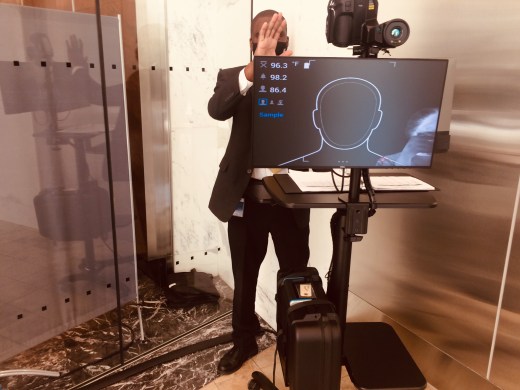
Large office buildings have tasked their building entry concierge team to first conduct a quick health screening of all who enter, in addition to the usual ID check, appointment confirmation and badge ritual. Those running a fever are denied entry.

Smaller office buildings may leave health screenings to each tenant and perform only the ID protocol. Regardless of your building’s protocol, be sure to post a sign at the office entrance to announce that masks will be required. A basket of free surgical masks to offer will be a nice touch.

Disinfecting

Lysol, Clorox and 70% alcohol solutions are known to kill the coronavirus, according to the Environmental Protection Agency. Daily wipe downs are a must for items such as shared desks, conference tables, chairs, computer keyboards and nearly all surfaces in the en suite kitchen and restroom. Providing a bottle of hand sanitizer in high traffic areas will be helpful.

Door knobs, counter tops, microwave oven doors and handles. water faucets, remote control devices, light switches, heat or air conditioning knobs, product displays, telephones and cash registers/ point of sale devices are likewise virus (and bacteria) breeding grounds and in need of one or more disinfecting wipe downs every day.

Speaking of hand sanitizer, the pandemic has shown us that Mom was right about keeping our hands clean, whether with hand sanitizer or soap and water. We must also learn how to wash our hands. First. remember to wash the area between the thumb and the other fingers. Second, when performing a soap and water scrub, lather up for 20 seconds —-the time it takes to sing the Happy Birthday song—before rinsing.

Social distancing

We all know the drill by now—-6 feet of separation, as per CDC recommendations. We want to do whatever is possible and practical to retard the spread of the air-borne coronavirus. Most offices already have at least 6 feet between desks, but some work stations will need an adjustment.

Computers and keypads placed at common work stations will need a re-thinking. Conference tables will likely need several chairs removed. There may be limits on the number of people who may occupy the office kitchen or restroom or photocopy room at any one time.

Working from home

Many white collar workers can simply turn on their personal laptop, desktop, or tablet and commence office hours. A daily videoconference meeting or two is usually sufficient to keep team members on their paths, supplemented by brief phone calls when useful. Videoconferences can also be used to promote staff camaraderie.

A survey of 25,000 workers that was conducted by IBM in April 2020 showed that 75% of respondents hope to continue working from home at least partially after the pandemic. Millions of white collar workers apparently expect the work from home trend to continue and as a result, home sales in the suburbs and exurbs that border big cities have increased dramatically, as people search for living quarters that allow more space for a home office (or two). Space for at-home schooling is another consideration.

PPE

While in the office workers will be masked at all times, except when on the telephone, eating, or drinking. Masks, surgical gloves and hand sanitizer should be made available to as a courtesy to all who enter the premises. Some workers may prefer to wear a face shield. It is constricting but for the time being, it’s what we do.

Thanks for reading,

Kim

Photograph: Kim Clark. The health screening checkpoint at the Prudential Tower in Boston. The concierge conducts a body temperature reading using the laptop computer shown. If the computer reads an individual as afebrile, s/he is next invited to approach the ID checkpoint.