COVID-19 Cash-Flow Update

The nationwide economic shutdown that went into effect in mid-March has done the vast majority of U.S. businesses no favors. In fact, the shutdown has been devastating for business owners and Freelance consultants alike.

According to an April 18, 2020 survey of 16, 620 business owners conducted by Alignable, an online referral and business development organization for business owners and self-employed individuals that claims 4 million members, 43% of businesses in America have had to temporarily close. Of those that remain open, 28% report that business is down by 75%; 15% said that business is down by 50%; 11% found that business is down by 25%; and a lucky 2% report that the shutdown has been good for business (maybe grocery and liquor stores?). The enormous impact of COVID-19 on the economy has compelled the federal and state governments to offer financial assistance to U.S. citizens.

The Payroll Protection Program, which is designed to help businesses that employ fewer than 500 workers to retain those workers on the company payroll in the face of often drastic revenue reductions brought on by the coronavirus business shutdown, ran through the original $349 billion appropriation approved by Congress in less than two weeks. Happily, Congress has just pushed through another bill that will not only add $320+ billion to PPP but also earmark $60 billion of the funding for small banks, credit unions and community based lenders.

Furthermore, business owners and Freelance consultants can apply for a loan that’s up to 2.5 times the average monthly payroll of the business, not to exceed $10 million per entity.

Remember, the PPP loan can flip to a grant if the recipient Freelancer or business owner applies 75% of funds received to payroll expenses (I including the owner’s draw) and 25% of the funds to business operating expenses. Otherwise the loan, which must be repaid within 2 years, is payable at 1% interest.

The Small Business Administration has also played its customary role in assisting business organizations large and small through the Economic Injury Disaster Loan program. EIDL provides loans and also a maximum $10,000 immediate cash advance to businesses financially harmed by the shutdown. The SBA reported that as of April 20, nearly $3.3 billion in EIDL grants and $5.5 billion in EIDL loans had been awarded. Congress is expected to approve an additional $60 billion in EIDL funding, bundled with the $320+ billion initiative to replenish PPP.

Still more help will be made available to Freelancers by way of the new Pandemic Unemployment Assistance program , a variation of Unemployment Benefits and therefore administered by the states, is set to provide up to 39 weeks (maximum) of unemployment benefits to those who have historically been excluded , i.e., us—- independent contractors, the self-employed Professionals, or gig workers.

To be eligible, applicants must provide self-certification to demonstrate that they are available to work but are prevented from doing so as a result of COVID-19 or actions related to it, including one’s own illness due to the virus or a close family member who contracts the virus. Even workers who are collecting sick pay or other benefits that amount to less than one’s weekly pay, or those who are working fewer hours, resulting in diminished income, might nevertheless be eligible to collect PUA benefits. For more information, search Pandemic Unemployment Assistance in your state.

Thanks for reading,

Kim

Photograph: Kim Clark 4/23/2020. The Doc Martens store on Newbury Street in the Back Bay.

The Beat Goes On : Visit the Job Boards

As the coronavirus continues to stalk the land and our political leaders and many citizens continue to see a business shutdown as the only response, making a living has become very difficult for the 57 million Freelance Professionals in the U.S. (Statista). If our clients don’t work, neither do we.

Federal government relief was rumored to be on the way, but I don’t see any evidence of it. It’s probably going to be smarter to put one’s energy into finding projects from a mix of new and current clients (same as it ever was!).

Still, maintaining the discipline and enthusiasm required for a job hunt is difficult and discouraging when the prospects for success appear bleak. But if you can make yourself surf through job board listings three times per week, you might come up with a project, however small.

I am most grateful that my largest client came through and asked me to provide a one hour marketing consultation with one of their clients, an RN/ Nurse Practitioner and midwife who recently launched a Freelance business that focuses on hormone management in women, from post-partum to menopausal. BTW, I sent Easter/ Passover cards to a select group of clients, including this one, and thank heaven my outreach paid off!

Among the marketing strategies the RN will pursue as she builds her Freelance consultancy is a new website, which will function as a lead generator. I was so excited to be able to refer to the RN a Freelance web developer with whom I had worked a few years ago. I’ve reached out to him and as soon as his schedule allows, I’ll conduct an email introduction and hope that the relationship will be fruitful.

That is how we’ll make it through this never-before-experienced crisis, my Freelancer friends. We must rally forward and do some job hunting at least two or three times each week for at least an hour at a time and as well we ought to remember to refer our colleagues along the way.

Now about the job boards—-I found a few possibilities, some familiar and others unexpected, to help you jump-start the client building work,

Aquent

Specialties covered include Management, Marketing, IT Design, Managed Services and Professional Development. Some workers can qualify to receive benefits. Free online training courses for workers are also available. http://acquent.com

This company is strictly top- drawer and seeks only cream of the crop gig workers. Extended Workforce Services is what the company provides and the work assignments may not be remote; there are 35+ offices around the world, primarily in the U.S.

Guru

The site boasts that prospective employers will work with among the most talented professionals in the field, regardless of the assignment. Among the services provided are translation/ writing, legal services, architecture & engineering, marketing & sales, business & finance, software development & programming and administrative services. https://www.guru.com/d/jobs/

LinkedIn ProFinder

The ProFinder algorithm sends jobs to your inbox, thus eliminating the need to continually search for employment possibilities. Only five proposals are accepted for each assignment, so time matters for assignments that appear very attractive .

Proposals are short, which allows bidders to quickly put themselves into consideration but limits one’s ability to sell oneself in some instances.

I’ve submitted 8 -10 proposals over the past 12 – 18 months, and I came close to being hired only once. The project was interesting and the rate of pay offered was very decent. The lady who interviewed me over the telephone was very nice and also honest.

That said, I still recommend that you sign up for ProFinder, create a profile and compete for assignments. The first 10 submitted proposals are accepted at no charge but to submit additional proposals the job seeker must join LinkedIn Premium at $60/ month and that is steep. Depending on your luck, you may decide to pay up and roll the dice on being hired. Or you’ll pull the plug on this service.

However, none of my other proposals was ever acknowledged, including one submitted by a man who had once written for the New York Times. What was his motive for the job posting? Maybe he thought he just felt my writing isn’t good enough? http://LinkedIn.com

The Creative Group

Freelancers looking to earn money and work on interesting projects may be very happy with this site. It’s the place for advertising whiz kids, marketing rock stars, genius art directors, amazing website designers and super organized account managers, too. Full time and project work is available, both on-site and remote.

The company is a division of the global giant Robert Half Staffing Agency. https://www.roberthalf.com/submit-resumeglobal

TopTal

TopTal announces to both job seekers and prospective employers that the site features the top 3% of Freelancers from around the world. software developers, finance experts, product managers, marketers, graphic designers and project managers are the principal hires. ://www.toptal.com/careers#positions

Upwork

I’ve gotten a couple of small jobs on the site but I abandoned ship when it was announced that it would cost money to submit a proposal. On top of that payment, there will be a 20% fee attached to each invoice submitted. Furthermore, Upwork clients like to low-ball on fees, so there is not a lot of revenue to be generated, unless one specializes in software development and other IT functions.

I was lucky enough to start work on a sales training manual but then the client pulled the plug and regards was the end. She claimed to really like my work. The fee charged was less than half of what it should have been. I suspect that the client suddenly got spooked by the business start-up costs Oh. well. I sometimes think about reaching out to say hello to the client. She was great to work with. http://Upwork.com

Thanks for reading,

Kim

Photograph: Runner on Commonwealth Avenue in the Back Bay neighborhood (Boston, MA) on Monday April 20, 2020, what would have been the Boston Marathon.

Coronavirus Cash Flow

Because federal and state governments chose to require most businesses to cease operations as a way to decrease public exposure to COVID-19, those entities have recently decided to throw a few dollars back at the citizens, to help us manage our financial obligations as the shutdown grinds on. As you may have predicted, the response may be inadequate and imperfectly distributed, but it will help a little bit.

CARES Act Economic Impact Payment

Every citizen and legal resident not claimed as a dependent on someone else’s tax return is eligible to receive an EIP, that is, a Stimulus payment of up to $1200 per person, or $2400 per couple, plus an additional $500 for each child.

Eligibility for financial assistance will be calculated from one’s 2018 (or 2019, if filed) tax filing, so make sure that one or both are completed and in the hands of the Internal Revenue Service and your state Department of Revenue. The new tax filing deadline date is July 15, 2020 for 2019 federal taxes and most states have assigned that date as a deadline as well, but I suggest you verify that ASAP.

Filing for extensions on the federal or state level remains April 15, 2020. To keep abreast of this fast-changing situation on the federal level, check in at http://irs.gov/coronavirus.

Single filers whose Adjusted Gross Income was $75,000, joint filers whose AGI was $150,000 and marrieds filing separately (head of household) whose AGI was $112,500 in 2018 (or 2019) will receive the full amount of the award (see above).

Single filers whose 2018 AGI was between $75,001 – $99,000 and marrieds whose AGI was $150,000 – $198,000 will lose $5.00 for every $100 that their AGI exceeds the $75 K and $150 K single or married filers thresholds. Regarding those whose AGIs are below the thresholds, there doesn’t appear to be a plan in place.

Children who qualify for the Child Tax Credit can help their family receive an extra $500 each. Dependent students aged 17 – 24 years will not bring the Stimulus benefit to the family but working students aged 18 – 24 years who file their own taxes and are not listed as a dependent on the tax return of another are eligible to receive a Stimulus payment for themselves.

The Department of the Treasury prefers to send Stimulus payments electronically so if you’d like to receive payment more quickly, make sure that your bank or debit card info is on file. If the IRS does not have direct deposit information for you as a result of previous tax refunds, there will soon be a website to allow filers to add that information.

CARES Act Paycheck Protection Program

This program was originally created to help business owners who employ fewer than 500 workers to retain their employees in those essential operations that are sanctioned to remain open during the shutdown. The PPP is technically a loan program that has the potential to become a grant. Those who apply need not prove any lost income or financial hardship. It’s recommended to apply for the loan through your business banker.

If 75% of the loan money is applied to payroll expenses and 25% is used to pay operating expenses such as rent and utilities, the loan will then be forgiven and essentially become a grant. If that formula is not followed, the business owner will pay a 1% interest rate, payable over two years, with the first payment not due for six months.

Freelance consultants benefit when the payroll portion of the loan calculation is instead applied to our revenues as determined by one’s “net earnings, wage, commissions and/or income from the self- employment venture.” If the Freelancer employed any full or part- time workers, they must remain on the Freelance entity’s payroll for a minimum of 8 weeks, at the original rate of pay, in order to qualify for the loan, as is the case with typical business owners. If the Freelancer hired other Freelancer contract workers to help out on a project, those contract Freelancers are not covered in the PPP calculation; they may apply on their own for the benefit and include that income.

FYI, PPP loans may be administered only by a pre-approved list of banks and the word is that for the most part, only existing business banking customers will be approved for the loan.

There are now millions of Freelance workers in the U.S. and the demand for PPP loans, which if handled as described above can become a grant, is high. It’s rumored that Congress is weighing the possibility of adding $250 million to the original $500 million appropriated for PPP, so that the Small Business Administration can expand the list of approved lender banks. To be continued.

Thanks for reading,

Kim

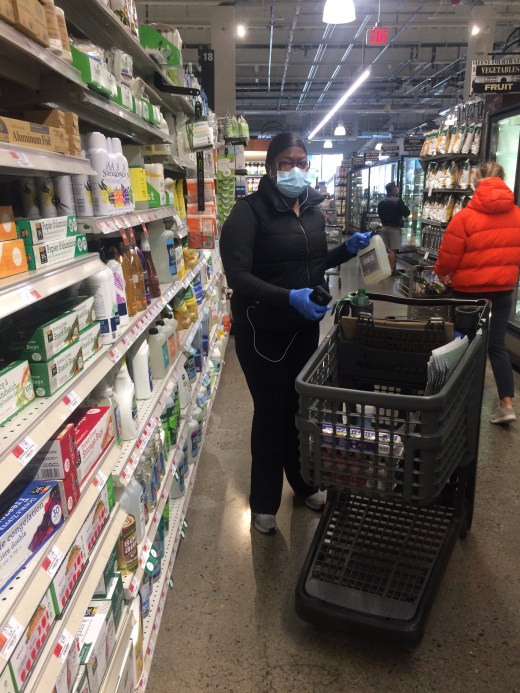
Photograph: Kim Clark. Shopping at the South End Whole Foods Market in Boston, MA.

Rituals and Recovery

This week I have another coronavirus coping strategy for Freelancers to r reand it boils down to this—do what you’ve always done, except when you have to pivot or adapt. Psychologists, sociologists and others who observe human behavior know that routines and rituals have real power. Michael Norton, professor at Harvard Business School and member of Harvard’s Behavioral Insights Group and Francesca Gino, professor of organizational psychology at Harvard Business School and author of Sidetracked: Why our Decisions get Derailed (2013) found that routines and rituals are stabilizers that ground us and help us to keep going when we’re feeling out of sorts, when we’re grieving the loss of a loved they keep families and friends closer they help to maintain the bond between martial partners.

There is a psychological benefit when, in times of uncertainty and stress, we return to our old routines and habits. Some routines that we turn to can be harmful, it is true. Binge eating, smoking and drinking come to mind. If those activities have been among your habits, I suggest that you leave them in the past. As we crawl our way through the coronavirus shutdown it will be the good rituals and habits, the sometimes silly and often idiosyncratic ways about us, that will nurture us and give us the strength and determination to see our way through this long dark tunnel.

Weddings, christenings, funerals and holiday dinners are all steeped in ritual (that is, habit). That is why whenever someone makes a change to the Thanksgiving or Easter dinner menu, there might be a mini riot. Even those who don’t love mashed turnip or mincemeat pie may complain long and loud if those items are not served on the fourth Thursday in November. The decision to serve an Easter ham or Easter lamb could lead to an armed standoff.

Routines and rituals are often small habits. One always wakes up at a certain hour, so as not to feel lazy. One always exercises in the morning (or in the evening) because at first it fits a schedule but now it is defining act that supports and even comforts.

Oddly, Norton and Franco found that a ritual or routine did not have to be practical or useful to be habit-forming and compelling. Competitive athletes are known to sometimes wear a favorite pair of socks or necklace, or eat a certain food for the pre-competition dinner because they feel the need for a good luck charm.

So what can you do to keep it together as you push through what is probably the most formidable challenge a Freelance consultant will face? As I said earlier, keep doing what you’ve been doing. If you always woke up at 6:30 AM on the weekdays, then continue to do so. If you always headed out to the gym at 7:00 AM, here is where you pivot and make an adaptation. Because gyms are closed, devise a combination run and power walk routine that lasts for 30 minutes.

This is a holiday week for Christians and Jews and I suggest that you apply the ritual usually practiced during the December holidays and send cards to your clients. Because you don’t know who is working from home and who is in the office, send an e-card (I use Jacquie Lawson).

Create a new ritual and visit online gig economy sites such as LinkedIn and Upwork. Tell yourself that you’ll check in on Tuesdays and Thursdays (or Mondays and Wednesdays) and use self-discipline to keep the routine going throughout the shutdown and beyond, because we all need money and we need lots more cash than the government stimulus will provide.

Another ritual that you can either continue , learn, or resuscitate is meditation and focused breathing. Both medical and psychological research has demonstrated that this technique promotes healing of the body and mind.

Thanks for reading,

Kim

Photograph: Kim Clark. Long-time Boston favorite Giacomo’s Ristorante pivots out of sit-down service and into takeouts, per the Commonwealth of Massachusetts coronavirus rules.