

COVID-19 Crisis Management

How are you holding up? I assume that you are taking steps to manage the impact of our coronavirus crisis and that you’re feeling somewhere between frightened and overwhelmed? This thing has hit like a tidal wave that has upended all business and taken nearly every Freelancer under, at least in the short term.

The shelter in place orders that panicked public officials have instituted have the ability to do particular harm to self-employed professionals and small business owners. We are concerned about public health and we understand more than most about the need for decisive action because our livelihoods depend upon it and our money and our brand are always on the line. We wish that along with epidemiologists, economists and even ethicists would also be invited to the decision-making tables.

The strategy that’s seen as quick fix crisis management by ventures large and small is to shed all or most Freelance workers and review all supplier and vendor contracts, with the purpose to renegotiate and trim fees.

I agree that cost-cutting measures are prudent and if I presided over a larger entity I would recommend such actions to my leadership team. Yesterday, I read that Exxon Mobil will follow exactly the same strategy.

Yet being perceived as expendable does nothing to improve one’s ability to sleep nights, to say nothing about one’s ability to pay living and business expenses. If a survival strategy ever was needed, the time is now! So what can we do? The short answer is to get practical, be resourceful and use online tools wherever possible because the practice of social distancing will be with us for a number of months.

TECH ENABLED TOOLS

I teach business courses and present workshops and that means I have an audience. Or maybe I should say I had an audience. For the time being, public speaking and gatherings as we have known them are over. I’ve already been in contact with two clients to discuss how educational programs will proceed.

One client has been doing online workshops for a number of years and they’re conducted over Skype and so my ID for that platform has been sent to them. Unfortunately, what was scheduled in the near term was cancelled, but since they have clients to satisfy and need me to achieve that imperative, I know that by late April I’ll be presenting on Skype.

To another client I recently sent an email and suggested that we postpone by a couple of weeks the workshop that I was scheduled to present and repackage it as a webinar. I offered to come to their place of business to use their equipment (and also guarantee a quiet studio, something that a home broadcaster can seldom provide what with the sirens of emergency vehicles passing by, however occasional).

A third client has for a number of years hosted social events that regularly attract 500 – 1000 visitors. I will soon reach out to my contacts there and suggest that they experiment with an online format. The logistics, format and flow will have to be carefully considered, but for several years many people have attended meetings virtually and the concept is no longer novel.

While on a recent (audio only)conference call meeting of 18 participants, three or four spoke up about using online platforms to conduct social events that have been successful. One caller spoke of online dinner parties that she and her husband share with their adult children who now live in other parts of the U.S. Another caller spoke of attending and enjoying a virtual cocktail party, where participants dressed up, poured themselves a cocktail or glass of wine, nibbled hors d’oeuvres and engaged in conversation with other guests all from their kitchen or dining room tables. Apparently, they had a blast.

Finally, to the writers among you, this crisis is the perfect time for clients —and Freelancers ourselves—-to review marketing strategies and update our messages and materials where needed. Stay the course and be brave.

Thanks for reading,

Kim

Photograph: Kim Clark. Star Market, Prudential Center Boston MA March 23, 2020

Continue reading
5 Clients You Need to Fire

It takes all kinds of people to make a world and unfortunately, from time to time one is destined to encounter an individual whose mission in life, so it seems, is to attack others and make them unhappy. Such people obtain a perverse pleasure from making the lives of others miserable. These people like to criticize, demean, diminish, bully, gaslight and even humiliate those with whom they interact, professionally and personally.

I’ve met more than my share of these damaged creatures (even one is too many!) and my recommendation is to keep them at arm’s length and whenever possible, cut ties with them altogether. There is no relationship compelling enough to justify any level of abuse as the price of interaction. Forget about keeping the peace. Troublemakers never worry about keeping the peace (but they will throw that excuse at a target, as a way to maintain control).

Some relationships are difficult to avoid but when it’s a client (or for that matter, a close relative), I guarantee that there is nothing positive that will ever be derived from a dysfunctional relationship. The best course of action is to politely cut the cord. Have you met any of the characters in this rogue’s gallery listed below? Deport and build the wall!

Commitment phobics

Some prospects prefer to shop around and consider several options before they decide which solution to invest in. That’s a smart thing to do; shopping is not a problem as long as the prospect is really a prospect and serious about finding a good solution for their needs. However, some “prospects” fall into analysis-paralysis quicksand and never move forward to get the project done, no matter what they promise you. They just string people along and waste time.

Fee hagglers

Start-up entrepreneurs, more than a few small business owners and many Freelance consultants, whether their venture has high growth potential or is likely to become only modestly profitable, may have limited funds. Likewise, leaders at not-for-profit organizations may direct as much of their financial resources as possible into supporting the mission, which may be a cause about which s/he feels passionate.

If you are offered an assignment that while it has a very modest budget but that you nevertheless feel is worthwhile, whether it advances a cause about which you are also passionate, or you’ll be able to take on a project that will, for example, allow you to expand into a niche that you’d like to enter and therefore has significance for you, then accept a lower than usual fee. Just don’t allow yourself to get bullied and frightened into lowering your fee by someone whose aim is to exploit. Respect that you must adequately cover the time and expertise that you will devote to this project. Be aware of what matters to you and set clear boundaries when deciding whether to accept “charity” cases. Establish a “walk-away” amount for every fee negotiation and accept nothing less (it’s not easy, I know).

Abusive

Along with time, expertise, judgment and resourcefulness are among a Freelancer’s most valuable and marketable attributes. In order for us to perform at peak efficiency, so that we can fulfill the needs and expectations of our clients, it is tremendously helpful, if not necessary, that those with whom we work, our clients, respect who we are and what we can do for them. Uncommunicative, uncooperative, unethical or just plain obnoxious clients greatly diminish our ability to do our best.

Behavior that persistently negative, undermining, passive-aggressive, micro-managing or outright verbally abusive are unacceptable and should never be encountered in the professional (or, for that matter personal) sector. Watch and listen for sign of this type of behavior in client meetings. If you see a red flag in the distance, back away quickly. You may need a contract, but you’ll pay back every dime that you earn in misery.

Complainers

Some clients are never satisfied, no matter what you do to please them. When clients provide negative feedback about your pitch or the work you’ve done, it’s important to determine its validity and make improvements as indicated. But some people make it a habit to continually criticize and complain about everything because nothing is ever good enough for them. It makes sense to avoid these clients whenever possible.

Slow payers

Late payers (or God forbid, no-payers) have no place in a successful business. A business requires steady cash-flow. Clients who don’t pay invoices on time disrupt your financial viability and make it difficult to effectively manage business and personal finances. Slow pay/ no pay clients can even prevent you from making important investments in the business or yourself.

Clients who constantly delay payment don’t appreciate the value that you and your organization bring to their business. While in fee negotiations with a client, remember that the best defense is a good offense; establish a protocol that will minimize, if not eliminate, the slow-pay/ no-pay risk.

A reasonable risk management fee collection strategy is to request a certain amount of the total fee at the signing of the work contract, maybe 15 %, before commencing work. Get agreement from the client on one or two project milestones and tie payments of 25% to them. Invoice the client for the final amount within two weeks after project completion and ask for payment upon receipt of the invoice.

Thanks for reading. Stay healthy!

Kim

P.S. Apologies for not publishing this post on March 17, as was my intention. The publish button was clicked and I thought that the post had published.

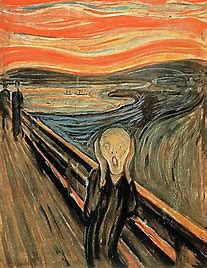
Image: “ The Scream, “ 1893, by the Norwegian painter Edvard Munch (December 1863 – January 1944) courtesy of The National Gallery in Oslo, Norway.