Your Business Advisor

As I go about my life, I will sometimes meet the owner of a small to mid-size business who, when I say that I’m a Freelance business strategy and marketing consultant who works with companies that need a professional to solve problems and get the company on track to grow and become profitable, or achieve other important objectives, they tell me about a business goal or obstacle they’re wrestling with. They ask if we can grab a coffee and talk sometime soon?

The stories that the business owners share are familiar—marketing problems, especially social media and content marketing questions; cash-flow bottlenecks; how to best launch a new product or develop a niche market; branding; pricing; and how can we scale and grow the company? Maybe a consultant can help?

Hiring a Freelance consulting expert can be helpful. The right specialist will give business owners and leaders an unbiased “view from 30,000 feet” of the business, making it possible to pinpoint problem areas and recommend strategies that will guide the organization to growth and profit. A consulting specialist can be brought in to address nearly any business need, from accounting, management and marketing to selling skills, IT, operations and even telephone etiquette.

If you hire the right person, the consulting fee will more than pay for itself, and save or make money for the organization. Consulting specialists work only on specific, predetermined business needs and do not add to the company payroll.

“Consultant” is a generic term; there are at least four types. Business consultants have a specific area of expertise based on their work experience and educational background—strategy, marketing, branding, sales training and financial management are common specialties. Process consultants develop practical solutions to improve a company’s day-to-day operations and overall functioning. IT consultants solve problems for those who need help with technology, Artificial Intelligence, Blockchain, cloud, cyber security and the Internet of Things. Executive coaches are counselors who guide clients through a wide variety of business or personal challenges. Increasingly, executive coaches do not have business expertise; many are psychologists (PhDs). Here’s a seven-point strategy to ensure you get the most from the consultant you’d like to hire.

Ask questions

Interview a prospective consultant before you hire. Questions to ask include: “What is your experience in my industry or field? Can you describe problems similar to mine that you’ve handled? Can you offer me full confidentiality and represent me without conflict of interest with your other clients?”

Also, confirm that the consultant will regularly communicate with the company contact person and prepare periodic progress reports. Request a written proposal that spells out how s/he plans to approach the organization’s problem, the approximate time needed and the fee you’ll be charged. If the business owner approves, that will serve as the contract.

As you evaluate a consultant’s experience and skills, consider your working relationship. Do you like and trust the person? Do you have a good rapport with him/her?

Expectations

A consultant is an advisor, not a miracle worker. If your marketing campaign hasn’t increased sales for the past six months, don’t expect a consultant to turn business around overnight. If someone promises to do so, be skeptical. You want a consultant who is knowledgeable in your industry or field and can recommend a workable solution, which is often not a quick fix.

Job specs

The business owner must decide what tasks to pursue and commit that to writing. The more specific, the better. There can be no confusion about the assignment. Asking for a strategy to increase sales by 10 % within 12 months, or increase social media followers by 25 % in a similar time frame, will ensure that the consultant understands the expectations.

On your end

The business owner should anticipate the information and resources that the consultant will likely need to do the job. Consider what documents, metrics, history are essential, along with any office equipment, office space, supplies, or team members that can make the job progress at a smooth and efficient clip.

The money talk

Some consultants charge flat rates or bill by the hour, the day, or the project. Others charge a contingency fee, in which the amount paid is based on the results. For instance, if a consultant reduces business operating expenses by $10,000, s/he might receive 10 % of the savings as the total fee or as a bonus in addition to the flat rate. I estimate that the average full-time consultant charges $75 to $150 per hour.

References

Ask the prospective hire for three recent references—and call them. You want to know if the consultant accomplished what was promised within the agreed-upon deadline, if s/he communicated regularly and if the company would hire the consultant again. Ideally, the consultant will have worked for at least one client who operates a businesses similar to yours.

Contract

Prepare a written agreement (the project proposal referenced above will usually suffice) that clearly spells out the terms of the arrangement. Define the services to be performed, the starting and ending dates, the fee schedule and how it will be paid, milestones, expenses that the business owner agrees to pa, and services the consultant will provide. For contracts $10,000 or more, the business owner is recommended to ask a business attorney to review and edit/ approve the agreement.

Thanks for reading,

Kim

Photograph: © Paramount Pictures. Robert Duvall ([L]as attorney and advisor Tom Hagen) shares information with his only client, Marlon Brando (as family business CEO Vito Corleone) in the multi-Academy Award winning film The Godfather, Part I (1972).

7 Kinds of Business Financing

Is 2020 your year to launch a business, or is growth and expansion of your existing venture on this year’s must-do list? If so, congratulations and best of luck to you! I’m sure you’ve thought of the most advantageous way to obtain the required financing for your plans and we’ll look at some good options right now.

A study conducted by the National Small Business Association found that 19% of small business owners cite a lack of available capital as the biggest challenge to plans for future growth and 82% of businesses outright fail because of cash flow management issues. In preparation for borrowing, I remind you that financial institutions will evaluate your credit score, so make paying off bills and boosting your savings immediate priorities.

According to the 2018 Small Business Lending Index, big (national) banks approve 25% of loan applications made by small business owners and smaller (community and regional) banks approve nearly 50% of loan applications made by small business owners. So whether it’s your food supply or your money supply, keeping it local is a good thing, am I right? https://www.biz2credit.com/small-business-lending-index/january-2018

Line of credit

A business line of credit functions like a credit card and it’s available to borrowers with either good or less than perfect credit. Borrowers can be approved for a potentially generous amount of funding that can be accessed immediately. The application process to obtain a line of credit is usually quick, and many businesses receive approval in a day or two. Interest rates range from 7% – 25% and repayment terms are usually between six months and one year, (meaning that one cannot run a balance ad infinitum) depending on the business’ revenue and credit score.

Short-term loan

Pursue this type of loan to, for example, bridge cash flow gaps, stock up on inventory that is available at an attractive price, or take advantage of a lucrative business opportunity. Surprisingly, borrowers often don’t need a great credit score to be approved for a short-term loan and that can be an advantage. In fact, the borrower could use the loan to pay off higher-interest debt and improve the credit score. Furthermore, short-term loans tend to involve less paperwork and processing is usually fast, making funds available quickly.

Short-term loans must be repaid in rather a short amount of time, often in just one year, and payments are usually due weekly, not monthly. They also generally come with a relatively high interest rate when compared to other types of loans and loan amounts are usually capped.

Secured loan

Secured business loans require a specific piece of collateral, such as a business vehicle or commercial property, that the lender can claim if the borrower fails to repay the loan. Unsecured loans, on the other hand, are not attached to collateral. Personal loans, student loans and credit cards are common examples of unsecured loans. Unsecured loans have higher interest rates and stringent approval requirements, to ensure that lenders gets their money back. Secured loans are often easier to obtain and may also have a lower interest rate, because the lender has a guaranteed way to recoup money lost to default by selling the borrower’s collateral.

Because of the increased risk an unsecured loan represents to the lender, borrowers may be asked to sign a personal guarantee in order to receive approval. If the borrower defaults on the loan, s/he will then be personally liable for repaying it. While a creditor can’t seize business property under a personal guarantee they can legally claim the borrower’s personal assets, including bank accounts, cars and real estate, until the loan is repaid.

Another common method used by institutions to mitigate the risk associated with secured loans is by reserving the right to file a blanket lien against the borrower’s business assets. Most business loan terms include a blanket lien clause that allows the lender to claim and resell business assets to collect the debt.

Term loan

Term loans, also known as long-term loans, are best for business owners with great credit and who are requesting a big loan. They may not be a good option for those who are launching a new business, however, since lenders usually want to see a track record of success (evidenced by 3- 5 years of business financials) before taking on the risk. 

The term loan application process is lengthy. If the application is accepted, borrowers must pay a principal amount plus interest each month until the debt is paid in full. Term loans are most often used to buy real estate, acquire another business, remodel or renovate a commercial space, or support long-term business expansion.

Equipment loan

Owners of businesses large and small often need to purchase, replace, repair, or upgrade various kinds of equipment to process, manufacture, or produce their products and equipment loans are essential to this process. These loans can be a great option for start-ups as well as established businesses, and they can be used to finance nearly every type of business equipment, including company vehicles. Owners of new businesses can take advantage of an equipment loan because the equipment secures the loan, regardless of the success or failure of the company. Interest rates are often reasonable and will reflect the individual’s or business’ credit rating and financial picture.

Be aware that excellent credit is required for most equipment loans. In general, borrowers will be able to finance 80% of the total purchase price of the equipment. A down payment of about 20% is typically required for most small business equipment loans.

Borrowers with less than stellar credit should investigate the terms of leasing the desired equipment. Leasing typically does not require a down payment and that especially benefits businesses that have little or no available working capital. When a down payment is required, it is typically relatively small compared to what a traditional loan down payment would be.

Purchase order financing

To qualify for purchase order financing, the company must sell finished goods (not raw materials or product components) to B2B or B2G customers with profit margins of at least 15%. Start-ups can qualify for PO financing because approval is based primarily on the creditworthiness of, and borrower history with, those customers and suppliers. The chances of being approved are even greater if customers and suppliers are well-established, reputable companies.

PO financing can present a great opportunity for start-ups that receive lots of orders but don’t have the cash to fulfill them. In these cases, similar to invoice financing, the purchase order secures the loan. Once the business receives a purchase order from a customer, the lender directly pays the supplier to manufacture and deliver the product to the customer. Once delivery is accepted, the customer pays the lender. The lender then deducts their fees from this amount and pays the remainder to the borrower, which can be counted as profits. 

PO financing is a great way to help your business grow without taking on bank debt or selling equity in your company. If sales outpace your incoming cash flow, then purchase order financing might be a good strategy to fulfill big orders.

Invoice financing

Also known as accounts receivable financing or factoring, this loan allows Freelance consultants to survive slow-paying clients. Small and medium- sized businesses will be able to manage the increasingly common practice of “net 90” receivables payment that large companies impose on smaller organizations, in exchange for big orders.

With invoice financing, lenders advance to borrowers the value of accounts receivable, less a fee of perhaps 15%. The borrower will pay a weekly fee while waiting for the customer to pay up. Invoice financing helps businesses improve cash flow, meet the employee payroll, pay vendors and suppliers and reinvest in operations and growth earlier than they could if they had to wait for clients and customers to pay their balances in full.

Thanks for reading,

Kim

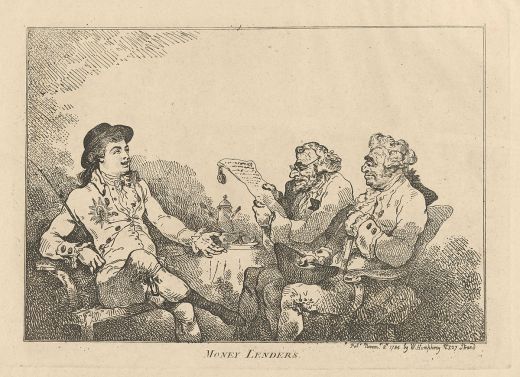
Image: Money Lenders (1784) an etching by Thomas Rowland. The aspiring borrower (L) is George, Prince of Wales (George IV 1820 -1830).

Paying You: How to Pay Yourself When You’re the Business Owner

Freelance consultants and business owners dedicate a considerable chunk of mental bandwidth to thinking about how to generate business, because the top line matters. We think a lot about making money, but we may not devote much time to thinking through the mechanics of paying ourselves once the money arrives.

Sole Proprietors and single person LLC owners may consider the self-payment process a no-brainer—as invoices are paid, one simply deposits the money into the business bank account. But like so may actions that seem easy at first glance there is usually a right way, a smart way, to pay oneself as a self-employed person.

So—are you on your business’ payroll or do you take payments from your business in the form of owner draws? Do you and your business partners take guaranteed payments (salary)?  Are you paying yourself too much or not enough? How can you tell? Also, where in your business financials are the payments recorded?

Business type Payment Tax return Payroll Tax

Sole Proprietor Owner’s draw         1040/ Sched. C     Yes                                

Single LLC Member draw 1040/ Sched. C Yes

Multi LLC Member share 1040/ Sched. K-1 Yes

S Corporation Dividend/ wage 1040/ Sched. K-1 Yes

C Corporation Dividends 1040 dividends not on dividends

Sole Proprietor

Business owners and Freelancers who adopt this, the default business structure, pay themselves through an owner’s draw, i.e., the amount of money taken from business earnings, after expenses and taxes, by the owner for his/her personal use. The payment is called a draw because money is drawn out of the business.

Sole Proprietors usually take draws by writing a check to themselves from their business bank accounts. Smart Sole Proprietors will then deposit that check into a personal bank account and avoid co-mingling business and personal funds, a practice that inevitably leads to accounting and tax complications. The owner’s draw doesn’t affect business taxes because the net income has already been taxed. The draw is also not a business expense. From an accounting and tax perspective, the owner’s draw is income distribution. Owner draws are recorded on the Balance Sheet.

Limited Liability Company (LLC)

LLC owners, who are known as members, are not (always) considered employees of the entity and therefore they do not (always) take a salary as would an employee. LLC members, especially single member entities, usually pay themselves with a member’s draw, which is taken from the member’s capital account (business bank account). Multiple owner LLCs are considered to be partners in the business and pay themselves with a member’s share distribution, also taken from the member’s capital account. 

While members may periodically draw from their capital account, a draw is in reality an early withdrawal of anticipated year-end profits, a goal that is perhaps at top-of-mind at multi-member LLCs. Whenever a member receives a draw during the year, his/her capital account decreases, but if the business shows a profit at the end of the year, the member’s capital account will increase in accordance with the percentage of ownership. If a member owns 25 % of the LLC, then s/he can expect to receive 25 % of year-end profits. Single member LLCs own 100 % of the entity and are entitled to 100 % of the profits. Member draws are recorded on the Balance Sheet.

A working member in a multi-member LLC has the option of either receiving a guaranteed salary amount as an LLC employee, or paying oneself with a member’s share distribution, as will a single member LLC owner. Members who are strictly silent partner investors and do not work in the business are not entitled to period draws, but will receive their member’s distribution of profits in accordance with their ownership percentage at the end of the tax year. 

The member salary, known as a guaranteed payment, is not based on the percentage split agreed upon in the LLC operating agreement but based on the work the member performs in the business. Unlike member distributions, guaranteed payments are recorded on the Profit & Loss (Income) Statement and are taken from business profits.

The LLC must be diligent about filing the correct tax forms on behalf of members and maintain accurate accounting histories for everyone throughout the year, to reflect member payment choices. Members paid as LLC employees must file IRS Form W-4 to calculate the amount of payroll tax withholding taken from from each paycheck. The member is then treated as a W-2 employee of the LLC. If the member is paid as an Independent Contractor, then s/he must file IRS Form W-9 with the LLC and the LLC must file IRS Form 1099-MISC by the end of the year. All member draws or distributions are deducted from the amount of profits assigned to the capital accounts, based on ownership percentages.

Corporations

An S Corporation is in reality either an LLC or C Corporation that has elected for special tax treatment with the IRS. S Corp income, losses, deductions and credits pass through to its shareholders’ personal IRS Form 1040. Shareholders then report the business’s income and losses on form 1040 and are taxed at their individual income tax rates. C Corps are subject to double taxation—a separate corporation tax and when dividends are paid to shareholders, that amount is recorded on IRS 1040 (but there is no payroll tax).

S and C Corporation owners who work in the business pay themselves a regular “salary” and also distribution payments. S Corp owners are usually employees of the business. Owners who work as employees must be paid a “reasonable salary” before profits (dividend distributions) are paid and the salary is subject to payroll taxes. The IRS has guidelines that define a reasonable salary, based on job responsibilities. Salaries are generally taken from business profits.

Owners of C Corps can elect to pay its shareholders a cash dividend, which is a distribution of company profits. However, the C Corp board may choose to retain either the entirety or some portion of business net profits and decline to pay a dividend in a given quarter or year. If a dividend is paid, that amount is added to income reported on the shareholder’s personal IRS Form 1040. The company records dividend payments on the Balance Sheet.

S corporation owners have been known to request that their corporations pay them little or no salary, since salaries are taxed, and instead take payments as dividend distributions, which are not taxed. The IRS has stepped up enforcement on this issue and in 2000 audited thousands of S Corps whose owner the IRS concluded had received a suspiciously low salary and very generous dividend distribution, in an apparent attempt to evade payroll taxes by disguising their salary as corporate distributions.

Thanks for reading,

Kim

Photograph: Pay day on a U.S. Navy cruiser (1942)

Elevator Pitch: Master Class

Every Freelancer has an elevator pitch, but few of those pitches are as effective as they could be. My own could use some work, to be honest. Freelancers are hunters and we thrive only when we bring in clients who trust us with lucrative and/or long-term projects. Arguably, the most important facet of a Freelancer’s skill set is the ability to quickly assess whether that interesting someone we’ve just met might have the potential to green light our next payday.

Street smart Freelancers anticipate the opportunity inherent in every meeting by using our hunter’s instinct to take aim and expertly deliver an elevator pitch that gets bells ringing in the head of a listener. In the conversation that’s sure to follow, these Freelancers ask a handful of smart questions designed to quickly weed out window shoppers, tire kickers and those whose needs do not align with our skill set.

The hunt starts with the pitch and Freelancers must build it with precision and deliver it in 30 seconds. The biggest mistakes Freelancers make in elevator pitch content are: (1) merely stating their skill set or job title, rather than giving a brief description of the problems they solve for clients and (2) failing to communicate the value they provide, the practical application of their expertise, that makes a persuasive case for working with them.

Skills or functions?

“I’m Bob Rossi, a business lawyer who also edits a digital business management magazine.” The information is accurate but Freelancer Bob has not expressed what is uniquely worthwhile about his business, he has not presented a story or any information that might persuade a listener to take notice. Expecting his job title to interest the listener is unrealistic because that alone doesn’t necessarily help anyone understand why s/he should care who Freelancer Bob is and envision how his products or services might be useful.

Whatever your job title and skill set, there are most likely dozens, if not hundreds, of highly skilled professionals who do some version of the same thing. There are many types of lawyers and business writers in the world. The successful hunter-Freelancer knows how to present a tidy little narrative of an elevator pitch that puts the listener at its center. In this much more compelling version, the Freelancer succinctly (1) names his/her specialty— the kind of work that you do best or most often (or your most popular product)— and how you add value; (2) identifies the types of clients you usually work with; and (3) gives three or four examples of article topics that regularly appear in the magazine (marketing, sales, finance and tech, perhaps).

“Hello, I’m Bob Rossi. I help business start-ups solve their management and legal issues, including LLC, incorporation and partnership set-ups. I also edit a nationally known monthly digital business management magazine that addresses topics that are important to business owners, entrepreneurs and self-employed professionals, primarily finance, marketing, sales and tech.”

It’s critical to wordsmith an elevator pitch that will convince the listener to pay attention and, if your timing is right, think of how s/he can use your know-how and imagine bringing you into a project that needs to get done in the near term. A money-making elevator pitch can convert a listener into a prospect who wants follow-up, who will say “take my card and shoot me an email, or call me at around 5:00 PM on a Tuesday.”

Finally, like the old joke says, “How do you get to Carnegie Hall? Practice!” Nothing sounds worse than clumsy delivery of an elevator pitch. You will be dead in the water and the VIP will never give you a second chance. Like an actor or an athlete, Freelancers must constantly rehearse and refine the elevator pitch, working it so that it slides off the tongue effortlessly. Because we never knows when a fortunate encounter with a VIP will occur, practice your elevator pitch often. Edit and edit again, until the wording is perfect and the cadence natural. Learn to step up to the plate on a moment’s notice with confidence, energy and enthusiasm and hit a home run every time.

Thanks for reading,

Kim

Photograph: ©TV Guide. Deluca (Giacomo Gianniotti) delivers his elevator pitch to Meredith (Ellen Pompeo) in Season 15, Episode 9 of Grey’s Anatomy.