Google Says You Are What You EAT

Freelancers and business owners must do whatever is possible and practical to promote our ventures and one perennial item on our marketing to-do list is the matter of Search Engine Optimization. Basically, that means how does our website fare in the all-important Google page ranking? Just the other day, I received an email marketing notice that examined whether email marketing or blogging was more effective for increasing Google page ranking and the answer was blogging (so I guess these folks will no longer send marketing emails?)

Google’s ever-evolving algorithms are a source of OCD -level obsession for many Freelancers and business owners. Big-budget companies spend thousands of dollars annually to follow the formula that will keep their business in the top 10 (i.e., page one) of Google searches. In February of this year, Google actually released a white paper that addresses the ranking issue, framed as an explanation of how they fight disinformation. In short, Google claims that we are what we EAT.

E-A-T in Google-speak stands for Expertise, Authoritativeness and Trustworthiness. This concept is discussed is detailed in its Quality Raters’ Guidelines. Demonstrating good EAT both on your website and social media platforms can potentially improve your company’s ranking. An excerpt from the report says, Our ranking system does not identify the intent or factual accuracy of any given piece of content. However, it is specifically designed to identify sites with high indicia of expertise, authority and trustworthiness (EAT).”

At the heart of the ranking system is a category of businesses that Google defines as Your Money or Your Life (YMYL). Introduced in 2014, its purpose is to protect those searching for medical, legal, financial, or safety-related articles and websites, along with other information deemed vital. Attorneys, physicians, dentists, mortgage brokers, banks and eCommerce sites are placed in the YMYL category, since consumers often must divulge personal information and payment details on those websites.

But let’s get to the meat of this thing, i.e., what does Google suggest we do to elevate page ranking? See below:

  1. Quality content
    YMYL industries are monitored because they impact people’s health, happiness, or finances and Google wants to ensure that these websites give enough information to make an informed decision possible. If you’re in this category and motivated to re-do your website, take care to tell prospective customers what they need to know about your products or services, so that an informed decision can be made and be concise as you do.
  2. Optimize your ‘About us’ page. Google will likely use your About us page to assess your team’s EAT. Include in About us:
    – History of your business
    – Notable team members, their photos, bios, qualifications and awards
    – Business awards, nominations and other recognition
    – Positive press about the business
    – Company values
  3. Reputation management
    Third-party endorsements that appear to be unbiased are a must. You may be very active online, frequently posting updated content on your website and social media platforms in an effort to convince prospects that your business is reliable, but your claims will not be adequately persuasive unless they’re supported by customers who’ve done business successfully with your company. Case studies are an excellent way to describe the customer journey and give detailed insight into how your business provides solutions that work.

    To boost visibility in search engines, make connections with online news sites and industry blogs and ask if they’ll quote you or link to your company’s blog or white papers. Forget about buying backlinks. Only submit your URL to reputable sites that have earned good online results. Signing up with Help A Reporter Out (HARO), a free service where members receive invitations every day to give a quote to a media outlet, is a good idea. I’ve been quoted twice in 12 months.
  4. Website’s security
    Google absolutely must be assured that searcher information will be safe when they visit a website. Having an up-to-date SSL certificate is important to them. While an SSL certificate is not a legal requirement, if there is a data breach on your site and your company is sued, your LLC or incorporation status may not protect you, since not having the SSL certificate could be called negligence. Be advised that 86.73% of the top 20 websites in Google search results use https:// (have an SSL certificate) and not just http:// in their web address. The SSL protects all user information submitted to the site. For the user, credit card and personal informational are protected and for the website owner, user login details are protected. Not all SSL certificates are equal, meaning the free services found online aren’t necessarily trustworthy. Check your website security (accurately, for free) by entering the URL into an SSL checker will help pick up any potential problems. In fact, Google sees non-secure websites as irrelevant and even flags them in their algorithm system. The less relevant your website, the farther down you are on the results pages and the less your company is seen. If you’re considering saving money by creating a free website, you may want to think again. Unless an SSL certificate comes with your domain (if you’re registering one), you’re most likely not going to have an encrypted website. Penny wise, pound foolish. The best thing you can do is go with a trustworthy website developer who can provide everything you need, from (maybe) hosting to (definitely) website design and content all at once. If your site is up and running, check security at no charge https://www.ssllabs.com/ssltest/ or https://www.thesslstore.com/ssltools/ssl-checker.php

Happy Thanksgiving and thanks for reading,

Kim

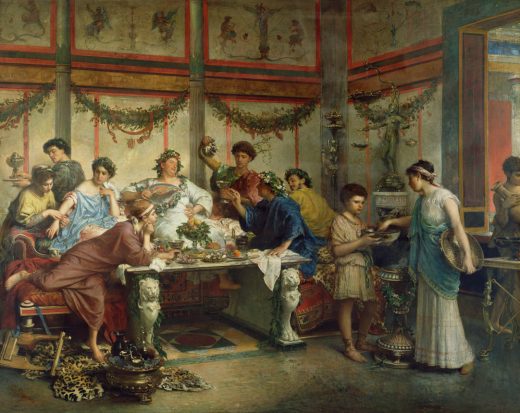
Image: Roberto Bompiani (Rome 1821 – 1908) A Roman Feast (late 1800s) courtesy of the J. Paul Getty Museum, Los Angeles, CA

10 Qualities Leaders Need to Succeed

What makes a great leader? Possessing qualities such as confidence, vision, decisiveness, integrity and persistence are often cited. Pictured above is Shahjahan Begum (1838 – 1901), who was the popular and effective Nawab Begum of Bhopal, the princely state in central India, from 1868 – 1901. During her reign she achieved several noteworthy operational efficiencies, including conducting a census, modernizing the weaponry of her military troops, raising the salaries of her troops, improving the tax revenue system and issuing the first postage stamps of Bhopal. Listed below are 10 characteristics often attributed to great leaders.

Vision During the devastating 1974 famine that struck Bangladesh, the Bangladeshi economist, banker and social entrepreneur Muhammad Yunus was inspired to make a small start-up loan ($27 U.S.) to a group of 42 families, so that they could purchase materials and make items to sell without borrowing from a bank and paying a predatory interest rate. He discovered that even a very small loan could make a tangible difference to poor people but unfortunately, banks refused to lend to them at a reasonable interest rate due to a perceived high risk of default.

 To confirm his initial observation about the power of micro loans, Yunus launched a research project at Chittagong University, where he was on the faculty of the Economics Department, to design and study a credit delivery system that would provide banking services to the rural poor. In October 1983 his project was authorized by Bangladeshi national legislation to operate as Grameen Bank. In 2006, Yunus was awarded the Nobel Peace Prize for founding Grameen Bank and pioneering the concepts of microcredit and microfinance.

Authenticity Madam C.J. Walker, the orphaned daughter of freed slaves and a former laundress, in 1905 founded a hair care products company, the Madam C.J. Walker Manufacturing Company. That she was both female and African-American in a time of enormous discrimination and limitations placed on those of her gender and race was apparently beside the point. As all successful entrepreneurs do, Walker saw a problem, set about solving it and monetized the solution. She was not afraid to dream big and take action.

Initially, Walker made batches of hair care potions herself, in a washtub, and personally sold them door to door to friends and neighbors in Denver, CO, where she had moved to give herself a fresh start after marrying at age 14, becoming a mother at age 17 and widowed at 20 years old. To persuade women to try the products, she gave free demonstrations that created the necessary buzz.

By 1908, Walker had hired and trained a team of female sales representatives and by 1910 she employed 950 representatives who crisscrossed the country, making sales and creating loyal customers. The company expanded internationally, when her products became available in the Caribbean and South America. By 1917, Walker had become the nation’s first female self-made millionaire, founder and Chief Executive of the country’s most successful African-American and woman-owned business.

Integrity Honesty and integrity are foundational ingredients in developing trust and essential to establishing credibility. A leader’s credibility is central to his/her ability to influence others and provide strong leadership.

Warren Buffett, Chairman of Berkshire Hathaway, the multinational holding company that wholly owns Duracell Batteries, Geico Insurance, Netjets, Dairy Queen and other well-known companies, pays very strong attention to integrity and honesty both when evaluating potential investments and when selecting managers for his businesses. “You’re looking for three things, generally, in a person,” says Buffett, “intelligence, energy and integrity. If they don’t have the last one, don’t even bother with the first two.”

Passion Tony Hsieh, CEO of the online shoe sales giant Zappos, has made customer satisfaction and company culture his mission and he is passionate about both. Hsieh regularly states that money shouldn’t be the most important company goal and that passion has been a key element in the enormous success of Zappos. Hsieh’s book, Delivering Happiness: A Path to Profits, Passion, and Purpose (2013) was written with the intention of spreading the message of using passion to both find one’s purpose and turn a profit.

Innovation In a July 2019 interview for the influential business-themed podcast Masters of Scale, host Reid Hoffman, co-founder of LinkedIn, interviewed Tory Burch, co-founder of her eponymous women’s wear company, to share key insights about how Burch so effectively scaled her company, which now has more than 250 boutiques on five continents and the collection is carried in more than 3,000 department stores and specialty shops around the world.

“I’ve always been a risk-taker,” Burch confessed as she detailed a strategic decision that in 2005 saw her launch an e-commerce website to make her merchandise available online, a practice that was nearly unimaginable in high-end retail at the time. Along the way, she “did trunk shows in different cities across the country and got a feel for where it would make sense to open more boutiques.”

Patience As Burch and Hoffman spoke more specifically about the episode’s theory of how a company might successfully scale, Hoffman observed, “It’s this combination of patient watchfulness and explosive speed that lets companies grow fast and go the distance.” Hoffman said of Burch, “You may have noticed as she spoke that she has clarity. You have to know what you’re building and what you’re waiting for.” Patience takes courage and confidence and demonstrates the leader’s faith that worthwhile results will be achieved when the time is right.

Decisiveness Strategic decisiveness is among the most vital success attributes for leaders in every position and every industry. Indecisiveness can severely cripple both your business and your life, potentially stunting growth, limiting financial success and diminishing personal satisfaction.

In a 2010 study, Psychologist Georges Potworowski at the University of Michigan found that certain personality traits (e.g., emotional stability, social boldness and feeling in control) predict why some people are more decisive than others. Decisively gifted leaders make it clear from the beginning that while they will carefully consider the opinions of others, they will ultimately choose what they judge to be best for their team. These leaders make the decision early on and move quickly to enlist all parties to implement that decision. Some members of the team may not be thrilled with the choice but in the end, most are quietly pleased to have clarity of direction.

Persistence Jewelry designer Tal Man, cofounder of Talia Jewelry, initially opened a small workshop where she designed and sold custom-made fine jewelry. As her customer list grew, she transitioned from operating a small custom jewelry house to becoming the creative director of a much larger enterprise that has customers on every continent.

Man faced the challenges associated with rapid growth and expansion boldly as her company scaled. She is happy to inspire fellow entrepreneurs, advising, “Never take no for an answer. I don’t even hear the word ‘no.’ When someone closed the door in my face, I went in through the window.” Additionally she says, “Know who you are seeking business advice from. Know what that person’s fear is. Is that person afraid of trying new things or going in a new direction? Or is the person’s fear about losing money? Don’t listen to the fears of others. Ask the right person for advice, ask someone who doesn’t have fear.”

Communication It’s a two-way street if you’re doing right. Sir Richard Branson, founder of Virgin Atlantic Airways and (now defunct) Virgin Records says, “Listening is one of the most important skills that anyone can have. That’s a very Virgin trait. Listening enables us to learn from each other, from the marketplace and from the mistakes that must be made in order to get anywhere that is original and disruptive. I learn so much from guests and employees that way.”

“Researching the competition has never been the Virgin way. Many of our products and services come about because we pay attention to what the market is missing or what’s not being done well. The commitment is about doing things differently.”

Accountability “The buck stops here” is a phrase that was popularized by U.S. President Harry S. Truman, who kept a sign with that phrase on his desk in the Oval Office. The phrase refers to the notion that a leader has to make the decisions and accept the ultimate responsibility for those decisions.

Thanks for reading,

Kim

Photograph: Nawab Shahjahan Begum (1838 – 1901) has been credited with the authorship of several books, written in Urdu. One book discussed socio-political conditions that existed during her reign and another examined the customs of purdah and the hijab followed by women in Asia and Egypt.

Guiding Light: Your Business Plan

Business plans and email marketing have something in common. The two stalwarts have often been declared dead by so-called experts, yet both continue to demonstrate value to current and aspiring business owners. Despite the naysayers, business plans are the foundation of business success, for the unavoidable reason that many new businesses fail.

Of the 400,000 companies started in 2014, 44% had failed by year four and just 18% of first-time Entrepreneurs were able to launch and sustain a successful entity. As the saying goes, “No one plans to fail. They just fail to plan.” Don’t let that be you, Dear.

The primary reason for aspiring Freelance consultants and Entrepreneurs to write a business plan is to test assumptions about the viability of the business idea against credible information that reveals the likely demand for the product or service and customer groups that have the money and possible motive to buy those products and services. The potential viability of a business is revealed in factors such as the size of the market (i.e., those with money and motive to buy), the founder’s access to potential customers (a big factor in B2B and B2G sales), competitors who sell an identical or similar product or service (are they thriving or just hanging on?) and the amount of money required to set up shop and start doing business.

A second compelling reason to write a business plan is to develop strategies that provide a roadmap, or blueprint, that will guide the founder as s/he builds and launches the venture. Confirming target customers, identifying possible niche markets, choosing the pricing strategy and the sales strategy; creating the financial plan, the operations plan, a realistic business model and selecting the most advantageous legal structure will also be thought through in advance of the company launch.

During the process, the founder will make discoveries that may persuade him/her to refine certain aspects of the products and services intended to be sold, or adjust perceptions of who the ideal customers will be. This information may have the power to substantively improve the venture’s chances of success and sustainability.

A third reason that motivates aspiring Freelance consultants and Entrepreneurs to write a business plan is the need to seek financing for their venture, whether the funds will be used to launch or scale the company. The financing source may be a bank or credit union, a micro financing organization, private investment (friends and family), or even self-financing. Those holding money will use the business plan to make funding decisions, so founders would be wise to develop a realistic financial blueprint that projects three years into the future, as well as a credible marketing plan that accurately defines target customer groups and identifies key competitors.

In sum, a powerful business plan needs to be three-dimensional, so it distills lessons from the real world and allows the founder(s) to test and when necessary revise assumptions. This ongoing process will give the business the highest chance of success while also increasing your credibility with investors, your team and most of all, yourself.

Thanks for reading,

Kim

Image: © Ubisoft Entertainment SA, artist’s rendering of the Lighthouse of Alexandria. The lighthouse stood on the island of Pharos, guiding ships as they entered the harbors of Alexandria, Egypt on the Mediterranean coast. The structure was built during the reigns of Ptolemy I and II, c. 300 – 280 BC. With a height of over 330 feet, the lighthouse was so impressive that it was named one of the Seven Wonders of the Ancient World. Now lost, the lighthouse was a welcomed navigational aid for over 1600 years.

2020 Health Insurance Open Enrollment: The Facts

Hello Freelancer Friend, the enrollment period for health insurance is here, now through mid-December (in most states). Because health insurance is a vital topic, I decided to defer to an expert and pass along info compiled by Les Masterson for Insure.com. For more detailed information, please visit the site. https://www.insure.com/health-insurance/open-enrollment-for-individual-health-insurance.html

We have 6 weeks to make a decision on individual/ family health insurance or the Affordable Care Act (ACA) exchanges plan (in most states). We can sign up for health insurance on our state’s health insurance exchange or individual marketplace only during the annual open enrollment period, unless one has a “qualifying life event.” Those events include getting married or having a baby.

If buying health insurance on your own, there are several options for purchasing a policy:

  • Your state’s health insurance marketplace — see healthcare.gov https://www.healthcare.gov
  • Directly from a health insurance company
  • Sites like Insure.com that offers insurance quotes from multiple carriers
  • A health insurance agent
Open enrollment for 2020 individual and family health insurance plans
Begins Ends
November 1, 2019 December 15, 2019

The open enrollment period differs in these states: 

  • CA – Oct. 15, 2019 to Jan. 15, 2020
  • CO – Nov. 1, 2019 to Jan. 15, 2020
  • DC – Nov. 1 , 2019 to Jan. 31, 2020
  • MA – Nov. 1, 2019 to Jan. 23, 2020
  • MN – Nov. 1, 2019 to Dec. 23, 2019
  • NY – Nov. 1, 2019 to Jan. 31, 2020
  • RI – Nov. 1, 2019 to Dec. 23, 2019

If you buy after December 15 in the states that are extending the enrollment period, confirm when the coverage will start. Most states require you to obtain your plan by December 15 for a January 1 start date. If you buy late, your plan might not start until February 1 or March 1.

Those who qualify for Medicaid or the Children’s Health Insurance Program (CHIP) can enroll at any time, because they are state/ federal programs created for people with limited incomes or disabilities.

Marketplace Open Enrollment is for health insurance only

The Open Enrollment period does not apply to life insurance, long-term care insurance, or Medicare. The fall open enrollment period for Medicare is October 15 to December 7, 2019. If you qualify for employer-sponsored health insurance, you will want to buy health insurance through your employer. Individual insurance usually costs more than employer-sponsored plans.

That said, if you qualify for subsidies based on your income, you may find an inexpensive plan on the Affordable Care Act (ACA) Exchange. Many states offer financial help for people with income below 400% of the federal poverty limit. You can find out more about these subsidies at insure.com. 

Remember to enroll!

It is not possible to sign up for coverage if you miss open enrollment, unless one qualifies for one of the special enrollment periods. The following events may grant entrance into a special enrollment period:

  • Divorce
  • Marriage
  • Birth or adoption of a child
  • Death of a spouse or partner that leaves you without coverage
  • Your spouse or partner, who has you covered, loses his/her job and health insurance
  • You lose your job and with it your health insurance
  • Your hours are cut making you ineligible for your employer’s health insurance plan
  • You are in an HMO and move outside its coverage area

Update your plan during Open Enrollment only

What you can do during open enrollment:

  • Renew your current individual or family health insurance plan
  • Choose a new health insurance plan through the marketplace in your state or through private insurance

If currently enrolled in a marketplace health insurance plan, it will automatically renew. However, the plan may make changes to its provider network, co-pays, co-insurance and drug coverage. Your plan must send you a notice of any changes it will make for 2020.

Read the health insurance update notice to learn what it means for youConfirm that your doctors and preferred hospital are still in your network. Be aware that you may be able to use out-of-network doctors and hospitals if you’re willing to pay more. That’s an option in Preferred Provider Organization (PPO) plans. In some cases, such as Health Maintenance Organization (HMO) plans, you’re covered if you go out of network. That means you’ll have to pick up the costs. 

Prescription drug coverage also could change. The plan may no longer cover the drugs you take to manage your chronic conditions. Confirm your plan’s drug benefits for 2020 before you allow it to renew. You may need to find a different plan for your needs and now’s the time to do it. Health plans must provide an online link to the list of drugs they will cover, known as formularies.

ACA Premiums set to decrease for some plans

The premium you pay depends on several factors, including income, your state and the plan type. The Centers for Medicare and Medicaid Services said the average ACA federal exchange plans premium costs dropped for the first time this year. However, because not all plans will be cheaper, it’s still important to shop around to find the right plan for you. 

Choose a level of health plan coverage

Plans in the health insurance marketplace are divided into 4 categories:

  • Bronze – highest out-of-pocket expenses for services (lower premiums)
  • Silver
  • Gold
  • Platinum – least out-of-pocket expenses for services (higher premiums)

Each level indicates how much cost-sharing each requires. Cost-sharing includes deductibles, co-pays and co-insurance that we must pay until the annual out-of-pocket maximum limit is reached.

Bronze plans have the highest deductibles and other cost-sharing expenses. That means more out-of-pocket costs when one uses healthcare services. Silver plans have lower cost-sharing than Bronze and Gold plans even lower than Silver. Platinum plans have the lowest deductibles and co-pays. Once one signs up for a level of coverage, changes are not allowed during that year. If you choose a Bronze plan and discover you need surgery, you cannot change to a plan with a lower deductible.

Generally, the more you pay in premiums the lower your cost-sharing.

In a 2019 report, eHealth estimated that 2-person families paid more than $1,000 in premiums monthly for the first time in the individual market in 2019. Premiums for individual coverage for a single person was $448 in 2019. 

The average premiums for individual coverage according to eHealth:

  • Bronze — $440
  • Silver — $481
  • Gold — $596
  • Platinum — $706

The average premiums for family coverage according to ehealth:

  • Bronze — $1,080
  • Silver — $1,179
  • Gold — $1.426
  • Platinum — $1,460

The health plans, no matter the level, must provide some coverage for at least 10 essential benefits. They are:

  • Outpatient care including chronic disease management
  • Emergency care
  • Hospitalization
  • Pregnancy and newborn care
  • Mental health and substance abuse services
  • Prescription drugs
  • Rehabilitation services and devices
  • Lab tests
  • Preventive and wellness services
  • Dental and vision care for children

The level of coverage for these services can vary. All the plans in the marketplace must provide consumers with a brief, understandable description of what they cover and how their plan works. The Summary of Benefits and Coverage (SBC) must be posted on the plan’s website. Check out the SBCs for the different plans you are considering. This is a good way to compare plans and benefits.

Not all states require health insurance

The ACA once required nearly all Americans to have health insurance. However, Congress decided in 2017 to eliminate the individual mandate penalty. Although the individual mandate is technically still on the books, the tax penalty is not. Still, a growing number of states have implemented their own individual mandate. Here are states that have an individual mandate in 2020:

  • California
  • District of Columbia
  • Massachusetts
  • New Jersey 
  • Rhode Island
  • Vermont

I hope you found this information helpful.

Thanks for reading,

Kim

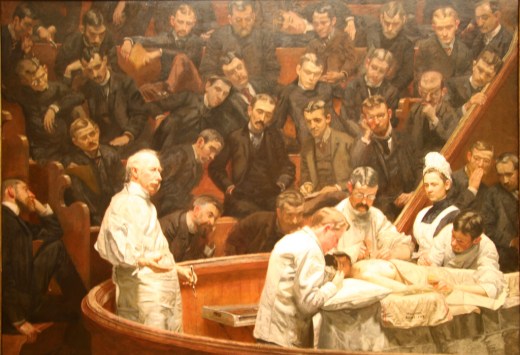
Image: Thomas Eakins (Philadelphia 1844-1916) The Agnew Clinic, 1899 courtesy of The Philadelphia Museum of Art. The painting was commissioned to honor the anatomist and surgeon David Hayes Agnew, on his retirement from teaching at the University of Pennsylvania.