Finally, A Social Media Strategy for Your B2B Company

Social Media has a B2B image problem.  Business owners, Freelancers and owners / leaders of B2B companies are for the most part able to recognize the effectiveness of Social Media marketing in the B2C realm, but many still don’t see Social Media platforms as resonating with B2B buyers, despite its pervasive use across most customer demographic groups in the U.S.

Yet numerous studies have demonstrated that the various Social Media platforms can quickly and effectively increase brand awareness and generate leads for B2B and B2C companies.  Moreover, once a Social Media strategy is developed, it’s relatively easy to implement and monitor. Consider the following statistics, courtesy of the 2019 Global Digital Report prepared by We Are Social, a top-tier digital marketing firm:

  • 76% of Americans who are on the Internet use Social Media
  • Social Media (inbound marketing) has a 100% higher lead-to-close rate than traditional marketing (outbound marketing)
  • 45% of business owners/ marketers have acquired customers through LinkedIn
  • 43% of B2B companies on Facebook report generating leads as a result
  • Brands that are on Twitter generate 2x as many leads than those who are not
  • 66% of business owners/ marketers see lead generation benefits with Social Media by putting in as little as six hours/ week

Where to start

Perhaps the simplest way to generate B2B leads with Social Media is to optimize your business page profile on the platform you decide to use.  Your business must be visible. Include a link to the company website, along with links to your blog and/or newsletter. Make your value proposition obvious and devise a compelling call-to-action that indicates to prospective customers how they can learn more about your product or service.  “Enter your email here and receive a free ebook that teaches B2B leaders how to use five Social Media platforms.

Facebook

  • Call-to-Action Button: Facebook gives business pages the option to include a call-to-action button. The seven options include Book Now, Contact Us, Use App, Play Game, Shop Now, Sign Up and Watch Video. You can send the link to a page on your business website. Here’s how you can entice browsers to get familiar with your products or services with a free offer, such as a 30 minute consultation, or a free trial of an online service.
  • About Page: Facebook provides businesses a place to list their address, phone number, hours of operation and a brief summary of their business. Be sure to complete all this information. Not only is it helpful to visitors, but also boosts the pages SEO value.


Instagram

B2B leaders/ owners must first understand that marketing on Instagram is less about selling the benefits of your products and services and more about establishing deeper connections with people, including industry thought-leaders and prospective clients.

Instagram is a channel where building and maintaining awareness of your brand needs to come before lead generation.  Unlike Twitter, Facebook and LinkedIn, where you can drive traffic to your site, think of Instagram as a way to grab the attention of industry influencers and prospective clients at a time when they’re not really in ‘work mode’.  When they’re not in ‘work mode’ they’re not going to be clicking links, they’re not going to be interested in being ‘sold to’.  This is your chance to seamlessly inject your brand values into their Instagram feed so it doesn’t look out of place amongst the B2Cs, friends and co-workers they also follow on Instagram.

The key to leveraging Instagram as a marketing tool for B2B buyers is to not think of it as a marketing tool at all.  Instead, think about Instagram as a way to tell your story as part of a larger online marketing strategy.

Instagram will help you to demonstrate your company’s commitment to Corporate Social Responsibility when you include three or four photos of you and your team participating in spring clean-up, or fall planting of tulip bulbs, in a public park.  You can show the celebration of a team member’s baby shower. You can even show the team sharing beer and wine and celebrating that a big project deadline was successfully met.

LinkedIn:

  • Images: As with both Facebook and Twitter, your profile and banner images can have a big impact on the success of your page. Make your profile image some recognizable variation of your company logo and be sure to mirror your header image with current marketing initiatives.
  • SEO: LinkedIn company profiles are often indexed by search engines. Be sure that the first few lines of your company description are compelling and contain your target keywords, as this text will often be used as Google’s preview text. LinkedIn users can browse the platform using keywords, meaning that this optimization will help get more eyes on your profile within the platform.
  • Showcase Pages: LinkedIn offers the ability to create separate pages to showcase products or examples of your work, such as writing. These pages live at the top of your profile in prime page real estate. Use these to help out with your lead generation efforts.


Twitter

  • Bio: Twitter marketing expert, Madalyn Sklar recommends that “Your bio should be compelling and inviting. Don’t be cutesy or funny. Your profile should paint your story in 160 characters and encourage me to want to learn more about you.”
  • Profile/Header Images: For most B2B organizations, your Twitter profile image should be some variation of your logo — consider color, size, and how it will look on different devices. Your image, more than your handle, is what your followers will come to recognize you for, so it’s important to keep it consistent. Your header image, on the other hand, should be changed fairly regularly to match your marketing initiatives. Running an important event? Holding a webinar? Promoting a new product? This should be reflected in your banner image.
  • Pinned Tweet: Twitter allows you to pin important tweets to the top of your feed so they don’t get lost among your other tweets. If your goal is lead generation, this tweet should contain a call-to-action and a link to your website. Consider pinning a tweet about exclusive content, a free trial, or a special product discount.
  • Open Your DMs: Make sure your Direct Messages are open to the public. That way, if customers or prospects have questions, they can come to you directly. Prepare responses to common questions ahead of time.
  • Hashtags: Studies show that tweets with hashtags generate twice the engagement as tweets without. But be careful, because too many hashtags can resemble spam. Your marketing team should develop a strategy around which hashtags to use and how often. Soon your followers, customers and prospects will catch on and use these hashtags, too.

That’s all for today. Go to work on this and we’ll pick up the thread next week.

Thanks for reading,

Kim

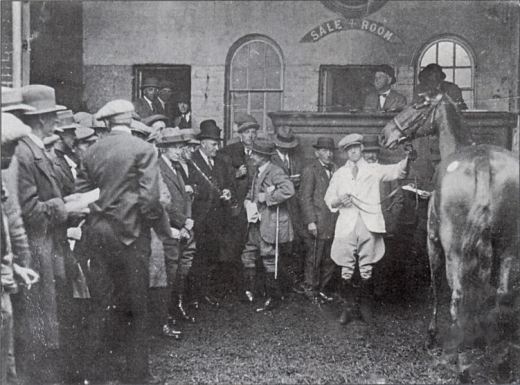
Photograph: Hussey’s Horse Auction (1926) at the Bonhay Cattle Market. Exeter, UK

Ramp Up Your Customer Service Protocols

Identifying competitive advantages for your business can be a real challenge. You probably have a fine product and service line, but how can you distinguish your company from the pack and rise to the top in the minds of customers? As product features and price are not necessarily the determining factors that they once were.  In response, business leaders and owns have turned to the customer experience to build competitive advantages and brand loyalty that are the bedrock of sustainable long-term success.

Before we go any further, let’s define the term customer experience.  The customer experience is your customers’ perception of how your company treats them. These perceptions affect their behaviors and build memories and feelings to drive their loyalty. In other words: if they like you and continue to like you, they are going to do business with you and recommend your business to the others.  Why should business owners and leaders invest time to map out the customer experience and improve it at every touch point?

  1.  Improves customer retention (by 42%, according to some reports)
  2. Improves customer satisfaction (by 33%)
  3. Enhances cross-selling and up-selling opportunities (by 32%)

A 2013 Deloitte survey showed that 62% of companies now rank the customer experience as a competitive differentiator. They are coming around to understand that what customers really want from your organization is help solving their problem. They want to hear what other customers were able to achieve by using your solution. They want to understand the value and benefits your products promise to deliver, not just the product itself.  The Temkin Group,  a customer experience research and consulting firm, in 2018 found that:

  • 86% of buyers are willing to pay more for a great customer experience
  • 73% of buyers point to customer experience as an important factor in purchasing decisions
  • 65% of buyers find a positive experience with a brand to be more influential than great advertising


Excellent customer service means you fix your problems without the customer knowing the problem.  There is no reason for customers ever to see the back of the house problems. Never put that burden on a customer. Customer service also demands a timely response as well as empathy. Customer service also includes mobile, since 52% of customers will not return if they have a negative mobile experience with your organization.

A Harvard Business Review study found that customers are seven times more likely to buy a product when their calls are returned within one hour. In addition to speed and customization, you must handle comments with empathy. “I’m sorry,” is a powerful phrase that can repair a bad experience. Everyone wants to be heard, appreciated and respected. Empathy is free and should be a minimum requirement for any employee that interfaces with a customer.

Customer journey maps include every touchpoint and examine frustration points and areas that create satisfaction. Using internal and external marketing data you can look for gaps between what the customer expects at each step and what the customer experiences. Establish a voice-of-the-customer program, which is a formal process and procedure to solicit feedback and share it across the entire organization to all relevant employees.

From the top down, your organizational culture should encourage all employees to appreciate and respond to customer feedback. Through sharing and by using reputation management software, you can analyze data and can implement actionable goals. Continually look for ways for your organization to improve and continue to become more customer-focused.

Thanks for reading,

Kim

Image: L’here du The. by Albert Lynch (1851 – 1912)


Email Writing Perfected

Now that you’ve completed your business plan, you’re ready to put it in motion. Here’s the guide that will make sure you know how to get your entrepreneurial groove on! In Be Your Own Boss, Part 2: The Implementation and Beyond, you’ll learn to recognize the strengths or weaknesses in your proposed business model and develop an effective customer acquisition plan. You’ll get insight into what you should consider when choosing the right legal entity for your venture. Learn to implement savvy marketing, branding and social media strategies, get real about business financing options and build a solid financial strategy that will sustain your dream. Thursdays April 18 & 25 6:00 PM – 9:00 PM. Register here.

Every day, the typical professionally employed adult sends and receives an avalanche of emails. In response, dozens of articles that address the challenge of email management have appeared in business targeted media outlets. Those articles are all somewhat helpful but my feeling is, when emails are effectively written fewer of them are written, because writers express themselves clearly and recipients understand how to respond.

As luck would have it, an amazing and highly organized polymath named Kabir Seghal, who is a U.S. Navy veteran, former Vice President at J.P. Morgan, Grammy Award-winning producer (Afro-Latin Jazz) and author of seven books in both the children and adult genres including Coined: The Rich Life of Money and How its History Has Shaped Us (2015) has stepped up to guide mere mortals in the fine art of email writing. Seghal applies lessons he learned while in the military when advising us on how to write the ideal email communication.

Subject line

Subject lines are crucial. They can determine when or even if your email is opened. The wrong subject line can result in your email being ignored or deleted. A powerful subject line communicates the purpose of the email and the action the writer would like the recipient to take. A sampling of subject line verbs include:

Action                                 Meet

Decision                             Request

FYI                                      Sign

ACTION:  The recipient must do something, usually within a certain time frame.                                                                                                                                                                                                                                                                                                         frame.

DECISION: A decision must be made by the recipient, or a decision that impacts the recipient has been made.

FYI: For Your Information messages keep the recipient in the loop. Action is not required (choice of the recipient).

MEET: Consult your calendar and reserve time.

REQUEST: The writer seeks approval or permission from the recipient.

SIGN: The recipient must read and sign a document and return it with a certain time frame.

Bottom line up front (BLUF)

Begin the body of the email with a short statement that concisely answers Who, What, When, Where and Why to explain the purpose of your email and what you’d like the recipient to do. The BLUF distills the message and allows the recipient to easily digest the information you share and how s/he will be impacted. Seghal suggests that the writer lead with the heading Bottom Line to call attention to your email’s core messages.

Active voice

Seghal recommends that we use the active, rather than passive, voice when composing emails. It’s important to be clear about who has or is taking action, or who will be required to take action (and when) and the impact of that action.

Cut to the chase

Short emails are preferred by military personnel, but sometimes longer communications are unavoidable. Should your email exceed three paragraphs, follow-up your Bottom Line (BLUF) statement with bullet points, so the recipient can quickly focus on critical information.  Rather than adding files as attachments to the email, embed hyperlinks to the files and enable faster access.

Thanks for reading,

Kim

Photograph: Typist, circa 1930s.


How to Target Content Marketing

Now that you’ve completed your business plan, you’re ready to put it in motion. Here’s the guide that will make sure you know how to get your entrepreneurial groove on! In Be Your Own Boss, Part 2: The Implementation and Beyond, you’ll learn to recognize the strengths or weaknesses in your proposed business model and develop an effective customer acquisition plan. You’ll get insight into what you should consider when choosing the right legal entity for your venture. Learn to implement savvy marketing, branding and social media strategies, get real about business financing options and build a solid financial strategy that will sustain your dream. Thursdays April 18 & 25 6:00 PM – 9:00 PM. Register here.

Content marketing continues to be an effective Inbound Marketing strategy for Freelancers and other business leaders who seek to interest and engage potential clients, nurture relationships with current clients, demonstrate an understanding of client concerns and generate leads that have a healthy possibility to convert to sales.

Yet according to sales and marketing experts, fewer than 50% of those who claim to be evaluating a product or service purchase are ready to buy. Therefore, the job of business leaders/ owners and Freelancers is to move prospects through the buyer’s journey, also known as the sales funnel, and toward the sale.

Recall if you will the shape of a funnel—wide at the top and narrow at the bottom. The shape of a funnel reflects to the buyer’s journey.  Early in the search for a solution, would-be clients search for information. Many are window shoppers. Others are more serious. They explore options, compare prices, clarify their needs and confirm their budgets. Eventually the most serious shoppers become fewer in number as they acknowledge their must-haves and narrow their choices down to a short list of sellers (i.e., businesses).  Only a relative handful buy make a purchase. 

Let’s examine the typical buyer’s journey and understand how inbound marketing can function to encourage the sale along the way.

Tofu: Top of Funnel 

This stage signals awareness and potential prospects are searching for information.  Content here will cast a wide net, to attract the attention of all those who are searching for insights, opinions, research and other data in their early stage and education process. Just as you may scan rating sites such as Yelp or Trip Advisor when searching for a hotel or restaurant, Tofu tier leads get familiar with your products and services through your blog, newsletter and social media postings.  It’s too early to present a call-to-action appeal, which could be a turn-off at this point. In general, the value of Tofu leads is low.

Nevertheless, your objective is to peel off the most promising leads and move them into the next tier.  Achieve this aim when you offer a 15 minute free consultation, announce a podcast or webinar in which you’ll be featured to discuss a topic relevant to your typical clients, or extend an invitation to download an e-book that you’ve written, gratis. Those who register for these extras are making a commitment, to an extent, to your business.  Furthermore, they must share their name and email contact as they register. They will progress to Mofu.

MoFu: Middle of Funnel 

You now have a qualified lead. The prospect is real and has acknowledged that a problem that must be solved in the near term.  Your prospect must evaluate  which of the available solutions might be the best fit?

Content at this tier must continue to educate, but the approach will become more specific, to position your company as capable and trustworthy, prepared to deliver the right solutions and solve problems.  Here, content explains why your solution and approach to problem-solving are the best fit. Examples of your ability to understand client concerns and priorities, as well as provide the best solution, can be illustrated in white papers, case studies, or (video) testimonials.

This tier is often considered the most critical because prospects will either agree to move forward and approve the sale or decide you’re not the one based on the information  presented.  Demonstrate expertise, establish trust and build relationships here.  Flash the power of your brand by dropping the names of a marquis client or two.

On the other hand, if it becomes apparent that you are not the best fit for a client, be upfront and make that known. You always want to provide the optimum customer experience that leads to good word of mouth and avoids churn (see last week’s post).

BoFu: Bottom of Funnel

Here is where the buyer confirms his/her decision to do business with your organization and the actual sales process can begin.  According to research featured in Forbes Magazine in 2013, many prospects get 60% – 70%  through the buyer’s journey before they care to speak with a sales representative.

There may be no content offered at this stage, but time-sensitive special offers can make a big difference.  Your prospect is ready to buy but there is still no guarantee that s/he will buy from you.  Here you give a little nudge, a sweetener, as you present your call-to-action, at last.

Depending on whether your business is B2B or B2C, tangible product or intangible service, you may offer a modest discount to buy now (or within 24 hours).  You might offer a tantalizing (and inexpensive to provide) upgrade or add-on to what the prospect has indicated s/he would like to purchase.  Free or discounted installation and a free trial are also effective.  Art galleries have been known to allow serious prospects to take an artwork home so that they can live with it for 10 days.

Inbound Marketing is lots more work than tried-and-true Outbound Marketing, where you scrape together some money and place an advertisement or two in target publications, or distribute flyers in certain zip codes, and hope for the best. Outbound Marketing still works, but Inbound Marketing is how to highly target your marketing campaigns and receive the highest ROI.

Thanks for reading,

Kim

Image: A 13th century Ottoman (Turkish) horseman draws his bow. Artist unknown.