Combat Customer Churn

If you’re ready to greenlight a business idea that you feel has money-making potential, then it’s time to create your road map to entrepreneurial success! Learn to build a Business Plan that will become both the foundation and launching pad for your exciting new venture. We’ll take a deep dive into all the ingredients of a basic Business Plan, including how to evaluate the profit-making potential of your business idea; define your ideal customer groups; evaluate competitors; develop a savvy marketing and social media plan; and build a solid financial strategy that will sustain your dream.  Thursdays March 28 & April 4 6:00 PM – 9:00 PM. Register here .

Every business owner works hard to add new customers to the company roster. Customer acquisition is a key component of an owner’s role, but attention must also be  paid to customer retention. It’s critical that business owners/ leaders develop a customer retention strategy for the organization—and implement it!

Depending on which study you believe and the industry you’re in, acquiring a new customer costs anywhere from 5 to 25 times more than the cost of retaining an existing customer.  Consider the time and resources utilized to recruit even one new customer, to say nothing of prospects whom you pursue and do not win.  It’s much more cost-effective and efficient to keep the customers you already have happy.

The phenomenon called churn refers to losing customers and the metric that measures the rate at which customers are lost, as compared to customers on the roster, is known as the customer churn rate. “Customer churn rate is a metric that measures the percentage of customers who end their relationship with a company in a particular period,” explains Jill Avery, senior lecturer at the Harvard Business School. The churn rate is measured during any month, quarter, or year, depending on the industry and the product or service that your company supplies.

In other words, if your business begins the quarter with 400 customers and ends with 380, the customer churn rate is 5%, since 20 of the 400 customers no longer do business with the company.  Avery goes on to say that many business owners/ leaders prefer to monitor and report churn rate’s opposite: customer retention rate, or how many customers remain. Both calculations tell the same story.

Changes in a company’s churn rate could signal that something is working well (if the number goes down) or needs addressing (if the number increases).  When you notice that an unexpected number (or percentage) of customers whom you’d expect to be more than just one-offs instead decline to do business at least intermittently, it’s time to take action and stanch the hemorrhage. The usual culprits are customer service failing,  products/ services that are not fulfilling customer expectations, or the presence of an aggressive competitor.

Churn is more than a metric to occasionally monitor. The future of your business depends on understanding why customers might leave and knowing what you can to do to retain those who may be ready to jump ship.  Avery advises that “Looking at churn rates by customer segment illuminates which types of customers are at risk and which types may need an intervention. It’s a nice simple metric that tells us a lot about when and how to interact with customers.”

Likewise, it’s important to study your customer acquisition channels. They don’t all yield equal results, so examine each to learn if customers coming through a specific channel have a higher churn rate than others.  Acquisition channels failing to deliver the best customers as you and your team define them will be discovered, so you can decide whether or not it’s worth continuing to fund that channel, or instead shift resources to channels that more consistently deliver the premium customers.

According to InsightSquared, a Boston marketing and sales analytics company, reducing customer churn by 5 % can increase profits by 25 % to 125 %. InsightSquared also found that 70 % of customers it polled leave not because of the product/ service purchased, but because of poor customer service. Further, 91 % of unhappy customers will not do business with your company again.

Other common issues to address include a lack of customer engagement or support, poor product-market fit and the user experience. It is essential to identify company weaknesses and shore up any products/ services that need to be better attuned to trends in market preferences, customer service protocols, or customer engagement that builds loyalty.

A mistake that business owners/ leaders make is to look at churn as simply a number, rather than as an indicator of customer behavior.  Questions to ask include:

  1. What is the company doing to cause customer turnover?
  2. What are customers doing or thinking that causes them to leave?
  3. How can we better manage customer relationships and diminish the churn?

That said, a high churn rate can be the result of poor customer acquisition efforts. “Many firms are attracting the wrong kinds of customers. We see this in industries that promote price heavily up front. They attract deal seekers who then leave quickly when they find a better deal with another company,” Avery says.

Finally, there is no standard acceptable churn metric. Avery cautions, “The truth is that what’s acceptable varies widely by business model and is largely dependent on how quickly and efficiently a company can acquire customers and how profitable customers are in the short and long-term. Some business models thrive despite high churn rates and others rely on low.”

Instead of fixating on a certain number, smart managers look at the churn rate of prior years and ask themselves what they might improve. “It’s really a metric that shows how well you’re managing your customer relationships, and you can usually always improve your performance in that area,” Avery says.

Before you assume you have a retention problem, consider whether the problem instead turns on customer acquisition.  Avery concludes, “Think about the customers you want to serve up front and focus on acquiring the right customers. The goal is to bring in and keep customers who you can provide value to and who are valuable to you.”

Thanks for reading,

Kim

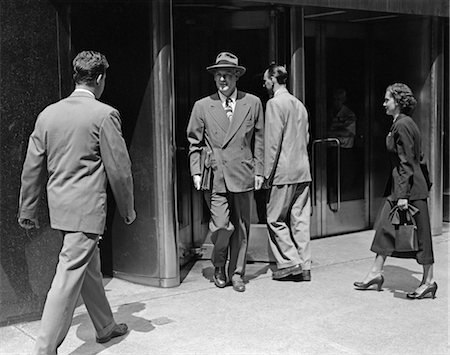
Photograph: 1950s, photographer and location unknown

More Sales Channels Means More $ales

If you’re ready to greenlight a business idea that you feel has money-making potential,  then it’s time to create your road map to entrepreneurial success! Learn to build a Business Plan that will become both the foundation and launching pad for your exciting new venture. We’ll take a deep dive into all the ingredients of a basic Business Plan, including how to evaluate the profit-making potential of your business idea; define your ideal customer groups; evaluate competitors; develop a savvy marketing and social media plan; and build a solid financial strategy that will sustain your dream.  Thursdays March 28 & April 4 6:00 PM – 9:00 PM. Register here.

The number one job of a business owner is to sell the company’s products and services (at a profit).  To achieve this goal, numerous activities are undertaken to promote, support and sustain the sales process and its co-dependent twin, the buying process.  The push-me, pull-you of businesses selling and customers buying rests on a vital and complex foundation.

The business model, i.e., the rationale for how a business will generate sales and make a profit, is the starting point.  In the business model, the products and services that will be sold and the target market(s) are identified.  The method(s) and location(s) by which customers will obtain the products and/or services and the payment protocols are also detailed (E.g., do customers pay in full in advance, or do they pay a deposit and then the balance when the product or service is delivered? Is this a bricks & mortar or e-commerce operation?).

The value proposition, perhaps the most important component of the business model, will describe why prospective customers are expected to value and purchase the products and/or services that the company plans to sell.  Estimating business start-up costs and preparing a credible Break-Even Analysis to provide a time line that predicts the expected pace of sales revenue growth that products/ services are expected to achieve, will determine when profits can be expected to accrue and is yet another purpose of the business model.

Business strategy rests on the business model and marketing strategies, campaigns and tactics lend still more support to driving the selling – buying process.  Yet after all is said and done, it’s imperative to get the products in front of potential buyers.

Savvy business owners know that those with motive and money to buy what your company sells need a little help.  Offer your products and services (where applicable) through different sales channels and make your products/ services easy for customers to buy.  Map the selling – buying process at your organization, talk to and survey your customers and then consider which sales channels, direct, indirect and hybrid, will make it more convenient for customers to do business with you.

Direct Channels: The selling – buying is done through channels, or might we say venues, that you control.  Customers may visit your office or store, or they may buy online through your website.  You might also offer certain of your products and services on your Facebook page.

According to 2018 research conducted by Hootsuite, there are 2.32 billion Facebook users globally, 1.1 billion speak English and about 10% live in the U.S., 232 million. 78% of American users have discovered retail products to buy on Facebook.  Customers will click your Facebook Store tab once you build it out and take it live. Payment processing and customer transaction history are handled by Shopify and Facebook does not take a commission on your sale.

Indirect Channels:  Have you ever booked a plane ride or hotel through Expedia, Hotels.com, Orbitz, or Travelocity? If so, you are comfortable buying through an Indirect Sales Channel and you could be ready to sell selected products and services through this method.  I’ve promoted and sold my P.R. and writing services on Upwork and LinkedIn ProFinder.  Self-published authors who produce books through Create Space have Amazon for an Indirect Sales Channel.

Tangible products have a much longer history with Indirect Sales Channels.  A company can investigate the possibility of selling products to a wholesale distributor, who in turn sells to retailers.  Freelance artisans often place their hand-crafted items into (typically locally owned) stores on consignment.  In both scenarios, products gain access to a significantly larger pool of target market customers than would be possible if the business only used Direct Sales Channels.

Hybrid Channels: Describes two or more sales channels utilized to provide a multi-channel product promotion and distribution system that will maximize product sales. Starbucks offers an easily visible example of Hybrid Sales Channel product distribution.

The primary sales channels are the free-standing Starbucks restaurants that are sprinkled throughout commercial and residential neighborhoods in countless cities and towns across the country.  Secondary Starbucks sales channels are found in many Barnes & Noble bookstores, chain grocery stores, hotel and hospital lobbies and airports.  By way of Hybrid Sales Channels, Starbucks successfully carpet bombs key shopping districts coast to coast.

Small and medium business owners cannot compete in this manner, but it may be possible to offer products and services through two or more sales channels to broaden product exposure and drive sales.

Thanks for reading,

Kim

Photograph: Leslie Jones (1886 – 1967) Pushcarts on Blackstone Street, circa 1940   Haymarket in Boston, MA. Courtesy of Boston Public Library.

The 10 Faces of Guerilla Marketing

If you’re ready to greenlight a business idea that you feel has money-making potential,  then it’s time to create your road map to entrepreneurial success! Learn to build a Business Plan that will become both the foundation and launching pad for your exciting new venture. We’ll take a deep dive into all the ingredients of a basic Business Plan, including how to evaluate the profit-making potential of your business idea; define your ideal customer groups; evaluate competitors; develop a savvy marketing and social media plan; and build a solid financial strategy that will sustain your dream.  Thursdays March 28 & April 4 6:00 PM – 9:00 PM. Register here .

In his 1984 book Guerilla Marketing, Jay Conrad Levinson (1933 – 2013), whose studies in psychology led him to advertising agencies, brought to the forefront a marketing strategy that has a long history in American business.  Levinson borrowed the term guerilla, “little war” in Spanish, that is, warfare waged in unexpected ways and usually using low-budget weapons, to describe disruptive marketing campaign tactics (that can be humorous as well).

Ho Chi Minh, the revolutionary leader who successfully fought superpowers France and America and who eventually became Prime Minister of Viet Nam, demonstrated that guerilla tactics can win a war.  Might you, Freelancer friend, be able to incorporate a guerilla tactic or two in your marketing mix?

When done correctly, Guerrilla Marketing associates your product or service (brand) with innovation and authenticity.  But to make your Guerrilla Marketing strategy effective, conduct thoughtful and comprehensive market research and confirm that you understand what is likely to resonate with, and not offend, your target customers.  Ask yourself  these questions:

1.  Who are my customers, i.e. my target audience, and what do they respond to?

Not knowing your target audience will result in misguided efforts that only serve to confuse. Marketing is all about communicating with an audience you understand.  Your current and potential consumers will know when you’ve failed to do your research.

2. Can we deliver this strategy as well as it needs to be delivered?

In other words, do we have the physical resources to make this happen the right way?

3. Is my brand right for this type of campaign (Guerilla Marketing or otherwise)?

It is important to consider how your unusual marketing tactics might be perceived. If it seems possible that a Guerilla Marketing campaign might seem irritating to the planned targets, it will create a negative impression for you and your company.  Take into account the opinions of those who matter most to your business.  For example, those under age 40 may love a Guerilla marketing campaign, but if they’re not your buyers, then don’t go there.

Finally, bear in mind that Guerrilla campaigns can’t be duplicated. If they are repeated too many times, they lose their effectiveness. So you must structure a strong follow up to your marketing efforts including more promotional acts and ways to convert the traction and interest into buyers. Leverage traction and convert to sales revenue.

Viral   Uses social media platforms to promote a product, service, or an event. Viral means the message is shared among users of the platform and the info spreads to many thousands online.

Undercover   Stealth marketing pitch that sometimes will feature a celebrity using the product in a public place while expressing his/her confidence in the product.  The expectation is that fans will buy the product or use the service, since viewers may not realize that they’re getting a sales pitch.

Alternative   Low-cost methods to target specific neighborhoods, usually by leafletting flyers and postcards on parked cars and doorways.

Presence   Keeps your product or service constantly visible, to raise and sustain public awareness of the company and its products. Sponsorship of a popular drive-time radio show, billboards in key locations, sponsorship of major festivals or concerts. Whatever it takes to keep the company and its products and services at top-of-mind.

Ambush   Promoting a product or service, often at a big event, where the company hasn’t paid to be an official sponsor. A surprise attack on a competitor’s marketing campaign. Guerrilla brand war. The ambusher uses creative methods to grab attention and steal the spotlight from a competitor.

Ambient   Think of the Red Bull car and marketing messages placed in other unexpected places. On staircase steps, wrapped on a bus, banners on street light poles and ads for Broadway shows on the tops of taxi cabs.

Presume   Often used for products sold online. Attention-getting visuals on high-traffic websites and also social media platforms direct prospective customers to the website, where the sales process begins. The purpose is to make prospective customers aware of the product or service. Product placement in films and TV is another form of this tactic.

Wild posting   Urban street marketing, usually consisting of many posters for a rock band, hip-hop singer, or products used by the young and urban posted on the exterior of abandoned buildings and near bus or subway stops.

Experiential   Grocery stores, malls, high foot traffic streets and special events are the usual venues. Prospective customers interact with the product or service directly and will associate their immediate reactions with the featured brand. Invite people to sample product after they’ve receive a pitch on why the product is beneficial and should be valued. Often a coupon is given to encourage a purchase.

Buzz   Uses high profile media (traditional and social) to stimulate talk about the product or service. Buzz marketing works best when customer responses and eventual endorsement of the product or service are genuine.  The ROI is amplified positive word of mouth.

Thanks for reading,

Kim

Photograph: Viet Cong soldiers in North Viet Nam in the 1960s.  #Metoo!

Keep it Going: Sustaining Your Success

OMG you did it!! The months and years of working hard and working smart, of knowing when to listen to your inner voice and when to listen to a good adviser, the months of living on four hours of sleep and no vacations for what seems like forever and—–your company grossed $1 million over four consecutive quarters! You’ve reached a milestone that defines success.

OK. So now that you’ve reached the mountaintop, you have to figure out how to keep your footing and stay up there.  In fact, because you are focused, ambitious and determined, you’re already thinking about climbing even higher.  But sustaining and growing your success might demand as much work and determination as you invested to attain it. Here are four commonsense choices that can help you hold on to your earnings and continue the positive slope of your company’s future.

Pay taxes

Meet with a business accountant and figure out how much money you should reserve each quarter for tax payments (usually 30% – 40%). You don’t want to wait until the annual tax time and realize that you owe big money to the IRS.  Before you spread money around, pay the quarterly tax bill and set aside enough to ensure that all remaining tax bills in the calendar year can be covered.

Smart celebration

When you hit the revenue milestone that you’ve defined as your “made it” metric, whether the amount is a net or gross figure, you owe it to yourself to celebrate. What’s important, though, is not only how you celebrate but also with whom.

First, don’t overspend.  If you want to take a week-long spa vacation then go for it, because that will dissolve your stress and prepare you for the work you’ll do to build on your new-found success.  Or maybe you’d like to visit a place you’ve always wanted to see, or return to?  A splurge that refreshes and replenishes your energy stores is likewise always worth it.

Where you want to be careful is the amount you spend on consumer goods.  You may need a new car and if you can afford it, then do so, but be careful about splurging on luxuries.  Buying a Saab or Volvo probably makes more sense than buying a BMW or Benz at this point.  Save real luxury purchases for when you’ve raised your net worth to a more substantial level.

Others may want to throw a party.  Caution is advised when developing the guest list.  The sad fact is that there will be certain individuals, including family members, who will feel more envy than happiness upon hearing news of your success.  If a party is a must-do (and why not?), invite only those who supported and believed in you.

Fair-weather friends, frenemies, passive-aggressives, or critical types who claim that they’re just playing “devil’s advocate” or being “objective” are mostly about undermining and sabotaging. They are not your friends, even if they’re family members.  Don’t invite them and don’t let your mother guilt you into including them.  They don’t belong.

Save money

After you’ve paid down or, ideally, paid off any significant debts, business and personal, it’s time to save money.  Start with your retirement fund. Research options available to you in accordance with the business you own and pay the maximum amount allowed by your age and income level.  Investigate opening a Roth retirement account as a place to hold after-tax money if you anticipate having surplus cash.

Once you’ve figured out your retirement fund strategy, focus on other long-term investments. By all means, invest in the equipment, staffing, technology and office or manufacturing space that will support operations (including customer service), generate ROI and advance the business. But what if the building where you lease space comes up for sale? It might be a good move to buy the building, so that you can control your costs more effectively and also collect some rents.  For that, you’ll need money and a good credit score.

You can give yourself a wish-list savings account to build up cash reserves. There are other investments that can be made as well and to learn about your options, ask people you trust to recommend an investment counselor.  If you’ve got even $5000 to invest, investigate certificates of deposit, online banks such as Everbank, index stock funds, or actively managed mutual funds.

Keep doing what it was that made you successful

Now that you have a blueprint for making lots of money, continue to follow the template and don’t slack off! Don’t think that once you reach a certain level of success that things will just cruise along on their own. You must continue to do those things that created the conditions for success.  You can, however, devise methods that help processes become more efficient—that comes from experience. Operational efficiencies make money.  Plan your work to give priority to income-generating activities, such as sales calls and networking, to conserve your energy and bolster your stamina and creativity.

Thanks for reading,

Kim

Image: Emanuel Leutze (1816 – 1868, Germany) Washington Crossing the Delaware (River) December 25- 26, 1776 (1851)